

P0606 on 2007-2014 GMC Yukon: ECM/PCM Processor Fault Causes and Fixes
P0606 on a 2007-2014 GMC Yukon means the Engine Control Module (ECM/PCM) has an internal processor fault. The most common fix is replacing the ECM, which often costs between $600 and $750 for parts and labor, including required programming. Before replacing the ECM, it is critical to rule out low voltage from a bad battery/alternator and poor ground connections, which are common culprits.
- P0606 is a critical code indicating an ECM processor fault.
- Driving is not recommended due to the risk of stalling.
- The most common fix is ECM replacement, but thorough diagnosis is required first.
- Always check battery, alternator, and all ground connections before replacing the ECM.
- ECM replacement requires professional programming.
What's Unique About the 2007-2014 Gmc YUKON
For the third-generation (2007-2014) GMC Yukon and its GM GMT900 siblings (Tahoe, Suburban, Escalade), the P0606 code is a well-documented issue that typically points directly to a failing Engine Control Module (ECM), specifically the ACDelco E38 model used in many of these trucks. While external factors like bad grounds or low voltage can trigger it, these trucks are known for the ECM itself being the root cause after years of service. GM has issued technical bulletins about this family of codes, acknowledging that internal module faults can occur. [Bulletin #05-06-04-060A] Unlike some newer vehicles where a P0606 might be triggered by a simple sensor fault, on this platform, it's more often the 'death code' for the ECM itself after other electrical issues are ruled out.
Diagnostic Flowchart
Tap your situation to follow the diagnostic path that matches what you're seeing on this vehicle.
Symptoms You May Notice
- Engine stalling or shutting off randomly
- Vehicle will not start, or has a 'crank, no-start' condition
- "Reduced Engine Power" message on the dashboard, often with complete loss of throttle response
- Check Engine Light is on
- Erratic shifting or other transmission problems
- Unstable or rough idle
- Instrument cluster gauges behaving erratically or flashing
- Radio and other electronics acting strangely (e.g., ejecting CDs) simultaneously with other symptoms
- A 'click, no-start' condition where the engine doesn't turn over
- Replacing sensors like the throttle body or MAF sensor. While these can cause drivability issues, they typically set their own specific codes and do not directly cause a P0606. The exception is a shorted sensor that disrupts the ECM's 5V reference circuit.
Most Likely Causes
- Internal ECM/PCM Failure 🔴 High Probability After years of heat cycles and electrical stress, the internal processors and circuit boards of the E38 ECM can fail. This is the most common reason for a P0606 code when no other codes are present and power/grounds are confirmed good.
How to confirm: After verifying all power/ground circuits and ruling out other causes, the ECM is condemned. This is a process of elimination. 🎬 Watch this walkthrough of a Suburban ECM replacement and fix. Sometimes a burnt smell can be detected near the module.
Typical fix: Replace the Engine Control Module (ECM) and have it programmed by a dealer or qualified shop with the correct OEM software.
Est. part cost: $250-$500 - Poor Battery Health or Low Voltage 🟡 Medium Probability Control modules require a stable voltage (typically 13.5-14.5V when running) to operate. A weak or failing battery, or a faulty alternator, can cause voltage to drop during cranking, leading the ECM to incorrectly flag an internal fault. This is a very common trigger for an intermittent P0606.
How to confirm: Test the battery with a digital battery tester that can measure cold cranking amps (CCA) under load. Check the alternator output with a multimeter; it should be stable and between 13.5 and 14.5 volts with the engine running.
Typical fix: Replace the battery and/or alternator.
Est. part cost: $150-$400 - Corroded or Loose Power/Ground Wires 🟡 Medium Probability The main grounds for the ECM on the GMT900 platform (G100-G105, G108) are located on the engine block, frame, and near the battery. These can corrode over time, starving the module of stable power and causing unpredictable behavior and false codes.
How to confirm: Visually inspect and physically check the main battery cables, ground straps (especially from engine block to chassis), and the wiring harness connectors at the ECM for looseness, corrosion, or damage. A voltage drop test across the ground circuit is the definitive test.
Typical fix: Disconnect, clean all grounding points to bare metal, apply dielectric grease, and tighten connections. Replace any corroded cables or connector pins.
Est. part cost: $10-$100
Rare But Worth Checking
- Faulty Camshaft Position Sensor: A GM Technical Service Bulletin (17-NA-132) for later models notes that an open in the camshaft position sensor circuit can sometimes incorrectly trigger a P0606 code during cranking without setting a specific cam sensor code. The bulletin explicitly states NOT to replace the ECM until the cam sensor circuit is checked. While for 2017+ models, the logic could potentially apply if you have a crank/no-start issue.
- Aftermarket Engine Tuning: A poorly written or improperly installed engine tune (especially from cross-flashing a different Operating System) can corrupt the ECM's software or use incorrect throttle mapping, leading to processor faults. This is often called the 'ECM death code' in the tuning community. If the vehicle has been modified, this is a possible cause.
Diagnosis Steps
- Scan for all DTCs in all modules. Note any other codes, especially voltage-related (P0562, P0563) or communication (U-codes) codes.
- Check Battery and Charging System: This is the most important first step. Test the battery's state of charge and health under load. Start the engine and measure the alternator's output voltage. It must be stable and within the 13.5-14.5V range.
- Inspect Main Ground Connections: Locate and inspect the main engine and chassis ground straps (G103, G104, G108 on the GMT900 platform). 🎬 See this guide to locate and identify your engine grounds. Disconnect the battery, remove the grounds, clean the contact surfaces to bare metal, and re-secure them tightly.
- Inspect ECM Power and Grounds: Disconnect the battery. Locate the ECM and inspect its connectors for any signs of corrosion, moisture, or bent/loose pins. A user on Tahoe Yukon Forum recommended checking pin fitment.
- Verify Power at the ECM: Using a wiring diagram for your specific Yukon, use a multimeter to confirm that the ECM is receiving proper battery voltage and has a solid ground at its connector pins. Perform a voltage drop test on the power and ground circuits.
- Consider a 'Reset': As a simple check, disconnect the battery for 15-30 minutes. This will clear any temporary glitches. If the code immediately returns, it points towards a hard fault.
- Check for Burnt Smell: Carefully smell around the ECM. A distinct electrical or burnt plastic smell can indicate internal component failure.
- Final Diagnosis: If all external wiring, power, and grounds are confirmed to be good, and no other codes point to a specific component failure, the ECM itself is highly likely to be faulty and needs to be replaced.
Parts You'll Likely Need
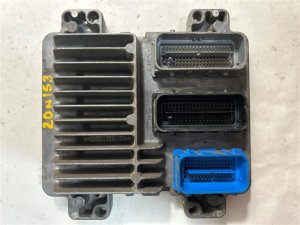
- Engine Control Module (ECM/PCM)
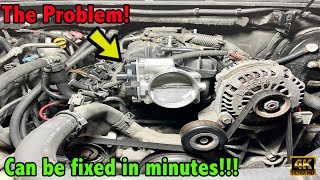
(OEM #Varies by year/engine. Examples: 12616477 (2007 5.3L), 12612384 (2008 5.3L), 12639269 (2011 5.3L). Always verify by VIN.)— This is the most common failed component for a P0606 code after all external electrical issues have been ruled out. 🎬 Watch a breakdown of common P0606 processor causes and fixes.
Trusted brands: ACDelco (OEM), Cardone, Flagship One
OEM price range: $350-$500
Aftermarket price range: $250-$400
Related Codes That Often Appear With This One
- P0562 — Indicates system voltage is low, which can be a root cause of the P0606 as the module isn't getting enough power.
- P0563 — Indicates system voltage is high, often from a faulty alternator, which can damage the ECM's internal circuits.
- U-series codes (e.g., U0100) — These are communication codes. If the ECM is failing, it may stop communicating with other modules on the vehicle's network, triggering these codes alongside the P0606.
Technical Service Bulletins (TSBs) & Recalls
- 05-06-04-060A: Information on Control Module Diagnostic Trouble Code(s) (DTC)(s) P0601, P0602, P0603, P0604, P0606, P062F, P06F3, P1621 which can be shared in multiple modules.
- 17-NA-132: Information on Malfunction Indicator Lamp (MIL) Illuminated - DTC P0606 Set. Warns that a faulty camshaft position sensor circuit can set a P0606 without a cam sensor code.
Platform-Specific Known Issues
- GM issued an informational bulletin (#05-06-04-060A) that includes P0606, acknowledging that this type of internal control module fault can occur across various modules in their vehicles. It advises technicians to follow standard diagnostic procedures before replacing a module.
- The ACDelco E38 ECM used in many of these trucks is known to be sensitive to voltage fluctuations. Owners report that a weak battery is a very common trigger for an intermittent P0606 code that resolves with a new battery.
Mechanic-Grade Diagnostic Values
- Battery Voltage (Key Off, Static) — expected: 12.4V - 12.6V. Failure: Below 12.4V indicates a discharged or failing battery. A reading where the difference from 12.6V is divisible by 2.1 suggests a dead cell.
- Charging System Voltage (Engine Running) — expected: 13.5V - 14.5V. Failure: Voltage below 13.5V or above 14.5V indicates a faulty alternator or voltage regulator, which can trigger a false P0606.
- Voltage at ECM Connector X1, Pin 20 (RD/WH wire) — expected: Should match battery voltage (B+). Failure: Voltage significantly lower than at the battery terminals indicates high resistance in the power supply wire or fuse block.
- Voltage at ECM Connector X1, Pin 19 (PK wire) — expected: Should show battery voltage when Key is in ON/RUN position. Failure: No voltage indicates a problem with the ignition switch signal circuit.
- Resistance/Continuity at ECM Connector X1, Pin 73 (BK wire) to Chassis Ground — expected: Less than 0.5 Ohms. Failure: High resistance indicates a poor ground connection for the ECM, a primary cause of false codes.
Hidden / Shadow Codes Worth Checking
- P0606 set with no other codes: Per GM TSB 17-NA-132, a P0606 that sets during a crank-no-start condition may be incorrectly triggered by a faulty camshaft position sensor circuit. The ECM sets the P0606 and aborts the start before it has a chance to set the correct cam sensor code. (see via Standard OBD-II scanner. The key is the context: a crank-no-start with a lone P0606 should lead to checking the cam sensor circuit before replacing the ECM.)
- P0606 set with 10+ other ECM codes: According to GM preliminary information bulletin PIP5530 (for a different model but same manufacturer logic), if a P0606 is present along with ten or more other ECM-related trouble codes, it is a strong indicator of an internal ECM failure. (see via Dealer-level scan tool (GDS2/Tech2) that can pull all codes from all modules.)
Scan Tool Commands That Help
- Tech2 / GDS2 or equivalent professional scan tool: Crankshaft Position System Variation Learn — This procedure is often required after replacing the ECM. Failure to perform it may result in a P0315 code and potential misfire detection issues.
- Tech2 / GDS2: VIN/Software Programming — This is a mandatory function when installing a new or remanufactured ECM to load the correct vehicle software, VIN, and security information. The vehicle will not start without it.
Wiring & Ground Locations
- G103 — On the front of the passenger-side cylinder head.. This is a primary engine ground. Corrosion or looseness here can cause unstable voltage to various components, including the ECM, potentially triggering a false P0606.
- G104 — On the left (driver's side) rear corner of the engine, mounted to the cylinder head.. This ground is critical for engine sensors and components. A poor connection can lead to erratic sensor data and module behavior.
- G108 — On the firewall in the left rear corner of the engine compartment, where the main engine-to-body ground strap attaches.. This is the main ground path from the engine harness to the vehicle's chassis. A failure here can cause widespread electrical issues, including no-start and module communication errors.
- ECM Connector X1, Pin 20 — The main 73-pin connector at the Engine Control Module. Pin 20 has a Red/White wire.. This is the main, constant battery positive voltage supply to the ECM. It must be checked with a multimeter during diagnosis.
- ECM Connector X1, Pin 73 — The main 73-pin connector at the Engine Control Module. Pin 73 has a Black wire.. This is a primary ground pin for the ECM. A voltage drop test should be performed on this circuit to ensure its integrity.
Real Owner Repair Stories
- GMTNation forum user (2008 GMC Sierra (GMT900 platform)) — In very cold weather, experienced a 'click, click, click' no-start, followed by limp mode and code P0606. Voltmeter on the dash was reading high (way over 14V).
❌ Tried (didn't work) Cleaning the badly corroded positive battery cable terminal initially seemed to work, but the problem returned.
✅ What actually fixed it The positive post on the old battery had internal play. Replacing the battery with a known-good spare made all symptoms and the P0606 code disappear. The final fix was a new battery and ensuring clean, tight cable connections. - Tahoe Yukon Forum user 'Nap73' (2007 GMC Yukon XL 2500 with 216,000 miles) — Intermittent 'click but not turn over', followed by 'Reduced Engine Power' message and P0606. On a previous occasion, the dash flashed and the radio went crazy, ejecting a CD.
❌ Tried (didn't work) The user was in the process of diagnosis when posting.
✅ What actually fixed it The consensus from veteran forum members was to immediately and thoroughly check the battery, all battery cable connections, and all major ground points for corrosion and tightness before even considering replacing the ECM, as these symptoms strongly pointed to a power supply issue.
OEM Part Supersession History
12612384 (Example for 2008)→Varies, e.g., 12633238 (Example for 2010-2014)— Hardware and software updates to accommodate changes in vehicle hardware and improve reliability.
Heads up: E38 ECMs are not universally interchangeable even with the same service number. For example, a 2009 model year truck received a new throttle body, making its ECM calibration incompatible with a 2008 model. Flashing the wrong OS can 'brick' the ECM. The Operating System (OS) must match the vehicle's year and hardware configuration.
Model Year Variations Within This Range
- 2009 vs. 2008: Many 2009 GMT900 trucks received a new throttle body design. This requires a different internal calibration on the E38 ECM compared to the 2008 models. Attempting to use an ECM with the wrong year's operating system can cause drivability issues or a no-start condition.
Helpful Videos
Used OEM Parts in Stock



New Aftermarket Parts Available



The information in this article is provided for general reference and educational purposes only. Vehicle specifications, procedures, and part compatibility can vary by production date, trim level, and region. Always consult your vehicle's factory service manual and verify part numbers before purchasing or performing repairs. Safety-critical components such as airbags, seat belts, and braking systems should be installed by a qualified professional.
- Gmc YUKON:
- 🎬 Helpful Videos
- 🛍️ Shop This Part
- What's Unique About the 2007-2014 Gmc YUKON
- Diagnostic Flowchart
- Symptoms You May Notice
- Most Likely Causes
- Rare But Worth Checking
- Diagnosis Steps
- Parts You'll Likely Need
- Related Codes That Often Appear With This One
- Technical Service Bulletins (TSBs) & Recalls
- Platform-Specific Known Issues
- Mechanic-Grade Diagnostic Values
- Hidden / Shadow Codes Worth Checking
- Scan Tool Commands That Help
- Wiring & Ground Locations
- Real Owner Repair Stories
- OEM Part Supersession History
- Model Year Variations Within This Range
- 🎟️ Get 5% Off