

P0606 on 2012-2016 Ford Focus: PCM Failure Symptoms and Fixes
P0606 on a 2012-2016 Ford Focus almost always indicates an internal failure of the Powertrain Control Module (PCM). This is a known issue, often linked to severe transmission problems with the DPS6 automatic transmission. The only reliable fix is PCM replacement and programming, typically costing $800-$1500 at a dealer or qualified shop. However, checking battery health and ground connections is a crucial first step, as voltage issues can sometimes trigger this code.
- P0606 on a 2012-2016 Focus is a critical code that almost always means the main engine computer (PCM) has failed.
- Symptoms are severe and dangerous, including stalling, loss of power, and transmission failure. Do not drive the vehicle.
- This is not a DIY repair. The replacement PCM must be programmed by a professional with Ford-specific equipment.
- Before replacing the PCM, a technician should always verify its power and ground circuits are intact.
- The repair is costly, typically ranging from $750 to $1500, but is necessary to make the vehicle operational again.
What's Unique About the 2012-2016 Ford FOCUS

The 2012-2016 Ford Focus is equipped with the DPS6 "PowerShift" dual-clutch automatic transmission, which is notorious for electronic problems. Code P0606 is frequently intertwined with these transmission issues. Ford even issued Technical Service Bulletins (TSBs) that specifically link P0606 to symptoms like loss of power and failure of the transmission to engage, often caused by a faulty control module. In fact, Ford released software updates specifically to help detect these module failures earlier by enabling the P0606 code. The close relationship between the PCM and the problematic Transmission Control Module (TCM) means that symptoms often appear to be transmission-related, even when the P0606 code points to the PCM.
Diagnostic Flowchart

Tap your situation to follow the diagnostic path that matches what you're seeing on this vehicle.
Symptoms You May Notice

- Check Engine Light is on
- "Transmission Fault Service Now" message on the dash.
- Vehicle will not start or has an intermittent no-start condition. [TSB160044, 3, 7]
- Sudden loss of power or acceleration while driving. [TSB160044, 7]
- Transmission fails to engage from Park. [TSB160044, 7]
- Flashing PRNDL/S gear selector light on the instrument cluster. [TSB 16-0129, 5, 7]
- Erratic or harsh shifting, or getting stuck in a gear.
- Engine stalling, especially when coming to a stop.
- Vehicle enters "limp mode".
- Replacing the Transmission Control Module (TCM) only. While the symptoms are transmission-related and the TCM is also a known failure point with an extended warranty (14M02), P0606 specifically indicates a PCM processor fault. TSBs often call for replacing the TCM and reprogramming the PCM, acknowledging the link between the two, but P0606 itself points to the PCM.
- Replacing transmission hard parts. A mechanic incorrectly diagnosed a P0606 car as needing a whole new transmission, when the actual fault was the TCM, which was covered under warranty. This highlights the importance of correct electronic diagnosis before expensive mechanical repairs. 🎬 Watch: Why P0606 isn't always a simple TCM failure.
Most Likely Causes

- Faulty Powertrain Control Module (PCM) 🔴 High Probability This is a widely documented failure on this platform, confirmed by multiple Ford TSBs and owner complaints. The PCM is responsible for both engine and transmission control, and its internal processor failure leads to the severe symptoms associated with this code. Ford even created software updates that enable the P0606 code to be set as an indicator of this specific failure mode.
How to confirm: After verifying all power and ground circuits to the PCM are intact and the battery/charging system is healthy, the diagnosis points to an internal PCM fault. This is often a last-step diagnosis after ruling out external factors.
Typical fix: Replace the PCM and program the new unit to the vehicle's VIN and security settings using a Ford-specific diagnostic tool.
Est. part cost: $500-$1100 - Poor PCM Power or Ground Circuits ⚪ Low Probability Ford vehicles of this era are known for having grounding issues. A specific ground point on a bell housing bolt stud is a known weak point that can corrode or break, causing intermittent connection and a host of electrical problems, including P0606. The main chassis ground point under the airbox is also a common source of problems due to paint overspray from the factory, which prevents a solid connection.
How to confirm: Use a multimeter to test for correct voltage at the PCM power supply pins and check for continuity to ground on the ground pins. Visually inspect wiring for corrosion or damage, paying special attention to the main ground strap connection at the transmission bell housing and the chassis ground under the airbox. 🎬 See this walkthrough on cleaning the transmission ground points.
Typical fix: Clean and tighten ground connections, add redundant ground straps, or repair the damaged section of the wiring harness. In one documented case, cleaning the corroded ground on the transmission stud and adding washers to ensure good contact resolved the code. For the chassis ground, removing the bolt, sanding the paint off the contact surface, and re-securing the connection is a common fix.
Est. part cost: $5-$50
Rare But Worth Checking
- Low Battery Voltage or Failing Battery: A weak or failing battery can cause a variety of erroneous electrical codes during cranking, and P0606 is one of them. The 2.0L engine in the Focus can crank seemingly normally even with a weak battery, masking the underlying issue. Always test the battery and charging system before condemning an expensive control module.
- Faulty external component causing electrical noise: While rare, a shorted-out sensor or component, like a fuel injector, can feed electrical noise back to the PCM, causing it to register an internal fault and set a P0606. If other codes are present, they should be diagnosed first.
Diagnosis Steps

- Check the battery and charging system. Ensure battery voltage is stable and above 12.4 volts with the engine off, and between 13.5-14.5 volts with the engine running. Clean any corrosion from battery terminals.
- Scan for all DTCs in every module. Pay close attention to any accompanying U-series (network) codes, as they strongly support a control module or wiring issue.
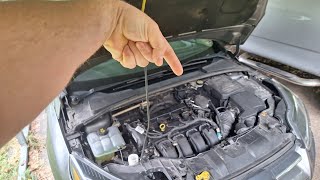
- Visually inspect the PCM wiring harness and connectors. Look for any signs of corrosion, water intrusion, or physical damage. The PCM is located in front of the front left wheel, behind the fender liner and underneath the headlight. 🎬 Watch: How to find the PCM location on your Focus.
- CRITICALLY, inspect the main ground connections. There are two key locations: a ground point on a transmission bell housing stud and the main chassis ground points under the airbox. Check for tightness and corrosion. Cleaning these ground points has been shown to fix the issue.
- Verify the PCM's power and ground connections. Use a multimeter and wiring diagram for the C175B connector to confirm the module is receiving proper voltage and has a solid ground connection. This is a critical step before replacing the PCM.
- If TSB 16-0129 applies, follow its specific diagnostic procedure, which may involve replacing the TCM and reprogramming the PCM.
- If all external factors (wiring, power, grounds, battery) are confirmed to be good, the PCM is faulty and must be replaced.
- Install the new PCM and program it using a Ford-specific diagnostic tool (IDS). This step, known as a 'Parameter Reset', is essential for the vehicle to run and requires at least two programmed keys.
Parts You'll Likely Need
- Powertrain Control Module (PCM)
(OEM #BV61-12B684-BC, EM5A-12A650-PA, EM5A-12A650-GC (Note: Part numbers are VIN-specific, these are examples only))— This code directly indicates an internal processor fault within the PCM. On the 2012-2016 Focus, this is the most common and direct cause.
Trusted brands: Motorcraft (OEM), CARDONE Reman, Flagship One, AutoZone (Duralast)
OEM price range: $800-$1200
Aftermarket price range: $200-$600
Related Codes That Often Appear With This One
- U0100 — Lost Communication With ECM/PCM 'A'. This code often appears with P0606 because the internal PCM fault disrupts its ability to communicate on the vehicle's network. [TSB160044, TSB 16-0129, 4, 5, 7]
- U0101 — Lost Communication with TCM. This indicates the PCM can no longer talk to the Transmission Control Module, a common symptom of the PCM failure. [TSB160044, TSB 16-0129, 4, 5, 7]
- U1013 — Invalid Internal Control Module Monitoring Data Received. This is another code indicating a breakdown in communication and self-diagnostics. [TSB160044, TSB 16-0129, 4, 5, 7, 31]
- P06B8 — Internal Control Module Non-Volatile Random Access Memory (NVRAM) Error. This code points to a specific memory fault within the PCM and is often seen alongside P0606. [ODI #11374027, 10]
- P0702 — Transmission Control System Electrical. This code can be triggered by the same underlying electrical issues, such as a bad ground or failing battery, that can also cause P0606.
Technical Service Bulletins (TSBs) & Recalls
- TSB 16-0129: Supersedes TSB 16-0044. Addresses no-start, no transmission engagement, or loss of power with DTC P0606 and various U-codes.
- TSB 16-0044: Links P0606 with DPS6 transmission issues like no-start, loss of power, and loss of engagement.
- TSB 15-0121: Preceded TSB 16-0129, introduced the P0606 code as an early warning for TCM failure.
Platform-Specific Known Issues
- Ford TSB 16-0129 (which supersedes TSB 16-0044) directly addresses P0606 in conjunction with U-codes, linking it to no-start, loss of power, and transmission engagement failures on vehicles with the DPS6 transmission.
- An owner complaint to the NHTSA explicitly connects P0606 to a fault in the ECM/PCM. [ODI #11374027]
- Ford issued a customer satisfaction program (15B22) to update software, which helps provide an earlier warning (by setting code P0606) that the control module is failing.
- Ford also extended the warranty on the Transmission Control Module (TCM) to 10 years or 150,000 miles (Program 14M02) for many of these vehicles due to high failure rates. While P0606 points to the PCM, the issues are often related, and owners sometimes get a P0606 diagnosis when the root cause is a warrantied TCM.
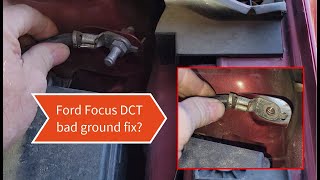
- A known failure point is the ground wire attached to a stud on the transmission bell housing. The connection can become loose or corroded, causing intermittent electrical faults that trigger P0606 and P0702.
Scan Tool Commands That Help
- Ford IDS (or equivalent J2534/FORScan): Parameter Reset — This is a mandatory procedure after installing a new or used PCM. It synchronizes the replacement PCM with the vehicle's existing security modules (PATS) and instrument cluster. Failure to perform this will result in a no-start condition.
- Ford IDS (or equivalent J2534/FORScan): Ignition Key Code Erase / Program — After a Parameter Reset, all existing keys are erased from the system. This function is used to program a minimum of two keys to the newly installed PCM.
- Ford IDS: Module Programming — Used to flash the PCM with the latest calibration software from Ford. TSB 16-0044 specifies reprogramming the PCM/TCM to the latest calibration as part of the repair procedure.
Wiring & Ground Locations
- Powertrain Control Module (PCM) — Located in the front of the driver's side wheel well, behind the fender liner and underneath the headlight assembly.. This is the module that has failed internally when P0606 is set. Its location makes it susceptible to moisture and physical damage if the fender liner is compromised.
- Transmission Ground Stud — A stud on the transmission bell housing where a main ground cable for the engine/transmission assembly attaches.. This is a widely reported failure point. The nut can become loose or the connection can corrode, causing an intermittent ground and triggering P0606, P0702, and other electrical faults. Cleaning the stud and cable end and ensuring it's tight is a critical diagnostic step.
- Main Chassis Grounds (under airbox) — After removing the airbox, there are two ground bolts on the chassis frame rail that serve as primary ground points.. Factory paint on the chassis under the ground terminals can create a poor connection from day one. Over time, this can lead to intermittent electrical issues that can trigger a P0606. The fix is to remove the bolts, sand the paint away to bare metal, and re-secure the terminals.
- PCM Connector C175B — This is one of the main electrical connectors that plugs into the Powertrain Control Module.. This connector carries the power, ground, and various signal wires for the PCM. A wiring diagram for C175B is necessary to perform pin-point voltage and continuity tests to rule out a wiring issue before condemning the PCM.
Real Owner Repair Stories
- YouTube user 'vinsmash.com' (2014 Ford Focus) — Transmission failsafe engagement, codes P0606 and P0702, plus various body control module codes.
❌ Tried (didn't work) The user was looking for more complex issues before checking the basics.
✅ What actually fixed it The ground cable on the transmission bell housing stud was loose and the plastic isolator had broken, causing a poor connection. The user cleaned the contact surfaces, used washers to ensure good contact, and tightened the nut. This resolved the codes. - Reddit user 'Gottafocus2k' (Ford Focus (year not specified, but Mk3)) — No-start condition after working on the transmission.
❌ Tried (didn't work) Initially re-attaching the ground wire to the transmission did not work because the connection was still loose., Tightening the ground wire did not work.
✅ What actually fixed it The user had to remove the ground cable from the transmission thread, and clean both the cable end and the transmission surface with a brass brush to remove debris before re-attaching it. This created a solid ground and fixed the no-start problem. - YouTube user 'Mike Potts' (2012 Ford Focus with DCT) — Transmission fault message, limp mode, erratic shifting (skipping gears, going to neutral).
❌ Tried (didn't work) Living with the intermittent problem.
✅ What actually fixed it The user performed a "ground mod" by cleaning three main ground points: the main chassis ground on the strut tower and two grounds located under the airbox. He sanded the paint off the contact points to ensure a bare-metal connection, reattached the terminals, and coated them with a protective spray. This is reported by many owners to improve transmission behavior and resolve electrical faults.
OEM Part Supersession History
BV61-12B684-BA, BV61-12B684-BB→BV61-12B684-BC— Standard hardware and software revisions by the manufacturer.
Heads up: Part numbers are extremely specific to VIN, engine, and transmission type. An exact match or a confirmed superseded part number is required for compatibility.
Model Year Variations Within This Range
- 2011-2016 Fiesta, 2012-2016 Focus: Ford's Customer Satisfaction Program 15B22 involved a software update for the PCM/TCM. This update specifically enabled the P0606 DTC to be set as an early warning for an internal TCM microprocessor failure. Vehicles serviced after August 2015 should have this update.
Helpful Videos

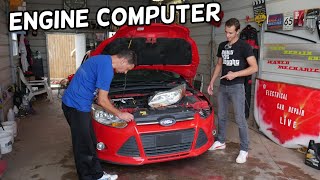


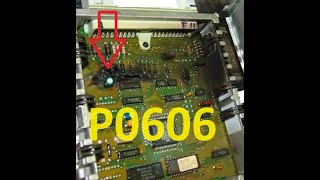

We Have This Part in Stock
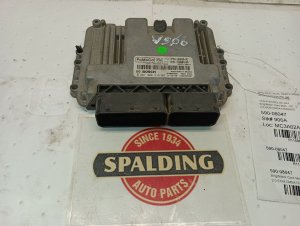



The information in this article is provided for general reference and educational purposes only. Vehicle specifications, procedures, and part compatibility can vary by production date, trim level, and region. Always consult your vehicle's factory service manual and verify part numbers before purchasing or performing repairs. Safety-critical components such as airbags, seat belts, and braking systems should be installed by a qualified professional.
- Ford FOCUS:
- 🎬 Helpful Videos
- 🛍️ Shop This Part
- What's Unique About the 2012-2016 Ford FOCUS
- Diagnostic Flowchart
- Symptoms You May Notice
- Most Likely Causes
- Rare But Worth Checking
- Diagnosis Steps
- Parts You'll Likely Need
- Related Codes That Often Appear With This One
- Technical Service Bulletins (TSBs) & Recalls
- Platform-Specific Known Issues
- Scan Tool Commands That Help
- Wiring & Ground Locations
- Real Owner Repair Stories
- OEM Part Supersession History
- Model Year Variations Within This Range
- 🎟️ Get 5% Off