

P0606 on 2007-2014 Chevrolet Impala: ECM/PCM Processor Fault Guide
P0606 on a 2007-2014 Impala indicates a critical internal failure of the main engine computer (PCM). This is a serious fault that often requires replacing and reprogramming the PCM, a job for a professional. Before replacing the PCM, it is crucial to rule out simpler issues like a weak battery, bad grounds, or charging system problems, as unstable voltage is a known trigger for this code.
- P0606 is a critical fault code indicating the engine's main computer has failed its internal self-test.
- Do not continue to drive the vehicle, as it can stall at any time or enter a severely limited power mode.
- Before replacing the expensive PCM, always test the battery, alternator, and all power/ground connections to the module, as unstable voltage is a very common trigger.
- PCM replacement is not a DIY job; it requires special tools to program the new unit to your car's VIN and security system.
- Symptoms can include a check engine light, stalling, reduced power, erratic transmission behavior, and other seemingly unrelated electrical issues.
What's Unique About the 2007-2014 Chevrolet IMPALA
For this generation of Chevrolet vehicles (and its W-body platform mates), the P0606 code is a well-documented, critical fault. A GM Technical Service Bulletin (TSB #05-06-04-060A) acknowledges that this internal processor fault code can appear in multiple control modules. While the ultimate cause is often a failed PCM, it's crucial to first eliminate external electrical issues like poor grounds or voltage spikes from a faulty alternator, as these are frequently reported by owners to trigger the code without the PCM itself being defective. The service manual for a 2007 Impala confirms the ECM runs continuous internal performance checks when system voltage is above 5.23 volts, highlighting its sensitivity to power supply.
Diagnostic Flowchart
Tap your situation to follow the diagnostic path that matches what you're seeing on this vehicle.
Generation note: This range covers two Impala generations: the ninth (2006-2013, extended to 2016 as the 'Impala Limited') and the tenth (2014-2020). While the P0606 code has the same meaning for both, specific part numbers for the PCM will differ. The diagnostic approach of checking power/grounds first remains the same.
Symptoms You May Notice
- Check Engine Light is on
- Vehicle enters 'limp mode' or reduced power mode, as described in NHTSA complaint #10470380 and by owners of platform mates.
- Engine stalling or refusing to start
- Rough or erratic idling
- Erratic or harsh automatic transmission shifting
- Other electrical issues, such as the key getting stuck in the ignition or haywire interior electronics (NHTSA ODI #10470380)
- Drop in fuel economy due to incorrect engine management.
- ABS and Traction Control lights may illuminate simultaneously.
- Replacing sensors (e.g., throttle body, accelerator pedal) when their erratic signals are a symptom of the failing PCM, not the cause.
- Replacing the transmission when shifting problems are caused by the PCM's inability to control it properly.
Most Likely Causes
- Internal PCM Failure 🔴 High Probability As noted in TSB #05-06-04-060A, internal processor faults are a recognized issue across many GM vehicles. Failures can occur from thermal stress, voltage spikes, or age-related component degradation.
How to confirm: This is diagnosed by exclusion. 🎬 Watch: How to diagnose an ECM processor error code If all power, ground, and network circuits test good, and the software is up-to-date, the PCM itself is condemned.
Typical fix: Replace the Powertrain Control Module (PCM) and program it to the vehicle's VIN.
Est. part cost: $200-$653 - Poor PCM Power or Ground Circuits 🟡 Medium Probability Corroded or loose ground straps and power connections are common on aging vehicles and can cause intermittent voltage drops, confusing the PCM's internal self-tests. Forum users frequently report that low voltage during cranking or from a bad connection is enough to trigger a P0606.
How to confirm: Perform a voltage drop test on the PCM's main power and ground wires under load. Inspect all chassis and engine ground connections for corrosion and tightness, especially the main engine-to-chassis ground strap.
Typical fix: Clean or replace corroded terminals and ground straps. Repair any damaged wiring.
Est. part cost: $10-$50 - Charging System Malfunction 🟡 Medium Probability A failing alternator can produce voltage spikes or low, unstable voltage, which can disrupt or damage the PCM's sensitive processor. The PCM requires a stable voltage (typically 13.5-14.5V when running) to operate correctly.
How to confirm: With the engine running, test the alternator's output voltage at the battery terminals. It should be stable and within the 13.5 to 14.5-volt range. Watch for excessive AC ripple with a multimeter that has this function.
Typical fix: Replace the alternator if its output is out of specification.
Est. part cost: $150-$350
Rare But Worth Checking
- Corrupted PCM Software: Sometimes, the PCM's software can become corrupted. Before replacing the hardware, a dealership or qualified shop can check if a software reflash is available, which could resolve the issue.
- Shorted External Sensor or Component: A sensor that has shorted internally can sometimes feed back improper voltage and disrupt the PCM, causing it to set a P0606 code. A technician in a forum noted a case where a shorted brake light bulb caused a P0606 on a Toyota, illustrating the principle. Unplugging suspect sensors one by one can be a diagnostic step if other codes are present.
Diagnosis Steps
- Scan for all DTCs in all modules. Note any other codes, especially other P06xx, U-codes, or specific sensor codes.
- Perform a hard reset. Disconnect the battery for 15-30 minutes to clear any temporary glitches, then reconnect and see if the code returns.
- Check the battery. Ensure it is fully charged and healthy using a digital tester that can check its health under load. A weak battery is a known cause of this code.
- Test the charging system. With the engine running, verify the alternator is providing a stable voltage (typically 13.5-14.5V).
- Perform a thorough visual inspection of the PCM wiring harness and connectors. Look for any signs of corrosion, damage, or loose connections.
- Inspect and clean all major engine and chassis ground connections. Perform a voltage drop test on the ground circuit to ensure its integrity under load. 🎬 Learn how to diagnose and solve bad ground connection problems
- Check for available PCM software updates (reflash). A dealer or qualified shop with a subscription to GM's service information can perform this check.
- If all wiring, power, and grounds are confirmed to be good and a reflash does not solve the problem, the PCM has an internal fault and must be replaced.
Parts You'll Likely Need
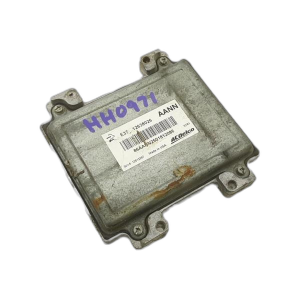
- Powertrain Control Module (PCM/ECM)
(OEM #12643248, 12651631, 12663374 (Note: These are for later models, e.g. 2012-2017, always verify with VIN))— This code directly indicates an internal processor fault within this module. After ruling out external electrical issues, replacement is the only fix. 🎬 See this quick walkthrough on replacing the engine control module
Trusted brands: ACDelco (OEM), Cardone (Remanufactured), FS1 (Programmed)
OEM price range: $595-$653 (Part only, per RepairPal)
Aftermarket price range: $200-$450 (Often requires programming service)
Related Codes That Often Appear With This One
- P0601, P0602, P0603, P0604 — These are all internal control module memory or processor error codes, as listed in TSB #05-06-04-060A. Their presence alongside P0606 strongly reinforces the diagnosis of a failed PCM.
- U-codes (e.g., U0100) — Communication codes often appear when the PCM is failing and can no longer communicate effectively with other modules on the vehicle's network (CAN bus).
- C0240 — On platform mates like the Pontiac Grand Prix GXP, P0606 is often seen with C0240 (PCM Traction Control Not Allowed), indicating the PCM has disabled traction control due to its internal fault.
Technical Service Bulletins (TSBs) & Recalls
- 05-06-04-060A: Information on control module Diagnostic Trouble Code(s) (DTC)(s) P0601, P0602, P0603, P0604, P0606, P062F, P06F3, P1621 which can be shared in multiple modules.
Platform-Specific Known Issues
- NHTSA Technical Service Bulletin #05-06-04-060A is an informational bulletin for technicians acknowledging that P0606 and related codes indicate internal module failures and are not specific to just one controller.
- An owner complaint filed with the NHTSA (ODI #10470380) for a 2007 Impala describes classic symptoms of P0606: the vehicle suddenly entered a low-power mode at 30 MPH and exhibited bizarre electrical problems, including the key getting stuck.
- The GM service manual for the 2007 Impala with the 5.3L V8 (LS4) specifies that the P0606 diagnostic runs continuously when the ignition is on and system voltage is above 5.23 volts, highlighting the system's sensitivity to voltage stability.
Mechanic-Grade Diagnostic Values
- Battery Voltage, Key-Off — expected: ~12.6 Volts. Failure: Voltage significantly below 12.4V indicates a discharged or failing battery.
- Charging System Voltage, Engine Running — expected: 13.5 - 14.5 Volts. Failure: Voltage below 13.2V or above 15V, or fluctuating wildly, indicates a faulty alternator or connection.
- PCM Internal Diagnostic Minimum Voltage — expected: Must be above 5.23 Volts. Failure: If system voltage drops below this threshold, the P0606 self-test may not run or could be triggered erroneously.
- PCM Power and Ground Voltage Drop — expected: Less than 0.1 Volts (100mV) on ground side, Less than 0.2 Volts (200mV) on power side. Failure: Higher voltage readings indicate excessive resistance in the circuit, which can cause the PCM to malfunction.
Scan Tool Commands That Help
- J2534 Interface / Tech2 / GDS2: Security Password Relearn Procedure — This is required after installing a replacement PCM if the vehicle does not start or sets a P0633 code. The procedure learns the security password to the new module, allowing the vehicle to start and run.
Wiring & Ground Locations
- ECM/PCM — Inside the air cleaner (air filter box) assembly in the engine bay.. This is the component that sets the code. Its location inside the airbox makes it susceptible to damage during air filter service if care is not taken.
- G101 — At the front of the engine, on the lower engine block.. This is a primary ground point for the Engine Control Module (ECM). A poor connection here can directly cause low voltage or voltage instability at the ECM, triggering a P0606.
- G111 — Located on a transmission-to-engine bolt, above the starter.. This is another major engine-related ground. Corrosion or looseness at this point can cause a wide range of electrical issues, including those that mimic PCM failure.
- PCM Connector C1, Pins 16 & 60 — At the main wiring harness connector for the PCM.. These are PCM ground pins (typically Black/White wires). They are the specific points to test for a voltage drop on the ground side of the circuit directly at the module.
- PCM Connector C1, Pin 20 — At the main wiring harness connector for the PCM.. This is a main battery positive voltage feed to the PCM (typically an Orange wire). It should be tested to ensure the PCM is receiving full and stable battery voltage.
OEM Part Supersession History
Varies by year/engine→Varies by year/engine— PCMs for this vehicle range are highly specific to the year, engine, and emissions package. For example, a 2014 Impala with a 2.5L engine may use part number 12659670, while a 2012-2016 Impala with a 3.6L may use 12651994.
Heads up: There is no universal cross-compatibility. The part number must be matched exactly or verified by VIN to ensure correct operation. Using the wrong part will result in a no-start condition or other critical failures.
Model Year Variations Within This Range
- 2014: The 2014 model year was a split year. The 'Impala Limited' was a continuation of the 9th generation platform (W-body), while the all-new 10th generation Impala was also introduced. These are completely different vehicles using different PCMs and electrical architectures. It is critical to identify whether the vehicle is an 'Impala' or 'Impala Limited' before sourcing parts.
- 2012-2014: Starting in 2012, the 3.6L LFX V6 engine became the standard V6, replacing the previous 3.5L and 3.9L options. This engine uses a different, more modern Engine Control Module (e.g., ACDelco E39 or similar) than the earlier V6 engines, affecting part numbers and some diagnostic procedures.
Helpful Videos

We Have This Part in Stock




The information in this article is provided for general reference and educational purposes only. Vehicle specifications, procedures, and part compatibility can vary by production date, trim level, and region. Always consult your vehicle's factory service manual and verify part numbers before purchasing or performing repairs. Safety-critical components such as airbags, seat belts, and braking systems should be installed by a qualified professional.
- Chevrolet IMPALA:
- 🎬 Helpful Videos
- 🛍️ Shop This Part
- What's Unique About the 2007-2014 Chevrolet IMPALA
- Diagnostic Flowchart
- Symptoms You May Notice
- Most Likely Causes
- Rare But Worth Checking
- Diagnosis Steps
- Parts You'll Likely Need
- Related Codes That Often Appear With This One
- Technical Service Bulletins (TSBs) & Recalls
- Platform-Specific Known Issues
- Mechanic-Grade Diagnostic Values
- Scan Tool Commands That Help
- Wiring & Ground Locations
- OEM Part Supersession History
- Model Year Variations Within This Range
- 🎟️ Get 5% Off