

P0606 on 2007-2014 Chevrolet Corvette: ECM/PCM Processor Fault Causes and Fixes
P0606 on a Corvette indicates an internal fault in the engine's main computer (ECM/PCM). Before replacing the expensive ECM, you must first check for a weak battery, loose ground wires, or issues with an aftermarket tune, as these are common and much cheaper root causes. Driving is not recommended as the engine can stall unexpectedly.
- P0606 is a critical code indicating an ECM processor fault. Do not drive the vehicle.
- **DO NOT** immediately replace the ECM. The most common causes on a Corvette are a weak battery or a bad ground connection.
- Always load test the battery and inspect the main ECM ground strap on the engine block before proceeding with further diagnostics.
- If the car has an aftermarket tune, it is a strong suspect. Try flashing back to the stock tune.
- ECM replacement is the last resort and requires professional programming to the vehicle.
What's Unique About the 2007-2014 Chevrolet CORVETTE
On the C6 (E38 ECM) and early C7 (E92 ECM) Corvette, a P0606 code is often a 'phantom' code triggered by other issues. These cars are notoriously sensitive to battery voltage, and since they are often stored for long periods, a weak or dying battery is a primary suspect. A user on CorvetteForum noted, "This platform is VERY sensitive to voltage. If you've depleted your battery to dead status then it will never be the same until you replace your battery." Furthermore, aftermarket modifications and tunes, very common on Corvettes, can cause conflicts that trigger this code, particularly when changing settings like traction control or when the tune's parameters for components like the electronic throttle body are incorrect. The provided TSB #05-06-04-060A also notes that codes like P0606 can be shared across multiple modules, suggesting a complex diagnostic path beyond just a faulty ECM. [⭐ MANUFACTURER TSB — highest authority]
Diagnostic Flowchart
Tap your situation to follow the diagnostic path that matches what you're seeing on this vehicle.
Generation note: This range covers two distinct Corvette generations: the C6 (2007-2013) and the first year of the C7 (2014). The C6 generation primarily uses the E38 ECM. The 2014 C7 introduced the new E92 ECM for the Gen V LT1 engine. While the code's meaning is the same, the specific ECMs are different hardware. However, the primary causes—voltage/ground issues, aftermarket tunes, and eventual ECM failure—are common problems for both generations due to their complex electronics and high-performance nature.
Symptoms You May Notice
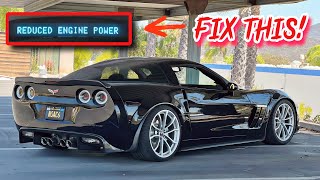
- Engine enters 'Reduced Engine Power' mode
- Check Engine Light is on
- Engine stalls, runs rough, or will not start
- Erratic or poor automatic transmission shifting
- "Service Stabilitrak" or other warnings on the driver information center
- No-crank condition, even with a good battery 🎬 Watch: An easy fix for a Corvette no-start condition.
- Engine smells like it is running extremely rich (excess fuel)
- Immediately replacing the ECM/PCM without checking the battery, battery terminals, and ground connections first. This is an expensive mistake, as power supply issues are a very common cause of this code on voltage-sensitive Corvettes.
Most Likely Causes
- Weak or Failing Battery 🔴 High Probability Corvettes are often not daily drivers and are susceptible to battery drain. A low state of charge or poor cold cranking amps can cause voltage drops during startup, confusing the ECM and triggering false module faults. Many owners on forums report that these cars do "funny and unexpected things" when they don't have the right voltage.
How to confirm: Load test the battery with a professional battery analyzer. A simple voltage check is not sufficient, as a battery can show 12.6V but lack the amperage to properly power all modules during cranking. The system needs a stable voltage above a certain threshold (e.g., 8-9 volts) during crank to initialize correctly.
Typical fix: Replace the battery and ensure it is kept on a battery tender if the vehicle is stored for extended periods. Disconnecting the battery for 30 minutes can sometimes clear the phantom code after a new battery is installed.
Est. part cost: $150-$300 - Poor ECM/PCM Ground Connection 🟡 Medium Probability Engine vibrations and heat cycles can cause critical ground connections to loosen or corrode over time. The main ECM ground on the C6 is particularly susceptible.
How to confirm: Inspect the main ECM ground strap. On the C6 Corvette, a critical ground point is located on the engine block, above the starter. Another key ground is located under the battery tray. Check for tightness (11mm nut) and any signs of corrosion. Perform a voltage drop test on the ground circuit to confirm a solid connection.
Typical fix: Disconnect the battery. Remove the ground nut, clean the contact surfaces of the ground cable lug and the engine block with a wire brush until they are shiny, then securely retighten the bolt/nut.
Est. part cost: $0-$5 - Aftermarket Tune/Software Corruption 🟡 Medium Probability Many Corvettes are modified with aftermarket engine tunes. Improperly calibrated parameters, especially related to the electronic throttle control (ETC) or torque management, can cause the ECM to fail its internal self-checks. This is often seen when disabling traction control on a modified car.
How to confirm: If the vehicle has an aftermarket tune, flash it back to the stock GM calibration. If the P0606 code disappears, the tune is the cause. A user on Camaro5 (a platform mate) noted that returning his ETC settings to factory fixed his P0606. A CorvetteForum user fixed his track-day P0606 by having the computer reflashed with the latest HP Tuners build.
Typical fix: Contact the tuner to have the calibration file corrected or return the vehicle to the stock tune. The tuner may need to adjust torque management or throttle-related tables.
Est. part cost: $0-$200 - Internal ECM/PCM Failure ⚪ Low Probability
How to confirm: This should be the last diagnosis after all other possibilities (battery, grounds, wiring, software, and other modules) have been thoroughly ruled out. One forum vendor noted that while it can be other things, "90% of the time it needed a new PCM." A definitive failure story on CorvetteForum involved a car that would sputter and surge, and after checking all else, a new ECM fixed it for good.
Typical fix: Replace the Engine Control Module. The new module must be programmed to the car's VIN and specific configuration by a dealer or a qualified shop with GM programming tools (SPS subscription). Some vendors sell pre-programmed or cloned ECMs.
Est. part cost: $400-$900
Rare But Worth Checking
- Faulty Electronic Brake Control Module (EBCM): In one documented case on a 2007 Corvette, a P0606 code that appeared during hard track driving was traced back to the EBCM. The owner swapped the ECM and battery with no luck. The code would appear repeatably when selecting 'competition mode'. Pulling the EBCM fuses resolved the issue, and a final fix was achieved by reflashing both the ECM and EBCM, suggesting corrupted code in the EBCM was causing the ECM to fault.
- Short in a Sensor or Actuator Circuit: A short circuit in a 5-volt reference line for a sensor (e.g., camshaft position sensor, O2 sensor) can disrupt the ECM's operation and cause it to falsely report an internal processor fault. If P0606 is accompanied by other sensor-specific codes, diagnosing that sensor's circuit first is crucial. Unplugging the suspected faulty sensor and seeing if the P0606 code clears can be a valid diagnostic step.
- Faulty Alternator: An alternator that is failing can produce unstable voltage (over or under-charging), which can confuse the ECM and trigger a P0606 code. With the engine running, voltage at the battery terminals should be stable, typically between 13.5 and 14.5 volts.
Diagnosis Steps
- Read all stored DTCs. Note any other codes that accompany P0606, as they may point to the root cause (e.g., P0641, P1516).
- Inspect Power Supply: Fully charge and load test the battery. Do not skip this step. Check the alternator output with a multimeter; it should be stable at 13.5-14.5V with the engine running.
- Inspect Connections: Check that battery terminals are clean and tight. Locate and inspect the main ECM ground connection on the engine block (above the starter on C6) and the ground point under the battery tray for tightness and corrosion.
- Check for Aftermarket Tune: Determine if the vehicle has an aftermarket calibration. If so, flash the vehicle back to its stock tune and see if the code returns. Pay special attention to tunes on heavily modified cars.
- Check Fuses: Inspect all fuses related to the ECM/PCM, often labeled 'ECM', 'ECU', or 'EFI'. Ensure they are not blown and the contacts are clean.
- Check for Software Updates: Use a GM-compatible scan tool (Tech 2 or equivalent) to check if there are any available software or calibration updates for the ECM. A reflash can sometimes resolve software glitches.
- Isolate Other Modules: If the issue persists and is intermittent (e.g., only happens in competition mode), consider diagnostic steps like temporarily disconnecting other modules like the EBCM to see if the fault changes.
- Inspect 5V Reference Circuits: If other sensor codes are present, investigate those circuits for shorts that could be affecting the ECM. Unplugging a suspect sensor to see if P0606 clears is a valid diagnostic step.
Parts You'll Likely Need
- Engine Control Module (ECM/PCM)
(OEM #12617568 (C6 LS3/LS7, e.g., 2008), 12633238 (Later C6, e.g., 2010-2012), 12669318 (C7 LT1, e.g., 2014))— This is the part that is replaced if the module has definitively failed internally, after all other causes are ruled out. Part numbers are specific to year and engine.
Trusted brands: ACDelco (New or Remanufactured)
OEM price range: $500-$900
Aftermarket price range: $300-$600 (Remanufactured/Programmed) - AGM Battery — A weak or failing battery is a very common trigger for a false P0606 code on Corvettes due to voltage instability.
Trusted brands: ACDelco, Optima, Odyssey, Interstate
OEM price range: $200-$300
Aftermarket price range: $150-$250
Related Codes That Often Appear With This One
- P0641 — This code for 'Sensor Reference Voltage 'A' Circuit/Open' can appear with P0606, pointing to a wiring or power supply issue affecting the ECM and the sensors it powers. This combination was seen in a case where the EBCM was ultimately the root cause.
- P1516 — This code relates to the Throttle Actuator Control (TAC) module. It can appear with P0606 on modified cars, suggesting a conflict between the throttle body's performance and the ECM's expectations, often due to a tune or an auto-to-manual transmission swap.
Technical Service Bulletins (TSBs) & Recalls
- 05-06-04-060A: An informational bulletin noting that P0606 is one of several DTCs that can be shared across multiple modules, advising technicians on this possibility during diagnosis. [⭐ MANUFACTURER TSB — highest authority]
Platform-Specific Known Issues
- On modified Corvettes, especially those with extensive changes like forced induction or transmission swaps, P0606 can appear specifically when traction control is turned off, indicating a calibration conflict in the tune.
- Corvettes used on a race track may experience this code under high-heat, high-load conditions, which can sometimes be traced to issues with other modules like the EBCM, not the ECM itself.
Mechanic-Grade Diagnostic Values
- Battery Voltage (Key Off, Engine Off) — expected: 12.4V - 12.6V. Failure: Below 12.4V indicates a low state of charge. A reading exactly 2.1V lower than expected (e.g., ~10.5V) can indicate a dead cell.
- Alternator Output Voltage (Engine Running at Idle) — expected: 13.5V - 14.5V. Failure: Voltage that is unstable, below 13.5V, or above 14.5V suggests a faulty alternator or voltage regulator.
- 5-Volt Reference at Sensor — expected: ~5.0V. Failure: If the 5V reference is missing at a sensor, unplug the sensor. If the voltage returns at the connector, the sensor is shorted internally. If voltage does not return, test at the ECM pin.
- ECM Power and Ground Pins — expected: Battery voltage at power pins (e.g., X1-20 on E38) and near 0V on ground pins.. Failure: Voltage at the ECM connector that doesn't match battery voltage indicates high resistance in the wiring harness.
Scan Tool Commands That Help
- GM Tech 2 / GDS2: Idle Learn Reset — Required after cleaning or replacing the throttle body, which is a common step when diagnosing P0606 alongside throttle-related codes like P2101.
- GM Tech 2 / GDS2: Module Setup / Programming (SPS) — This is mandatory when replacing the ECM. The new module must be programmed with the vehicle's VIN and correct software calibration to function.
- GM Tech 2 / GDS2: Clear DTCs — As a primary step, a GM diagnostic flow chart suggests clearing the code to see if it immediately resets. If it does, it points more strongly toward a hard internal ECM failure.
Wiring & Ground Locations
- G105, G106, G107 — These are three key engine block grounds for the C6 Corvette. G106 and G107 are located on the lower left side of the engine block, with G105 on the lower right side. The main ECM ground is often cited as being above the starter.. These are the primary ground points for the engine's electrical system, including the ECM. A loose or corroded connection at any of these points can cause floating grounds and erratic behavior, leading to a false P0606 code.
- G102 — Located on the frame rail near the battery tray in the engine compartment.. This ground is critical for components in the right-front of the engine bay. Corrosion from battery fumes can compromise this connection, affecting modules and sensors.
- Starter Positive Lug — The main positive terminal stud on the starter solenoid.. On a C6, the main battery cable and the alternator charging wire both connect at this stud. Heat from the catalytic converter can fatigue this connection, causing it to break or create high resistance. This can lead to no-start, no-charge, and various electrical faults that mimic a bad ECM.
- E38 ECM Connector X1 — The black 73-way connector on the Engine Control Module, located in the right front of the engine bay.. This connector contains critical power and ground pins. Pin 19 (Ignition 1 Voltage) and Pin 20 (Battery Positive Voltage) should be tested for proper voltage.
Real Owner Repair Stories
- CorvetteForum user (2007 Corvette C6) — P0606 and P0641 codes, 'Reduced Engine Power' mode.
❌ Tried (didn't work) Replacing the ported throttle body with the stock one., Replacing the ECM., Replacing the battery.
✅ What actually fixed it The codes only appeared on a road course when selecting 'competition mode'. The owner pulled the EBCM (Electronic Brake Control Module) fuses, and the problem stopped. The final fix was reflashing both the ECM and the EBCM with original tunes, then reloading the custom ECM tune. This suggests corrupted software in the EBCM was causing the ECM to report a processor fault. - CorvetteForum user (2007 C6 with stroker motor, supercharger, and auto-to-manual transmission swap.) — P0606 and P1516 codes, 'Reduced Engine Power' mode.
❌ Tried (didn't work) Replacing the throttle body (this temporarily cleared P1516)., Replacing the PCM (this cleared P0606 until traction control was turned off).
✅ What actually fixed it The P0606 code would only appear when traction control was turned off. This points to a conflict in the aftermarket tune related to the extensive modifications (auto-to-manual swap, stroker motor). The resolution required a professional tuner to correct the calibration file to account for the hardware and system changes. - YouTube user 'C6 Corvette No Start' video (C6 Corvette) — Intermittent no-start (click-no-crank), sluggish start, or sometimes normal start but no charging.
❌ Tried (didn't work) Diagnosing the battery., Diagnosing the alternator., Checking fusible links.
✅ What actually fixed it The positive terminal stud on the starter solenoid had fatigued and broken due to heat from the nearby catalytic converter. This stud is a junction point for both the battery and alternator cables. The poor connection caused a variety of electrical symptoms. Replacing the starter motor resolved all issues.
When the Usual Fixes Don't Work
- While Pass 2 correctly identifies common causes like battery, grounds, and tune, several real-world repair stories show these fixes are not always sufficient. In one documented case, a persistent P0606 that occurred only during track use in 'competition mode' was ultimately traced to corrupted software in the Electronic Brake Control Module (EBCM), not the ECM itself. The fix required reflashing both modules. Another non-obvious cause was a physically broken positive stud on the starter motor, which created intermittent power issues that mimicked a failing ECM or alternator. These cases highlight that for the Corvette, P0606 can be a misleading code where the root cause is an external component creating an electrical environment that forces the ECM to fail its internal self-test.
OEM Part Supersession History
12597121, 12612384, 12625455→12633238— Standard component revisions and updates by GM for the E38 ECM used in C6 Corvettes.
Heads up: While physical replacements, using an ECM from a different engine (e.g., an LS7 Z06 ECM in an LS3 car) requires a full reflash with the correct operating system, not just a tune file transfer. A user attempting to 'write entire' with HP Tuners from an LS3 to an LS7 ECM was advised against it, as it could brick the module.12656993, 12662034, 12663391→12669318, 12672965, 12692067— Standard component revisions for the E92 ECM used in the 2014+ C7 Corvette.
Heads up: These part numbers are for the E92 ECM used in the 2014 C7 and other Gen V GM vehicles. They are not compatible with the C6 Corvette's E38 ECM.
Model Year Variations Within This Range
- 2007-2013: These C6 models use the E38 ECM. Ground locations and common failure points like the starter solenoid are well-documented for this generation.
- 2014: The 2014 C7 model introduced the new Gen V LT1 engine and the E92 ECM. While the general causes of P0606 (voltage, grounds, tune) are similar, the physical hardware, part numbers, and specific wiring pinouts are different from the C6.
Helpful Videos


We Have This Part in Stock



The information in this article is provided for general reference and educational purposes only. Vehicle specifications, procedures, and part compatibility can vary by production date, trim level, and region. Always consult your vehicle's factory service manual and verify part numbers before purchasing or performing repairs. Safety-critical components such as airbags, seat belts, and braking systems should be installed by a qualified professional.
- Chevrolet CORVETTE:
- 🎬 Helpful Videos
- 🛍️ Shop This Part
- What's Unique About the 2007-2014 Chevrolet CORVETTE
- Diagnostic Flowchart
- Symptoms You May Notice
- Most Likely Causes
- Rare But Worth Checking
- Diagnosis Steps
- Parts You'll Likely Need
- Related Codes That Often Appear With This One
- Technical Service Bulletins (TSBs) & Recalls
- Platform-Specific Known Issues
- Mechanic-Grade Diagnostic Values
- Scan Tool Commands That Help
- Wiring & Ground Locations
- Real Owner Repair Stories
- When the Usual Fixes Don't Work
- OEM Part Supersession History
- Model Year Variations Within This Range
- 🎟️ Get 5% Off