

P0606 on 2008-2015 Buick Enclave: Understanding the ECM/PCM Processor Fault
P0606 on a Buick Enclave indicates an internal error in the Engine Control Module (ECM). While this can mean the ECM needs replacement, the cause is often a software glitch requiring a dealer update, or a simple wiring or power supply issue. Always diagnose power, grounds, and software before replacing the expensive ECM. On the Lambda platform, wiring harness chafing is a known issue that can mimic ECM failure.
- P0606 is a serious code indicating a fault with the Engine Control Module's processor.
- DO NOT immediately replace the ECM. The fault is often caused by a software glitch, bad wiring, or a weak battery.
- The first diagnostic step after checking for other codes should be to test the battery and inspect all power and ground connections to the ECM.
- Ask a dealership or qualified shop to check for an available ECM software update, as reprogramming is a common fix for this code on GM vehicles.
- Replacing the ECM is the last resort and must be followed by programming the new module to your vehicle.
What's Unique About the 2008-2015 Buick ENCLAVE
For GM vehicles like the Buick Enclave built on the Lambda platform, a P0606 code does not automatically mean the computer is fried. General Motors has issued technical service bulletins for other models indicating that this exact code can be triggered by a software anomaly or even wiring harness chafing. A notable TSB for similar GM trucks (21-NA-149) highlights that the engine harness can rub against brackets or the chassis, causing shorts that perfectly mimic a failed ECM. Before condemning the expensive Engine Control Module (ECM), a crucial first step for these vehicles is to check for software updates and thoroughly inspect the wiring harness for damage.
Diagnostic Flowchart
Tap your situation to follow the diagnostic path that matches what you're seeing on this vehicle.
Symptoms You May Notice
- Check Engine Light illuminated
- Engine may stall unexpectedly, especially at idle
- Vehicle enters 'Reduced Power' mode
- Engine cranks but will not start
- No-crank, no-start condition 🎬 Watch: Troubleshooting a common no-start condition on the Enclave
- Erratic automatic transmission shifting
- Noticeable decrease in fuel economy
- Engine may run rough or misfire
- Inability to communicate with the ECM using a scan tool
- Replacing sensors like throttle position or oxygen sensors when the ECM is the actual cause of the fault.
- Immediately replacing the ECM without first checking for software updates, power/ground issues, or wiring problems.
- Replacing the ECM when the actual fault is a chafed wiring harness, which is a known issue on similar GM platforms.
Most Likely Causes
- ECM Software Anomaly 🔴 High Probability GM has documented this issue on other vehicles, where a software glitch can falsely trigger a P0606 code. The fix is a software update, not hardware replacement.
How to confirm: A GM dealership or a qualified shop with access to GM's Techline Connect system can check for and apply available ECM software updates.
Typical fix: Reprogramming the Engine Control Module with the latest software version.
Est. part cost: $0 - Poor Power or Ground Supply 🟡 Medium Probability Corroded ground straps or battery terminals can cause voltage fluctuations that the ECM may misinterpret as an internal fault. Forum users have reported that corrosion can hide under the insulation of battery cables, causing intermittent issues. A failing alternator can also cause voltage instability leading to this code.
How to confirm: Use a multimeter to perform a voltage drop test on the ECM's power and ground circuits. Check the battery terminals and main engine/body grounds for corrosion or looseness. Test the battery and charging system output to ensure stable voltage (typically 13.5-14.5V when running).
Typical fix: Clean or replace battery terminals, clean grounding points on the chassis and engine block, or repair the specific power/ground wire. In some cases, replacing a faulty alternator is required.
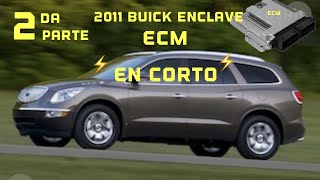
Est. part cost: $5-$350 - Faulty Engine Control Module (ECM) 🟡 Medium Probability Like any complex electronic component, the ECM (often an ACDelco E39 or E39A type 🎬 Watch: Step-by-step guide for replacing a shorted ECM for this platform) can fail internally over time due to heat cycles and vibration.
How to confirm: This is a process of elimination. If all power sources, grounds, wiring, and software have been confirmed to be good, the module itself is the likely culprit.
Typical fix: Replace the ECM and program the new unit to the vehicle. Services exist that can repair the original module.
Est. part cost: $300-$800 - Damaged Wiring Harness ⚪ Low Probability Wiring can be damaged by heat, chafing against other components, or rodent activity, leading to shorts or open circuits. GM has a TSB (21-NA-149) for other models that warns of the engine harness chafing on brackets, which can cause symptoms identical to a bad ECM. One owner of a platform-mate (Chevy Traverse) found a no-start was caused by a damaged harness near the headlight module, which interrupted CAN bus communication to the ECM.
How to confirm: Visually inspect the wiring harness leading to the ECM for any signs of physical damage, melting, or corrosion. Pay close attention to where the harness may contact engine brackets, the chassis, or other components. Check for continuity on key wires with a multimeter.
Typical fix: Repair or replace the damaged section of the wiring harness.
Est. part cost: $20-$200
Rare But Worth Checking
- Low Battery Voltage: A weak or failing battery can cause a drop in voltage during engine cranking, which can be enough to trigger a P0606 code. Always test the battery's health before diving into more complex diagnostics.
- Faulty Camshaft Position Sensor: According to GM TSB 17-NA-132 for other models, a P0606 that appears during a crank-no-start condition can be falsely triggered by a faulty camshaft position sensor circuit. The ECM may set P0606 before it has time to set the correct cam sensor code.
Diagnosis Steps
- Scan for all DTCs. Address any other codes, especially those related to communication (U-codes) or sensor circuits, before focusing on P0606.
- Test the Battery and Charging System. Ensure the battery is fully charged (12.4-12.6V) and passes a load test. A weak battery can cause this code. With the engine running, check alternator output (should be ~13.5-14.5V).
- Inspect ECM Connections and Grounds. Visually inspect the ECM connectors for corrosion, bent pins, or looseness. Locate and inspect the main engine and chassis ground connections for tightness and corrosion. GM vehicles are known for ground issues.
- Inspect the Wiring Harness. Thoroughly inspect the entire engine wiring harness for signs of chafing, melting, or rodent damage, paying special attention to areas where it might rub against engine brackets or the chassis, a known issue on similar GM platforms.
- Verify ECM Power and Ground Circuits. Using a multimeter and a factory wiring diagram, confirm that the ECM is receiving proper voltage and has a solid ground connection at the connector pins.
- Check for Software Updates. Contact a GM dealer or qualified shop to determine if a software update is available for the ECM. A re-flash is a common fix for this code on GM vehicles.
- Condemn the ECM. If all wiring, power, grounds, and software are confirmed to be good, the ECM has an internal fault and requires replacement.
Parts You'll Likely Need
- Engine Control Module (ECM/PCM)
(OEM #12653998, 12643248, 12651994 (Varies by year, check VIN))— This is the most likely part to have failed if all other diagnostic steps (wiring, grounds, software) do not resolve the issue. The specific module is often an ACDelco E39 or E39A.
Trusted brands: ACDelco (OEM), Cardone (Remanufactured), Standard Motor Products, Flagship One (Programmed)
OEM price range: $500-$830
Aftermarket price range: $300-$550
Related Codes That Often Appear With This One
- P0601, P0602, P0603, P0604 — These are all internal control module memory 🎬 See these diagnostic tips for troubleshooting the P0606 code or processor error codes. The provided TSB #05-06-04-060A groups them together, indicating they relate to similar module integrity faults.
- U-series codes (e.g., U0100) — If the ECM is failing or has lost power/ground, it can disrupt communication on the CAN bus network, leading to communication loss codes with other modules like the TCM or BCM.
Technical Service Bulletins (TSBs) & Recalls
- 05-06-04-060A: An informational bulletin for technicians regarding a group of control module DTCs including P0606, which can appear in multiple modules.
- 21-NA-149 (Related Platform): Details how engine harness chafing can cause shorts and a wide range of DTCs, including P0606, mimicking a failed ECM.
- 17-NA-132 (Related Platform): Notes that a P0606 during a crank-no-start can be falsely set by a bad camshaft position sensor circuit.
Platform-Specific Known Issues
- The TSB #05-06-04-060A specifically mentions that codes like P0606 can be shared across multiple modules, highlighting the importance of a full-system scan to see where the fault originates. [⭐ MANUFACTURER TSB — highest authority]
- The first-generation Enclave and its platform mates (Traverse, Acadia) are known for issues that can mimic ECM failure, such as stretched timing chains, faulty ignition coils, and power steering leaks. While not direct causes of P0606, they highlight the platform's electrical and mechanical sensitivities.
- A video diagnosis of a no-start 2008 Enclave showed that CAN bus communication was being interrupted by a damaged wiring harness near the headlight module, preventing the ECM from communicating. This underscores the importance of checking the entire communication network, not just the ECM itself.
Mechanic-Grade Diagnostic Values
- Battery Voltage (Key Off) — expected: ~12.6 Volts. Failure: Voltage below 12.4V indicates a discharged or weak battery that can cause spurious codes.
- Charging System Voltage (Engine Running) — expected: 13.5 - 14.5 Volts. Failure: Voltage that is too low, too high, or fluctuating can indicate a faulty alternator, causing electrical issues that mimic ECM failure.
- ECM Power Supply at Connector — expected: Battery Positive Voltage (B+). Failure: Voltage significantly lower than battery voltage indicates a wiring issue (voltage drop) between the fuse block and the ECM.
- ECM Ground Circuit Voltage Drop — expected: < 0.1 Volts. Failure: Voltage higher than 0.1V between the ECM ground pin and the negative battery terminal indicates a poor ground connection, a very common cause for this code.
Scan Tool Commands That Help
- GDS2 / Tech2Win: SPS (Service Programming System) — This function is required to program a new or used ECM to the vehicle. It downloads the correct software and VIN to the module. Failure to program renders the vehicle inoperable.
- GDS2 / Tech2Win: Immobilizer Learn / Key Relearn — After replacing and programming the ECM, the anti-theft system must be relearned to recognize the existing keys. The vehicle will not start until this procedure is completed.
- GDS2: Module Diagnostics / Data Display — Used to monitor live data from the ECM, check for communication with other modules on the CAN bus, and verify that the ECM is receiving correct inputs from sensors before condemning the module.
Wiring & Ground Locations
- G101 — On the left frame rail in the engine compartment.. This is a primary ground point for the Engine Control Module (ECM) and Transmission Control Module (TCM). A poor connection here can directly cause power supply issues to the ECM, triggering a P0606.
- G113 — On the left side of the engine, at an engine-to-transmission stud.. This is another critical engine ground. Corrosion or looseness at this stud can cause intermittent electrical faults that are often misdiagnosed as a failed ECM.
- G110 — On the right front of the engine, mounted to the cylinder head.. Provides a ground path for various engine components. While not a direct ECM ground, a poor connection can introduce electrical noise that may affect ECM operation.
- G103 — On the left inner fender panel in the engine compartment.. Grounds the Body Control Module (BCM) and Data Link Connector (DLC). A fault here can disrupt communication between the ECM and other modules, potentially causing network-related codes alongside P0606.
- ECM Connector X1 — The main connector at the Engine Control Module, located behind the cooling fan shroud.. Specific pins must be tested here for power and ground. For example, Pin 20 (RD/WH wire) is a key Battery Positive Voltage feed, and Pin 19 (PK wire) is an Ignition 1 Voltage feed. Testing these pins directly confirms if the module is receiving power.
Real Owner Repair Stories
- YouTube channel 'JVFIX' (2009 Buick Enclave) — Crank, no-start condition with anti-theft light on. Vehicle had been sitting for two years.
❌ Tried (didn't work) Installing a used ECM from another vehicle and attempting to program it. The SPS programming failed because the used ECM was locked to the donor vehicle's VIN.
✅ What actually fixed it A new, pre-programmed ECM was installed. The technician then used GM's SPS (Service Programming System) to perform an immobilizer relearn procedure, which allowed the vehicle to recognize the keys and start.
OEM Part Supersession History
12633555→12653998— Standard part revision and consolidation by the manufacturer.
Heads up: Part number 12653998 is listed for 2013-2016 Enclave models. While it may physically connect to earlier models, the internal hardware and software calibration are designed for the LFX engine, not the earlier LLT engine. Using the wrong ECM will cause programming failures and running issues.
Model Year Variations Within This Range
- 2008-2011: These models use the 3.6L LLT V6 engine, which is paired with a Bosch ECM.
- 2012-2015: These models use the updated 3.6L LFX V6 engine. This engine features an integrated exhaust manifold and uses a different, Delphi-made ECM (like the ACDelco E39A). The diagnostic and programming procedures are similar, but the physical ECM and its software are not interchangeable with the earlier LLT models.
- 2013-2015: The diagnostic software for these later models transitions fully from Tech2Win to GDS2 (Global Diagnostic System 2), which is the modern GM diagnostic platform.
Helpful Videos



We Have This Part in Stock



The information in this article is provided for general reference and educational purposes only. Vehicle specifications, procedures, and part compatibility can vary by production date, trim level, and region. Always consult your vehicle's factory service manual and verify part numbers before purchasing or performing repairs. Safety-critical components such as airbags, seat belts, and braking systems should be installed by a qualified professional.
- Buick ENCLAVE:
- 🎬 Helpful Videos
- 🛍️ Shop This Part
- What's Unique About the 2008-2015 Buick ENCLAVE
- Diagnostic Flowchart
- Symptoms You May Notice
- Most Likely Causes
- Rare But Worth Checking
- Diagnosis Steps
- Parts You'll Likely Need
- Related Codes That Often Appear With This One
- Technical Service Bulletins (TSBs) & Recalls
- Platform-Specific Known Issues
- Mechanic-Grade Diagnostic Values
- Scan Tool Commands That Help
- Wiring & Ground Locations
- Real Owner Repair Stories
- OEM Part Supersession History
- Model Year Variations Within This Range
- 🎟️ Get 5% Off