

P0604 on 2007-2010 GMC Sierra 2500: Internal Memory Error Causes and Fixes
P0604 on a 2007-2010 GMC Sierra 2500 indicates an internal RAM error in a control module, often the TCM or ECM. Before replacing any modules, check for low battery voltage or bad ground connections, as these are common, simpler causes. Key grounds to inspect are on the engine block and frame. If the module is faulty, replacement and programming are required.
- P0604 signifies an internal memory error in a control module, most often the ECM or TCM on this truck.
- Always start diagnosis by testing the battery and checking all main power and ground connections before condemning an expensive control module.
- GM has issued service bulletins indicating this code can appear in the TCM and be shared across modules, making professional diagnosis with an advanced scan tool important.
- If a module replacement is necessary, it must be programmed to your vehicle's VIN to function correctly.
What's Unique About the 2007-2010 Gmc SIERRA 2500
On the GMT900 generation of Sierra trucks, this code has specific nuances documented by GM. Technical Service Bulletins (TSBs) indicate that P0604 can frequently be set in the Transmission Control Module (TCM). [Bulletin #PIP4653E] Another bulletin highlights that this and similar internal module codes can be shared across multiple modules, complicating diagnosis. [Bulletin #05-06-04-060A] This means that while the code points to a module failure, the root cause could be an issue affecting the entire vehicle network, like a corroded ground strap or a failing alternator, not just one isolated component. On these trucks, the TCM for the 6-speed automatic (6L90) is located inside the transmission pan, subjecting it to extreme heat cycles that can lead to failure.
Diagnostic Flowchart
Tap your situation to follow the diagnostic path that matches what you're seeing on this vehicle.
Symptoms You May Notice
- Check Engine Light is on
- Transmission may shift harshly or go into 'limp mode'
- Engine may stall, hesitate, or fail to start
- ABS or Traction Control lights may illuminate
- Reduced fuel economy
- Vehicle may crank but not fire
- Intermittent loss of all power while driving
- Replacing the ECM or TCM without first verifying battery health and the integrity of all power and ground connections. A weak battery or a corroded ground strap is a very common and much cheaper root cause for this code.
Most Likely Causes
- Low Battery Voltage or Poor Connections 🔴 High Probability Large trucks with complex electrical systems are sensitive to voltage drops, especially during cranking. A weak battery or corroded ground can cause a momentary 'brown-out' that corrupts a module's RAM. GMT900 trucks are known for having issues with main engine-to-chassis ground straps.
How to confirm: Test the battery voltage with a multimeter; it should be above 12.4V at rest and not drop below 9.6V during cranking. Inspect battery terminals and main chassis/engine grounds for corrosion or looseness. Key locations include the strap from the passenger cylinder head to the firewall and the ground point under the driver's side door on the frame.
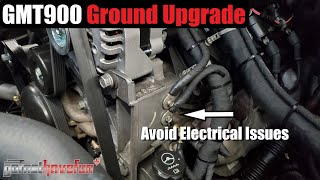
Typical fix: Clean battery terminals and all major ground points with a wire brush until shiny. Charge or replace the battery if it fails a load test. Consider adding a redundant ground strap for improved reliability. 🎬 Watch: How to upgrade and fix GMT900 ground straps.
Est. part cost: $0-$250 - Faulty Transmission Control Module (TCM) 🟡 Medium Probability GM issued a TSB (#PIP4653E) specifically mentioning that P0604 may be stored in the TCM on these trucks, indicating a known issue. The TCM (often a T43 model for the 6-speed 6L90E transmission) is located inside the transmission oil pan, where it is subjected to heat and vibration, contributing to failure.
How to confirm: A professional scan tool is needed to check which module logged the P0604 code. If it's isolated to the TCM and power/grounds are good, the TCM is the likely culprit.
Typical fix: Replace the Transmission Control Module (which is often part of the valve body assembly, also called a TEHCM) and have it programmed to the vehicle's VIN.
Est. part cost: $200-$500 - Faulty Engine Control Module (ECM/PCM) 🟡 Medium Probability The ECM (typically an ACDelco E38) is the central computer and is susceptible to failure from voltage spikes, heat, and internal component degradation over time. Sometimes the only fix is ECM replacement, even after checking all external factors.
How to confirm: If diagnostic scans show the P0604 code is stored in the ECM and all power/ground circuits test good (resistance under 0.1 Ω), the ECM is suspect. This is often a diagnosis of elimination after multiple attempts to clear the code fail.
Typical fix: Replace the Engine Control Module and have it programmed by a dealer or qualified technician with access to GM's TIS2WEB service.
Est. part cost: $300-$700 - Aftermarket Programming/Tuner ⚪ Low Probability Modifying the stock calibration on the ECM or TCM can sometimes lead to software conflicts or memory errors. A user on Reddit with a 2009 Suburban noted the code appeared on a tuned truck.
How to confirm: Determine if the vehicle has an aftermarket tune. If so, flash the module back to the stock factory program and see if the code returns.
Typical fix: Remove the aftermarket tune and return the module to its stock programming.
Est. part cost: $0
Rare But Worth Checking
- Wiring Harness Issues: While less common than a bad module, a damaged wire or corroded pin in the harness leading to the ECM or TCM can cause voltage drops or communication errors that trigger a P0604 code. On some GM trucks, the engine harness can chafe against the ECM/TCM bracket, upper control arm, or shock tower.
- Communication Enable Circuit Failure: GM has noted that high resistance or an open in the Communication Enable circuit (Circuit 5986) can cause various module issues. This circuit is known to have problems in the wiring harness located under the driver's and passenger's front sill plates.
Diagnosis Steps
- Check and record any other stored DTCs. Address other codes first, especially communication (U-codes) or power-related codes.
- Clear the codes and see if P0604 returns immediately. If it does, it suggests a hard internal fault.
- Thoroughly test the battery and charging system. Ensure voltage is stable and within the 13.5-14.8V range when the engine is running.
- Inspect all battery cables, terminals, and major ground straps. Key GMT900 grounds are on the firewall, engine block, and frame rails. Clean any corrosion and ensure all connections are tight. Use a multimeter to check ground resistance from the module connector to the chassis; it must be below 0.1 Ω.
- Using a professional scan tool, determine which module (ECM or TCM) has stored the P0604 code.
- Inspect the wiring harness and connectors for the identified module. Look for any signs of damage, corrosion, or loose pins. Check for a burnt electronics smell near the module, which can indicate internal failure. Pay close attention to known chafe points near the ECM/TCM bracket and driver's side upper control arm.
- If possible with your scan tool, attempt to re-flash the module with the latest OEM software. 🎬 See this walkthrough on diagnosing and fixing the P0604 code. If the code returns immediately after a re-flash, it points strongly to a hardware failure.
- If all external factors (power, grounds, wiring) are confirmed to be good, the control module itself is the most likely cause of the fault.
Parts You'll Likely Need
- Engine Control Module (ECM)
(OEM #12625455, 19210738 (ACDelco E38 family, specific number is VIN-dependent))— If diagnosis points to the ECM as the source of the RAM error after ruling out external issues, replacement is the only reliable fix.
Trusted brands: ACDelco
OEM price range: $400-$700
Aftermarket price range: $300-$500 - Transmission Control Module (TCM)
(OEM #24256960, 19434978 (ACDelco T43 family for 6-speed, specific number is VIN-dependent))— A GM TSB specifically points to the TCM as a potential source for this code on the Sierra 2500. [Bulletin #PIP4653E] It is located inside the transmission and is a common failure point.
Trusted brands: ACDelco
OEM price range: $300-$500
Aftermarket price range: $200-$400 - Battery — A weak or failing battery is a frequent root cause of spurious module memory codes due to low voltage during startup.
Trusted brands: ACDelco, DieHard, Interstate
OEM price range: $200-$300
Aftermarket price range: $150-$250
Related Codes That Often Appear With This One
- P0601 — This code indicates an Internal Control Module Memory Check Sum Error, another type of internal module fault. Both are cited in the same GM TSBs. [Bulletin #PIP4653E, #05-06-04-060A]
- P0606 — This code indicates a PCM/ECM Processor Fault. It often appears with other internal module codes when the main processor is failing. [Bulletin #05-06-04-060A, 7]
- P1621 — This GM-specific code relates to Control Module Long Term Memory Performance. It is mentioned alongside P0604 in TSBs for these trucks. [Bulletin #PIP4653E, #05-06-04-060A]
Technical Service Bulletins (TSBs) & Recalls
- PIP4653E: Discusses P0604 and other codes being stored in the Transmission Control Module.
- 05-06-04-060A: Informational bulletin about internal control module DTCs (including P0604) being shared across multiple modules.
Platform-Specific Known Issues
- TSB #PIP4653E notes that DTCs P0601, P0603, P0604, P062F, or P1621 may be found stored in the Transmission Control Module (TCM). [Bulletin #PIP4653E]
- TSB #05-06-04-060A is an informational bulletin about various internal control module DTCs (including P0604) that can be shared across multiple modules, advising technicians on the nature of these codes. [Bulletin #05-06-04-060A]
- Corroded or broken ground straps are a well-documented problem on GMT900 trucks. The main engine-to-chassis ground is a frequent culprit for a wide range of electrical issues, including module memory codes.
- The engine wiring harness on some GM trucks is prone to chafing against the ECM/TCM bracket, the driver's side upper control arm, and the shock tower, which can cause shorts and various electrical faults.
Mechanic-Grade Diagnostic Values
- Module Ground Resistance — expected: Below 0.1 Ω. Failure: A reading higher than 0.1 Ω indicates a poor ground connection that can cause module errors.
- Battery Voltage During Cranking (at module) — expected: Above 9.0V (some sources say 9.6V). Failure: Voltage dropping below this level can cause a 'brown-out' condition, corrupting module RAM.
- Charging System Voltage (Engine Running) — expected: 13.5V - 14.8V. Failure: Voltage outside this range indicates an alternator or regulator issue that can damage control modules.
- Communication Enable Circuit (Circuit 5986) Voltage — expected: Approximately 12V with key in ACC, ON, or START. Failure: Low or no voltage indicates an open or high resistance in the circuit, often under the driver's/passenger's sill plate.
Scan Tool Commands That Help
- GM Tech 2 / GDS2: Module Setup > Idle Learn Reset — Used after replacing the ECM to relearn the engine's idle characteristics. This is a required step to prevent idle-related codes after replacement.
- GM Tech 2 / GDS2: Crankshaft Position Variation Learn — Required after ECM replacement to calibrate the crankshaft position sensor to the new module, preventing misfire codes and ensuring accurate timing.
- GM Tech 2 / GDS2: Theft Deterrent Relearn — Necessary after replacing the ECM to synchronize the new module with the vehicle's anti-theft system, allowing the engine to start.
- Professional Scan Tool: Memory Test / RAM-Integrity Test — Some OEM-level tools have a specific function to test the module's internal RAM. A failure on this test directly confirms an internal hardware fault.
Wiring & Ground Locations
- G101 — Located at the front of the engine, lower block.. This is a primary ground point for the Engine Control Module (ECM) and Transmission Control Module (TCM). A poor connection here directly affects the modules that set P0604.
- G103 — Located on the front of the passenger side cylinder head.. This ground serves multiple modules, including the Body Control Module (BCM), which communicates with the ECM/TCM. A bad ground here can cause widespread communication issues.
- G104 — Located on the rear of the passenger side cylinder head, near the firewall.. This ground point is shared with the Vehicle Control Module (VCM) on some models and is critical for stable module operation. It is often a braided strap that can corrode or break.
- ECM/TCM Bracket Chafe Point — On the driver's side of the engine bay, where the engine wiring harness passes the bracket holding the ECM and TCM.. GM has identified this as a common area where engine vibration can cause the harness to rub through on the sharp edge of the bracket, shorting out critical power or data wires to the modules.
- Sill Plate Harness (Circuit 5986) — Under the driver's and/or passenger's front door sill plates.. The Communication Enable circuit (5986), which 'wakes up' various control modules, is known to develop high resistance or opens in this area, leading to communication DTCs and module errors.
Real Owner Repair Stories
- YouTube video by 'thediagtech' (2010 Chevrolet Silverado (GMT900 platform sibling)) — Check Engine Light with a control module memory error code.
❌ Tried (didn't work) Not specified, diagnosis led directly to the PCM.
✅ What actually fixed it The Powertrain Control Module (PCM/ECM) was replaced and programmed using GM's TIS2WEB service. After replacement, several relearn procedures were required: Idle Learn Reset, Crankshaft Position Variation Learn, and Theft Deterrent Relearn.
OEM Part Supersession History
24239224→24252114, which was then superseded by 24256960— Internal revisions and software updates for the T43 TCM used in 6-speed automatic transmissions.
Heads up: While later part numbers are generally backward compatible when programmed correctly, using an older, non-superseded part number may re-introduce previously fixed software or hardware vulnerabilities. Always use the latest available part number.
Model Year Variations Within This Range
- 2007-2010: The 2007 model year included both the older 'Classic' GMT800 body style and the new GMT900 body style. This guide applies specifically to the GMT900 platform. The control modules and wiring architecture are significantly different between the two generations, so it is critical to correctly identify the vehicle's platform before diagnosing.
Helpful Videos
Used OEM Parts in Stock


New Aftermarket Parts Available




The information in this article is provided for general reference and educational purposes only. Vehicle specifications, procedures, and part compatibility can vary by production date, trim level, and region. Always consult your vehicle's factory service manual and verify part numbers before purchasing or performing repairs. Safety-critical components such as airbags, seat belts, and braking systems should be installed by a qualified professional.
- Gmc SIERRA 2500:
- 🎬 Helpful Videos
- 🛍️ Shop This Part
- What's Unique About the 2007-2010 Gmc SIERRA 2500
- Diagnostic Flowchart
- Symptoms You May Notice
- Most Likely Causes
- Rare But Worth Checking
- Diagnosis Steps
- Parts You'll Likely Need
- Related Codes That Often Appear With This One
- Technical Service Bulletins (TSBs) & Recalls
- Platform-Specific Known Issues
- Mechanic-Grade Diagnostic Values
- Scan Tool Commands That Help
- Wiring & Ground Locations
- Real Owner Repair Stories
- OEM Part Supersession History
- Model Year Variations Within This Range
- 🎟️ Get 5% Off