

OBD-II Code P0604: Internal Control Module Random Access Memory (RAM) Error
What P0604 means, why it triggers, and how to fix it
- P0604 indicates a failure in the Powertrain Control Module's short-term memory (RAM), causing sudden stalling, no-starts, or erratic shifting.
- Test the electrical system before replacing parts; a cranking voltage below 9.5V, charging voltage outside 13.5-14.8V, or ground resistance above 0.1 Ω frequently trigger this code.
- Check for Technical Service Bulletins (TSBs) immediately, as a $150-$275 dealer software update is the definitive fix for many Ram and GM trucks.
- Never replace the $600+ PCM as a first step; it is a last resort only after ruling out weak batteries, bad grounds, and outdated software.
What Does P0604 Mean?

P0604 means the Powertrain Control Module (PCM) has a problem with its Random Access Memory (RAM). The PCM uses RAM to store temporary data for real-time engine and transmission calculations. When the PCM runs a self-test and cannot reliably read or write to this memory, it triggers P0604.
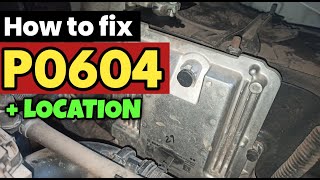
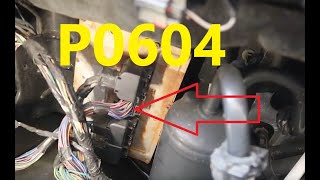
Technical definition: The official SAE/OBD-II definition for P0604 is "Internal Control Module Random Access Memory (RAM) Error." This indicates the Powertrain Control Module (PCM) 🎬 Watch: A quick overview of the P0604 RAM error code or another control module (like the TCM) detected a malfunction in its internal RAM during a self-check.
Can I Drive With P0604?
No — Do Not Drive. Do not drive. This fault indicates critical instability in the main computer, causing sudden engine stalling, unpredictable power loss, or a no-start condition. Continuing to drive risks severe transmission damage, potentially adding thousands to repair costs.
Common Causes

- Low Battery Voltage or Charging System Fault (Very Common) — A weak battery, failing alternator, or corroded battery terminals cause voltage drops or spikes. Control modules are extremely sensitive to unstable voltage, which corrupts the RAM and triggers P0604. A voltage drop below 9.5V during cranking is a primary trigger.
- Outdated or Corrupted Module Software (Common) — The problem is frequently a software bug rather than a hardware failure. Manufacturers release software updates (reflashes) to fix logic errors that cause a false P0604 code. This is the most common issue on Ram and GM trucks.
- Poor Power or Ground Connections (Common) — Loose or corroded ground straps and power wires interrupt the PCM's power supply. This intermittent connection mimics a module failure by causing the RAM to lose data. A ground circuit resistance above 0.1 Ω indicates this problem.
- Faulty Powertrain Control Module (PCM) (Less Common) — The internal components of the PCM, including the RAM chip itself, fail due to age, heat, or electrical surges. While this is a direct cause, it is less frequent than external electrical or software problems.
- Water Intrusion or Overheating (Less Common) — Exposure to moisture from a water leak or excessive heat from the engine bay damages the PCM's internal circuit board and memory chips. This causes short circuits and permanent damage to the RAM.
- Blown Fuse or Open in PCM Power Circuit (Rare) — A blown fuse dedicated to the ECM/PCM or an open wire providing power to the module interrupts the voltage needed to maintain memory and pass the self-test.
- Aftermarket Tuning or Programming Issues (Rare) — Using a low-quality aftermarket performance tuner or an improper 🎬 See this breakdown of common causes and potential fixes programming procedure corrupts the PCM's software or memory, directly leading to a P0604 fault.
Symptoms

- Check Engine Light is On — This is the first and sometimes only symptom you will notice.
- Engine Stalls or Will Not Start — The engine cranks but does not fire, or it starts and immediately stalls without warning.
- Harsh or Incorrect Transmission Shifting — The PCM controls the transmission; a memory error forces the transmission to shift hard, erratically, or lock into "limp mode."
- Erratic Engine Performance — You will experience a loss of power, rough idling, hesitation, or misfires as the PCM struggles to calculate fuel and timing.
- ABS or Traction Control Light On — Because the PCM communicates with other modules, P0604 triggers the Anti-lock Brake System (ABS) or Traction Control warning lights as a secondary fault.
Diagnostic Flowchart
Tap your situation to follow the diagnostic path that matches what you're seeing on this code.
Common Fixes & Costs
- Replace Battery — Parts: $150-$350, Labor: $50-$100, ~0.7 hr book time (DIY)
- PCM Software Update (Reflash) — Parts: $0, Labor: $150-$275, ~1.5 hr book time (Professional)
- Clean or Repair Ground Connections — Parts: $5-$20, Labor: $100-$200, ~1.5 hr book time (Intermediate)
- Replace Alternator — Parts: $300-$700, Labor: $150-$300, ~2 hr book time (Intermediate)
- Replace Powertrain/Transmission Control Module (PCM/TCM) — Parts: $600-$1200, Labor: $150-$400, ~2 hr book time (Professional)
DIY vs Professional
- Replace Battery — Beginner:
Tools: Basic wrench set, terminal cleaning brush. - PCM Software Update (Reflash) — Beginner:
Tools: Dealer-level scan tool (e.g., wiTECH, GDS2) and subscription to manufacturer's service network. - Clean or Repair Ground Connections — Beginner:
Tools: Wrench set, wire brush, sandpaper, multimeter. - Replace Alternator — Beginner:
Tools: Wrench and socket set, serpentine belt tool. - Replace Powertrain Control Module (PCM) — Beginner:
Tools: Wrench set to physically replace, but professional programming tools are mandatory.
Used vs. New Parts: Buying Guide
When a used part is worth it: For older, high-mileage vehicles (>150k miles) where a new OEM PCM/TCM is prohibitively expensive. This is a high-risk option that requires an exact part number match and a functional warranty.
Donor-vehicle mileage cap: roughly under 80000 miles for the part to have meaningful remaining life.
Donor quality checklist:
- Part number on the module housing must be an exact match.
- Verify the donor vehicle was not scrapped for electrical or engine failure.
- Avoid modules from flood-damaged vehicles or those from regions with high corrosion.
Decision logic:
- If The fix is a known software update (TSB exists) → Do not buy any part; pay for the reflash service on the existing module.
- If Vehicle is under 80K miles or still under warranty → Buy a new OEM or high-quality remanufactured module to ensure longevity and compatibility.
- If Vehicle is >150K miles and budget is the primary concern → A used module is a high-risk option, but a remanufactured unit with a warranty is a safer compromise.
Warranty tradeoff: Used parts typically offer a 30-90 day warranty at best. Remanufactured modules come with a 1-year to lifetime warranty. New OEM parts carry a 1-2 year warranty but require dealer installation.
Worst-case if a used part fails: $500-$1000. If a used module fails, you pay for diagnostic time, programming attempts, and repeat labor, plus the cost of another replacement module.
What Happens If You Wait — Timeline
- 0-2 weeks: Code P0604 appears, Check Engine Light is on. There are no other symptoms, or a rare, momentary hesitation. The fault is intermittent. (MPG impact: 0-2%% · Added cost: $0)
- 2 weeks - 3 months: Intermittent stalling becomes frequent, especially when stopping or at idle. Harsh or delayed transmission shifting occurs. A no-start condition happens occasionally, requiring a key cycle to resolve. (MPG impact: 3-8%% · Added cost: $50-$150 in wasted fuel and potential towing costs.)
- 3-6 months: Vehicle becomes unreliable. Stalling in traffic and no-start conditions are common. Erratic transmission behavior causes accelerated wear on internal clutches and solenoids. The vehicle enters 'limp mode' frequently. (MPG impact: 10-15%% · Added cost: $500-$2000 (Risk of internal transmission damage from continued harsh shifting).)
- 6+ months: Catastrophic failure is likely. The PCM or TCM fails completely, resulting in a permanent no-start condition, rendering the vehicle undrivable. Significant secondary damage to the transmission is highly probable. (MPG impact: N/A (Vehicle likely undrivable)% · Added cost: $2500-$6000+ (Cost of PCM/TCM replacement plus potential transmission rebuild).)
Cost of Not Fixing It
- 0-1 month: Intermittent stalling, no-start conditions, and harsh shifting, posing a significant safety risk. Potential for a 5-10% drop in fuel economy. (Added cost: Negligible, besides fuel cost and towing.)
- 1-6 months: Continued erratic transmission shifting causes accelerated wear on internal components like clutch packs and solenoids. Poor fuel control degrades the catalytic converter. (Added cost: $1500-$4000)
- 6+ months: Catastrophic failure of the transmission is possible. Complete failure of the PCM due to ongoing electrical stress renders the vehicle undrivable. (Added cost: $3000-$7000+)
Diagnosis Steps

- Check the Battery and Charging System
Using a multimeter, check the battery voltage with the car off (should be ~12.6V) and while running (should be ~13.5-14.8V). During engine cranking, the voltage must not drop below 9.5V. A professional load test is mandatory, as a battery can show good voltage but fail under load.
Tools: Multimeter, Battery Load Tester (Beginner) - Inspect Battery Terminals and Main Grounds
Clean any corrosion from the battery terminals, posts, and cable ends. Follow the negative battery cable to where it bolts to the chassis and engine block. A ground resistance check using a multimeter between the negative battery post and the chassis/engine block must show below 0.1 Ω.
Tools: Wrench set, wire brush, multimeter (Beginner) - Check for Technical Service Bulletins (TSBs)
Search online for TSBs related to P0604 for your specific vehicle make and model. Manufacturers issue bulletins if a software update is the required fix. This is a critical step before considering module replacement.
Tools: Smartphone or Computer (Beginner) - Clear Codes and Test Drive
Use an OBD-II scanner to clear the P0604 code. 🎬 Watch: How to diagnose and fix a P0604 fault Drive the vehicle to see if the code returns immediately. A random voltage fluctuation sets this code as a one-time event, especially after a battery replacement or jump-start.
Tools: OBD-II scanner (Beginner) - Pro Tip: Check for AC Ripple Voltage
A failing alternator produces excessive AC voltage (ripple) that corrupts sensitive electronics. Set your multimeter to a low AC voltage scale. With the engine running at 1500 RPM and electrical loads on, touch the probes to the battery terminals. A reading above 0.5V AC indicates a failing alternator diode.
Tools: Multimeter with AC Voltage setting (Intermediate) - Pro Tip: Perform a Parasitic Draw Test
If the battery dies overnight, a parasitic draw causes low voltage conditions that trigger P0604 on startup. With the vehicle off for an hour, disconnect the negative battery terminal and place a multimeter in series. A reading above 50-85 milliamps indicates a component is draining the battery.
Tools: Multimeter with Amps setting (Intermediate) - Inspect PCM Wiring and Connectors
Visually inspect the wiring harness going to the PCM for damage, chafing, or corrosion. Unplug the PCM connectors (with the battery disconnected) and look for bent, corroded, or water-damaged pins.
Tools: Flashlight, inspection mirror (Intermediate) - Advanced: Perform a CAN Bus Resistance Check
If communication codes (U-codes) are present with P0604, test the CAN network. With the battery disconnected, measure the resistance between Pin 6 (CAN-H) and Pin 14 (CAN-L) at the OBD-II port. A healthy network reads approximately 60 Ω.
Tools: Multimeter (Advanced) - Advanced: Check Module-Specific PIDs
For vehicles like a GM truck where the TCM is suspect, a professional scan tool accesses module-specific data. For a 6L80 transmission, measure solenoid resistance. Readings outside factory specifications point to an internal TCM failure.
Tools: Professional Scan Tool (Advanced) - Have the PCM Software Updated
If a TSB exists or if electrical issues are ruled out, have a dealership or qualified shop reflash the PCM with the latest manufacturer software. This is often the definitive fix.
Tools: Professional scan tool (dealer-level) (Professional)
When This Code Triggers (Freeze-Frame Conditions)
- Engine Coolant Temp: 180-200°F (Fully warmed up, as the PCM runs continuous self-tests.)
- RPM: 0 or <400 RPM (During engine cranking, when low voltage is a common trigger.)
- System Voltage: <9.5V (During engine cranking, indicating a weak battery.)
- Vehicle Speed: 45-65 mph (Highway driving, when the system is stable.)
Related Codes
- P0601 — Indicates an 'Internal Control Module Memory Check Sum Error.' P0601 points to a problem with the permanent memory (ROM), which is more severe and requires module replacement. P0604 points to temporary memory (RAM), often caused by external factors like low voltage.
- P0603 — Means 'Internal Control Module Keep Alive Memory (KAM) Error.' P0603 is specifically for memory retained when the car is off, commonly triggered by a recent battery disconnection. P0604 is a broader RAM failure occurring during the active self-test.
- U0100 — Means 'Lost Communication With ECM/PCM.' It appears with P0604 because the internal memory error causes the module to stop functioning and drop off the vehicle's CAN bus network. Seeing U0100 reinforces the severity of the PCM fault.
- P0602 — Signifies a 'Control Module Programming Error.' It appears with P0604 after a failed software update or if the wrong software is installed. Seeing them together strongly suggests a reflash attempt is the next step.
Climate & Environmental Factors
- Cold Weather: Cold temperatures reduce a battery's chemical efficiency, lowering available voltage. During a cold start, the high current draw from the starter combined with a weak battery causes system voltage to drop below the threshold required by the PCM, corrupting the RAM self-test.
- High Humidity / Water Intrusion: Water finds its way into the engine bay or cabin. If the PCM is not perfectly sealed, moisture penetrates the housing. This leads to corrosion on the circuit board and connector pins, causing short circuits that result in a P0604 error.
How to Talk to a Mechanic About This Code
Say this: "I have a P0604 code and I'd like to schedule a diagnostic. I want to start with the most common and least expensive causes first. Please test the battery under load, check the alternator for AC ripple, and perform a voltage drop test on the main PCM power and ground wires. Also, please check for any open TSBs related to a PCM software update for my VIN before recommending a module replacement."
This signals to the shop that you are an informed consumer. It directs them to follow a logical diagnostic path from cheapest (electrical tests) to most expensive (PCM replacement), preventing them from jumping to the most profitable conclusion. It specifically requests they rule out bad power, grounds, and software before condemning an expensive module.
Avoid saying:
- 'My check engine light is on, can you fix it?'
- 'My car is stalling, I think it's the computer.'
- 'Just do whatever it takes to get it running again.'
Questions to ask before authorizing the repair:
- What were the results of the battery load test and alternator ripple test?
- What was the resistance reading on the main ground connections?
- Did you find any Technical Service Bulletins for a software reflash?
- If you are recommending a PCM/TCM replacement, what specific tests did you perform to condemn the module and rule out all external electrical and software issues?
Where to Take It: Dealer vs Independent vs Chain
- Dealer:
Recommended if a software reflash or module replacement is confirmed to be the necessary fix.
Best for: Vehicles under warranty., Confirmed software update (reflash) is needed., Confirmed PCM/TCM replacement is required, as they have guaranteed access to correct parts and programming tools.
Downsides: Highest labor rates., May default to module replacement without performing thorough electrical diagnostics first. (Typical cost: +50% vs. baseline) - Independent Shop:
Best starting point. A good independent shop is ideal for diagnosing the common electrical causes of P0604. If they diagnose a software or module issue they cannot fix, take it to the dealer for that specific procedure.
Best for: Initial diagnosis of electrical systems (battery, alternator, grounds)., Out-of-warranty vehicles where cost is a concern.
Downsides: Not all independent shops have the expensive, manufacturer-specific tools to perform software reflashes or program new modules. You must verify their capabilities beforehand. (Typical cost: +0% vs. baseline) - Chain Shop:
AVOID for diagnosis. Their business model is not suited for the careful, step-by-step diagnosis that P0604 requires. Only use them if you need a simple part replacement already diagnosed elsewhere.
Best for: Selling you a battery or alternator if you have already confirmed one is bad.
Downsides: Technicians are often not equipped or trained for complex electrical or module-level diagnostics., High pressure to sell parts leads to misdiagnosis (e.g., selling a PCM when only a ground wire was loose). (Typical cost: -10% vs. baseline)
When to Walk Away From the Repair
If the estimated repair cost for a P0604 fault (which is often a high-cost PCM replacement) exceeds 50% of the car's private-party value, strongly consider selling or trading in the vehicle.
- Car worth $3500, fix is $1800: Walk away. The repair cost is over 50% of the vehicle's value. It is not economical to repair.
- Car worth $15000, fix is $250: Fix it. The repair is a low-cost software reflash, which is well below the threshold and restores full function to a valuable vehicle.
- Car worth $8000, fix is $1600: Borderline. The repair is 20% of the car's value. Before authorizing, consider the car's overall condition, mileage, and any other needed repairs. A second opinion is wise.
What Scan Tool You Need for This Code
Minimum: A scanner that reads manufacturer-specific codes and identifies the module that set the code (e.g., ECM vs. TCM).
A basic $20 code reader only shows 'P0604', leaving you blind. On many GM vehicles, this code is set by the TCM, not the ECM; a basic reader cannot tell the difference, leading to a costly misdiagnosis. You also need live data to check module voltage.
Budget: BlueDriver Pro (~$100) — Confirms the code, provides freeze-frame data, and displays live data (like module voltage) to help diagnose electrical issues. It reads manufacturer-specific codes to help identify the source module.
Mid-range: Foxwell NT510 Elite (~$180) — Offers OE-level diagnostics for a specific brand. It definitively tells you which module (ECM, TCM, etc.) stored the P0604 code. It includes bidirectional controls to test components, a major step up for diagnosis.
Professional: Autel MaxiCOM MK808 / Launch X431 series (~$450-1200) — These professional-level tools provide full bidirectional control, comprehensive live data, and crucially, the ability to perform software flashing and module programming (often requiring an additional subscription and a J2534 device). This is the level of tool required to complete a PCM/TCM replacement yourself.
Rent vs buy: For P0604, a rental scanner is insufficient for proper diagnosis. You need to own a scanner capable of reading live data and manufacturer codes to effectively test the electrical system. If a software reflash or module replacement is needed, this is not a DIY job and requires professional tools.
How to Clear the Code After You Fix It
- Use an OBD-II scan tool to clear diagnostic trouble codes.
- Perform a complete OBD-II drive cycle to allow readiness monitors to run.
Drive cycle (~30 minutes): Cold start the engine and let it idle for 2-3 minutes. Drive in stop-and-go city traffic for 10-15 minutes. Drive at a steady highway speed (55-65 mph) for 10-15 minutes. Allow the vehicle to cool down completely.
Readiness monitors affected: Catalyst, Evaporative System, Oxygen (O2) Sensor, O2 Sensor Heater
Before emissions retest: drive at least 100 miles to fully set monitors.
Watch out for:
- The code returns immediately if the underlying issue (e.g., low voltage, bad ground, software bug) is not resolved.
- Clearing the code resets all emissions readiness monitors; the vehicle fails an emissions test until a full drive cycle is completed.
Will This Fail Emissions / State Inspection?
Yes — this code typically fails an OBD-II emissions inspection.
- California: An illuminated Check Engine Light results in an automatic smog check failure. All OBD-II readiness monitors must be complete, which is prevented by an active P0604 code.
- New York: The NY VIP2 inspection includes an OBD-II scan. An active P0604 code and the associated Check Engine Light cause an immediate emissions test failure.
- Texas: In counties that require emissions testing, a vehicle with an active P0604 code fails the OBD portion of the test.
Most Commonly Affected Vehicles
- Ram 2500/3500 with 6.7L Cummins (2014-2020) — Extremely prone to P0604 due to software glitches. TSBs like #18-002-14 REV. B confirm the fix is a PCM software update. The dual-battery system must be tested, as one weak battery is a common trigger.
- Chevrolet / GMC Silverado / Sierra 1500/2500/3500 (2007-2018) — On these trucks, the code points to a fault in the Transmission Control Module (TCM), not the ECM. Weak batteries and poor ground connections (engine-to-firewall strap) are also very common causes.
- Ford Focus, Mondeo, S-Max, Fiesta (2004-2016) — These models report issues with both the PCM and TCM triggering P0604. A failing alternator causing voltage spikes is a known trigger. The TCM on Focus/Fiesta models with the DPS6 transmission is covered by extended warranty programs.
- Volkswagen Golf, Passat, Touareg (1999-2014) — P0604 is caused by poor connections at the PCM, a need for a software update, or an internal PCM fault. Water intrusion into the plenum chamber where the ECU is located is a known issue leading to connector corrosion.
- Subaru Forester, Outback, Legacy (2005-2015) — This code is frequently traced back to a weak battery or failing alternator causing voltage instability. Owners resolve the issue by replacing the battery and cleaning all main ground connections, particularly on the intake manifold.
- Hyundai / Kia Various (2006-2014) — Intermittent P0604 codes are resolved after discovering and repairing corroded PCM connectors or loose ground wires. In some cases, an internal ECU hardware failure is the cause.
- BMW 325ci (E46) (2001-2006) — This code indicates a true internal failure of the engine computer (DME), leading to no-start conditions and complete electrical cut-outs. Water damage is a known cause on models where the DME is located in a vulnerable area.
- Honda Civic, Accord (2003-2012) — These models have known issues with the Engine Control Module (ECM) causing this code, related to internal hardware failure or water damage to the module.
Manufacturer-Specific Notes

- Ram/Dodge (Cummins): A P0604 code is most likely a software bug. A dealer reflash is the first step, not PCM replacement. TSBs like #18-002-14 REV. B confirm this. The dual-battery system must also be checked.
- General Motors (Chevrolet/GMC): P0604 is often set by the Transmission Control Module (TCM), not the main engine computer (ECM). A professional scan tool is needed to see which module stored the code. TSB #PIP4653E points to the TCM on Allison-equipped trucks.
- Ford: On Focus and Fiesta models with the DPS6 automatic transmission, P0604 is related to the notoriously faulty Transmission Control Module (TCM). Ford issued Customer Satisfaction Program 14M02, extending the TCM warranty.
- Mitsubishi: The service manual states that if P0604 is set, the only probable cause is a malfunction of the A/T-ECU (Automatic Transmission ECU). The diagnostic procedure is to check if the code resets, and if it does, replace the transmission computer.
Real Owner Stories
2015 Ram 2500 6.7L Cummins at 110K miles
Check engine light came on with P0604. Truck occasionally hesitated or shifted hard. Owner worried about a failed PCM.
What they tried:
- Took it to a local shop that recommended a new $1200 PCM.
- Owner searched online forums and found TSB #18-002-14 REV. B.
- Took the truck to a dealership for a second opinion.
Outcome: Dealer confirmed the TSB applied and performed a PCM software update (reflash). Total cost was $210 for one hour of labor. The code cleared and did not return.
Lesson: For modern Ram trucks, P0604 is very often a software bug. Always check for TSBs and get a dealer reflash before replacing the expensive PCM.
2009 GMC Sierra 3500 Allison at 155K miles
Truck went into 'limp mode' with harsh shifting and a check engine light for P0604 and U0101 (Lost Communication with TCM). Symptoms worsened when hot.
What they tried:
- Replaced both batteries - no change.
- Cleaned all visible ground connections, including the main engine-to-firewall strap - no change.
- A mechanic diagnosed a bad ECM and replaced it, but the problem persisted.
Outcome: A transmission specialist used a GM-specific scan tool to confirm the P0604 code originated from the Transmission Control Module (TCM), not the ECM. Replacing and programming the TCM fixed the issue. The initial ECM replacement was a $900 misdiagnosis.
Lesson: On GM trucks, P0604 often points to the TCM, not the ECM. A professional scan tool is needed to see which module set the code.
2013 Ford F-150 EcoBoost at 85K miles
P0604 appeared immediately after the owner replaced the battery. The truck ran fine, but the check engine light was on.
What they tried:
- Cleared the code with a basic scanner, but it returned on startup.
- Checked battery connections and they were tight and clean.
- Took the truck to an auto parts store for an alternator test.
Outcome: The alternator test revealed it produced voltage spikes up to 15.5V. The old, weak battery masked the failing alternator. Replacing the alternator and clearing the code resolved the P0604 issue permanently.
Lesson: A code appearing after a battery change is a major clue. The event was caused by an underlying charging system problem revealed by the new battery.
How to Prevent This Code From Triggering
- Maintain Battery Health and Connections (Every 6 months) — Low voltage is a primary cause of P0604. Regularly clean battery terminals of corrosion, ensure connections are tight, and test the battery. Replace it every 4-5 years to prevent sudden voltage drops.
- Inspect and Clean Main Ground Points (Every 30,000 miles or annually) — Corroded or loose ground straps create unstable voltage for the PCM/TCM. Inspecting and cleaning the battery-to-chassis and engine-to-chassis grounds ensures the modules have a stable reference.
- Use a Battery Tender for Long-Term Storage (When vehicle is parked for more than 2 weeks) — A battery tender maintains an optimal charge level, preventing the battery from discharging. This avoids the low voltage conditions upon startup that trigger P0604.
- Protect Modules from Water and Heat (During any under-hood maintenance) — Moisture and excessive heat destroy a PCM's internal circuits. Ensure all engine bay seals, cowls, and covers are intact. Avoid pressure washing the engine bay directly over electronic modules.
- Avoid Overloading the Electrical System (When installing accessories) — Adding high-power aftermarket electronics without upgrading the electrical system strains the alternator and causes voltage fluctuations that damage sensitive modules.
Frequently Asked Questions
Can a weak battery really cause the P0604 code?
Yes. A weak or failing battery is one of the most common causes. The vehicle's computers require stable voltage, and a drop below 9.5V during startup corrupts the temporary memory (RAM), triggering P0604.
What is the most common misdiagnosis for P0604?
The most expensive mistake is immediately replacing the Powertrain Control Module (PCM). Always rule out a weak battery, failing alternator, corroded ground wires, and available software updates first. These external factors cause the vast majority of P0604 codes.
I just replaced my battery and now I have a P0604 code. What happened?
This usually means the computer's temporary memory reset when the power was disconnected. Clear the code with a scanner, and it typically will not return. If it does, it points to a voltage surge during the battery change or an underlying charging system problem.
My car seems to run fine with the P0604 code. Can I just ignore it?
Do not ignore this code. P0604 indicates critical instability in the vehicle's main computer. This causes sudden and unpredictable failures, such as stalling in traffic or a no-start condition, posing a significant safety risk.
Is fixing a P0604 code expensive?
Repair costs range from nearly free for a loose battery cable to over $1,500 if the entire PCM requires replacement. A common software update costs between $150 and $275. Always diagnose the simple, cheap electrical causes first to avoid unnecessary expenses.
Do I have to go to the dealer to fix a P0604 code?
You can check the battery, grounds, and wiring yourself, but some fixes require a dealer. A software update (reflash) or PCM replacement requires specialized programming tools. Take the vehicle to a well-equipped independent shop or dealership for these specific procedures.
Can the P0604 code clear itself?
If the code triggers from a one-time event like a jump-start voltage spike, it clears itself after a few driving cycles. However, if the underlying cause exists, the code returns immediately. Never ignore P0604 hoping it disappears.
What's the difference between RAM (P0604) and ROM (P0601)?
RAM is the computer's temporary scratchpad, erased when you turn the car off, while ROM is the permanent instruction manual. P0604 is a scratchpad problem, frequently caused by external electrical issues. A ROM error (P0601) means the permanent manual is corrupted, requiring complete module replacement.
Key Takeaways
- P0604 indicates a failure in the Powertrain Control Module's short-term memory (RAM), causing sudden stalling, no-starts, or erratic shifting.
- Test the electrical system before replacing parts; a cranking voltage below 9.5V, charging voltage outside 13.5-14.8V, or ground resistance above 0.1 Ω frequently trigger this code.
- Check for Technical Service Bulletins (TSBs) immediately, as a $150-$275 dealer software update is the definitive fix for many Ram and GM trucks.
- Never replace the $600+ PCM as a first step; it is a last resort only after ruling out weak batteries, bad grounds, and outdated software.
Helpful Videos

The information in this article is provided for general reference and educational purposes only. Vehicle specifications, procedures, and part compatibility can vary by production date, trim level, and region. Always consult your vehicle's factory service manual and verify part numbers before purchasing or performing repairs. Safety-critical components such as airbags, seat belts, and braking systems should be installed by a qualified professional.
- 🎬 Helpful Videos
- What Does P0604 Mean?
- Can I Drive With P0604?
- Common Causes
- Symptoms
- Diagnostic Flowchart
- Common Fixes & Costs
- DIY vs Professional
- Used vs. New Parts: Buying Guide
- What Happens If You Wait — Timeline
- Cost of Not Fixing It
- Diagnosis Steps
- When This Code Triggers (Freeze-Frame Conditions)
- Related Codes
- Climate & Environmental Factors
- How to Talk to a Mechanic About This Code
- Where to Take It: Dealer vs Independent vs Chain
- When to Walk Away From the Repair
- What Scan Tool You Need for This Code
- How to Clear the Code After You Fix It
- Will This Fail Emissions / State Inspection?
- Most Commonly Affected Vehicles
- Manufacturer-Specific Notes
- Real Owner Stories
- 2015 Ram 2500 6.7L Cummins at 110K miles
- 2009 GMC Sierra 3500 Allison at 155K miles
- 2013 Ford F-150 EcoBoost at 85K miles
- How to Prevent This Code From Triggering
- Frequently Asked Questions
- Can a weak battery really cause the P0604 code?
- What is the most common misdiagnosis for P0604?
- I just replaced my battery and now I have a P0604 code. What happened?
- My car seems to run fine with the P0604 code. Can I just ignore it?
- Is fixing a P0604 code expensive?
- Do I have to go to the dealer to fix a P0604 code?
- Can the P0604 code clear itself?
- What's the difference between RAM (P0604) and ROM (P0601)?
- Key Takeaways
- 🎟️ Get 5% Off