

P0603 on 2007-2014 Cadillac CTS: Keep Alive Memory (KAM) Error Causes and Fixes
P0603 on a Cadillac CTS almost always points to an electrical power supply issue. Before suspecting expensive computers, check for a weak battery, corroded terminals, or a failing alternator, as these are the most common fixes. This code indicates a power loss to a control module, not necessarily a faulty module.
- P0603 means a control module lost its memory, usually due to a power supply problem.
- Always check the battery, its connections, and the alternator first. These are the most likely and cheapest fixes.
- On the CTS, this code can be in the engine or transmission computer, potentially causing shifting issues.
- Do not immediately assume the expensive computer module has failed; it is rarely the root cause.
- If the battery was recently disconnected, the code is likely normal and may clear on its own.
What's Unique About the 2007-2014 Cadillac CTS
On the 2007-2014 Cadillac CTS, P0603 is not just an engine computer code. General Motors issued Technical Service Bulletin (TSB) #PIP4653E specifically noting that this code can be stored in the Transmission Control Module (TCM). This means you might experience shifting problems, like harsh or erratic shifts, in addition to engine-related symptoms. The TSBs also clarify that a single power loss event, such as a weak battery, can cause this code to appear in multiple modules at once (per TSB #05-06-04-060A), so seeing it alongside other codes is common and points to a central electrical issue rather than multiple failed components.
Diagnostic Flowchart
Tap your situation to follow the diagnostic path that matches what you're seeing on this vehicle.
Generation note: This range covers the end of the first generation (2007) and the entire second generation (2008-2014) of the Cadillac CTS. While the causes are similar, the provided TSBs specifically apply to the 2008-2014 models, indicating the issue is well-documented for the second generation. The 3.6L V6 engine (LLT), common in this generation, is explicitly mentioned in related GM diagnostic documents for this code family.
Symptoms You May Notice
- Check Engine Light is on
- Transmission may shift harshly or erratically
- Engine is hard to start or won't start at all
- Rough idle or stalling, especially when coming to a stop
- Hesitation during acceleration
- Increased fuel consumption
- Other warning lights, such as for the ABS or traction control, may illuminate
- "Service Stability System" or similar messages on the driver information center (DIC)
- Replacing the PCM or TCM without first thoroughly testing the battery, alternator, and all major ground connections. The code points to a memory *loss*, which is most often caused by a power supply problem, not a faulty module. 🎬 Watch: Understanding the P0603 code and how to fix it
Most Likely Causes
- Weak or Failing Battery 🔴 High Probability Modern vehicles like the CTS have a significant constant power draw for various modules. An aging battery may not maintain the stable voltage required, triggering a KAM error during engine cranking or overnight. A voltage drop during startup is a very common trigger.
How to confirm: Test the battery voltage with a multimeter. A healthy battery should read above 12.4 volts with the engine off. During engine crank, the voltage should not drop below 9.6 volts. Many auto parts stores offer free battery load testing, which is a more definitive test.
Typical fix: Replace the vehicle's battery. The BCI group size is often 101 or similar.
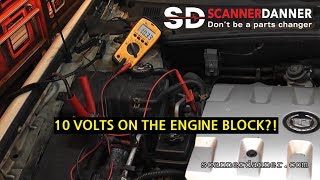
Est. part cost: $150-$300 - Loose or Corroded Battery Terminals/Grounds 🔴 High Probability Vibration and time can loosen connections, while moisture can cause corrosion, interrupting the power supply to the control modules. The main engine-to-frame ground strap is a known failure point on GM vehicles and can cause a host of electrical issues, including a no-start. 🎬 See how a bad engine block ground causes no-crank issues
How to confirm: Visually inspect the battery terminals for white or blue-green powder (corrosion) and physically check if the cable clamps are tight. Follow the main negative cable to the chassis and the engine block ground strap (often a braided cable from the block to the frame) to inspect for corrosion, fraying, or looseness.
Typical fix: Clean the battery terminals and cable ends with a wire brush and baking soda solution. Tighten all connections securely. Replace any corroded or broken ground straps.
Est. part cost: $10-$50 - Failing Alternator or Charging System Issue 🟡 Medium Probability An alternator that produces inconsistent voltage (too high or too low) can disrupt the modules' memory and trigger a P0603 code. This can also overwork and prematurely kill a new battery.
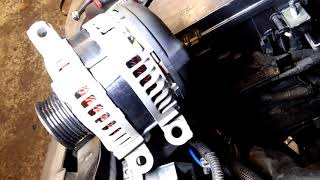
How to confirm: With the engine running, test the voltage at the battery terminals. It should be stable, between 13.5 and 14.5 volts. If it's outside this range or fluctuating wildly, the alternator is suspect. 🎬 Watch: Step-by-step guide to replacing your Cadillac CTS alternator
Typical fix: Replace the alternator.
Est. part cost: $200-$500 - Recent Battery Disconnection ⚪ Low Probability
How to confirm: Ask yourself or your mechanic if the battery has been disconnected recently. Clear the code with a scanner and see if it returns after driving.
Typical fix: Clear the code and drive the vehicle.
Est. part cost: $0
Rare But Worth Checking
- Blown Fuse for PCM/TCM: A blown fuse in the Keep Alive Power (KAPWR) circuit will cause this code instantly. This can happen due to a short in the wiring or a faulty component on that circuit.
- Faulty Powertrain or Transmission Control Module (PCM/TCM): While this is the most expensive possibility, it is also the least likely. The module itself can fail internally, but all other power and ground-related causes must be ruled out first. TSB #PIP4653E notes that if the code is isolated to the TCM and all power/grounds are good, the dealer may need to reprogram the module.
- Aftermarket Performance Tuner: Using an aftermarket programmer to change the vehicle's performance parameters can sometimes trigger a P0603 code if the program conflicts with the PCM's self-test procedures.
Diagnosis Steps
- Read all codes from all modules using an OBD-II scanner. Note if P0603 is present in the ECM, TCM, or both. This is critical as TSB #PIP4653E specifically addresses P0603 in the TCM.
- Ask about recent repairs. Has the battery been disconnected or replaced recently? If so, clear the code and test drive.
- Perform a thorough battery and charging system test. Visually inspect terminals for corrosion and ensure they are tight. Use a multimeter to check battery voltage (should be >12.4V off, 13.5V-14.5V running). Get a load test to confirm battery health.
- Inspect all major ground connections. The battery ground to the chassis and the main engine block-to-frame ground strap are critical. Look for corrosion, looseness, or breaks. A voltage drop test across the ground connections is the most effective way to find a bad ground.
- If all power and ground sources are good, inspect the fuses related to the PCM and TCM constant power circuits in the underhood fuse box.
- If the code persists and is isolated to the TCM, refer to TSB #PIP4653E. The next step may be dealer-level diagnostics and potential reprogramming of the Transmission Control Module.
- If all else fails, the problem may be in the wiring harness providing power to the module or the module itself, which may require professional diagnosis.
Parts You'll Likely Need
- Battery
(OEM #ACDelco Gold 101-6YR (or similar Group 101/H6 battery))— This is the most common cause. An old or weak battery cannot maintain the stable voltage required by the vehicle's control modules. The CTS often uses a Group 101 or H6 battery.
Trusted brands: ACDelco, DieHard, Interstate, Optima
OEM price range: $200-$300
Aftermarket price range: $150-$250 - Alternator
(OEM #23480514)— A faulty alternator provides unstable voltage, causing modules to lose their keep-alive memory. The part number 23480514 is listed for some 2010-2014 CTS models with the 3.6L engine.
Trusted brands: ACDelco, Bosch, Denso
OEM price range: $350-$500
Aftermarket price range: $200-$350 - Battery Cables / Ground Strap — Corroded or damaged terminals/cables create resistance and voltage drops, leading to power interruptions. The main engine ground strap is a common point of failure.
Trusted brands: ACDelco, Standard Motor Products
OEM price range: $50-$150
Aftermarket price range: $20-$80
Related Codes That Often Appear With This One
- P0601, P0604, P062F, P1621 — These are other internal module memory or processor fault codes. GM TSB #PIP4653E and #05-06-04-060A list them as appearing together with P0603, often pointing to a common power supply or module issue that can affect the ECM or TCM.
- U-series codes (e.g., U0101) — U-codes indicate a loss of communication between modules. A power supply issue causing P0603 in the TCM could easily cause it to lose communication with other modules on the CAN bus, triggering related U-codes.
Technical Service Bulletins (TSBs) & Recalls
- PIP4653E: Mentions that DTCs P0601, P0603, P0604, P062F or P1621 can be stored in the Transmission Control Module (TCM) and advises checking which module set the code before proceeding with diagnostics, which may include reprogramming the TCM.
- 05-06-04-060A: Informs technicians that DTCs like P0603 can be shared in multiple modules and that low voltage conditions should be repaired before diagnosing these codes.
Platform-Specific Known Issues
- Per TSB #PIP4653E, this code may be found specifically in the Transmission Control Module (TCM), which may require reprogramming by a dealer if other diagnostics do not resolve the issue. This TSB applies to a wide range of GM vehicles including the 2008-2014 CTS and SRX.
- Per TSB #05-06-04-060A, this code can be shared across multiple modules due to a single electrical event, reinforcing that diagnosis should focus on the central power supply and grounding systems rather than individual modules.
Mechanic-Grade Diagnostic Values
- High-Speed GMLAN Network Resistance — expected: Approximately 60 Ohms. Failure: A reading of 120 Ohms indicates an open circuit or a disconnected module. A reading near 0 Ohms indicates a short between the CAN high and low wires.
- Module Ground Connection Voltage Drop — expected: Less than 0.1 Volts (100 millivolts). Failure: A reading greater than a few tenths of a volt (e.g., >0.2V) under load indicates a high-resistance ground connection that needs to be cleaned or repaired.
Scan Tool Commands That Help
- GDS2/Tech2: Module Programming/Setup — Required if the Transmission Control Module (TCM) or other primary control module is replaced. The new module will not function correctly until it is programmed to the vehicle's specific VIN and configuration.
Wiring & Ground Locations
- G101 — On the lower front of the engine block.. This is a primary ground point for both the Engine Control Module (ECM) and the Transmission Control Module (TCM). A poor connection here can directly cause power interruptions and codes like P0603.
- G103 — On the cowl in the left rear of the engine compartment, above the brake booster.. This ground serves the Body Control Module (BCM), Instrument Panel Cluster (IPC), and the Data Link Connector (DLC). A fault here can cause bizarre electrical symptoms and prevent proper communication for diagnosis.
- TCM Location (2007) — External module located in the engine bay, near the passenger side strut tower.. On first-generation (2007) models with the 5-speed automatic, the TCM is a separate, accessible module. Its external connectors and ground wire are subject to engine bay conditions and should be inspected.
- TCM Location (2008-2014) — Internal to the transmission, part of the Transmission Electro-Hydraulic Control Module (TEHCM).. On second-generation models with the 6-speed automatic, the TCM is inside the transmission pan. This makes a direct module failure more difficult to service and points diagnosis towards external factors like wiring (X1 connector) and power supply first.
- ECM Location (2008-2014) — On the front right valve cover (for 3.6L V6 models).. Knowing the location is essential for inspecting its connectors and nearby wiring harness for damage or corrosion.
- X1 Connector — The main 16-pin electrical connector on the driver's side of the transmission housing.. Multiple GM TSBs identify this connector as a primary failure point for loose, corroded, or unseated terminals, causing a host of communication and module codes, including those related to the TCM.
Model Year Variations Within This Range
- 2007 vs. 2008-2014: The 2007 model is the final year of the first generation, while 2008 marks the start of the second generation, featuring a significant redesign. This impacts the location of key components.
- 2007 (5L40-E trans): The Transmission Control Module (TCM) is a separate, external module located under the hood near the passenger strut tower, making it easier to access for testing or replacement.
- 2008-2014 (6L50/6L80 trans): The Transmission Control Module (TCM) is integrated into the valve body inside the transmission pan (as a TEHCM). This makes external wiring, power, and grounds the primary diagnostic focus before considering a much more involved internal module replacement.
- 2008-2014: The Engine Control Module (ECM) for the common 3.6L V6 is located on the front right valve cover, easily accessible in the engine bay. This differs from some earlier GM models where it was located in the fender well.
Helpful Videos


Used OEM Parts in Stock


New Aftermarket Parts Available


The information in this article is provided for general reference and educational purposes only. Vehicle specifications, procedures, and part compatibility can vary by production date, trim level, and region. Always consult your vehicle's factory service manual and verify part numbers before purchasing or performing repairs. Safety-critical components such as airbags, seat belts, and braking systems should be installed by a qualified professional.
- Cadillac CTS:
- 🎬 Helpful Videos
- 🛍️ Shop This Part
- What's Unique About the 2007-2014 Cadillac CTS
- Diagnostic Flowchart
- Symptoms You May Notice
- Most Likely Causes
- Rare But Worth Checking
- Diagnosis Steps
- Parts You'll Likely Need
- Related Codes That Often Appear With This One
- Technical Service Bulletins (TSBs) & Recalls
- Platform-Specific Known Issues
- Mechanic-Grade Diagnostic Values
- Scan Tool Commands That Help
- Wiring & Ground Locations
- Model Year Variations Within This Range
- 🎟️ Get 5% Off