

P0601 on 2007-2010 GMC Sierra 2500: Internal Module Memory Error Guide
P0601 on a 2007-2010 GMC Sierra 2500 indicates a fatal internal memory error in a control module, most often the Engine Control Module (ECM) or Transmission Control Module (TCM). The fix is almost always replacing the faulty module and having it programmed by a professional. Before replacement, check battery voltage and all power/ground connections, especially the engine-to-chassis ground straps.
- P0601 is a critical code indicating an internal failure of a control module, most often the ECM or TCM.
- Diagnosis must begin with a scan tool to determine WHICH module has set the code.
- Before replacing any module, thoroughly inspect the battery, charging system, and all power/ground connections.
- This is not a DIY repair; the replacement module must be professionally programmed to the vehicle.
What's Unique About the 2007-2010 Gmc SIERRA 2500
On this generation of GMC trucks (GMT900), P0601 is not exclusively an ECM code. Manufacturer Technical Service Bulletins (TSBs) specifically point out that the Transmission Control Module (TCM) is also a known source for this code. Therefore, it's crucial to use a scan tool that can identify which specific module has set the code before assuming the ECM is the culprit. Ignoring this step can lead to replacing the wrong expensive component, a common misdiagnosis.
Diagnostic Flowchart
Tap your situation to follow the diagnostic path that matches what you're seeing on this vehicle.
Symptoms You May Notice
- Check Engine Light is on
- Engine may stall or shut off while driving, sometimes after reaching operating temperature
- Vehicle may not start (no-crank or cranks-but-no-start condition)
- Reduced engine power ('limp mode') message on the dash
- Harsh or erratic transmission shifting if the TCM is the source
- ABS and Traction Control lights may illuminate
- Failure to pass an emissions test
- Replacing the ECM when the TCM was the actual cause. It is critical to use a scan tool to identify which module set the code.
- Immediately replacing a control module without first verifying the battery, charging system, and all power and ground connections are stable and clean. A broken ground wire near the motor mount has been documented as a cause.
Most Likely Causes
- Failed Engine Control Module (ECM) 🔴 High Probability The ECM (ACDelco E38 for this generation) can fail internally from age, heat cycles, and electrical stress, leading to corrupted memory. This is the most frequent cause for a P0601 code and is often called the 'kiss of death' for the module.
How to confirm: After verifying all power and ground circuits to the ECM are good (voltage drop test < 0.5 V) and the battery/charging system is healthy (13.5-14.5V running), a persistent P0601 code that returns immediately after clearing points to internal failure.
Typical fix: Replace the Engine Control Module and have it professionally programmed to the vehicle. A crankshaft position sensor relearn procedure may also be required.
Est. part cost: $300-$800 - Failed Transmission Control Module (TCM) 🟡 Medium Probability GM Technical Service Bulletin #PIP4653E explicitly identifies the TCM as a potential source for the P0601 code on these trucks. The TCM, an ACDelco T43 for 6-speed transmissions, is located inside the transmission pan on some models, where it is subjected to heat and vibration, contributing to failure.
How to confirm: Use a professional-grade scan tool (like a Tech 2 or GDS2) to determine if the P0601 code is stored in the TCM's memory. The TSB directs technicians to verify which module set the code before proceeding.
Typical fix: Replace the Transmission Control Module (which may be part of the valve body assembly, also known as TEHCM) and perform the required programming and setup procedures.
Est. part cost: $250-$700 - Low Voltage or Poor Power/Ground Connections ⚪ Low Probability These trucks are notoriously sensitive to voltage fluctuations. A weak battery, failing alternator, or corroded/loose ground straps can trigger a false P0601. Key ground locations to inspect include G103 (on front of right cylinder head) and G107 (top left rear of engine).
How to confirm: Test the battery to ensure it holds a charge above 12.4V. With the engine running, check alternator output (typically 13.5-14.5V). Perform a voltage drop test on the ECM/TCM power and ground wires and physically inspect all major ground straps for corrosion or looseness, especially the one near the driver's side motor mount.
Typical fix: Charge or replace the battery, replace the alternator, or clean/tighten/replace the faulty ground connections.
Est. part cost: $0-$400
Rare But Worth Checking
- Corrupted Software from Aftermarket Tuning: If the truck has a performance tune, an error during the programming process or a bug in the tune itself can corrupt the module's memory. Reverting to the stock OEM software is a crucial diagnostic step.
- Voltage Spike from Improper Jump-Start: Connecting jumper cables incorrectly or using a high-voltage industrial booster can create a voltage surge that permanently damages sensitive electronics like the ECM or TCM, leading to an immediate P0601 code.
Diagnosis Steps
- Check the battery. Ensure it is fully charged (12.4-12.6V engine off) and that the terminals are clean and tight. Load test the battery to confirm its health.
- Use a professional-grade scan tool to confirm which module (ECM, TCM, etc.) has stored the P0601 code. This is the most critical diagnostic step.
- Inspect all power and ground connections to the identified module. Check for loose wires, corrosion, or damage. Pay special attention to the main engine block and chassis ground straps (G103, G104, G107).
- Perform a voltage drop test on the primary power and ground circuits for the suspect module. Any reading over 0.5 volts indicates a problem that needs to be addressed.
- Check for any blown fuses related to the ECM or TCM. In the underhood fuse block, this may include fuses related to the powertrain or engine control circuits.
- If the vehicle has an aftermarket tune, flash it back to the stock OEM program and see if the code returns.
- If the code returns immediately after clearing and all external factors (power, grounds, fuses, software) have been ruled out, the control module itself is faulty and must be replaced.
Parts You'll Likely Need
- Engine Control Module (ECM)
(OEM #12633238)— This is the most common component to fail and cause a P0601 code. The internal memory becomes corrupted, failing its self-check. The specific model for this platform is the ACDelco E38.
Trusted brands: ACDelco
OEM price range: $400-$800
Aftermarket price range: $300-$600 - Transmission Control Module (TCM)
(OEM #24256939)— GM TSBs confirm this module can also set the P0601 code. If diagnosis points to the transmission computer, it must be replaced. The model for the 6-speed automatic is often the ACDelco T43.
Trusted brands: ACDelco
OEM price range: $350-$700
Aftermarket price range: $250-$500
Related Codes That Often Appear With This One
- P0700 — Transmission Control System (MIL Request). This is a generic code indicating the TCM has stored a fault. It is very common to see P0700 alongside P0601 when the TCM is the source of the failure.
- P0603 — Internal Control Module Keep Alive Memory (KAM) Error. This code is often seen with P0601 as it also relates to module memory integrity. TSB #PIP4653E lists them together.
- P0604 — Internal Control Module Random Access Memory (RAM) Error. Another internal memory fault code that can accompany P0601, as noted in TSB #PIP4653E.
- P1621 — Control Module Long Term Memory Performance. This GM-specific code also points to a memory issue within a control module and is cited alongside P0601 in TSBs.
Technical Service Bulletins (TSBs) & Recalls
- PIP4653E: Notes that DTCs P0601, P0603, P0604, P062F or P1621 can be stored in the Transmission Control Module (TCM). It instructs technicians to use a scan tool (Tech 2 or GDS2) to verify which module set the code before reprogramming or replacement.
- 05-06-04-060A: An informational bulletin that communicates to technicians that control module DTCs including P0601 can be shared in multiple modules.
Platform-Specific Known Issues
- Owner Experience: Intermittent Stalling and Ground Wire Connection: In a YouTube video by Phillip Bailey featuring a 2011 GM truck with a P0601 and stalling issues, the mechanic noted that wiggling the ground wires near the driver's side motor mount caused the code to reset. This highlights the sensitivity of these trucks to ground integrity and provides a specific physical location to check during diagnosis before condemning a module.
- Owner Experience: Aftermarket Tune Complication: A user on the DiabloSport forums with an 11' Sierra experienced repeated P0601 codes and engine shutdowns only when a performance tune was active. While returning to the stock tune provided a temporary fix, the ECM eventually failed completely and required replacement, suggesting the tune may have exposed or accelerated a pre-existing hardware fault in the module.
Mechanic-Grade Diagnostic Values
- Battery Voltage (Engine Off) — expected: 12.4V - 12.6V. Failure: Below 12.4V indicates a weak or discharged battery which can cause false codes.
- Charging System Voltage (Engine Running) — expected: 13.5V - 14.5V. Failure: Voltage outside this range indicates a faulty alternator or regulator, which can cause voltage spikes or drops that damage modules.
- ECM Power/Ground Circuit Voltage Drop — expected: < 0.5V. Failure: A voltage drop greater than 0.5V on a power or ground wire under load indicates high resistance in the circuit that must be repaired.
- ECM Ground Strap Resistance — expected: < 0.1 Ω. Failure: Resistance higher than 0.1 Ω between the ground point and the battery negative terminal indicates a poor ground connection.
Scan Tool Commands That Help
- GDS2 / Tech 2: Module Identification — This is the first and most critical step to determine which module (ECM, TCM, etc.) has actually stored the P0601 code, as directed by GM TSBs.
- GDS2 / Tech 2: Service Programming System (SPS) — Required after replacing the ECM or TCM to load the correct VIN-specific software and operating system onto the new module.
- GDS2 / Tech 2 / High-End Aftermarket Scanner: Crankshaft Position System Variation Learn (P0315 Relearn) — This procedure is almost always required after replacing the ECM. Failure to perform the relearn will result in a P0315 code and a persistent Check Engine Light.
Wiring & Ground Locations
- G103 — On the front of the right cylinder head.. This is a primary engine ground point. Corrosion or looseness here can disrupt power to critical components, including the ECM.
- G104 — On the front of the left cylinder head.. Another key engine ground. Both G103 and G104 provide the main ground path for the engine's electrical system.
- G107 — Top left rear of the engine.. This ground is crucial for various sensors and systems that communicate with the ECM/TCM. A poor connection can cause erratic data and trigger fault codes.
- G108 — On the left side of the firewall.. This is a major body-to-chassis ground point. A bad connection here can cause a host of seemingly unrelated electrical issues.
- ECM Connector X1 — The main connector block on the Engine Control Module, often color-coded (e.g., blue or black insert).. Pin 20 (RD/WH wire) is a primary Battery Positive Voltage feed, and Pin 19 (PK wire) is an Ignition 1 Voltage feed. These pins must be tested for correct voltage during diagnosis.
Real Owner Repair Stories
- EFILive Forum user (2009 Pontiac G8 (uses similar E38 ECM)) — Vehicle was tuned by a shop that closed. Customer wanted a new tune, but the old one was locked.
❌ Tried (didn't work) Customer supplied a new ECM (P/N 12625455). A GM dealer installed it and flashed it to stock. The new tune would not load because the VIN showed as all zeros.
✅ What actually fixed it It was discovered the dealer had flashed the wrong model year OS to the ECM. The original ECM was a different part number (12612384). The fix required getting the correct ECM part number for the vehicle and having it programmed with the correct OS, highlighting the critical importance of matching part numbers and software.
OEM Part Supersession History
12597121, 12612384, 12625455→12633238— Standard GM part consolidation and minor hardware/firmware revisions over the production run.
Heads up: While 12633238 is a common service replacement, it is critical to ensure the correct Operating System (OS) for the specific vehicle's model year is flashed. Flashing a 2009 OS onto an ECM intended for a 2008 vehicle can render the module unusable ('bricked').24241873, 24251029→24256939— Revisions to address reliability and performance of the T43 TCM.
Heads up: Part numbers for the T43 TCM are grouped by year ranges (e.g., '07-'13). Using a module from a different year group may cause communication or programming failures. Always verify compatibility by VIN.
Model Year Variations Within This Range
- 2007.5-2010: The 2007 model year was a split. The early 2007 'Classic' models were on the old GMT800 platform. The new body style 'GMT900' trucks were introduced mid-year as '2007.5' models and featured the new LMM Duramax engine (if diesel-equipped), which replaced the LBZ. The LMM introduced a Diesel Particulate Filter (DPF) and other emissions changes, which can affect engine diagnostics and performance.
- 2007: Early 2007 LMM Duramax models were noted to have some issues with glow plugs and initial ECM calibrations that were later refined.
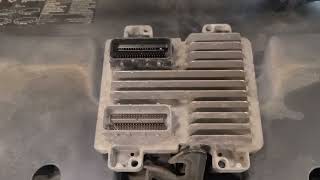
Helpful Videos
Used OEM Parts in Stock


New Aftermarket Parts Available




The information in this article is provided for general reference and educational purposes only. Vehicle specifications, procedures, and part compatibility can vary by production date, trim level, and region. Always consult your vehicle's factory service manual and verify part numbers before purchasing or performing repairs. Safety-critical components such as airbags, seat belts, and braking systems should be installed by a qualified professional.
- Gmc SIERRA 2500:
- 🎬 Helpful Videos
- 🛍️ Shop This Part
- What's Unique About the 2007-2010 Gmc SIERRA 2500
- Diagnostic Flowchart
- Symptoms You May Notice
- Most Likely Causes
- Rare But Worth Checking
- Diagnosis Steps
- Parts You'll Likely Need
- Related Codes That Often Appear With This One
- Technical Service Bulletins (TSBs) & Recalls
- Platform-Specific Known Issues
- Mechanic-Grade Diagnostic Values
- Scan Tool Commands That Help
- Wiring & Ground Locations
- Real Owner Repair Stories
- OEM Part Supersession History
- Model Year Variations Within This Range
- 🎟️ Get 5% Off