

P0558 on 2017-2021 Cadillac XT5: Brake Booster Pressure Sensor Circuit High Causes and Fixes
This code indicates a problem with the brake booster pressure sensor, often causing a 'Service Power Brake Assist' message and a hard brake pedal. The most common fix is replacing the faulty sensor itself. A GM Technical Service Bulletin (TSB #20-NA-071) exists for this exact issue, which points to a known problem with the sensor's wiring circuit and prescribes replacing a hose and harness assembly.
- P0558 on a 2017-2021 Cadillac XT5 almost always points to a faulty brake booster pressure sensor circuit, a known issue addressed by GM.
- Key symptoms are a hard brake pedal and a 'Service Power Brake Assist' warning light.
- A GM Technical Service Bulletin (20-NA-071) exists for this specific problem, identifying the cause as wiring-related (EMI/tension) and prescribing a hose and harness replacement, not just a sensor swap.
- This is a safety-critical repair; professional service is highly recommended due to the involvement of the braking system and ECM wiring.
What's Unique About the 2017-2021 Cadillac XT5
For the 2017-2021 Cadillac XT5 and its platform mates, this code is common enough that General Motors issued a specific Technical Service Bulletin (TSB #20-NA-071). The bulletin indicates the cause is likely not just a failed sensor, but rather "poor terminal tension at the B19B Brake Booster Vacuum Sensor and/or the wiring from the brake vacuum sensor to the Engine Control Module (ECM)" which may be susceptible to electromagnetic interference (EMI). The official fix involves replacing the power brake booster vacuum hose and installing a new, separate wiring harness to resolve the underlying circuit issue.
Diagnostic Flowchart
Tap your situation to follow the diagnostic path that matches what you're seeing on this vehicle.
Symptoms You May Notice
- Check Engine Light is on.
- "Service Power Brake Assist" message on the instrument cluster.
- Brake pedal is hard to press or requires more effort than usual.
- Intermittent loss of power brake assist.
- Hissing sound from the brake booster area.
- ABS or Electronic Stability Control (ESC) warning lights may also appear.
- Replacing the entire brake booster when only the sensor circuit is faulty. The sensor and its related components are serviceable separately from the booster itself.
- Replacing only the brake booster pressure sensor without performing the full TSB #20-NA-071 repair. The issue may return if the underlying wiring/EMI problem is not addressed with the new harness.
Most Likely Causes
- Faulty Brake Booster Pressure Sensor Circuit 🔴 High Probability A known issue acknowledged by GM through TSB #20-NA-071 points to a design flaw. The bulletin suggests the cause is poor terminal tension and/or electromagnetic interference (EMI) in the engine harness affecting the sensor's signal.
How to confirm: Using a scan tool, monitor the live data for the brake booster pressure sensor voltage. If the voltage is stuck at a high value (typically near 5 volts) and does not change, it confirms a circuit high fault. The TSB is the primary confirmation of this being a known platform issue.
Typical fix: Per TSB #20-NA-071, the fix is to replace the power brake booster vacuum hose and install a new external wiring harness that splices into the ECM. This is more involved than just replacing the sensor.
Est. part cost: $100-$200 for the hose and harness kit. - Wiring or Connector Issue 🟡 Medium Probability The TSB specifically calls out poor terminal tension at the sensor connector as a primary cause, separate from a damaged harness from external factors.
How to confirm: Visually inspect the wiring harness and connector going to the sensor for any signs of damage, corrosion, or loose connections. Use a multimeter to check for a short to voltage on the signal wire. However, the issue may be internal to the harness or related to EMI, which is difficult to confirm visually.
Typical fix: If damage is found, repair the specific wiring or clean/replace the connector. If no visible damage is found, the TSB repair (hose and harness replacement) is the recommended procedure.
Est. part cost: $5-$50 for simple repairs, or the cost of the TSB kit.
Rare But Worth Checking
- Failing or Weak Battery: On modern vehicles like the XT5 with auto start/stop, a weak battery can cause low voltage conditions during engine restart, triggering a variety of seemingly unrelated error messages, including 'Service Brake Assist'. An owner reported that replacing a weak AGM battery, which passed a simple test but failed an extended load test, resolved these warnings.
- Engine Control Module (ECM) Failure: This is very rare, but a faulty ECM could misinterpret the sensor's signal. This should only be considered after the sensor and its entire circuit have been thoroughly tested and proven to be good per the TSB.
- Brake Booster Vacuum Leak: While a vacuum leak is a possible cause, it would more commonly trigger a P0557 (Circuit Low) code. However, an intermittent or unusual leak could potentially cause erratic sensor readings.
Diagnosis Steps
- Connect an OBD-II scanner and confirm that P0558 is present. Note any other codes.
- First, check the vehicle's battery health. A weak battery can cause various electrical faults on this platform.
- Check for Technical Service Bulletins (TSBs). TSB #20-NA-071 is directly related to this code on this vehicle and outlines the most likely cause and repair.
- With the scanner, view the live data stream for the Brake Booster Pressure Sensor. The voltage should be within the manufacturer's specified range and react to changes in brake pedal application. A reading stuck high (near 5V) points to the fault.
- Perform a visual inspection of the sensor, its connector, and the wiring harness for any obvious damage, corrosion, or loose connections. The sensor is typically located on the brake booster or in the vacuum line leading to it.
- If no obvious damage is found, the recommended procedure is to follow TSB #20-NA-071, which involves replacing the vacuum hose assembly and installing a new dedicated wiring harness for the sensor.
- If you choose to test the circuit manually, disconnect the sensor and check the connector terminals for 5V reference voltage and a good ground from the ECM. Check the signal wire for a short to power.
- After repairs, clear the DTCs and perform a test drive to ensure the fault does not return.
Parts You'll Likely Need
- Power Brake Booster Vacuum Hose and Harness Kit
(OEM #Varies by engine (LGX/LFY/LCV). Refer to TSB #20-NA-071 for specific kit part numbers.)— This is the official repair prescribed by GM in TSB #20-NA-071 to fix the root cause of the P0558 code, which is often related to wiring and EMI, not just a faulty sensor.
Trusted brands: GM Genuine Parts
OEM price range: $100-$200
Aftermarket price range: N/A
Related Codes That Often Appear With This One
- P0557 — P0557 is for 'Brake Booster Pressure Sensor Circuit Low'. These codes are often linked in service literature (like TSB #20-NA-071) because they relate to the same sensor, indicating either a low or high signal fault within the same system.
Technical Service Bulletins (TSBs) & Recalls
- 20-NA-071: Addresses a customer concern of the Service Engine Soon Lamp illuminated and/or Service Power Brake Assist message displayed, with DTCs P0557 or P0558 Stored. The cause is identified as potential EMI or poor terminal tension, and the fix is to replace the power brake booster vacuum hose and install a new external wiring harness.
Platform-Specific Known Issues
- GM Technical Service Bulletin #20-NA-071 was issued to address DTC P0558 (and P0557). It states the cause may be 'potential for EMI in the engine harness negatively impacting the signal from the vacuum sensor' or 'poor terminal tension'. The fix is to install a new hose assembly and an external wiring harness.
Mechanic-Grade Diagnostic Values
- Brake Booster Pressure Sensor Live Data Voltage (Scan Tool) — expected: With the pedal at rest, the sensor voltage should be near 0 V. Voltage should rise proportionally as the pedal is depressed.. Failure: A reading stuck at a high value, near 5V, indicates a 'Circuit High' fault.
- Engine Vacuum at Brake Booster Supply Hose — expected: 18-21 inches of Hg at idle.. Failure: A reading below 18 inches of Hg may indicate an engine vacuum issue or a leak in the supply hose, rather than a sensor fault.
Scan Tool Commands That Help
- GM GDS2 (Global Diagnostic System 2): Data Display > Brake System Data > Brake Booster Vacuum Sensor — This is the primary function used to monitor live voltage/pressure readings from the sensor to see if it's stuck high, as described in the diagnostic steps.
- GM GDS2 (Global Diagnostic System 2): Control Functions — While there isn't a specific bidirectional command for the vacuum sensor itself, GDS2's control functions allow technicians to activate other related components in the braking and engine systems to rule out cascading failures.
Wiring & Ground Locations
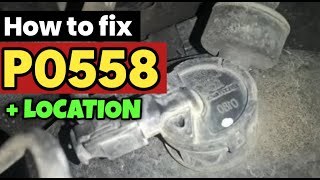
- B19B Brake Booster Vacuum Sensor — Located on the power brake booster vacuum hose, between the intake manifold and the brake booster itself.. This is the sensor that generates the signal. TSB #20-NA-071 identifies poor terminal tension at this sensor's connector as a primary cause of the fault.
- ECM Connector X1 (for LGX/LFY V6 Engines) — On the Engine Control Module (ECM).. The TSB repair requires re-pinning the sensor wires at this connector. The original wires are at pins 44 (Ground), 45 (Signal), and 65 (5V Reference). The new harness routes the new wires to these same locations.
- Circuit 6032 (BK/YE wire) — At ECM connector X1, pin 44 for V6 engines.. This is the original ground circuit for the sensor. The TSB explicitly states that multiple ground circuits are tied to this wire. The repair requires cutting this wire and splicing the ECM side, the harness side, and the new ground wire from the new TSB harness together to maintain proper grounding for all systems.
OEM Part Supersession History
Original integrated engine harness wiring→Varies by engine. TSB 20-NA-071 lists specific kit part numbers for LGX, LFY, and LCV engines.— The original wiring design was susceptible to poor terminal tension and/or electromagnetic interference (EMI).
Heads up: The fix is not just a new sensor, but a new vacuum hose assembly and a dedicated, externally-routed wiring harness that bypasses the problematic section of the original engine harness.
Helpful Videos
We Have This Part in Stock


The information in this article is provided for general reference and educational purposes only. Vehicle specifications, procedures, and part compatibility can vary by production date, trim level, and region. Always consult your vehicle's factory service manual and verify part numbers before purchasing or performing repairs. Safety-critical components such as airbags, seat belts, and braking systems should be installed by a qualified professional.
- Cadillac XT5:
- 🎬 Helpful Videos
- 🛍️ Shop This Part
- What's Unique About the 2017-2021 Cadillac XT5
- Diagnostic Flowchart
- Symptoms You May Notice
- Most Likely Causes
- Rare But Worth Checking
- Diagnosis Steps
- Parts You'll Likely Need
- Related Codes That Often Appear With This One
- Technical Service Bulletins (TSBs) & Recalls
- Platform-Specific Known Issues
- Mechanic-Grade Diagnostic Values
- Scan Tool Commands That Help
- Wiring & Ground Locations
- OEM Part Supersession History
- 🎟️ Get 5% Off