

P0557 on 2017-2021 GMC Acadia: Brake Booster Pressure Sensor Circuit Low Fixes
On a 2017-2021 GMC Acadia, P0557 is almost always caused by a known issue with the brake booster vacuum sensor's wiring or the sensor itself. A GM Technical Service Bulletin (TSB) recommends replacing the vacuum hose assembly and installing a revised wiring harness. Expect a shop to charge between $250 and $500 for this specific repair.
- P0557 on a 2017-2021 Acadia is a serious safety issue indicating a problem with your power brakes.
- The cause is very likely a known issue covered by GM Technical Service Bulletins #20-NA-071 or #21-NA-107.
- Do not simply replace the sensor; the official fix involves replacing the vacuum hose/pipe assembly and potentially installing a new wiring harness.
- Driving the vehicle is not recommended due to the potential for increased stopping distances and a hard brake pedal.
- This repair is best left to a professional technician who is aware of the specific TSBs for this vehicle.
What's Unique About the 2017-2021 Gmc ACADIA
The 2017-2021 GMC Acadia and its C1XX platform mates have specific, well-documented issues that trigger code P0557. One is related to electrical interference (EMI) and poor terminal tension in the engine wiring harness affecting the sensor's signal. Another known cause is an inconsistent electrical current during auto start/stop engine cranking, which can overwhelm the original sensor. General Motors has issued multiple technical service bulletins (TSBs) with specific part numbers and procedures to address these exact problems, making the diagnosis on this platform more direct than on other vehicles.
Diagnostic Flowchart
Tap your situation to follow the diagnostic path that matches what you're seeing on this vehicle.
Symptoms You May Notice
- "Service Power Brake Assist" message on the dashboard.
- Check Engine Light (Service Engine Soon lamp) is on.
- Brake pedal is hard to press.
- Noticeably longer stopping distances.
- Brake warning light may be illuminated.
- A brake shudder may be felt during braking.
- Replacing the entire power brake booster when the actual fault is with the much cheaper sensor, a vacuum hose, or the wiring harness.
Most Likely Causes
- Faulty Wiring Harness or Poor Terminal Connection 🔴 High Probability Per TSB #20-NA-071, the engine harness is susceptible to electrical interference (EMI) and poor terminal tension at the B19B Brake Booster Vacuum Sensor connector, leading to a low voltage signal.
How to confirm: A technician will follow the diagnostic steps outlined in the TSB, which involve inspecting the harness and installing an overlay harness. The old wiring from the sensor is cut and abandoned.
Typical fix: Install a new external wiring harness (Part No. 84733328) and replace the power brake booster vacuum hose as a unit, per TSB instructions. This involves running new wires from the sensor to the ECM and splicing them in.
Est. part cost: $70-$150 - Faulty Brake Booster Pressure Sensor 🔴 High Probability Per TSB #21-NA-107, the original sensor may not be robust enough to handle electrical in-rush current variations during auto start/stop events, causing it to fail or send incorrect signals. TSB 17-NA-314 also points to an internal circuit board fault in the sensor.
How to confirm: Test the sensor's voltage output with a multimeter; a reading below the specified range (typically under 0.5V) with good vacuum points to a failed sensor. However, given the TSBs, replacing the sensor as part of the hose assembly is the recommended path.
Typical fix: Replace the power brake booster vacuum pipe which includes an updated, more robust sensor. The part number varies by engine, for example, GM Part #84298056 was specified for the 2018 Traverse. TSB 21-NA-107 lists multiple updated part numbers like 84974392 (LHD & LYX engine).
Est. part cost: $100-$180 - Vacuum Leak 🟡 Medium Probability
How to confirm: Visually inspect all vacuum hoses connected to the brake booster for cracks, brittleness, or disconnection. A smoke machine test can definitively identify hard-to-see leaks. A hissing sound near the booster with the engine running is a strong indicator.
Typical fix: Replace the cracked or leaking vacuum hose.
Est. part cost: $20-$60
Rare But Worth Checking
- Failed Brake Booster: While possible, this is less common than the sensor or wiring issues. A failed internal diaphragm in the booster can cause a total loss of vacuum, leading to a P0557 code. This is usually accompanied by a loud hissing sound from the driver's footwell when the brake is applied.
- Faulty Engine Control Module (ECM): This is extremely rare. The ECM is the last item to suspect after all other possibilities, including wiring, sensor, and vacuum system, have been thoroughly tested and ruled out.
Diagnosis Steps
- Scan the vehicle's computer system to confirm P0557 is the active code and check for any other related codes, like P0558 or C025E.
- Check for any applicable Technical Service Bulletins (TSBs). For this vehicle, TSBs #20-NA-071, #21-NA-107, and #17-NA-314 are highly relevant.
- Visually inspect the brake booster pressure sensor's electrical connector and wiring harness for any signs of damage, corrosion, or looseness.
- With the engine running, listen for any hissing sounds around the brake booster and its vacuum hoses that would indicate a leak.
- If a TSB-related repair has not been performed, follow the manufacturer's procedure. TSB #20-NA-071 instructs the technician to cut the original sensor connector off, tape the wires, and abandon them. A new overlay harness is then run and spliced into the ECM connector.
- Simultaneously, replace the power brake booster vacuum hose/pipe assembly with the updated part number specified in the TSBs.
- If TSBs do not apply or have been performed, test the sensor circuit. Check for the correct reference voltage (usually 5V) and a good ground at the sensor connector. A three-wire sensor will have a 5V reference, ground, and a variable voltage signal wire.
- Measure the sensor's signal voltage with a vacuum gauge connected. The voltage should change smoothly with the vacuum level. A static low voltage indicates a faulty sensor or a major leak.
- Clear the trouble code and perform a test drive with several braking events to ensure the repair was successful and the code does not return.
Parts You'll Likely Need
- Power Brake Booster Vacuum Hose with Sensor
(OEM #Varies by TSB/engine, e.g., 84298056, 84974392, 84974393)— This is the primary fix recommended by GM TSBs #17-NA-314 and #21-NA-107 to resolve known issues with internal sensor faults and robustness against electrical variations.
Trusted brands: ACDelco, GM Genuine Parts
OEM price range: $100-$180
Aftermarket price range: $80-$150 - Overlay Wiring Harness
(OEM #84733328)— TSB #20-NA-071 specifies installing this new external harness to bypass the original wiring that is prone to electrical interference and poor connections.
Trusted brands: GM Genuine Parts
OEM price range: $50-$100
Related Codes That Often Appear With This One
- P0558 — This code means 'Brake Booster Pressure Sensor Circuit High'. Both P0557 and P0558 are cited in TSB #20-NA-071 as resulting from the same wiring and sensor issues, indicating an erratic signal.
- C025E — This code for 'Brake Booster Vacuum Sensor Circuit' is also mentioned in TSB 17-NA-314 (revised) as being related to the same faulty sensor issue.
Technical Service Bulletins (TSBs) & Recalls
- 20-NA-071: Service Engine Soon Lamp Illuminated and/or Service Power Brake Assist Message Displayed, with DTCs P0557 or P0558 Stored.
- 21-NA-107: Malfunction Indicator Lamp Illuminated And/or Service Brake Assist Message Displayed, With DTC P0557 Stored.
- 17-NA-314: Intermittent Service Power Brake Assist Message With a Brake Shudder and Possible DTC P0557 Set/Stored.
Platform-Specific Known Issues
- TSB #20-NA-071: Addresses this exact code (along with P0558) caused by poor terminal tension and/or electrical interference in the engine harness. The fix is to replace the vacuum hose and install a new, separate wiring harness (Part #84733328) for the sensor.
- TSB #21-NA-107: Also addresses P0557, noting that inconsistent current during auto start/stop events can cause the fault. The fix is to replace the vacuum pipe with a version containing a more robust sensor.
- TSB #17-NA-314: An earlier bulletin for the 2018 Traverse (a platform mate) that identified the cause as the sensor providing intermittent incorrect vacuum values due to an internal circuit board fault.
Mechanic-Grade Diagnostic Values
- Brake Booster Pressure Sensor 5V Reference Voltage — expected: 4.9V to 5.1V. Failure: Voltage outside this range indicates a problem with the ECM or wiring, not necessarily the sensor.
- Brake Booster Pressure Sensor Signal Voltage — expected: Typically ~5V with engine off (no vacuum) and drops towards ~0.5V with engine running (full vacuum).. Failure: A constant voltage below 1V, or a reading of 0.3V or less for more than 2 seconds, indicates a sensor or circuit failure.
Scan Tool Commands That Help
- GDS2 / Professional Scan Tool: Read Brake Booster Pressure Sensor Input via PCM/ABS Module — Use this bidirectional control to compare the voltage value the control module is reporting to the actual voltage measured at the sensor with a multimeter. A discrepancy points to a problem with the module or wiring, rather than the sensor itself.
Wiring & Ground Locations
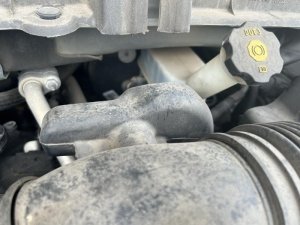
- B19B — The Brake Booster Vacuum Sensor itself, mounted on the power brake booster vacuum hose/pipe in the engine bay.. This is the sensor that generates the signal. TSBs identify poor terminal tension at its connector as a primary cause of the code.
- ECM Connector X1 (Blue) — On the Engine Control Module (ECM) in the engine bay.. For V6 (LGX/LFY) engines, this connector houses all three circuits for the brake booster sensor at pins 44 (Ground), 45 (Signal), and 65 (5V Reference). The TSB #20-NA-071 overlay harness is wired directly to these pins.
- ECM Connector X3 — On the Engine Control Module (ECM) in the engine bay.. For 4-Cylinder (LCV) engines, this connector houses the Signal and Ground circuits at pins 15 and 20, respectively. The 5V reference is in connector X1 at pin 32.
- Circuit #2151 (Ground) — A Black/White wire running to pin 44 of ECM connector X1 (on V6 models).. This is the sensor's ground circuit. TSB #20-NA-071 explicitly states this ground is shared with other components and must be carefully cut and spliced with the new overlay harness and the original ECM pin lead. An improper splice will cause other issues.
OEM Part Supersession History
13388368, 84259588, 84361879→84974392— Updated, more robust sensor design to address intermittent incorrect vacuum values and susceptibility to electrical variations, per TSBs 17-NA-314 and 21-NA-107.
Model Year Variations Within This Range
- 2017-2021: The ECM pin locations for the B19B Brake Booster Vacuum Sensor vary between V6 (LGX, LFY) and 4-Cylinder (LCV) engines per TSB #20-NA-071. V6 uses pins 65, 45, 44 in connector X1. The LCV uses pin 32 in X1 and pins 15, 20 in connector X3.
We Have This Part in Stock


The information in this article is provided for general reference and educational purposes only. Vehicle specifications, procedures, and part compatibility can vary by production date, trim level, and region. Always consult your vehicle's factory service manual and verify part numbers before purchasing or performing repairs. Safety-critical components such as airbags, seat belts, and braking systems should be installed by a qualified professional.
- Gmc ACADIA:
- 🛍️ Shop This Part
- What's Unique About the 2017-2021 Gmc ACADIA
- Diagnostic Flowchart
- Symptoms You May Notice
- Most Likely Causes
- Rare But Worth Checking
- Diagnosis Steps
- Parts You'll Likely Need
- Related Codes That Often Appear With This One
- Technical Service Bulletins (TSBs) & Recalls
- Platform-Specific Known Issues
- Mechanic-Grade Diagnostic Values
- Scan Tool Commands That Help
- Wiring & Ground Locations
- OEM Part Supersession History
- Model Year Variations Within This Range
- 🎟️ Get 5% Off