

P0556 on 2016-2021 Volkswagen Golf: Causes and Fixes for the Brake Booster Sensor
On a 2016-2021 VW Golf (MQB platform), code P0556 almost always points to a failed brake booster pressure sensor (Part No. 5Q0906207). This is a very common failure causing a Check Engine Light and sometimes a hard brake pedal. For 2016-2017 models, a dealer software update (TSB 2045383) should be checked for first. Otherwise, the sensor itself is relatively inexpensive ($40-$80) and can be replaced in under 30 minutes.
- P0556 on a 2016-2021 Golf indicates a problem with the brake booster pressure sensor circuit, which is critical for power-assisted braking.
- The most common cause by far is a failed brake booster pressure sensor, part number 5Q0906207 (or its revisions).
- For 2016-2017 models, a software update (TSB 2045383) may be the required fix and should be investigated before replacing parts.
- Symptoms include a Check Engine Light and potentially a hard brake pedal, which is a significant safety concern.
- The repair is generally simple and inexpensive, often involving the replacement of the sensor located on the brake booster vacuum line.
- This issue is common across the entire VW/Audi MQB platform, including the Jetta, Tiguan, and Audi A3.
What's Unique About the 2016-2021 Volkswagen GOLF

The Mk7 generation of the Volkswagen Golf and its siblings on the MQB platform (like the Jetta, Tiguan, and Audi A3) are known for a very high failure rate of the brake booster pressure sensor. While vacuum leaks or wiring can cause this code, the sensor itself is the most frequent point of failure. Owners often report this issue appearing without any other symptoms besides the check engine light, though a hard brake pedal can also occur, sometimes triggered by a single hard-braking event.
Diagnostic Flowchart
Tap your situation to follow the diagnostic path that matches what you're seeing on this vehicle.
Symptoms You May Notice
- Check Engine Light is on
- Brake pedal feels hard or requires more effort to press.
- Increased stopping distance.
- Hissing noise from the brake booster area, indicating a vacuum leak.
- Intermittent pedal feel, where it may shift between normal and hard.
- Check Engine Light appears immediately after a hard braking event.
- Replacing the entire brake booster when only the small, external pressure sensor has failed.
- Replacing the master cylinder, which is unrelated to the vacuum assist system.
- Replacing the sensor on a 2016-2017 model without first checking if the TSB software update is the actual required fix.
Most Likely Causes

- Failed Brake Booster Pressure Sensor 🔴 High Probability This specific sensor is a widely documented common failure part on the VW/Audi MQB platform. The sensor's internal electronics can fail and send a corrupted digital signal to the ECM.
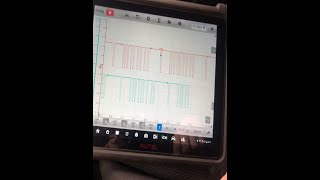
How to confirm: After visually inspecting for vacuum leaks, the most common diagnostic step is to replace the sensor. Advanced diagnosis with an oscilloscope can show a malformed digital signal compared to a new sensor, even when OBD-II live data appears to respond correctly. 🎬 Watch: A diagnostic summary of the P0556 sensor failure.
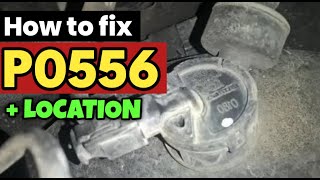
Typical fix: Replace the brake booster pressure sensor. It is located directly on the brake booster or on the main vacuum line connected to it.
Est. part cost: $40-$80 - Outdated ECM Software (2016-2017 models) 🟡 Medium Probability A specific TSB (01-16-22 / 2045383) was issued because the original ECM software was too sensitive, leading to false P0556 codes.
How to confirm: A VW dealer can check if the vehicle's VIN falls within the affected range (AJ_GM000001 to AJ_HM272378) and if the software update has been applied.
Typical fix: The dealer performs a software update (reflash) of the Engine Control Module.
Est. part cost: $0 if under warranty, otherwise dealer labor charge for flashing (approx. $150-$250). - Vacuum Leak 🟡 Medium Probability Vacuum hoses can become brittle and crack. In some cases, the entire vacuum pipe assembly, which includes the sensor port, may have a hairline crack from rubbing against other components.
How to confirm: Visually inspect all vacuum hoses connected to the brake booster for cracks, swelling, or loose connections. A professional can use a smoke machine to find leaks that are not visible.
Typical fix: Replace the cracked or leaking vacuum hose or the entire vacuum pipe assembly.
Est. part cost: $20-$150 - Damaged Wiring or Connector ⚪ Low Probability
How to confirm: Visually inspect the sensor's electrical connector and wiring for any signs of corrosion, damage, or loose pins. Use a multimeter to check for proper voltage (typically 0.5V-4.5V range) and ground at the connector.
Typical fix: Repair the damaged section of wiring or replace the connector pigtail.
Est. part cost: $10-$50
Rare But Worth Checking
- Faulty Engine Control Module (ECM): This is extremely rare. All other possibilities, especially the sensor and vacuum lines, should be thoroughly ruled out before considering the ECM as the cause. In one documented case, an aftermarket part may have damaged the ECM, requiring replacement.
- Internal Brake Booster Failure: The booster itself can develop an internal diaphragm leak, but this is much less common than the external sensor failing.
Diagnosis Steps
- Read the fault codes with an OBD-II scanner to confirm P0556 is present.
- For 2016-2017 models, check with a dealer if TSB 2045383 applies to your VIN and has been performed. This should be the first step for these model years.
- Visually inspect the brake booster pressure sensor, its connector, and the associated vacuum lines for any obvious signs of damage, cracking, or rubbing against other components.
- With the engine running, listen for any hissing sounds around the brake booster and vacuum lines, which would indicate a leak.
- If a vacuum leak is suspected but not visible, a smoke test is the most effective way to pinpoint its location.
- If no leaks or software issues are found, the next logical step is to replace the brake booster pressure sensor due to its high failure rate on this platform.
- After replacing the sensor, clear the fault code and perform a test drive, applying the brakes several times to see if the code returns.
- If the code persists, perform electrical checks on the sensor's circuit. Check for 5V reference, good ground, and a signal voltage that changes with vacuum (typically 0.5V at full vacuum to 4.5V at atmospheric pressure). For definitive diagnosis, an oscilloscope is needed to verify the integrity of the sensor's digital communication packets.
Parts You'll Likely Need

- Brake Booster Pressure Sensor
(OEM #5Q0906207 / Superseded by 5Q0906207A, 5Q0906207B)— This is the most common part to fail and cause the P0556 code on the Mk7 Golf.
Trusted brands: Bosch, Hella, Genuine Volkswagen
OEM price range: $60-$90
Aftermarket price range: $30-$60 - Brake Booster Vacuum Pipe
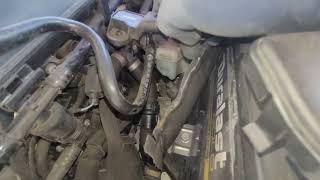
(OEM #1K0612041LG (Note: This may be for older platforms, verify fitment))— In some cases, the plastic pipe that houses the sensor and connects to the booster can crack, causing a vacuum leak. The replacement part often includes a new sensor. A video on a 2017 Jetta showed this failure.
Trusted brands: Genuine Volkswagen
OEM price range: $100-$150
Aftermarket price range: $70-$120
Related Codes That Often Appear With This One
- P2279 — An intake air system leak (P2279) can sometimes be triggered along with P0556 if there is a significant vacuum leak affecting multiple systems, such as a cracked main vacuum pipe 🎬 See this walkthrough for replacing a cracked vacuum hose. that serves the brake booster.
Technical Service Bulletins (TSBs) & Recalls

- VIN4APIN20210114: Notes that customers may report the MIL on with code P0556, among others.
- TSB 01-16-22 (NHTSA ID 10130153): Addresses false P0556 codes on 2016-2017 models with the 1.4T engine and recommends an ECM software update.
- TT 01-16-04 (NHTSA ID 10123383): Pertains to the Jetta Hybrid but provides useful diagnostic context for P0556, pointing to the vacuum pump or relay as a typical cause on that specific model.
Platform-Specific Known Issues
- A Technical Service Bulletin (TSB 01-16-22 / #2045383) was issued for 2016-2017 Jetta models with the 1.4T CZTA engine, but is widely applied to Golfs with the same powertrain. It recommends an ECM software update to better monitor the brake vacuum system and reduce the chance of false P0556 fault codes. The affected VIN range is up to AJ_HM272378. The update also proactively addresses other codes like P3018, P0456, and P0300-P0304.
Mechanic-Grade Diagnostic Values
- Brake Booster Pressure Sensor Signal Voltage — expected: 0.5V (at full vacuum) to 4.5V (at atmospheric pressure).. Failure: Voltage is stuck, flat, or outside the expected range as vacuum changes.
- Brake Booster Pressure Live Data (Scan Tool) — expected: Approx. 14.4 PSI (ambient) with key on, engine off. Drops to approx. 6 PSI with engine running at idle (vacuum applied).. Failure: Pressure reading does not change when the engine is started, or does not correspond to brake pedal application.
- Brake Booster Vacuum Level (Manual Gauge) — expected: A normal vacuum of 600 to 950 mbar is reached with the engine running.. Failure: Vacuum level is significantly below 600 mbar, or drops rapidly after the engine is shut off.
- Brake Booster Vacuum Leakdown Rate — expected: On a parked vehicle, the vacuum may drop by up to 400 mbar over a 12-hour period.. Failure: A vacuum drop significantly faster than 400 mbar in 12 hours indicates a leak in the booster, check valve, or lines.
Scan Tool Commands That Help
- VCDS (VAG-COM) or ODIS: Measuring Blocks (or Advanced Measuring Values) in ABS Brakes — This is used to view live data from the brake booster pressure sensor to see if the readings are plausible. A technician would watch the pressure/vacuum value while the engine is running and as the brake pedal is applied.
- VCDS (VAG-COM): No Supported Basic Settings or Output Tests — This is a critical note for technicians. For the 1.4L CZTA engine, the ECU does not support automated tests for the vacuum pump or related components. Diagnosis must be done manually by checking wiring, fuses, and live data, saving the technician from searching for a non-existent function.
Wiring & Ground Locations
- G294 — The component identifier for the Brake Servo Pressure Sensor in official wiring diagrams.. This is the official name to look for when navigating a wiring diagram to find the correct circuit.
- 104 — Designates the 'Earth connection in front right wiring harness - sensor earth'.. This is the specific ground point for the sensor harness. A poor connection at this ground point would cause faulty sensor readings and trigger a P0556 code.
- Sensor Connector Pins — At the sensor itself.. The sensor uses a 3-wire connector for 5V reference, signal, and ground. Checking for correct voltages at these pins is a primary electrical diagnostic step.
Real Owner Repair Stories
- Reddit user in r/mechanic (2019 VW Jetta 1.4L) — Persistent Check Engine Light with code P0556.
❌ Tried (didn't work) Replacing the brake booster vacuum pump with an aftermarket part., Replacing the brake booster sensor.
✅ What actually fixed it The vehicle was taken to a dealership, which determined the aftermarket vacuum pump had damaged the control module. The final fix was replacing the engine control module (ECM). - Reddit user in r/Volkswagen (2017 Jetta) — Check Engine Light with code P0556, but brakes felt normal.
❌ Tried (didn't work) Visual inspection of the sensor.
✅ What actually fixed it Another user pointed out TSB V011618 (NHTSA ID 10130153), which recommends a software update for the ECM instead of sensor replacement. The owner confirmed this was the correct path, avoiding unnecessary parts replacement.
"I Checked Everything" — The Actual Cause
- In a detailed diagnostic video, a technician found that standard scan tool live data (PID values) for the brake booster pressure appeared to be responding correctly. However, the P0556 code would set every time the brake pedal was pressed. The actual cause was a malformed digital signal packet sent by the 'smart' sensor. This was not visible in the live data but was clearly identifiable using an oscilloscope, which showed a corrupted data pattern compared to a new sensor. This highlights that even with no vacuum leaks and seemingly correct pressure readings, the sensor's internal electronics can be the root cause.
OEM Part Supersession History
5Q0906207→5Q0906207A, then 5Q0906207B— Standard part revision and improvement by the manufacturer.
Model Year Variations Within This Range
- 2016-2017: The original ECM software on these models with the 1.4T engine was overly sensitive and could set a false P0556. TSB 01-16-22 / 2045383 was issued to update the software. For these years, checking for this software update should be the first diagnostic step before replacing any parts.
Helpful Videos
We Have This Part in Stock



The information in this article is provided for general reference and educational purposes only. Vehicle specifications, procedures, and part compatibility can vary by production date, trim level, and region. Always consult your vehicle's factory service manual and verify part numbers before purchasing or performing repairs. Safety-critical components such as airbags, seat belts, and braking systems should be installed by a qualified professional.
- Volkswagen GOLF:
- 🎬 Helpful Videos
- 🛍️ Shop This Part
- What's Unique About the 2016-2021 Volkswagen GOLF
- Diagnostic Flowchart
- Symptoms You May Notice
- Most Likely Causes
- Rare But Worth Checking
- Diagnosis Steps
- Parts You'll Likely Need
- Related Codes That Often Appear With This One
- Technical Service Bulletins (TSBs) & Recalls
- Platform-Specific Known Issues
- Mechanic-Grade Diagnostic Values
- Scan Tool Commands That Help
- Wiring & Ground Locations
- Real Owner Repair Stories
- "I Checked Everything" — The Actual Cause
- OEM Part Supersession History
- Model Year Variations Within This Range
- 🎟️ Get 5% Off