

P0556 on 2019 Volkswagen Beetle: Brake Booster Pressure Sensor Causes and Fixes
On a 2019 VW Beetle, code P0556 is most often caused by a faulty brake booster pressure sensor or a vacuum leak in the attached hose. This can make the brake pedal feel hard and may disable driver-assist systems like ACC. The most common fix is replacing the sensor, which is often integrated with the vacuum line assembly.
- P0556 on a 2019 VW Beetle indicates a problem with the brake booster pressure sensor circuit, which is critical for power-assisted braking.
- The most common symptoms are a hard-to-press brake pedal and the Check Engine Light.
- The most probable cause is a faulty brake booster pressure sensor, which is often sold as an assembly with the vacuum line.
- Before replacing parts, always perform a thorough visual inspection of the vacuum lines for cracks or leaks.
- Due to the safety-critical nature of the braking system, this issue should be addressed promptly.
What's Unique About the 2019-2019 Volkswagen BEETLE
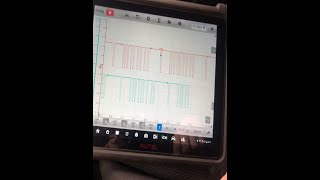
For the 2019 Beetle with the 2.0L TSI engine (EA888 family), the brake booster pressure sensor (VW designation G294) is often a digital 'smart' sensor integrated into a rigid vacuum pipe assembly. Unlike older vehicles where a simple rubber hose could be the culprit, a failure on this platform often means the entire plastic line assembly has developed a hairline crack from heat cycles or the sensor itself has failed electronically. A key diagnostic challenge is that the sensor can send plausible data on a standard OBD-II scanner but still be faulty because the digital signal pattern is corrupt, a fault that often requires an oscilloscope to definitively identify. 🎬 Watch: Diagnostic summary of a faulty digital pressure sensor. Failure of this sensor commonly disables driver-assist systems like Adaptive Cruise Control (ACC) and Front Assist.
Diagnostic Flowchart
Tap your situation to follow the diagnostic path that matches what you're seeing on this vehicle.
Symptoms You May Notice
- Check Engine Light (MIL) is on
- Hard brake pedal that requires more effort to press
- Increased stopping distances
- Warning messages related to driver-assist systems like "ACC and Front Assist not available" may appear
- A hissing noise from the engine bay, indicating a vacuum leak
- Brake Assist (BAS) or other brake-related warning lights on the dashboard
- Replacing the brake booster itself when the issue is just the sensor or a vacuum line.
- Replacing the master cylinder, which is a hydraulic component and unrelated to this vacuum-pressure electrical fault.
- Trusting basic scan tool live data that appears normal, when the sensor's digital signal is actually corrupt.
Most Likely Causes
- Faulty Brake Booster Pressure Sensor (G294) 🔴 High Probability The sensor is an electronic component that can fail internally, sending a corrupted digital signal. Forum users on VW platforms frequently report this specific part failing, sometimes intermittently at first.
How to confirm: Use a capable OBD-II scanner to monitor live data. While the readings may appear to change with brake application, this does not rule out a fault. Definitive diagnosis of a 'smart' sensor requires an oscilloscope to compare the digital waveform to a known-good pattern. If the signal pattern is incorrect despite plausible pressure readings, the sensor is bad. A common OEM part number for this sensor on related platforms is 5Q0906207B.
Typical fix: Replace the brake booster pressure sensor. On many modern VWs, this sensor is part of the vacuum hose assembly and is replaced as a single unit.
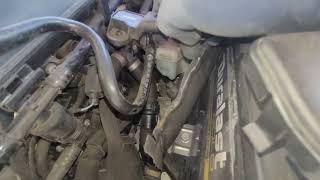
Est. part cost: $80-$150 - Vacuum Leak in Hose Assembly 🟡 Medium Probability The rigid plastic vacuum lines are exposed to constant engine heat and vibration, which can make them brittle and cause hairline cracks over time, especially near fittings or where they rub against other components.
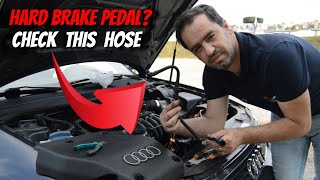
How to confirm: Visually inspect all vacuum hoses connected to the brake booster for cracks, chafing, or splits. A YouTube video by 'Jabo The Mechanic' shows this exact failure on a Jetta, where a rubbed section of the pipe caused both P0556 and a P2279 intake leak code. A smoke test is the most effective way to find small, hard-to-see leaks.
Typical fix: Replace the cracked or leaking vacuum hose assembly. The part number for a similar Jetta was 1K0612041LG.
Est. part cost: $70-$150 - Damaged Wiring or Connector ⚪ Low Probability Wiring in the engine bay can be damaged by heat, vibration, or rodents. The connector pins can also suffer from corrosion.
How to confirm: Visually inspect the sensor's wiring harness for any signs of damage, chafing, or corrosion. Disconnect the sensor and check for corrosion on the pins. Use a multimeter to check for proper voltage (typically a 5V reference) and ground at the connector.
Typical fix: Repair the damaged section of wiring or clean/replace the connector.
Est. part cost: $10-$50
Rare But Worth Checking
- Faulty Powertrain Control Module (PCM): This is extremely rare. All other possibilities, especially the sensor, vacuum lines, and wiring, should be exhaustively ruled out before considering the PCM as the cause. One forum user reported a faulty aftermarket sensor damaged their control module, requiring replacement of both.
- ECM Software Update Needed: On some VW models, particularly 2016-2017 Jettas with the 1.4L engine, VW issued TSB 01-18-09 (TPI 2045383) to fix a false P0556 with a software update. While not documented for this specific Beetle, it's a known possibility in the VW family if all hardware tests perfectly.
Diagnosis Steps
- Verify the code P0556 is present using an OBD-II scanner.
- Check for any other stored trouble codes, especially P2279 (Intake Leak) or those mentioned in TSBs (P1429, P0197, etc.).
- Visually inspect the brake booster, the pressure sensor, and all associated vacuum lines for obvious signs of damage, cracks, chafing, or disconnection. Pay close attention to where the plastic line may rub against other components.
- With the engine off, pump the brake pedal several times to deplete any stored vacuum. Then, hold the pedal down firmly and start the engine. The pedal should drop slightly as vacuum builds, indicating the booster is working mechanically.
- Use a scan tool to monitor live data from the brake booster pressure sensor. The pressure reading should change smoothly as you press and release the brake pedal. Note that plausible readings do not rule out a faulty 'smart' sensor.
- If a vacuum leak is suspected but not visible, perform a smoke test on the brake booster vacuum system to pinpoint the source of the leak.
- If the sensor signal is suspect and no vacuum leaks are found, inspect the sensor's electrical connector for damage or corrosion. Test for 5V reference voltage and ground integrity using a multimeter.
- For a definitive sensor test, use an oscilloscope to analyze the signal wire. Compare the digital waveform to a known-good pattern. A distorted or irregular pattern indicates a faulty sensor.
- If the wiring and vacuum system are good, the brake booster pressure sensor is the most likely failed component.
Parts You'll Likely Need
- Brake Booster Pressure Sensor / Vacuum Line Assembly
(OEM #5Q0906207B (sensor only), 1K0612041LG (example assembly))— This is the most common failure point for code P0556. The sensor often fails electronically or the plastic line it's integrated into cracks, causing a vacuum leak. It is typically replaced as a single assembly.
Trusted brands: Volkswagen Genuine, Bosch, HELLA
OEM price range: $100-$150
Aftermarket price range: $70-$120
Related Codes That Often Appear With This One
- P2279 — This code for 'Intake Air System Leak' can be triggered by the same vacuum hose crack that causes P0556, as the brake booster system is connected to the engine's intake vacuum.
- P1429 — As cited in VW TSB #VIN4APIN20190628 and #VIN4APIN20190617, P0556 can appear with P1429. While the TSB doesn't specify the direct link, P1429 is often related to the brake vacuum pump, suggesting a comprehensive issue within the brake vacuum system.
- P0197 — Cited in the same TSBs, P0197 is for 'Engine Oil Temperature Sensor Circuit Low'. The simultaneous appearance might point to a wiring harness issue or a broader electrical problem affecting multiple sensors, rather than a direct mechanical link.
Technical Service Bulletins (TSBs) & Recalls
- VIN4APIN20190628: Notes that a customer complaint of MIL-on may be associated with P0556 and/or other codes like P1429, P0197, P0133, P0116, and P2097.
- VIN4APIN20190617: Notes that a customer complaint of MIL-on may be associated with P0556 and/or other codes like P1429, P0197, P0133, P0116, and P2097.
- TSB 01-18-09 (TPI 2045383): While for 2016-2017 Jettas, this TSB is notable as it addresses false P0556 codes via an ECM software update, highlighting a potential non-hardware cause within the VW family.
Platform-Specific Known Issues
- Digital 'Smart' Sensor Complexity: The 2.0L TSI engine often uses a digital pressure sensor (G294) that can fail in a way not obvious with basic scan tools. Live data may look normal, but the digital signal pattern is corrupt, causing the P0556 code. A technician on 'The Keeney Garage' YouTube channel demonstrated this on a 2019 Jetta, where only an oscilloscope could confirm the sensor was faulty.
- Cracked/Rubbed Vacuum Pipe: The rigid vacuum pipe assembly is a common failure point. A YouTube video by 'Jabo The Mechanic' on a 2017 Jetta showed the pipe had rubbed through against another component, causing both P0556 and P2279 (Intake Air System Leak). A careful visual inspection of the entire line is critical.
Mechanic-Grade Diagnostic Values
- Brake Booster Pressure (Scan Tool Live Data) — expected: With Key On, Engine Off, the reading should be atmospheric pressure (approx. 14.4 PSI). With the engine running, it should show vacuum (e.g., ~6 PSI at idle). The value should increase toward atmospheric pressure as the brake pedal is depressed.. Failure: The code can set even if the live data appears to respond correctly. The true failure is often a corrupted digital signal pattern, not an incorrect pressure reading.
- Sensor Connector Pin Voltage (at harness) — expected: The 3-pin connector should have a 5-volt reference pin, a ground pin (near 0V), and a signal pin.. Failure: Loss of the 5V reference or a bad ground indicates a wiring or ECU issue. However, testing the signal wire with a multimeter is inconclusive for a 'smart' sensor; it requires an oscilloscope.
Scan Tool Commands That Help
- ODIS (VW Dealer Tool): Guided Fault Finding — This is the official dealer procedure. When a fault code like P0556 is present, the tool provides a step-by-step test plan for the technician to follow, integrating component tests, wiring checks, and expected value comparisons.
Wiring & Ground Locations
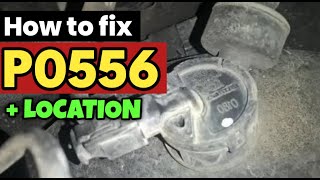
- G294 Sensor Connector — On the vacuum pipe connected to the brake booster, in the engine bay.. This is the primary connection point for the sensor. Checking for 5V power, ground, and signal integrity starts here. Corrosion or damage to the 3 pins in this connector can cause the P0556 code.
- Chassis Ground Lug — On the EA888 engine platform, a common, robust chassis grounding point is located on the passenger-side frame rail, behind the headlight.. While not specific to the G294 sensor, a poor main ground can cause widespread, intermittent electrical issues across multiple sensors. If sensor-specific ground tests are inconclusive, verifying main chassis grounds is a valid next step.
Real Owner Repair Stories
- Reddit user on r/camaro (2015 Camaro 2SS) — Check Engine Light with code P0556.
❌ Tried (didn't work) Replacing the brake booster pressure sensor., Verifying the wiring and brake booster were fine.
✅ What actually fixed it A thorough examination found a small crack in the brake booster vacuum pipe itself. Replacing the pipe with an OEM part resolved the code. - Camaro5 Forum user 'qniknam' (2010 Chevrolet Camaro SS (L99 Automatic)) — Recurring P0556 Check Engine Light, unusually dark/burned exhaust tips, high oil consumption.
❌ Tried (didn't work) Initial diagnosis of a bad sensor.
✅ What actually fixed it A GM Specialist identified that aggressive engine lifters were causing excessive oil to enter the intake manifold. This oil then clogged the brake booster vacuum line, leading to the P0556 code. The fix involved addressing the engine's lifter issue.
"I Checked Everything" — The Actual Cause
- In a well-documented case on a 2019 VW Jetta with P0556, the vehicle's scan tool live data for the brake booster pressure sensor appeared perfectly normal; it changed with vacuum and responded to brake pedal input. A smoke test would likely have found no leaks. The actual cause was a corrupted digital signal pattern from the 'smart' sensor. The pressure values were plausible, but the timing and structure of the digital message sent to the ECU were incorrect, which could only be diagnosed by comparing the sensor's output waveform on an oscilloscope to that of a known-good sensor.
When the Usual Fixes Don't Work
- While the brake booster pressure sensor (G294) is the most common cause for P0556, it should not be replaced without confirming it is the fault. A real-world repair story on a vehicle with the same code showed that replacing the sensor did not fix the issue. The ultimate cause was a small, hard-to-see crack in the rigid vacuum pipe connected to the sensor. This highlights the importance of a thorough visual inspection and a smoke test of the vacuum lines before condemning the more expensive electronic sensor.
OEM Part Supersession History
5Q0906207A→5Q0906207B— Standard part revision by the manufacturer, likely for improved reliability or a minor design change.
Helpful Videos
Used OEM Parts in Stock

New Aftermarket Parts Available


The information in this article is provided for general reference and educational purposes only. Vehicle specifications, procedures, and part compatibility can vary by production date, trim level, and region. Always consult your vehicle's factory service manual and verify part numbers before purchasing or performing repairs. Safety-critical components such as airbags, seat belts, and braking systems should be installed by a qualified professional.
- Volkswagen BEETLE:
- 🎬 Helpful Videos
- 🛍️ Shop This Part
- What's Unique About the 2019-2019 Volkswagen BEETLE
- Diagnostic Flowchart
- Symptoms You May Notice
- Most Likely Causes
- Rare But Worth Checking
- Diagnosis Steps
- Parts You'll Likely Need
- Related Codes That Often Appear With This One
- Technical Service Bulletins (TSBs) & Recalls
- Platform-Specific Known Issues
- Mechanic-Grade Diagnostic Values
- Scan Tool Commands That Help
- Wiring & Ground Locations
- Real Owner Repair Stories
- "I Checked Everything" — The Actual Cause
- When the Usual Fixes Don't Work
- OEM Part Supersession History
- 🎟️ Get 5% Off