

OBD-II Code P0548: Exhaust Gas Temperature Sensor Circuit Low (Bank 2, Sensor 1)
The Ultimate Guide to Diagnosing and Fixing P0548 for Mechanics and DIYers
- Code P0548 triggers when the Bank 2 Exhaust Gas Temperature (EGT) sensor sends a voltage signal below 0.2V, indicating a shorted wire or failed sensor.
- Extreme exhaust heat and vibration destroy EGT sensors and melt wiring harnesses, making these two components responsible for 90% of P0548 faults.
- Driving with an active P0548 code disables diesel DPF regeneration, turning a $200 sensor fix into a $2,500+ DPF or catalytic converter replacement within weeks.
- Test the sensor's resistance and verify a 5-volt reference signal at the connector before spending $150 on a replacement part.
- VW and Audi TDI owners must verify 'Dieselgate' extended warranty coverage before paying out of pocket, as this repair is often fully covered up to 162,000 miles.
What Does P0548 Mean?

The Powertrain Control Module (PCM) detects a voltage signal below 0.2 volts from the Bank 2 exhaust temperature sensor. This sensor measures exhaust heat before it enters the catalytic converter or Diesel Particulate Filter (DPF). The computer uses this data to prevent emissions system overheating and to time diesel DPF regeneration.
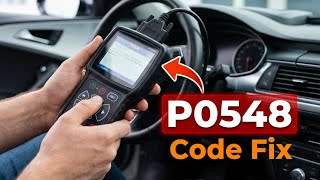
Technical definition: Exhaust Gas Temperature (EGT) Sensor Circuit Low Bank 2 Sensor 1. The PCM detects the voltage signal from the first EGT sensor on the second cylinder bank is below the 0.2V minimum threshold for several seconds. 🎬 Watch: A quick guide to understanding the P0548 engine code. The sensor is a thermistor whose resistance changes inversely with temperature. The PCM supplies a 5-volt reference and reads the voltage drop across the sensor to calculate exhaust heat.
Can I Drive With P0548?
Yes, But With Caution. You can drive for a few days, but immediate attention is required. Continuing to drive with P0548 causes irreversible damage to your catalytic converter or Diesel Particulate Filter (DPF). On diesel vehicles, this fault prevents DPF regeneration, turning a simple sensor fix into a $1,000 to $10,000 filter replacement.
Common Causes

- Failed Exhaust Gas Temperature (EGT) Sensor (Very Common) — Constant exposure to 1,500°F+ exhaust gases causes the internal thermistor to fail or short out, sending a continuous low-voltage signal.
- Damaged, Corroded, or Shorted Wiring/Connectors (Very Common) — The EGT sensor wiring sits in a harsh environment exposed to extreme heat and road debris. Melted insulation causes the signal wire to short directly to ground.
- Soot Buildup on Sensor Tip (Common) — A thick layer of carbon soot cakes onto the sensor tip, insulating it from the hot exhaust gas. This forces the sensor to report an artificially low temperature.
- Exhaust System Leaks (Common) — A cracked exhaust manifold or blown gasket upstream of the sensor draws in cooler ambient air. This fresh air cools the exhaust stream, causing a falsely low temperature reading.
- ECU/PCM Software Glitch (Less Common) — The PCM's software logic is sometimes too sensitive. Manufacturers frequently release Technical Service Bulletins (TSBs) with software updates to correct erroneous P0548 triggers.
- Aftermarket Exhaust Modifications (Less Common) — Installing aftermarket exhaust systems without proper EGT sensor bungs alters exhaust flow and temperature, triggering the code.
- Low Battery Voltage or Poor Grounds (Rare) — A failing battery or alternator drops system voltage, causing erratic sensor behavior and false circuit-low codes.
- Failed Powertrain Control Module (PCM) (Very Rare) — The internal PCM circuit that processes the EGT signal fails. This is extremely rare and requires ruling out all wiring and sensor faults first.
Symptoms

- Check Engine Light is On — The Malfunction Indicator Lamp (MIL) illuminates immediately when the fault is detected.
- Flashing Glow Plug Light (VW/Audi TDI) — Volkswagen and Audi diesel models flash the glow plug light as a primary warning for EGT sensor failures.
- Reduced Engine Power / Limp Mode — The PCM enters 'limp mode' to protect the catalytic converter or DPF, severely limiting engine speed to 2,500 RPM and cutting acceleration.
- Increased Fuel Consumption — The PCM enriches the fuel mixture to artificially raise exhaust temperatures, dropping fuel economy by 10-15%.
- DPF Regeneration Inoperative (Diesel Engines) (also visible on scanner) — The PCM requires accurate EGT readings to initiate DPF regeneration. P0548 halts this process, causing the DPF to clog rapidly.
- Failed Emissions Test (also visible on scanner) — An active P0548 code automatically fails any OBD-II based state emissions inspection.
Diagnostic Flowchart
Tap your situation to follow the diagnostic path that matches what you're seeing on this code.
Common Fixes & Costs
- Replace the Exhaust Gas Temperature (EGT) Sensor
— Parts: $70-$250, Labor: $130-$450, ~1.5 hr book time
(DIY)
Volkswagen/Audi TDI (2009-2015): OEM 03L906088J, 03L906088T (Alt: Bosch 0986259025, Denso DET-0106)
Ford F-Series 6.7L Power Stroke (2011-2016): OEM AC3Z-12B591-C (Alt: Dorman 904-402, Walker 273-10339)
Chevrolet/GMC 6.6L Duramax LML (2011-2016): OEM GM 12636612 (Alt: Bostech BTS010001) - Repair or Replace Damaged Wiring/Connector — Parts: $15-$60, Labor: $100-$300, ~1.5 hr book time (Intermediate)
- Clean Soot Buildup from Sensor Tip — Parts: $5, Labor: $50-$150, ~1.0 hr book time (DIY)
- Repair Exhaust System Leak — Parts: $20-$100, Labor: $150-$400, ~2.5 hr book time (Intermediate)
- Reprogram or Replace the Powertrain Control Module (PCM) — Parts: $800-$1,500, Labor: $150-$500, ~2.0 hr book time (Professional)
DIY vs Professional
- Replace the Exhaust Gas Temperature (EGT) Sensor — Beginner:
- Repair or Replace Damaged Wiring/Connector — Beginner:
- Repair Exhaust System Leak — Beginner:
Used vs. New Parts: Buying Guide
When a used part is worth it: Buying a used EGT sensor never makes sense. It is a high-wear electronic item. The labor cost to replace a failed used sensor outweighs any initial savings.
Donor-vehicle mileage cap: roughly under 20000 miles for the part to have meaningful remaining life.
Donor quality checklist:
- Avoid sensors from 'Salt Belt' vehicles due to corrosion.
- Ensure the part number matches exactly.
- Inspect for melted wiring or corroded connector pins.
Decision logic:
- If A new OEM or reputable aftermarket EGT sensor is under $250 → Always buy new to guarantee longevity and secure a warranty.
- If The vehicle is being repaired on an absolute minimum budget → A used sensor from a verified low-mileage wreck is a last resort.
Warranty tradeoff: Salvage yard parts offer a 30-day warranty. New aftermarket sensors include a 1-year to lifetime warranty. New OEM parts carry a 1-2 year warranty.
Worst-case if a used part fails: 500-800
What Happens If You Wait — Timeline
- 0-1 month: Code P0548 sets and active DPF regeneration is disabled on diesel vehicles. Fuel economy drops slightly. (MPG impact: 0-5%% · Added cost: $0-50)
- 1-3 months (Diesel): DPF soot loading exceeds safe thresholds. The vehicle enters limp mode, and code P242F triggers. (MPG impact: 5-15%% · Added cost: $250-800)
- 1-4 months (Gasoline): The PCM runs a rich fuel mixture, causing the catalytic converter to overheat and degrade its precious metal coatings. (MPG impact: 5-10%% · Added cost: $0)
- 4+ months: Catastrophic emissions failure. The DPF irreversibly clogs, or the catalytic converter substrate melts, requiring full replacement. (MPG impact: 15-25%% · Added cost: $1,500-10,000)
Cost of Not Fixing It
- 0-1 Month: Reduced fuel economy, failed emissions tests, and potential entry into limp mode. (Added cost: 50-150)
- 1-6 Months (Diesel): Disabled DPF regeneration causes the filter to clog with soot, requiring professional cleaning or forced regeneration. (Added cost: 1500-4000)
- 1-6 Months (Gasoline): The PCM cannot protect the catalytic converter from overheating, causing the internal substrate to melt. (Added cost: 1200-2800)
- 6+ Months: Catastrophic failure of the DPF or catalytic converter. Excessive backpressure damages turbocharger seals. (Added cost: 2500-10000)
Diagnosis Steps

- Read Codes and Analyze Freeze Frame Data
Use an OBD-II scanner to confirm P0548. Examine the freeze frame data to identify the exact RPM, load, and temperature when the fault occurred. Clear the codes and test drive to see if it returns immediately.
Tools: OBD-II Scanner (Beginner) - Check for Technical Service Bulletins (TSBs)
Search manufacturer TSBs for your specific year and model. A known software glitch often causes P0548, requiring a simple dealership reflash rather than parts replacement.
Tools: Online Service Information Subscription or Google Search (Beginner) - Thorough Visual Inspection
Locate the Bank 2 EGT sensor. Inspect the wiring harness from the sensor to the PCM. Look for melted insulation touching the exhaust, chafing against the block, or corroded connector pins.
Tools: Flashlight, Inspection Mirror (Beginner) - Live Data Analysis
Monitor the 'EGT Bank 2, Sensor 1' PID on a scan tool. A cold engine should read ambient temperature. A reading stuck at -40°F indicates an open circuit, while a reading maxed out at 1,650°F+ indicates a short circuit.
Tools: OBD-II Scanner (with live data) (Intermediate) - Test for Reference Voltage
Disconnect the sensor and turn the ignition to 'On' (engine off). Test the vehicle-side connector with a multimeter. One pin must show a steady 5-volt reference signal from the PCM. If it reads 0V, the wiring to the PCM is broken.
Tools: Digital Multimeter (Intermediate) - Test Sensor Resistance (Static & Dynamic)
Measure resistance across the disconnected sensor's pins. A reading near zero ohms means the sensor is shorted; 'OL' means it is broken internally. If resistance is normal (e.g., 220 ohms at 70°F), heat the sensor tip with a heat gun. The resistance must change smoothly. Erratic jumps mean the sensor is failing.
Tools: Digital Multimeter, Heat Gun (Advanced) - Perform a Bias Voltage/Short-to-Ground Test
With the sensor disconnected and key on, use a jumper wire to connect the 5V signal pin to the ground pin in the harness connector. The scan tool's live data should plummet to -40°F. This confirms the wiring to the PCM is intact.
Tools: Digital Multimeter, Jumper Wire, OBD-II Scanner (with live data) (Advanced) - Check for Exhaust Leaks
Start the cold engine and listen for ticking sounds near the exhaust manifold or upstream pipes. Use a stethoscope or soapy water to find leaks drawing in cold air.
Tools: Mechanic's Stethoscope or Soapy Water (Intermediate) - Waveform Analysis with Oscilloscope
Back-probe the sensor's signal wire with the engine running. A healthy sensor produces a clean DC voltage signal. Sharp dropouts to ground indicate an intermittent wiring short.
Tools: Automotive Oscilloscope (Professional)
When This Code Triggers (Freeze-Frame Conditions)
- Engine Coolant Temp: 180-210°F (82-99°C) (The code sets when the engine is fully warmed up and operating in a steady state.)
- RPM: 1500-2500 RPM (The fault occurs during steady cruising, rarely during hard acceleration or idle.)
- Engine Load: 30-60% (Occurs under moderate engine load when the PCM expects a consistent exhaust temperature.)
- Vehicle Speed: 45-65 mph (72-105 kph) (Triggers during highway driving when the emissions system is in closed-loop operation.)
Related Codes
- P0549 — The direct opposite: 'Circuit High'. P0548 (Low) points to a short to ground, while P0549 points to an open circuit. Unplugging the sensor should change P0548 to P0549, confirming the wiring is good.
- P0546 — The identical 'Circuit Low' fault for Bank 1. If both codes appear simultaneously, suspect a shared ground fault or PCM issue rather than two failed sensors.
- P0420 — A long-term P0548 fault prevents the PCM from protecting the catalytic converter. Overheating destroys the catalyst, triggering P0420.
- P242F — P0548 prevents DPF regeneration on diesels. The DPF clogs with soot, triggering P242F and requiring forced regeneration or replacement.
Climate & Environmental Factors
- Road Salt / Corrosive Environments: Vehicles in the 'Salt Belt' experience accelerated corrosion of the sensor's wiring connector and body, leading to premature circuit failures.
- Extreme Heat Cycles: Frequent short trips prevent the exhaust from reaching full temperature. The resulting rapid heating and cooling stresses the sensor's internal thermistor.
How to Talk to a Mechanic About This Code
Say this: "I have a check engine light and my scanner shows code P0548. I'd like to book a diagnostic appointment to determine if the cause is a faulty EGT sensor or a wiring short. Please test the circuit and sensor resistance before recommending a replacement part."
This signals you understand the specific code and its common causes. It requests a proper diagnosis instead of just replacing parts, preventing unnecessary spending.
Avoid saying:
- 'My check engine light is on, can you fix it?'
- 'Just replace the EGT sensor.'
- 'Do whatever you think is right.'
Questions to ask before authorizing the repair:
- Did you test the sensor's resistance and check for a 5-volt reference at the connector?
- Did you visually inspect the wiring harness for heat damage or corrosion?
- If the sensor is seized, what is your process for removal to avoid damaging the exhaust pipe?
- What is the warranty on the replacement part and the labor for this repair?
Where to Take It: Dealer vs Independent vs Chain
- Dealer:
Required first stop for VW/Audi TDI owners. For other brands, it's the best choice for in-warranty repairs or if a known TSB applies.
Best for: VW/Audi TDI vehicles to check for 'Dieselgate' Extended Emissions Warranty coverage., Vehicles under the original powertrain warranty., Diagnosing complex electrical issues and performing software updates (TSBs).
Downsides: Highest labor rates, typically 1.5-2x more than independent shops., Recommends expensive, wholesale repairs instead of targeted fixes. (Typical cost: +50% vs. baseline) - Independent Shop:
Best overall fit for most out-of-warranty vehicles. A good independent shop easily diagnoses the sensor or wiring, and a diesel specialist handles seized sensors.
Best for: Out-of-warranty vehicles where cost is a primary concern., Diesel specialty shops are ideal for Ford/GM trucks known for seized sensors.
Downsides: Quality and diagnostic capabilities vary widely., Lacks access to the latest manufacturer software updates. (Typical cost: +0% vs. baseline) - Chain Shop:
Not recommended. The diagnostic nuance of wiring vs. sensor and the high risk of a seized sensor make this a poor choice.
Best for: Simple parts replacement if you have already confirmed the diagnosis yourself.
Downsides: Technician skill varies dramatically., High pressure to upsell services; frequently misdiagnoses a wiring issue as a failed sensor., Not equipped to handle a seized sensor that requires drilling and tapping. (Typical cost: -10% vs. baseline)
When to Walk Away From the Repair
If the total estimated repair cost exceeds 40-50% of your car's private-party market value, pause and consider if the investment is worthwhile.
- Car worth $5000, fix is $450: Fix it. The repair cost is well below the 50% threshold and restores critical engine protection functions.
- Car worth $8000, fix is $3500: Borderline. This scenario involves replacing a damaged DPF from ignoring the initial P0548 code. Get a second opinion on whether the DPF can be professionally cleaned before authorizing the repair.
- Car worth $2500, fix is $1600: Walk away. The repair cost is over 60% of the vehicle's value. It is not economically sound to proceed.
What Scan Tool You Need for This Code

Minimum: An OBD-II scanner that reads and displays live sensor data (Live Data or PIDs). A simple code reader is not sufficient.
A basic $20 code reader only gives you the code number. To diagnose P0548 correctly, you must see the live temperature reported by the EGT sensor to know if it is stuck, lazy, or dead.
Budget: BlueDriver Pro (~$100) — Connects to your smartphone and allows you to read codes, clear them, and view live data for the EGT sensor to see if readings are logical as the engine warms up.
Mid-range: Foxwell NT510 Elite (~$180) — A dedicated handheld scanner providing live data graphing and access to manufacturer-specific codes. It is more reliable than Bluetooth options and offers detailed information for specific vehicle brands.
Professional: Autel MaxiCOM MK808 (~$500) — Offers professional-level functions, including advanced live data analysis and bidirectional controls. It is overkill for just P0548 but valuable for serious DIYers.
Rent vs buy: For a one-time fix, major auto parts stores like AutoZone offer a free loaner tool program. You can borrow a capable OBD-II scanner that reads codes and displays live data.
How to Clear the Code After You Fix It
- Use an OBD-II scan tool to clear the P0548 fault code.
- Start the engine and idle for 3 minutes to re-establish sensor communication.
- Perform a complete OBD-II drive cycle to run readiness monitors.
Drive cycle (~20 minutes): Cold start and idle for 3 minutes. Drive in stop-and-go traffic for 10 minutes. Drive at a steady 60 mph for 15 minutes. Allow the vehicle to cool down completely.
Readiness monitors affected: Catalyst Monitor, Oxygen Sensor Monitor, Exhaust Gas Sensor Monitor
Before emissions retest: drive at least 100 miles to fully set monitors.
Watch out for:
- Clearing the code without a drive cycle leaves readiness monitors incomplete, causing an automatic emissions test failure.
- Disconnecting the battery clears the code but resets all learned adaptations, extending the time required to pass emissions.
- The code returns immediately if the underlying electrical short is not repaired.
Will This Fail Emissions / State Inspection?
Yes — this code typically fails an OBD-II emissions inspection.
- California: An active P0548 code is an automatic failure. A complete OBD-II drive cycle must be performed after repair to set readiness monitors.
- New York: The NYS DMV inspection includes an OBD-II scan. The Check Engine Light and this fault code result in an immediate failure.
- Texas: In the 17 counties requiring emissions testing, P0548 causes an automatic failure of the OBD portion of the annual inspection.
Most Commonly Affected Vehicles
- Volkswagen Golf TDI, Jetta TDI, Passat TDI, Touareg TDI (2009-2015) — Extremely common on 2.0L and 3.0L TDI engines. Presents with a flashing glow plug light. Verify the correct part number for 2009-2012 models.
- Audi A3, Q5, Q7 (TDI models) (2009-2016) — Shares the TDI engines with VW and suffers identical failure rates. Power loss is common as the ECU protects the DPF.
- Ford F-250/F-350/F-450 with 6.7L Power Stroke (2011-2016) — P0548 refers to EGT12. TSB 14-0108 addresses EGT codes on 2013-2014 models due to improperly crimped harness connectors.
- Chevrolet / GMC Silverado/Sierra 2500/3500 with 6.6L Duramax (LML) (2011-2016) — P0548 corresponds to Sensor 1 on the passenger side uppipe. These sensors frequently seize, requiring a weld-in bung repair kit.
- Subaru Forester XT, WRX/STI, Outback XT, Legacy GT (2008-2018) — The sensor is located in the exhaust uppipe. Failure causes the ECU to pull ignition timing, resulting in power loss often misdiagnosed as a bad turbo.
- BMW 335d, 535d, X5 xDrive35d (2009-2013) — M57 diesel engines suffer EGT sensor failures that inhibit DPF regeneration, leading to costly filter damage.
- Mercedes-Benz Sprinter, E-Class, GL-Class, ML-Class (BlueTEC models) (2010-2016) — BlueTEC diesels rely on precise EGT data for AdBlue injection. Sensor failure forces the vehicle into reduced power mode.
- Nissan Titan XD (5.0L Cummins) (2016-2019) — Check for ECM software updates via TSBs before replacing hardware, as revised software fixes erroneous sensor codes.
Manufacturer-Specific Notes
- Volkswagen/Audi: The 'Dieselgate' settlement provides an Extended Emissions Warranty covering all EGT sensors for up to 11 years/162,000 miles. Always check dealer eligibility before paying.
- Ford / GM (Diesel): EGT sensors on 6.7L Power Stroke and 6.6L Duramax engines notoriously seize in the exhaust pipe. OE-Fix kits include a new weld-in bung for when the original is destroyed.
- Subaru: On turbocharged models, the 'Sensor 1' EGT failure causes the ECU to pull ignition timing to protect the turbo, resulting in a massive power loss misdiagnosed as turbo failure.
- Nissan: For the 2016-2019 Titan XD, it is critical to check for ECM software updates via TSBs before replacing hardware, as software glitches frequently cause P0548.
Real Owner Stories
2012 VW Jetta TDI at 115,000 miles
Flashing glow plug light and Check Engine Light with P0548 triggered limp mode during a road trip.
What they tried:
- Owner suspected a DPF issue.
- Visual inspection revealed no wiring damage.
- Took the car to a dealership to check for warranty coverage.
Outcome: The dealer confirmed the EGT sensor was covered under the TDI Extended Emissions Warranty. The sensor was replaced at no cost.
Lesson: Always check for 'Dieselgate' extended warranty coverage before paying for emissions repairs on VW/Audi TDI vehicles.
2014 Ford F-350 6.7L Power Stroke at 140,000 miles
Check Engine Light for P0548 appeared with no noticeable power loss.
What they tried:
- Purchased a new aftermarket EGT sensor.
- The original sensor seized and broke off in the exhaust bung during removal.
- Tried penetrating oils and a torch with no success.
Outcome: A mechanic spent 2 hours drilling out the old sensor and tapping the threads to save the bung. Total labor cost exceeded $300.
Lesson: Sensor seizure is highly likely on diesel trucks. Soak the sensor in penetrating oil for days, and be prepared for it to break.
2011 Subaru WRX at 85,000 miles
P0548 code present alongside a significant loss of power under boost.
What they tried:
- Initially misdiagnosed as a failing turbocharger.
- A mechanic inspected the EGT sensor wiring harness and found melted insulation near the uppipe causing a short to ground.
Outcome: The mechanic repaired the shorted wire using a heat-resistant splice. The $180 repair cleared the code and restored power.
Lesson: A 'circuit low' code frequently points to a wiring short. Inspect the harness before buying a $200 sensor.
How to Prevent This Code From Triggering
- Perform regular highway driving (At least once every 1-2 weeks) — Sustained highway speeds allow diesel exhaust to reach temperatures required for active DPF regeneration, preventing soot from fouling the EGT sensor.
- Apply nickel-based anti-seize during sensor installation (Every time an EGT sensor is replaced) — Using a high-temperature (2,400°F) nickel anti-seize on the threads prevents the sensor from rust-welding to the exhaust pipe, saving hours of labor on future replacements.
- Inspect sensor wiring during oil changes (Every 5,000 to 10,000 miles) — Visually checking the EGT wiring harness for chafing or heat damage catches potential shorts before they trigger a code and disable the vehicle.
Frequently Asked Questions
What does 'Bank 2, Sensor 1' mean?
'Bank 2' refers to the side of the engine that does not contain the #1 cylinder. 'Sensor 1' indicates it is the first sensor in the exhaust stream for that bank, positioned upstream of the catalytic converter or DPF.
What's the biggest mistake when fixing P0548?
The most common mistake is replacing the EGT sensor without testing the circuit. The root cause is frequently a melted wire shorting to ground or a corroded connector. A five-minute multimeter test saves the cost of an unnecessary part.
Can I replace the EGT sensor myself?
Yes, but the sensor frequently rust-welds into the exhaust pipe. Liberally apply penetrating oil over several heat cycles before attempting removal. Using a proper flare-nut wrench or EGT sensor socket is mandatory to prevent rounding off the hex.
How much does it cost to fix code P0548?
A simple wiring repair costs $115 to $360 at a shop. Replacing the EGT sensor typically costs between $200 and $700 for parts and labor. A rare PCM replacement exceeds $1,500.
Is an EGT sensor the same as an O2 sensor?
No, they have entirely different functions despite looking similar. An EGT sensor is a thermistor that measures only exhaust temperature. An Oxygen (O2) sensor measures the concentration of unburned oxygen in the exhaust stream.
Can a bad battery cause code P0548?
Yes, a failing battery or alternator drops overall system voltage. This causes unpredictable behavior from electronic modules and sensors. It triggers 'circuit low' codes as a secondary fault.
Can I just bypass the sensor on my deleted truck?
Some tuners use a resistor to send a fixed signal to the ECU, but this is illegal for on-road vehicles. It guarantees an emissions test failure. It also removes a critical safety measure the ECU uses to prevent engine fires and component melting.
Key Takeaways
- Code P0548 triggers when the Bank 2 Exhaust Gas Temperature (EGT) sensor sends a voltage signal below 0.2V, indicating a shorted wire or failed sensor.
- Extreme exhaust heat and vibration destroy EGT sensors and melt wiring harnesses, making these two components responsible for 90% of P0548 faults.
- Driving with an active P0548 code disables diesel DPF regeneration, turning a $200 sensor fix into a $2,500+ DPF or catalytic converter replacement within weeks.
- Test the sensor's resistance and verify a 5-volt reference signal at the connector before spending $150 on a replacement part.
- VW and Audi TDI owners must verify 'Dieselgate' extended warranty coverage before paying out of pocket, as this repair is often fully covered up to 162,000 miles.
Helpful Videos
![What is P0548 Engine Code [Quick Guide]](https://img.youtube.com/vi/ys_yYTFxLd8/mqdefault.jpg)

The information in this article is provided for general reference and educational purposes only. Vehicle specifications, procedures, and part compatibility can vary by production date, trim level, and region. Always consult your vehicle's factory service manual and verify part numbers before purchasing or performing repairs. Safety-critical components such as airbags, seat belts, and braking systems should be installed by a qualified professional.
- 🎬 Helpful Videos
- What Does P0548 Mean?
- Can I Drive With P0548?
- Common Causes
- Symptoms
- Diagnostic Flowchart
- Common Fixes & Costs
- DIY vs Professional
- Used vs. New Parts: Buying Guide
- What Happens If You Wait — Timeline
- Cost of Not Fixing It
- Diagnosis Steps
- When This Code Triggers (Freeze-Frame Conditions)
- Related Codes
- Climate & Environmental Factors
- How to Talk to a Mechanic About This Code
- Where to Take It: Dealer vs Independent vs Chain
- When to Walk Away From the Repair
- What Scan Tool You Need for This Code
- How to Clear the Code After You Fix It
- Will This Fail Emissions / State Inspection?
- Most Commonly Affected Vehicles
- Manufacturer-Specific Notes
- Real Owner Stories
- 2012 VW Jetta TDI at 115,000 miles
- 2014 Ford F-350 6.7L Power Stroke at 140,000 miles
- 2011 Subaru WRX at 85,000 miles
- How to Prevent This Code From Triggering
- Frequently Asked Questions
- What does 'Bank 2, Sensor 1' mean?
- What's the biggest mistake when fixing P0548?
- Can I replace the EGT sensor myself?
- How much does it cost to fix code P0548?
- Is an EGT sensor the same as an O2 sensor?
- Can a bad battery cause code P0548?
- Can I just bypass the sensor on my deleted truck?
- Key Takeaways
- 🎟️ Get 5% Off