

OBD-II Code P0544: Exhaust Gas Temperature Sensor Circuit Malfunction (Bank 1, Sensor 1)
The Ultimate Guide to P0544: What It Means, Why It Happens, and How to Fix It for Good
- A failed Exhaust Gas Temperature (EGT) sensor causes 80% of P0544 codes due to extreme thermal stress in the exhaust stream.
- Fix this code within 100 miles; driving longer disables DPF regeneration and turns a $150 sensor replacement into a $3,000 DPF failure.
- Always check for melted wiring and manufacturer Technical Service Bulletins (TSBs) before buying parts, as PCM software updates fix this code permanently on 2013-2018 Ram trucks.
- Never confuse the EGT sensor with an Oxygen (O2) sensor; Bank 1 Sensor 1 is always the first temperature probe located immediately after the exhaust manifold or turbocharger.
What Does P0544 Mean?

Your Powertrain Control Module (PCM) detects an illogical or missing signal from the first exhaust gas temperature (EGT) sensor in Bank 1. This sensor measures exhaust gas temperature as it leaves the engine to protect the turbocharger from overheating and to manage Diesel Particulate Filter (DPF) regeneration. When the voltage reading falls outside programmed limits, the PCM logs P0544 and triggers the check engine light.
Technical definition: The official SAE/OBD-II definition for P0544 is "Exhaust Gas Temperature Sensor Circuit Bank 1 Sensor 1". This indicates the PCM detects EGT sensor voltage readings outside the manufacturer's pre-programmed limitations for a specified duration.
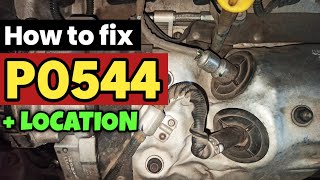
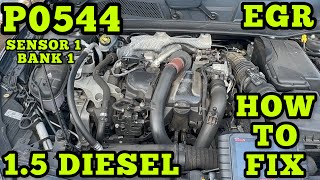
🎬 Watch: A quick breakdown of the P0544 circuit fault code.Can I Drive With P0544?
Yes, But With Caution. You can drive your vehicle to a safe location or repair shop, but you must repair it immediately. Continuing to drive disables DPF regeneration on diesel engines, turning a $150 sensor replacement into a $3,000 DPF or catalytic converter failure within a few hundred miles.
Common Causes

- Failed Exhaust Gas Temperature (EGT) Sensor (Very Common) — This is the primary cause. The EGT sensor operates in a 1,000°F+ environment, causing internal thermistor failure from severe thermal stress and vibration over time.
- Damaged Wiring or Connectors (Common) — The sensor's wiring harness routes near hot exhaust components. Heat melts the insulation, causing shorts. Road salt and moisture also corrode the electrical connector pins, breaking the circuit.
- PCM Software Glitch (False Code) (Common) — Manufacturers occasionally program the PCM with overly sensitive diagnostic parameters, triggering false P0544 codes. This is a documented, widespread issue on 2013-2018 Ram Cummins trucks requiring a software update.
- Soot or Carbon Buildup on Sensor (Less Common) — Heavy soot deposits coat the sensor tip in diesel engines. This acts as an insulator, slowing the sensor's response time and causing inaccurate readings that the PCM flags as a circuit fault.
- Exhaust System Modifications or Leaks (Less Common) — Cracks in the exhaust manifold introduce ambient air, cooling the exhaust stream. Alternatively, aftermarket exhaust systems that relocate or remove the EGT sensor trigger out-of-range readings.
- Upstream Engine Issues (EGR or Injectors) (Rare) — A stuck-open EGR valve or a leaking fuel injector drastically alters exhaust temperatures. The PCM flags the resulting extreme EGT reading as an irrational circuit fault.
- Failing Powertrain Control Module (PCM) (Very Rare) — A faulty input circuit within the PCM mimics a failed sensor signal. This requires replacing the engine computer and is only considered after verifying the sensor and wiring are perfect.
Symptoms

- Check Engine Light is On — The PCM illuminates the MIL immediately upon detecting the circuit fault and storing the P0544 code.
- Reduced Engine Power / Limp Mode — The PCM activates 'limp mode' to protect the turbocharger and engine from unknown exhaust temperatures, severely restricting throttle response and boost.
- Flashing Glow Plug Light (VW/Audi TDI) — Volkswagen and Audi diesels flash the glow plug light specifically to indicate a critical EGT sensor or emissions fault alongside the check engine light. 🎬 Watch: Why the G235 sensor fails on VW TDI models.
- Poor Fuel Economy and Black Smoke — Incorrect EGT data forces the PCM to alter fuel mixtures, causing a 10-20% drop in MPG and visible black smoke from rich running conditions.
- Failed Emissions Test — An active P0544 code and illuminated check engine light result in an automatic failure during state-mandated OBD-II emissions inspections.
- DPF Regeneration Failure (also visible on scanner) — The PCM requires accurate EGT readings to initiate DPF regeneration. P0544 completely disables this process, rapidly clogging the DPF.
Diagnostic Flowchart
Tap your situation to follow the diagnostic path that matches what you're seeing on this code.
Common Fixes & Costs
- Replace Exhaust Gas Temperature (EGT) Sensor (Bank 1, Sensor 1) — Parts: $70-$180, Labor: $100-$200, ~1 hr book time (DIY)
- Repair Damaged Wiring or Replace Connector Pigtail — Parts: $15-$50, Labor: $100-$250, ~1.5 hr book time (Intermediate)
- Update Powertrain Control Module (PCM) Software — Parts: $0, Labor: $100-$200, ~1 hr book time (Professional)
- Professional Diagnosis — Parts: $0, Labor: $120-$180, ~1 hr book time (Professional)
- Replace Clogged DPF or Catalytic Converter (Consequential Damage) — Parts: $1,500-$3,000, Labor: $200-$500, ~2.5 hr book time (Professional)
DIY vs Professional
- Replace EGT Sensor — Beginner:
Tools: Ratchet, 17mm/22mm EGT sensor socket, penetrating oil, torque wrench, anti-seize compound. - Repair Damaged Wiring — Beginner:
Tools: Soldering iron, solder, heat shrink tubing, wire strippers, multimeter, high-temp wire loom. - Update PCM Software — Beginner:
Tools: Manufacturer-specific diagnostic tool (e.g., wiTECH) and service portal subscription.
Used vs. New Parts: Buying Guide
When a used part is worth it: Never buy a used EGT sensor due to its high failure rate. Buy used DPFs or catalytic converters from low-mileage donor vehicles only if your original unit is destroyed and you are on a strict budget.
Donor-vehicle mileage cap: roughly under 80000 miles for the part to have meaningful remaining life.
Donor quality checklist:
- Verify the donor vehicle was not scrapped for engine failure.
- Match part numbers exactly; visual similarities guarantee nothing.
- Confirm the donor vehicle had primarily highway miles, which stress DPFs less than city driving.
Decision logic:
- If The part is an EGT sensor → Always buy new. Used sensors are a waste of labor.
- If The part is a DPF on a vehicle with >150k miles and a tight budget → Buy a used part from a verified low-mileage donor; expect a reduced lifespan.
- If The vehicle is in California or New York → Buy new OEM or CARB-certified aftermarket parts. Installing used emissions components is illegal.
Warranty tradeoff: Used parts offer a 30-day warranty. New aftermarket parts offer 1-3 years. New OEM parts carry the manufacturer's warranty.
Worst-case if a used part fails: $500-$1500 if a used DPF fails prematurely, covering repeat labor and sourcing another part.
What Happens If You Wait — Timeline
- 0-2 weeks: Code P0544 sets. The PCM disables DPF regeneration. The driver notices no major symptoms other than the check engine light. (MPG impact: 0-5%% · Added cost: $0)
- 2-8 weeks: The DPF accumulates soot. Fuel economy drops. The engine enters limp mode, and DPF warning lights illuminate. (MPG impact: 5-10%% · Added cost: $250-$500 for a professional forced regeneration.)
- 2+ months: The DPF cracks or melts internally from excessive backpressure. The vehicle is undrivable. The DPF assembly requires complete replacement. (MPG impact: 20-30%+% · Added cost: $2,000-$4,000+ for a new DPF or catalytic converter.)
Cost of Not Fixing It
- 0-2 weeks: DPF regeneration is disabled. Fuel economy drops 10%. The check engine light remains on. (Added cost: $0, but fuel costs increase.)
- 2-8 weeks: The DPF clogs with soot. The vehicle enters limp mode, severely restricting power. Additional DPF warning lights illuminate. (Added cost: $250-$500 for a professional forced regeneration or chemical cleaning.)
- 2+ months: Catastrophic failure of the DPF or catalytic converter. The component cracks or melts internally from excessive backpressure and heat, requiring complete replacement. (Added cost: $2,000-$4,000+ for DPF or catalytic converter replacement.)
Diagnosis Steps
- Confirm Code and Check for TSBs
Verify P0544 is the active code using a scanner. Before touching the vehicle, search for Technical Service Bulletins (TSBs) for your specific year/make/model. A PCM software update is the required fix for many vehicles, rendering physical diagnosis unnecessary.
Tools: OBD-II Scanner, Internet Access (Beginner) - Visual Inspection and Wiggle Test
Locate EGT Bank 1 Sensor 1 (pre-turbo or exhaust manifold). Inspect the wiring harness for melted insulation, chafing, or brittle wires. Disconnect the plug and check for corrosion. While watching live EGT data on a scanner, wiggle the harness; if the temperature reading drops out or spikes, you have a broken wire.
Tools: Flashlight, Advanced OBD-II Scanner (Beginner) - Analyze Live Sensor Data (Cold and Hot)
After an overnight cold soak, turn the key 'On' (engine off). Compare 'EGT Bank 1 Sensor 1', 'Intake Air Temp', and 'Coolant Temp' on your scanner. All three must be within 5°C of ambient temperature. Start the engine; the EGT reading must rise smoothly. A reading stuck at -40°C or 900°C+ confirms a hard fault.
Tools: Advanced OBD-II Scanner (Intermediate) - Verify 5V Reference and Ground
Disconnect the EGT sensor. Turn the ignition 'On' (engine off). Use a multimeter to probe the vehicle-side connector. One pin must show a steady 5-volt reference signal from the PCM. The other pin must show continuity to ground (less than 5 ohms). Missing voltage or ground indicates a wiring harness or PCM failure.
Tools: Digital Multimeter (Intermediate) - Test Sensor Resistance and Heat Response
Measure the resistance across the two pins of the disconnected sensor. Compare to the service manual (e.g., VW sensors are ~200 Ohms at 68°F). While measuring, apply heat to the sensor tip with a heat gun. The resistance must change smoothly. An 'OL' (open loop), zero reading, or erratic jumping confirms the sensor is dead.
Tools: Digital Multimeter, Heat Gun, Repair Manual (Advanced)
When This Code Triggers (Freeze-Frame Conditions)
- Engine Coolant Temp: 180-205°F (80-96°C) (Fully warmed up, indicating the diagnostic monitor runs at normal operating temperature.)
- RPM: 1500-2500 (Steady cruise or light acceleration, avoiding idle or heavy load extremes.)
- Engine Load: 30-60% (Moderate engine work, typical of highway cruising or maintaining speed on an incline.)
- Vehicle Speed: 40-70 mph (64-113 km/h) (Highway driving conditions where exhaust temperatures stabilize within a predictable range.)
Related Codes
- P0545 — Indicates 'EGT Sensor Circuit Low', pointing specifically to a short to ground (voltage stuck below ~0.2V). This narrows your diagnosis compared to the generic P0544.
- P0546 — Indicates 'EGT Sensor Circuit High', pointing to an open circuit (unplugged sensor, broken wire) or a short to power (voltage stuck above 4.8V).
- P2031 — Indicates a problem with 'Bank 1 Sensor 2', located further downstream after the catalytic converter. It is part of the same system but requires replacing a different physical sensor.
Climate & Environmental Factors
- Cold Climates and Road Salt: Road salt causes aggressive corrosion on the sensor body, guaranteeing it seizes in the exhaust bung. Salt also attacks electrical connector pins, causing the circuit faults that trigger P0544.
- Extreme Cold Starts: The PCM compares the EGT reading to Coolant and Intake Air temperatures on a cold start. In extreme cold, an aging, slow-responding EGT sensor fails this plausibility check, logging a fault.
- High Humidity: Sustained humidity accelerates corrosion on electrical connectors and sensor grounds, causing intermittent signal dropouts.
How to Talk to a Mechanic About This Code
Say this: "I have an OBD-II code P0544 for the EGT sensor on Bank 1, Sensor 1. Before replacing the sensor, please test the sensor's resistance, verify the 5V reference and ground at the connector, and inspect the wiring harness for heat damage. Also, check your system for any PCM software update TSBs related to this code."
This signals you understand the common failure points (wiring, software) beyond just the sensor. It demands a thorough circuit diagnosis, preventing the shop from firing the parts cannon at your expense.
Avoid saying:
- 'Just fix whatever's wrong'
- 'My check engine light is on, can you look at it?'
- 'Replace the EGT sensor for me'
Questions to ask before authorizing the repair:
- Did you find 5 volts and a solid ground at the sensor connector?
- Did you check for Technical Service Bulletins for my specific VIN?
- Are you installing an OEM sensor or aftermarket?
- What is the warranty on the part and labor?
Where to Take It: Dealer vs Independent vs Chain
- Dealer:
Best for: Vehicles under powertrain or emissions warranty., Vehicles requiring a PCM software reflash (like Ram Cummins trucks)., Complex electrical issues on German brands (VW, Mercedes-Benz).
Downsides: Labor rates are 50-100% higher than independent shops., Technicians default to replacing parts rather than repairing damaged wiring. (Typical cost: +50% vs. baseline) - Independent Shop:
Best overall fit for out-of-warranty vehicles, provided you choose a shop specializing in modern diesel or turbocharged systems.
Best for: Out-of-warranty vehicles., Diagnosing and repairing wiring harness issues cost-effectively.
Downsides: May lack the manufacturer-specific tools required to perform a PCM software update. (Typical cost: +0% vs. baseline) - Chain Shop:
Avoid for initial diagnosis. Acceptable only if you are 100% certain the sensor itself is the failure point.
Best for: Simple part replacements if you have already diagnosed the issue yourself.
Downsides: High risk of misdiagnosis (e.g., replacing an O2 sensor instead of an EGT sensor)., Incapable of performing PCM updates or complex wiring repairs. (Typical cost: -10% vs. baseline)
When to Walk Away From the Repair
If the estimated repair cost exceeds 40-50% of the car's private-party value, sell or trade in the vehicle instead of repairing it.
- Car worth $8000, fix is $350: Fix it — The repair cost is negligible compared to the vehicle's value.
- Car worth $5000, fix is $2500: Borderline — This repair hits 50% of the car's value (likely due to a ruined DPF). Evaluate the car's overall health before proceeding.
- Car worth $3000, fix is $2800: Walk away — The repair cost is over 90% of the car's value. It is financially irresponsible to proceed.
What Scan Tool You Need for This Code

Minimum: An OBD-II reader that displays and graphs live sensor data.
A $20 code reader only confirms the P0544 code. You must view live temperature data to determine if the sensor is stuck, responding slowly, or if the circuit is completely open.
Budget: BlueDriver Pro (~$100) — Connects to your smartphone to stream and graph live EGT sensor data. You can verify cold-start plausibility and watch the temperature rise, confirming a bad sensor versus a good one.
Mid-range: Foxwell NT510 Elite (~$180) — Provides live data plus limited bidirectional control and manufacturer-specific codes, allowing you to test specific modules directly.
Professional: Autel MaxiCOM MK808 (~$500-900) — Delivers full bidirectional control, OE-level diagnostics for all modules, and advanced data logging. Essential for diagnosing complex wiring issues across multiple vehicle systems.
Rent vs buy: Rent a scanner from an auto parts store for a one-time diagnosis. Buy the BlueDriver if you plan to perform DIY diagnostics more than once a year.
How to Clear the Code After You Fix It
- Use an OBD-II scan tool to clear the P0544 code.
- Ensure the fuel tank is between 30% and 70% full.
- Perform a complete OBD-II drive cycle to run readiness monitors.
Drive cycle (~30 minutes): 1. Cold start after sitting 8+ hours. 2. Idle for 3 minutes with A/C and defroster on. 3. Drive 20 minutes with mixed speeds, including steady cruising at 55 mph for 5 minutes. 4. Include four 30-second idle periods in gear.
Readiness monitors affected: Catalyst (CAT) Monitor, Oxygen (O2) Sensor Monitor, Exhaust Gas Recirculation (EGR) System Monitor
Before emissions retest: drive at least 100 miles to fully set monitors.
Watch out for:
- Clearing the code resets readiness monitors to 'Incomplete', causing an automatic emissions failure.
- The code returns immediately if you replaced the sensor but ignored a melted wiring harness.
- Failing to meet specific drive cycle conditions (like steady highway speeds) prevents monitors from setting to 'Ready'.
Will This Fail Emissions / State Inspection?
Yes — this code typically fails an OBD-II emissions inspection.
- California: An illuminated check engine light is an automatic failure. All required readiness monitors must be 'Complete'. Installing a used catalytic converter is illegal.
- New York: An active P0544 code causes an automatic failure during the OBD-II scan. Readiness monitors must be set to 'Ready'.
- Texas: In emissions-testing counties, an illuminated check engine light results in an automatic failure. You are allowed one 'Not Ready' monitor to pass.
Most Commonly Affected Vehicles

- Ram 2500/3500 with 6.7L Cummins (2013-2018) — Extremely common. Check TSB #18-045-15 REV A immediately; a PCM reflash is usually the correct fix, not a new sensor. P0544 points to the sensor right after the turbocharger.
- Volkswagen Jetta, Golf, Passat with 2.0L TDI (CJAA Engine) (2009-2015) — Triggers a flashing glow plug light and limp mode. The sensor (G235) typically fails by getting stuck reading a maximum value of 930°C.
- Chevrolet / GMC Silverado/Sierra with 6.6L Duramax (LML/L5P) (2011-2019) — P0544 indicates the first sensor in the exhaust stream. Failure disables DPF regeneration. Sensors frequently seize in the bung.
- Ford F-250 / F-350 with 6.7L Power Stroke (2011-2019) — Sensor 1 failure is critical for DPF regeneration logic. Real-world repair costs at a shop range from $350-$500.
- Subaru WRX, Forester XT, Outback XT (Turbo models) (2007-2014) — Located in the exhaust 'uppipe' leading to the turbocharger. It is a known failure item often replaced preventatively during turbo upgrades.
- Nissan / Renault Juke, Qashqai with 1.5L dCi Diesel (2010-2018) — P0544 specifies 'circuit voltage below threshold' for the turbine upstream temperature sensor. Wiring failures at the rear of the engine are common.
- Mercedes-Benz Sprinter, GL-Class, ML-Class with BlueTec Diesel (OM642/OM651) (2007-2018) — Logs codes for sensor plausibility. The sensor tests fine cold but gives incorrect readings at operating temperature.
- Infiniti Q30/QX30 with 1.5L Diesel (2015-2019) — Shares the Renault 1.5L dCi engine and the exact same pre-turbo EGT sensor failure pattern.
Manufacturer-Specific Notes
- Ram (Cummins): Always check for PCM software updates before replacing parts. TSBs #18-045-15 REV A and #18-053-14 fix false P0544 codes. The 6.7L engine has up to five EGT sensors; P0544 is ONLY the one immediately after the turbo.
- Volkswagen (TDI): A flashing glow plug light is the primary indicator. The car enters limp mode and completely disables DPF regeneration. The sensor (G235) often fails by reading a fixed 930°C.
- Subaru (Turbo EJ/FA Engines): On gasoline turbo models, this sensor sits in the exhaust 'uppipe'. Many owners install a 2.2k ohm resistor to trick the ECU after installing an aftermarket catless uppipe, preventing the code.
- General Motors (Duramax): P0544 points to the first sensor in the exhaust stream. These sensors are notoriously difficult to remove without breaking due to rust; soaking them in penetrating oil overnight is mandatory.
Real Owner Stories
2014 Ram 2500 6.7L Cummins - The TSB Fix
Owner experienced a 'Service Exhaust System' message and pulled code P0544 at 76,000 miles.
What they tried:
- The owner prepared to replace the EGT sensor (Bank 1, Sensor 1).
Outcome: Before buying parts, the owner found Ram TSB #18-045-15 REV A. A trip to the dealer for a PCM reflash permanently cleared the code without replacing any hardware.
Lesson: Always check for TSBs related to P0544 before replacing the sensor. A software update is often the only required fix.
2012 VW Jetta TDI - The Misdiagnosis Cascade
Car entered limp mode with a flashing glow plug light. Scanner revealed P0544, P0401 (EGR Flow), and P2463 (DPF Soot Accumulation).
What they tried:
- The owner paid for a chemical DPF flush, providing only a temporary fix.
Outcome: The failed EGT sensor (P0544) prevented the ECU from starting DPF regeneration, causing soot to build up (P2463) and clogging the EGR (P0401). Replacing the EGT sensor allowed regeneration to resume, clearing all codes.
Lesson: If you see DPF or EGR codes alongside P0544, the EGT sensor is the root cause. Fix P0544 first.
2014 Ram 2500 6.7L Cummins - The Melted Wire
Check Engine Light illuminated with code P0544. Truck ran normally.
What they tried:
- Replaced the EGT Sensor (Bank 1, Sensor 1).
Outcome: The code returned immediately. A detailed inspection revealed the wiring harness had melted against the exhaust manifold, shorting the circuit. Repairing the wires solved the problem.
Lesson: Never assume the sensor is the problem. Perform a detailed visual inspection of the wiring harness for melting or chafing before spending money.
2007 Subaru WRX - The Aftermarket Mod
Owner installed a catless exhaust 'uppipe' and immediately triggered a P0546 code.
What they tried:
- The new uppipe lacked a bung to install the original EGT sensor.
Outcome: The owner installed a 2.2k ohm resistor into the EGT sensor's electrical connector, tricking the ECU into reading a normal temperature and keeping the check engine light off.
Lesson: P0544/P0546 is guaranteed after removing the EGT sensor during exhaust modifications. The resistor mod is a known off-road workaround.
How to Prevent This Code From Triggering
- Allow a turbo cool-down period (After every drive, especially after towing) — Idling for 1-2 minutes cools the turbocharger and EGT sensor. Immediate shutdown causes 'heat soak,' stressing the sensor and shortening its life.
- Perform regular 'highway' drives (At least once a month for 30 minutes) — Sustained highway speeds maintain optimal temperatures for passive DPF regeneration, preventing excessive soot buildup that forces hotter, sensor-stressing active regenerations.
- Apply nickel-based anti-seize during sensor replacement (Every time an EGT sensor is replaced) — Applying high-temperature nickel anti-seize (rated to 2400°F) to the threads prevents the sensor from seizing in the exhaust bung, saving hours of labor during future replacements.
Frequently Asked Questions
What is Bank 1, Sensor 1?
Bank 1 is the side of the engine containing cylinder #1. Sensor 1 is the sensor located closest to the engine in the exhaust stream, before the catalytic converter and DPF.
Can I clean an EGT sensor to fix P0544?
No. P0544 is a circuit code indicating an internal electrical failure. Cleaning the outside soot will not fix a broken internal connection caused by heat fatigue.
Is an EGT sensor the same as an O2 sensor?
No. An EGT sensor measures temperature, while an Oxygen (O2) sensor measures oxygen content. Replacing the O2 sensor will not fix a P0544 code.
Why did P0544 come back after replacing the sensor?
You likely have damaged wiring, a corroded connector, or your vehicle requires a PCM software update from the dealer to correct overly sensitive fault logic.
How long does it take to replace an EGT sensor?
A professional mechanic completes the job in 1 hour. A DIYer takes 1-2 hours, primarily fighting to remove the rusted sensor without breaking it off in the exhaust pipe.
Where is the EGT Bank 1 Sensor 1 located?
It is the first temperature sensor in the exhaust system. On turbocharged engines, it sits in the exhaust manifold just before the turbo, or in the downpipe immediately after the turbo outlet.
What is the real-world cost to fix P0544?
A DIY sensor replacement costs $70-$180 for the part. A professional repair shop charges between $250 and $400, including diagnosis, parts, and labor.
Can a bad EGT sensor cause my car not to start?
No. A P0544 fault causes limp mode and disables emissions systems, but it does not prevent the engine from starting.
Key Takeaways
- A failed Exhaust Gas Temperature (EGT) sensor causes 80% of P0544 codes due to extreme thermal stress in the exhaust stream.
- Fix this code within 100 miles; driving longer disables DPF regeneration and turns a $150 sensor replacement into a $3,000 DPF failure.
- Always check for melted wiring and manufacturer Technical Service Bulletins (TSBs) before buying parts, as PCM software updates fix this code permanently on 2013-2018 Ram trucks.
- Never confuse the EGT sensor with an Oxygen (O2) sensor; Bank 1 Sensor 1 is always the first temperature probe located immediately after the exhaust manifold or turbocharger.
Helpful Videos


The information in this article is provided for general reference and educational purposes only. Vehicle specifications, procedures, and part compatibility can vary by production date, trim level, and region. Always consult your vehicle's factory service manual and verify part numbers before purchasing or performing repairs. Safety-critical components such as airbags, seat belts, and braking systems should be installed by a qualified professional.
- 🎬 Helpful Videos
- What Does P0544 Mean?
- Can I Drive With P0544?
- Common Causes
- Symptoms
- Diagnostic Flowchart
- Common Fixes & Costs
- DIY vs Professional
- Used vs. New Parts: Buying Guide
- What Happens If You Wait — Timeline
- Cost of Not Fixing It
- Diagnosis Steps
- When This Code Triggers (Freeze-Frame Conditions)
- Related Codes
- Climate & Environmental Factors
- How to Talk to a Mechanic About This Code
- Where to Take It: Dealer vs Independent vs Chain
- When to Walk Away From the Repair
- What Scan Tool You Need for This Code
- How to Clear the Code After You Fix It
- Will This Fail Emissions / State Inspection?
- Most Commonly Affected Vehicles
- Manufacturer-Specific Notes
- Real Owner Stories
- 2014 Ram 2500 6.7L Cummins - The TSB Fix
- 2012 VW Jetta TDI - The Misdiagnosis Cascade
- 2014 Ram 2500 6.7L Cummins - The Melted Wire
- 2007 Subaru WRX - The Aftermarket Mod
- How to Prevent This Code From Triggering
- Frequently Asked Questions
- What is Bank 1, Sensor 1?
- Can I clean an EGT sensor to fix P0544?
- Is an EGT sensor the same as an O2 sensor?
- Why did P0544 come back after replacing the sensor?
- How long does it take to replace an EGT sensor?
- Where is the EGT Bank 1 Sensor 1 located?
- What is the real-world cost to fix P0544?
- Can a bad EGT sensor cause my car not to start?
- Key Takeaways
- 🎟️ Get 5% Off