

P0524 on 2014-2021 Mazda CX-5: Engine Oil Pressure Too Low Causes and Fixes
This code indicates dangerously low engine oil pressure. Stop driving immediately. The most common causes are a low oil level, contaminated oil causing the engine oil solenoid valve to stick, or a faulty oil pressure sensor. The fix often involves an oil change, replacing the solenoid valve, and a PCM update per Mazda TSBs, especially on 2018+ models with cylinder deactivation.
- P0524 is a critical code indicating dangerously low oil pressure. Stop driving immediately and have the vehicle towed to prevent catastrophic engine damage.
- The first and simplest check is the engine oil level. A low oil level is a very common cause.
- For 2014-2021 Mazda CX-5s, this code is frequently caused by a sticking engine oil solenoid valve due to oil contamination, an issue addressed by multiple Mazda TSBs.
- A proper diagnosis involves verifying actual oil pressure with a mechanical gauge to distinguish between a faulty sensor and a true lack of pressure.
- The official Mazda fix often involves replacing the oil solenoid valve, performing an oil and filter change, and updating the vehicle's PCM software.
What's Unique About the 2014-2021 Mazda CX-5

On the Mazda CX-5, particularly 2018 and newer models with the 2.5L SKYACTIV-G engine with cylinder deactivation (CD), this code is frequently linked to specific issues addressed by Technical Service Bulletins (TSBs). A primary cause is oil contamination leading to a sticking engine oil solenoid valve, which disrupts proper oil pressure regulation. Mazda has issued several TSBs (e.g., 01-003-24, 01-020-18, 01-004-21) that detail a fix involving replacing this valve, changing the oil and filter, and updating the PCM software to correct control logic that may cause the valve to respond too slowly.
Diagnostic Flowchart

Tap your situation to follow the diagnostic path that matches what you're seeing on this vehicle.
Generation note: The 2014-2021 range covers the first generation (KE, 2014-2016) and the second generation (KF, 2017-2021) of the CX-5. While the root cause of low oil pressure can affect both, multiple TSBs specifically target 2018 and newer models with cylinder deactivation. TSB 01-020-18, for example, applies to 2018 CX-5s with VINs lower than JM3KF**406225 (produced before May 7, 2018) and blames 'improper PCM control logic'. Later TSBs like 01-004-21 address oil contamination causing a stuck solenoid valve in models up to 2021.
Symptoms You May Notice

- Check Engine Light ON
- Oil Pressure Warning Light ON (often a red oil can symbol)
- Engine running rough or rough idle
- Loss of engine power (limp mode)
- Unusual engine noises (knocking, whining, tapping)
- In some cases, only the Check Engine Light illuminates without the oil pressure warning, which can be misleading.
- Replacing the oil pressure sensor when the actual problem is a sticking oil solenoid valve or outdated PCM software, as outlined in Mazda TSBs.
- Assuming the engine is failing when the issue is a simple PCM software update, especially on early 2018 models.
- Replacing the oil pump when the issue is a clogged oil pickup tube or a faulty solenoid valve.
Most Likely Causes

- Low Engine Oil Level 🔴 High Probability All engines consume some oil over time. Some 2021 2.5L Turbo models were subject to TSB 01-003-23 for excessive oil consumption due to faulty valve seals, which could lead to a low oil level and trigger P0524.
How to confirm: Park the vehicle on a level surface, wait for the engine to cool, and check the oil level using the dipstick. If it is below the 'MIN' mark, the oil level is too low.
Typical fix: Top up the engine with the manufacturer-specified oil (Mazda recommends its own high-moly 0W-20 for non-turbo engines) to the correct level. Monitor for excessive consumption.
Est. part cost: $20-$40 for a 5-quart bottle of synthetic oil. - Sticking Engine Oil Solenoid Valve 🔴 High Probability This is the most documented, platform-specific failure. Mazda TSBs 01-003-24, 01-004-21, and 01-020-18 all state that oil contamination or improper PCM logic can cause the engine oil solenoid valve to stick or actuate too slowly, leading to P0524, often with P055F. This is especially common on 2018+ models with cylinder deactivation.
How to confirm: Diagnosis follows the TSB procedure. After confirming oil level and pressure, if the vehicle's VIN falls within the TSB range, the procedure calls for replacement of the valve and a PCM update. A technician can also command the valve to actuate with a diagnostic tool to listen for a click.
Typical fix: Replace the engine oil solenoid valve, change the engine oil and filter (using an OEM filter is recommended), and reprogram the PCM with updated software as per the relevant Mazda TSB.
Est. part cost: $60-$100 for the OEM solenoid valve. - Faulty Oil Pressure Sensor/Switch 🟡 Medium Probability Sensors can fail and send incorrect low-pressure readings to the PCM, even when the actual pressure is normal. Some owners have reported this as the sole cause, while others have replaced it only to have the code return, indicating a different root cause. These sensors are also known to develop external oil leaks.
How to confirm: After verifying the oil level is correct, a technician must connect a mechanical oil pressure gauge. If the mechanical gauge shows normal pressure (e.g., spec for a 2.5L is ~44-62 psi @ 4,500 rpm) but the scanner shows low pressure, the sensor is faulty.
Typical fix: Replace the oil pressure sensor and clear the code. 🎬 See how to test your oil pressure sensor at home. The sensor is often integrated with the oil temperature sensor.
Est. part cost: $25-$75 for an aftermarket sensor, $75-$120 for an OEM sensor. - Incorrect or Clogged Oil Filter ⚪ Low Probability Some owners on forums report that using non-OEM oil filters can cause oil pressure issues, possibly due to incorrect bypass valve specs or poor flow characteristics. TSB SA-055-20a specifically asks to verify the use of an OEM filter during diagnosis.
How to confirm: Inspect the installed oil filter. If it is not a genuine Mazda filter or a high-quality equivalent, replace it.
Typical fix: Perform an oil change using a genuine Mazda oil filter (Part No. 1WPE-14-302) and the correct viscosity oil.
Est. part cost: $10-$20 for an OEM filter.
Rare But Worth Checking
- Failing Oil Pump: While less common, a mechanically failing oil pump can cause genuine low oil pressure. This is a more serious repair and is usually suspected after all other common causes are ruled out. On SKYACTIV-D (diesel) engines, a clogged oil strainer is a more common cause of pump starvation.
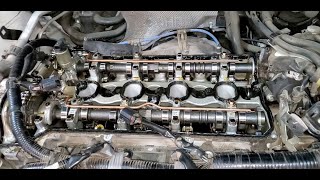
- Clogged Oil Pickup Tube/Strainer: Sludge or debris in the oil pan can clog the oil pump's pickup tube, starving the pump of oil and causing low pressure. This often happens due to extended oil change intervals or internal engine issues like failing injector seals on diesel models. 🎬 Watch: Fixing P0524 and P055F codes on Skyactiv diesel engines.
- Worn Internal Engine Components: In high-mileage engines, excessive wear on crankshaft bearings or camshaft journals can create larger clearances, leading to a drop in overall oil pressure. This is a worst-case scenario requiring an engine rebuild or replacement.
Diagnosis Steps
- STOP DRIVING IMMEDIATELY. Tow the vehicle for diagnosis to prevent engine damage.
- Check the engine oil level and condition. If low, top up with the correct viscosity oil (Mazda 0W-20 recommended for non-turbo). If the oil is old or contaminated, perform an oil and filter change using an OEM filter.
- Scan the PCM for stored trouble codes. Note if P0524 is present with P055F, as this strongly points towards the TSB-related issues.
- Consult Mazda TSBs. Check the vehicle's VIN and production date against bulletins like 01-020-18, 01-004-21, and 01-003-24.
- If the oil level is correct, connect a mechanical oil pressure gauge to the engine to verify the actual oil pressure. This is the most critical step to differentiate between a real pressure problem and a sensor issue.
- If mechanical pressure is good, the oil pressure sensor (PX9R-18-541) is likely faulty. Replace it.
- If mechanical pressure is low, and the vehicle matches a TSB profile, the next step is to replace the engine oil solenoid valve (PE01-14-420A), change the oil/filter, and perform a PCM software update.
- If the pressure remains low after the TSB procedure, further mechanical inspection of the oil pump, pickup tube, and internal engine bearings is required.
Parts You'll Likely Need
- Engine Oil Solenoid Valve
(OEM #PE01-14-420A)— This part is identified in multiple Mazda TSBs as a primary cause of P0524 due to sticking from oil contamination or slow response time. It often supersedes part number PE01-14-420.
Trusted brands: Mazda (OEM)
OEM price range: $60-$100
Aftermarket price range: $40-$80 - Engine Oil Pressure Sensor / Switch
(OEM #PX9R-18-541)— This sensor can fail and send false low-pressure signals to the PCM. It's a common failure point. This part number supersedes PY8V-18-541B and SH01-18-541.
Trusted brands: Mazda (OEM), Bosch, Standard Motor Products
OEM price range: $75-$120
Aftermarket price range: $25-$75
Related Codes That Often Appear With This One
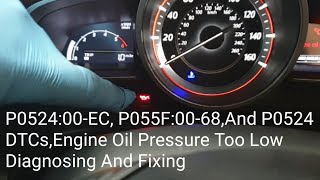
- P055F — This code for 'Engine Oil Pressure Malfunction' is almost always seen with P0524 and is mentioned in the same Mazda TSBs related to the sticking oil solenoid valve and PCM logic.
- P0015 — 'Exhaust CMP Timing Over-Retarded.' TSB 01-016-19 notes that a drop in oil pressure can cause this timing-related code to appear alongside P0524.
- P2096 / P2097 — A TSB mentions these air-fuel ratio codes can appear with P0524 and may be difficult to clear until the root oil pressure issue is resolved.
- P250F — This code for 'Engine Oil Level Low' may appear on certain 2021 models with a known oil consumption issue due to bad valve seals, which can be a precursor to the low pressure P0524 code.
Technical Service Bulletins (TSBs) & Recalls
- 01-003-24: Check Engine Light on with DTC P0524:00 or P055F:00 due to stuck engine oil solenoid valve.
- 01-004-23: Superseded bulletin for P0524/P055F, noting oil contamination as the cause for the stuck solenoid and modifying PCM software.
- 01-012-20-3738: Mentions P0524 appearing with air-fuel ratio codes (P2096/P2097) that may be difficult to clear.
- SA-055-20a: Service alert for P0524/P055F on vehicles outside the TSB 01-020-18 VIN range, instructing technicians to check oil condition and use of an OEM filter before contacting the hotline.
- 01-016-19-3627: Links P0524 with P0015 (Exhaust CMP Timing Over-Retarded) due to a drop in oil pressure.
- 01-020-18-3521: Specifically for 2018 CX-5s with cylinder deactivation, blaming 'improper PCM control logic' for slow oil pressure rise and instructing a PCM reprogram.
- 01-004-21: A widely cited bulletin covering 2018-2021 CX-5, Mazda6, and Mazda3, detailing the full repair of replacing the solenoid, changing oil/filter, and reprogramming the PCM.
Platform-Specific Known Issues
- Cylinder Deactivation (CD) Engine Prominence: The vast majority of TSBs and owner complaints regarding P0524 on the 2nd generation CX-5 are specific to the 2.5L SKYACTIV-G engine with cylinder deactivation, introduced in 2018. The TSBs often specify VIN ranges for vehicles with CD and the repair procedures are centered around components (like the oil solenoid valve) that are critical for the CD system's operation.
- PCM Software Logic Flaws: Early 2018 models were subject to TSB 01-020-18, which stated the cause was not a mechanical failure but 'improper PCM control logic' causing the oil valve to respond too slowly. This highlights that for some vehicles, the fix is purely a software update, making dealer diagnosis essential.
- Oil Contamination Sensitivity: Later TSBs (like 01-004-23) shift the focus to 'contamination in the engine oil' causing the solenoid valve to stick. This suggests the system is sensitive to oil quality and condition, reinforcing the importance of using high-quality, OEM-spec oil and filters and adhering to change intervals. Mazda even notes that factory processes were updated to reduce contamination.
Mechanic-Grade Diagnostic Values
- Engine Oil Pressure (Mechanical Gauge) — expected: 110—175 kPa (16.0—25.3 psi) at 1,500 rpm. Failure: Pressure below 110 kPa (16.0 psi) at 1,500 rpm indicates a mechanical oil pressure issue.
- Engine Oil Pressure (Mechanical Gauge) — expected: 300—430 kPa (43.6—62.3 psi) at 4,500 rpm. Failure: Pressure below 300 kPa (43.6 psi) at 4,500 rpm indicates a mechanical oil pressure issue.
- Live Data: Oil Pressure at Idle (SKYACTIV-D 2.2L) — expected: ~150-180 kPa with engine oil temp between 70-80°C. Failure: Significantly lower pressure reading at idle.
- Live Data: Oil Pressure at 3,500 RPM (SKYACTIV-D 2.2L) — expected: ~360 kPa with engine oil temp above 87°C. Failure: Pressure fails to rise to the target level, indicating a potential pump, strainer, or control valve issue.
Scan Tool Commands That Help
- Mazda M-MDS (or equivalent): PCM Reprogramming — This is a required step after replacing the engine oil solenoid valve, as per multiple TSBs (e.g., 01-004/21). The software update corrects control logic that can cause the valve to operate too slowly.
- Advanced Scan Tool (e.g., FORScan, Launch): View Live Data PIDs for 'Oil Pressure' and 'Oil Pressure Control Duty Cycle' — To monitor the PCM's commanded duty cycle to the oil control solenoid and the resulting oil pressure reported by the sensor. This helps determine if the control system is functioning as expected or if there's a discrepancy between command and result.
Wiring & Ground Locations
- Oil Pressure Sensor/Switch — On the engine block, typically on the passenger side. Access may require removing the front passenger tire and splash shield. On some models, the coolant overflow reservoir may need to be moved for better access.. This is the primary sensor that reports the pressure reading to the PCM. A faulty sensor, damaged connector, or compromised wiring at this location can directly cause a P0524 code by sending an incorrect signal.
- Engine Oil Solenoid Valve Connector — Located on the engine oil solenoid valve body, which is mounted to the engine block. Wiring diagrams are needed for specific pinouts.. A poor connection or damaged wiring to the solenoid will prevent it from operating correctly, leading to improper oil pressure regulation and triggering P0524 and P055F, as described in Mazda TSBs.
Real Owner Repair Stories
- Mazdas247 Forum User 'changes13' (2018 Mazda CX-5 AWD Touring, 4,900 miles) — Check Engine Light on with code P0524. Oil level was normal. No other warning lights or driveability issues noted.
❌ Tried (didn't work) Initially, the dealer just reset the code, but it returned.
✅ What actually fixed it The dealer checked the oil pressure and found it was 'within spec'. They then found a TSB related to the issue and performed a PCM reflash (software update), which resolved the problem. - Mazdas247 Forum User 'ferro_sk' (2018 Mazda CX-5 2.5L G194 (European model)) — Check Engine Light came on at ~1800km. No noticeable driveability issues.
❌ Tried (didn't work) The dealer initially just reset the error code, but the light came on again after about 100km.
✅ What actually fixed it After the code returned, the dealer, in consultation with Mazda support, replaced the oil control solenoid valve, the oil pump, the oil pressure sensor, and the connecting rod bearings. This comprehensive repair fixed the issue. - Reddit User 'I see the same thing...' (2019 Mazda CX-5 (non-turbo)) — Intermittent low oil pressure light at highway RPMs, which would sometimes go away on slower roads.
❌ Tried (didn't work) An oil change at a non-dealer shop (Firestone) using an aftermarket (Pennzoil) filter. The problem would disappear for a month or two and then return.
✅ What actually fixed it Switching to only using genuine OEM Mazda oil filters during oil changes at the dealership. The user noted that aftermarket filters can interrupt the normal oil circuit, and the problem has not returned since exclusively using OEM filters.
OEM Part Supersession History
PE01-14-420→PE01-14-420A— Updated part to address sticking and slow operation issues identified in TSBs.
Heads up: PE01-14-420A is the recommended replacement for all applications and should be used instead of the original part.PY8V-18-541B→PX9R-18-541— Part revision for the oil pressure sensor/switch.
Model Year Variations Within This Range
- 2018+: The introduction of the 2.5L SKYACTIV-G engine with cylinder deactivation (CD) is a major factor. TSBs 01-020-18 and 01-004/21 specifically call out these models, linking P0524 to improper PCM logic and a sticking oil solenoid valve related to the CD system's operation.
- 2018: A specific TSB (01-020-18) applies only to 2018 CX-5s with VINs lower than JM3KF**406225 (produced before May 7, 2018), indicating an early production software issue was a primary cause.
Helpful Videos


We Have This Part in Stock



The information in this article is provided for general reference and educational purposes only. Vehicle specifications, procedures, and part compatibility can vary by production date, trim level, and region. Always consult your vehicle's factory service manual and verify part numbers before purchasing or performing repairs. Safety-critical components such as airbags, seat belts, and braking systems should be installed by a qualified professional.
- Mazda CX-5:
- 🎬 Helpful Videos
- 🛍️ Shop This Part
- What's Unique About the 2014-2021 Mazda CX-5
- Diagnostic Flowchart
- Symptoms You May Notice
- Most Likely Causes
- Rare But Worth Checking
- Diagnosis Steps
- Parts You'll Likely Need
- Related Codes That Often Appear With This One
- Technical Service Bulletins (TSBs) & Recalls
- Platform-Specific Known Issues
- Mechanic-Grade Diagnostic Values
- Scan Tool Commands That Help
- Wiring & Ground Locations
- Real Owner Repair Stories
- OEM Part Supersession History
- Model Year Variations Within This Range
- 🎟️ Get 5% Off