

P0521 on 2005-2012 Chevrolet Tahoe: Oil Pressure Sensor Causes and Fixes
On a 2005-2012 Tahoe, code P0521 is most often caused by a faulty oil pressure sensor or its small, removable filter screen located at the back of the engine. Replacing the sensor and screen is a common fix, costing around $40-$80 for parts. Using the correct ACDelco PF48E oil filter is also critical, as specified in GM service bulletins to prevent this code. For engines with Active Fuel Management (AFM), this code can also be an early indicator of oil consumption or sludging issues.
- P0521 on a 2005-2012 Tahoe is most commonly a sensor circuit issue, not a catastrophic engine failure.
- The top two causes are a bad oil pressure sensor and its tiny, easily clogged filter screen located under it.
- Always replace the sensor and the screen together. Using an OEM ACDelco sensor is highly recommended.
- Always use an ACDelco PF48E oil filter and the correct viscosity oil, as specified in GM service bulletins, to prevent this code.
- Never ignore this code. You must confirm whether the oil pressure is actually low by using a mechanical gauge before driving further.
What's Unique About the 2005-2012 Chevrolet TAHOE

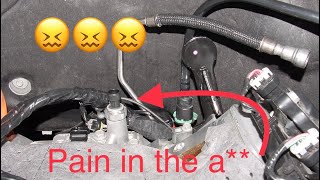
For this generation of Tahoe, particularly the 2007-2012 models with V8 engines featuring Active Fuel Management (AFM), oil pressure issues are a known concern. GM has issued multiple Technical Service Bulletins (TSBs) that link code P0521 to the type of oil filter used, specifically recommending the ACDelco PF48E filter to resolve issues that can appear after an oil change. The oil pressure sensor is also located in a difficult-to-access position at the back of the engine, and it includes a small, thimble-sized filter screen underneath it that frequently becomes clogged with sludge 🎬 See how to properly remove and clean the filter screen., leading to faulty readings. Furthermore, AFM engines have a Valve Lifter Oil Manifold (VLOM) which also contains a filter that can get clogged, and are susceptible to oil consumption issues which can exacerbate low pressure problems.
Diagnostic Flowchart

Tap your situation to follow the diagnostic path that matches what you're seeing on this vehicle.
Generation note: This range covers two Tahoe generations: the end of the 2nd Gen (GMT800, 2005-2006) and the beginning of the 3rd Gen (GMT900, 2007-2012). The causes are similar, but the 3rd Gen models with Active Fuel Management (AFM) V8s are particularly susceptible to issues related to the oil pressure sensor screen and oil consumption, as noted in GM TSBs like #10-06-01-008H which addresses oil consumption. These AFM-related issues can lead to sludge that clogs the sensor screen.
Symptoms You May Notice
- Check Engine Light is on
- Low Oil Pressure warning light or message on the instrument panel
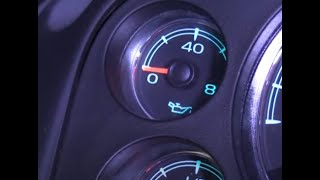
- Oil pressure gauge reads abnormally low (near zero) or abnormally high (maxed out).
- Engine may run rough or make unusual noises, like ticking or knocking.
- Remote start system is disabled.
- Service Stabilitrak / Traction Control message may appear, sometimes in conjunction with misfire codes.
- Replacing the oil pump before verifying actual oil pressure with a mechanical gauge.
- Replacing the instrument cluster or ECM when the issue is a simple sensor or clogged screen.
- Repeatedly replacing the sensor with aftermarket parts that fail quickly, instead of using a quality OEM part.
Most Likely Causes


- Faulty Oil Pressure Sensor 🔴 High Probability The sensor is a common failure point on these GM V8 engines. Aftermarket sensors have a reputation for premature failure, with some owners reporting they fail within months, making OEM ACDelco parts highly recommended.
How to confirm: With the engine running, unplugging the sensor should cause the gauge to drop to zero; this often points to the sensor or wiring. The most definitive test is to compare the gauge reading to a reading from a mechanical oil pressure gauge connected to the engine.
Typical fix: Replace the oil pressure sensor. This is located at the back of the engine, behind the intake manifold, and requires a special deep socket (1-1/16" or 27mm), a universal swivel joint, and several extensions to access.
Est. part cost: $35-$75 - Clogged Oil Pressure Sensor Filter Screen 🔴 High Probability A small, thimble-like filter screen is installed in the block underneath the oil pressure sensor. It is designed to protect the sensor but often clogs with sludge and debris, especially on engines with AFM or extended oil change intervals. TSB #PIP4786C directly addresses inspecting this filter for sludge.
How to confirm: The screen can only be inspected upon removal of the oil pressure sensor. It is often visibly clogged with black sludge.
Typical fix: Remove and replace the filter screen when replacing the oil pressure sensor. The old screen can be extracted using a pick or by threading a small bolt (commonly a 5/16" bolt) into it and pulling it out.
Est. part cost: $5-$15 - Incorrect or Low-Quality Oil Filter 🟡 Medium Probability GM has issued multiple TSBs (e.g., #PIP5276E, #PIP5276G) specifically advising the use of an ACDelco PF48E oil filter to prevent P0521, especially after an oil change. Forum users corroborate that switching to the recommended ACDelco or a high-quality alternative like the Mobil 1 M1-113A can resolve the code.
How to confirm: Check the part number of the currently installed oil filter. If it is not an ACDelco PF48 or PF48E (or a proven high-quality equivalent), it could be the cause.
Typical fix: Perform an oil change using the correct viscosity oil and install an ACDelco PF48E oil filter.
Est. part cost: $5-$10 - Low or Incorrect Engine Oil 🟡 Medium Probability Many of these V8 engines, especially those with AFM, are known to consume oil, as documented in TSB #10-06-01-008H. If the level drops too low, it can cause a loss of pressure and trigger the code.
How to confirm: Check the engine oil level on the dipstick and verify its condition. If it is low, black, or sludgy, it needs to be changed.
Typical fix: Top off or change the engine oil and filter. Reset the code and monitor if it returns.
Est. part cost: $40-$80
Rare But Worth Checking
- Failing Oil Pump or Worn Pickup Tube O-Ring: If the oil pressure is confirmed to be low with a mechanical gauge, the issue is more serious. A worn or cracked pickup tube O-ring in the oil pan can cause the pump to suck air, leading to system-wide low pressure. This is a more involved repair that requires dropping the oil pan.
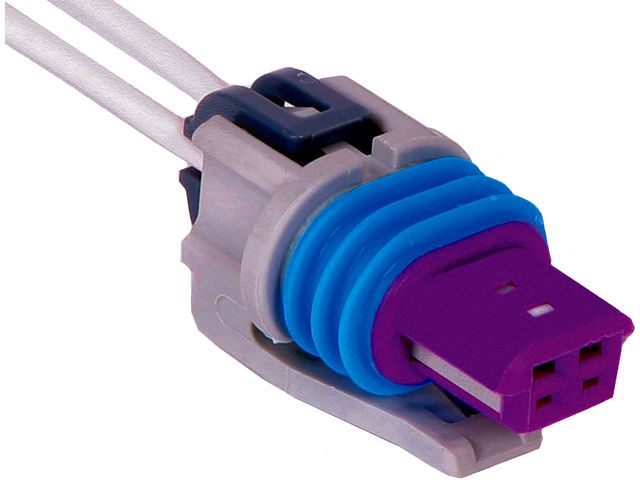
- Wiring Harness or Connector Issue: The wiring and connector (pigtail) to the oil pressure sensor are located in a hot, hard-to-reach area. They can become brittle, corroded, or damaged, leading to a bad signal. Checking the wiring for breaks or a poor connection is a key diagnostic step. The pigtail connector is available as a replacement part (e.g., ACDelco PT121).
- Internal Engine Wear: On very high-mileage engines, worn internal components like cam bearings can cause a genuine loss of oil pressure, which is a severe mechanical problem requiring engine overhaul.
- Clogged Valve Lifter Oil Manifold (VLOM) Filter: On AFM engines, a separate filter screen exists within the VLOM. TSB #PIP4786C notes that if pressure is good at the oil filter housing but low on the scan tool, this filter may be clogged with sludge, restricting flow to the pressure sensor.
Diagnosis Steps
- Check the engine oil level and condition. Top off or change if necessary.
- Scan the ECM for P0521 and any other stored codes (like P0523 or P030x). Note the freeze frame data.
- Inspect the oil filter to ensure it is the correct part number (ACDelco PF48E is recommended by TSBs).
- Observe the oil pressure gauge on the dash. Does it read 0, max out at 80+, or fluctuate wildly?
- The most crucial step: verify the actual engine oil pressure using a mechanical gauge. GM's minimum spec is often cited as ~24 psi at 1,000 RPM and ~35 psi at 2,000 RPM when warm, but anything below 20 psi at hot idle warrants investigation. If mechanical pressure is steady and within spec while the dash gauge is erratic, the problem is in the sensor circuit.
- If actual pressure is good, the fault is in the sensor circuit. Proceed to replace the oil pressure sensor and the filter screen underneath it.
- While replacing the sensor, inspect the wiring harness and connector for any signs of damage, corrosion, or oil contamination. The connector can become brittle and difficult to remove.
- If actual pressure is confirmed low, the problem is more severe. Investigate a failing oil pump, a clogged oil pickup tube screen, or a bad pickup tube O-ring in the oil pan. A temporary test for a bad O-ring is to overfill the oil by ~2 quarts; if idle pressure temporarily returns to normal, the O-ring is likely the culprit.
Parts You'll Likely Need
- Engine Oil Pressure Sensor
(OEM #12677836 (supersedes 12616646, D1846A))— This is the most common part to fail, causing incorrect readings to the ECM and gauge.
Trusted brands: ACDelco (GM Genuine)
OEM price range: $40-$75
Aftermarket price range: $25-$50 - Engine Oil Pressure Sensor Filter
(OEM #12585328)— This small screen sits below the sensor and frequently clogs with sludge, blocking oil from reaching the sensor and causing a false low-pressure reading. It should always be replaced with the sensor.
Trusted brands: ACDelco, Dorman
OEM price range: $5-$10
Aftermarket price range: $3-$8 - Engine Oil Pressure Sensor Connector (Pigtail)
(OEM #ACDelco PT2310)— The original connector can become brittle from heat cycles and break during sensor replacement, or develop a poor connection. Replacing the pigtail ensures a solid electrical connection to the new sensor.
Trusted brands: ACDelco, Dorman
OEM price range: $20-$35
Aftermarket price range: $10-$20
Related Codes That Often Appear With This One
- P0300-P0308 — Severe oil pressure issues related to the AFM system can affect lifter operation, leading to engine misfires. A failing AFM lifter can cause a misfire on a specific cylinder (e.g., P0304, P0307) along with P0521.
- P0523 — This code for 'Engine Oil Pressure Sensor/Switch High Voltage' often appears alongside P0521, indicating the sensor signal is erratic and going both above and below the expected range.
Technical Service Bulletins (TSBs) & Recalls
- PIP5276E / PIP5276G: Advises checking for leaks and using a PF48E type filter if P0521 appears after an oil change.
- PIP4786C: Recommends inspecting the Valve Lifter Oil Filter for debris/sludge if scan tool pressure is low but actual pressure is normal.
- 10-06-01-008H: Details causes and fixes for excessive oil consumption on AFM engines, a condition that leads to sludge and can trigger P0521.
Platform-Specific Known Issues
- A known issue, documented in TSB #PIP5276E and #PIP5276G, links code P0521 to oil changes, recommending the use of an ACDelco PF48E filter to resolve the problem.
- On engines with Active Fuel Management (AFM), issues with the valve lifter oil manifold (VLOM) or a leaking baffle in the valve cover can contribute to oil consumption and sludging, which are root causes for the sensor screen clogging.
- TSB #PIP4786C specifically points to a clogged Valve Lifter Oil Filter as a cause for P0521 when mechanical pressure is good but the sensor reads low.
Mechanic-Grade Diagnostic Values
- 5-Volt Reference Circuit Voltage — expected: 4.8-5.2 Volts (Ignition ON, sensor disconnected). Failure: Voltage outside this range points to an issue with the ECM or wiring, not the sensor.
- Low Reference Circuit Resistance — expected: Less than 1.0 ohm (Ignition OFF, sensor disconnected, measured between low ref terminal and ground). Failure: Resistance greater than 1.0 ohm indicates an open or high resistance in the ground circuit.
- Sensor Signal Voltage — expected: Approx. 1.0 - 4.0 Volts (normal operating range). Failure: A signal less than 0.5V (P0522) or greater than 4.5V (P0523) for more than 10 seconds will set a fault code.
- ECM Pressure Comparison — expected: Measured oil pressure should not be 47 kPa (6.8 psi) lower or 50 kPa (7.3 psi) higher than the ECM's expected pressure for more than 4 seconds.. Failure: If the pressure difference exceeds these thresholds for the specified time, code P0521 will be set.
Scan Tool Commands That Help
- GDS2 / Tech2: Engine Oil Pressure Sensor parameter display — To monitor the oil pressure value being reported to the ECM in real-time. With the engine on, varying the RPM should show a corresponding change of more than 5 PSI on the scan tool. If the gauge on the dash is erratic but the scan tool reading is stable and logical, it could point to an instrument panel cluster issue.
Wiring & Ground Locations
- G102 — Located at the left rear of the engine, grounds the 8 ignition coils.. A poor ground here could potentially introduce electrical noise that may affect sensor readings, although it's not a primary cause for P0521.
- G103 — Located on the front of the right cylinder head on GMT900 models.. This is a critical ground for the Engine Control Module (ECM). A poor connection at G103 can cause a wide range of erratic sensor readings and codes, including P0521, due to an unstable ground reference for the ECM and its sensors.
- Oil Pressure Sensor Connector — At the sensor, top rear of the engine block, behind the intake manifold.. The connector has three terminals: Pin 1 is the Low Reference (ground), Pin 2 is the 5-volt reference from the ECM, and Pin 3 is the signal wire back to the ECM. Verifying voltage and ground at this connector is a key diagnostic step.
Real Owner Repair Stories
- Reddit user in r/ChevyTrucks (2013 Chevrolet Tahoe, 159k miles) — Recurring P0521 code. Check engine light returns 1000-1500 miles after an oil change.
❌ Tried (didn't work) Replacing the oil pressure sensor., Performing multiple oil changes.
✅ What actually fixed it The user found that using a specific high-quality oil filter (Mobil 1 M1-113A) and ensuring proper oil levels resolved the recurring code, highlighting the sensitivity to oil filters noted in GM TSBs. - Reddit user in r/AskMechanics (2007 Chevrolet Tahoe) — P0521 code returned about a week after repair.
❌ Tried (didn't work) Replacing the oil pressure switch and screen with an aftermarket part.
✅ What actually fixed it The problem was resolved by replacing the aftermarket sensor with an OEM ACDelco sensor. This is a common theme where aftermarket sensors fail to perform correctly or have a short lifespan in this application. - Tahoe Yukon Forum user (2014 Cadillac Escalade (similar platform)) — P0521 code, oil pressure gauge reading low.
❌ Tried (didn't work) Preparing to replace the sensor and filter.
✅ What actually fixed it The user discovered the engine oil was low by 2.5 quarts. Topping off the oil to the correct level restored normal oil pressure readings and resolved the code, underscoring the importance of checking the basics first.
OEM Part Supersession History
12616646→12677836 (also listed as D1846A)— GM regularly updates part designs to integrate new materials and technologies for improved reliability.
Heads up: While physically similar, using the latest revision (12677836) is highly recommended for longevity and to prevent premature failure, a common complaint with older revisions and aftermarket equivalents.
Model Year Variations Within This Range
- 2007-2012 (GMT900): The GMT900 generation introduced Active Fuel Management (AFM) on many 5.3L and 6.2L V8s. These engines are more prone to oil consumption and sludge buildup, which can clog the oil pressure sensor screen, the VLOM filter, and lead to lifter issues that may present with P0521. The earlier GMT800 (2005-2006) trucks did not have AFM, making them less susceptible to these specific sludge-related failure modes.
- 2007+: GMT900 models feature a more refined chassis with coil springs and rack-and-pinion steering, and later models received a 6-speed automatic transmission. While not directly related to P0521, the increased electronic complexity and different engine management software (for AFM) mean diagnostic approaches can vary slightly from the simpler GMT800 platform.
Helpful Videos
Used OEM Parts in Stock
New Aftermarket Parts Available

The information in this article is provided for general reference and educational purposes only. Vehicle specifications, procedures, and part compatibility can vary by production date, trim level, and region. Always consult your vehicle's factory service manual and verify part numbers before purchasing or performing repairs. Safety-critical components such as airbags, seat belts, and braking systems should be installed by a qualified professional.
- Chevrolet TAHOE:
- 🎬 Helpful Videos
- 🛍️ Shop This Part
- What's Unique About the 2005-2012 Chevrolet TAHOE
- Diagnostic Flowchart
- Symptoms You May Notice
- Most Likely Causes
- Rare But Worth Checking
- Diagnosis Steps
- Parts You'll Likely Need
- Related Codes That Often Appear With This One
- Technical Service Bulletins (TSBs) & Recalls
- Platform-Specific Known Issues
- Mechanic-Grade Diagnostic Values
- Scan Tool Commands That Help
- Wiring & Ground Locations
- Real Owner Repair Stories
- OEM Part Supersession History
- Model Year Variations Within This Range
- 🎟️ Get 5% Off