

P0520 on 2013-2014 Jeep Wrangler: Engine Oil Pressure Sensor Circuit Guide
On a 2013-2014 Jeep Wrangler, the P0520 code almost always points to a faulty engine oil pressure sensor. Jeep issued a Technical Service Bulletin (TSB 18-034-14 REV. A) to replace the original sensor with a revised part. The sensor is located under the intake manifolds, making it a difficult (4/5) DIY job. Many owners and mechanics recommend replacing the entire oil filter/cooler housing assembly (which includes the sensor) with an upgraded aluminum version to prevent future leaks.
- P0520 on a 2013-14 Wrangler is almost certainly a bad oil pressure sensor.
- Jeep issued a TSB (18-034-14 REV. A) for this exact problem, calling for a revised sensor.
- The repair is very labor-intensive (3-5 hours) because the sensor is buried under the intake manifolds.
- While you have it apart, it is highly recommended to replace the entire oil filter/cooler housing assembly, preferably with a durable aluminum aftermarket unit, to prevent future oil leaks.
What's Unique About the 2013-2014 Jeep WRANGLER

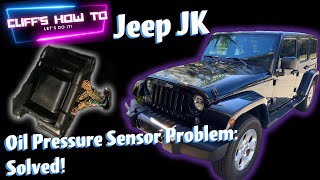
The 3.6L Pentastar V6 engine in the 2013-2014 Wrangler (JK generation) has a well-documented history with the P0520 code. The issue was so common that Jeep issued a Technical Service Bulletin (TSB 18-034-14 REV. A 🎬 Watch: A complete walkthrough of the P0520 sensor fix) acknowledging the problem and instructing technicians to replace the original oil pressure sensor with a revised part. The sensor is notoriously difficult to access, as it's located deep in the engine valley, under the upper and lower intake manifolds, as part of the oil filter/cooler housing assembly. This placement makes a simple sensor replacement a significant labor event.
Diagnostic Flowchart
Tap your situation to follow the diagnostic path that matches what you're seeing on this vehicle.
Symptoms You May Notice
- Check Engine Light (CEL) is on.
- No noticeable performance issues or drivability problems.
- Oil pressure gauge on the dashboard may read zero, an erratic value, or a normal value.
- In some cases, the code may appear intermittently, sometimes clearing on its own before returning.
- Replacing the oil pump. The P0520 code specifically points to an electrical circuit issue, not a mechanical pressure problem.
- Assuming low engine oil. While low oil can cause pressure issues, P0520 is an electrical fault code. Always check the oil level first, but the root cause is rarely the oil level itself.
Most Likely Causes

- Faulty Engine Oil Pressure Sensor 🔴 High Probability The original sensor was prone to failure, leading Jeep to issue TSB 18-034-14 REV. A, which calls for replacement with a revised part. The sensor is a known common failure item across the entire 3.6L Pentastar engine family.
How to confirm: After confirming proper oil level and checking the wiring, the sensor itself is the most likely culprit. A scan tool can monitor the sensor's output; a lack of signal or an erratic signal points to a bad sensor. Diagnosis requires testing the 5V reference, ground, and signal wires at the sensor connector, which is difficult to access.
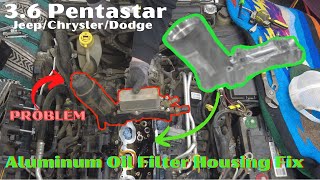
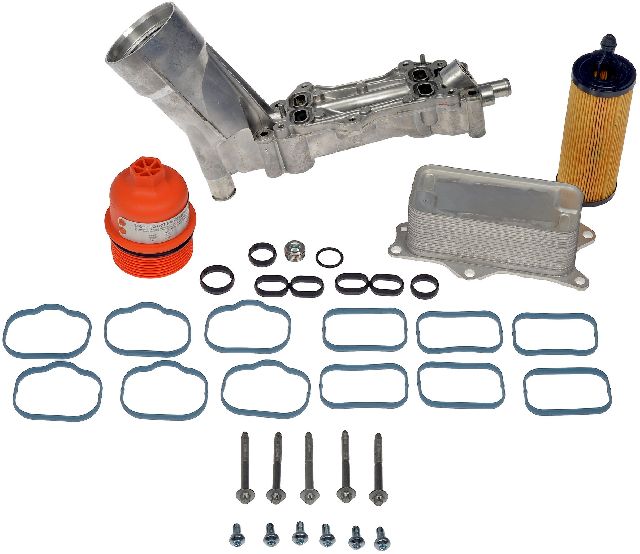
Typical fix: Replace the engine oil pressure sensor. Due to the difficult location, many owners and mechanics recommend replacing the entire oil filter/cooler housing assembly at the same time. This addresses potential leaks from the original plastic housing and includes a new sensor. Upgrading to a metal (aluminum) housing like the Dorman 926-959 is a popular 🎬 See how to install the upgraded aluminum oil cooler housing, more durable repair.
Est. part cost: $25-$60 for the sensor only, $120-$250 for the complete oil filter housing assembly. - Wiring Harness or Connector Issue ⚪ Low Probability The engine harness is routed in a tight space. While less common than sensor failure, wires can be damaged or connectors can become contaminated with oil from a leaking oil filter housing.
How to confirm: Visually inspect the wiring harness and connector leading to the oil pressure sensor for any signs of damage, corrosion, or loose connections. This requires removing the intake manifolds for access. Test for continuity, power (5V), and ground at the connector with a multimeter.
Typical fix: Repair or replace the damaged section of the wiring harness or the connector. Clean any oil contamination from the connector pins.
Est. part cost: $10-$50
Rare But Worth Checking
- Powertrain Control Module (PCM) Fault: This is extremely rare. All other possibilities, especially the sensor and its wiring, should be exhaustively ruled out before considering the PCM as the cause.
- Dual-Stage Oil Pump Solenoid Issue: The 3.6L Pentastar uses a dual-stage oil pump. A failure in the pump's control solenoid can cause pressure regulation issues that may, in some cases, trigger sensor circuit codes like P0520, often accompanied by P06DE. This is less common than a direct sensor failure.
Diagnosis Steps

- Verify the engine oil level and condition. Ensure it is full and not overly dirty.
- Use an OBD-II scanner to confirm the P0520 code and check for any other related codes, such as P0522 or P06DE.
- Begin disassembly to access the sensor. This requires disconnecting the battery, removing the air intake assembly, throttle body, and detaching numerous electrical connectors and brackets from the upper intake manifold.
- Remove the seven bolts holding the upper intake manifold and set it aside.
- Stuff rags into the lower intake ports to prevent debris from falling into the engine.
- Remove the eight bolts holding the lower intake manifold. The fuel rail may need to be unbolted and moved aside.
- Lift the lower intake manifold and prop it up or remove it completely to gain access to the oil filter housing in the engine valley.
- Locate the oil pressure sensor on the housing; it is typically the lower of two sensors (the upper one is the oil temperature sensor).
- Inspect the wiring and connector for visible damage, corrosion, or oil contamination.
- If wiring appears intact, use a multimeter to test the three pins on the connector for a 5V reference signal, a good ground, and the signal wire continuity back to the PCM.
- If the circuit tests okay, the oil pressure sensor is the confirmed cause. Replace the sensor as per TSB 18-034-14 REV. A.
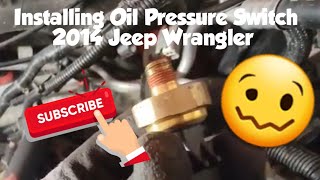
- During reassembly, replace the lower and upper intake manifold gaskets to prevent vacuum leaks. 🎬 Watch: Step-by-step guide to installing the new pressure switch Torque the lower intake manifold bolts to ~80 in-lbs (9 Nm) and the upper intake manifold bolts to ~80 in-lbs (9 Nm).
Parts You'll Likely Need

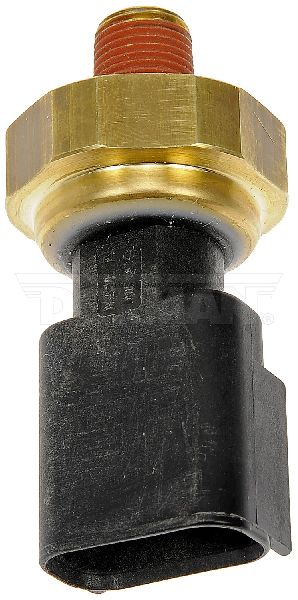
- Engine Oil Pressure Sensor
(OEM #Mopar 5149062AB)— This is the component identified as the failure point in manufacturer service bulletins and numerous owner complaints.
Trusted brands: Mopar, Dorman, Standard Motor Products (SMP)
OEM price range: $40-$60
Aftermarket price range: $25-$45 - Engine Oil Filter Adapter Housing Assembly
(OEM #68105583AF (or newer revisions like 68105583AG, 68596317AB))— The sensor is located in this housing, which is difficult to access. The original plastic housing can also crack and leak. Replacing the entire assembly is a common preventative repair that includes new sensors, gaskets, and an oil cooler, saving future labor.
Trusted brands: Mopar (Plastic), Dorman OE FIX (Aluminum, P/N 926-959), Crown Automotive
OEM price range: $180-$250
Aftermarket price range: $120-$200 - Intake Manifold Gasket Set
(OEM #Fel-Pro MS 97204)— The upper and lower intake manifolds must be removed to access the sensor, and the gaskets should always be replaced during reassembly to prevent vacuum leaks.
Trusted brands: Fel-Pro, Mopar
OEM price range: $30-$50
Aftermarket price range: $20-$40
Related Codes That Often Appear With This One
- P06DE — P06DE indicates the engine oil pressure control circuit is stuck on (high pressure mode). Since the oil pressure sensor provides the feedback for this system, a faulty sensor throwing P0520 can also trigger P06DE as the PCM defaults to high pressure mode for safety.
- P0522 — This code indicates 'Engine Oil Pressure Sensor/Switch Circuit Low'. It is a more specific version of P0520 and often points directly to a failed sensor or a short in the wiring. It frequently appears alongside P0520.
Technical Service Bulletins (TSBs) & Recalls
- 18-034-14 REV. A: States that for a P0520 code, the fix involves replacing the oil pressure sensor with a revised part (Mopar P/N 5149062AB). This TSB applies to 2013-2014 JK Wranglers among many other Chrysler vehicles with the 3.6L engine.
Platform-Specific Known Issues
- A known issue documented by Jeep TSB #18-034-14 REV. A involves a faulty original-spec oil pressure sensor, which requires replacement with a revised part to resolve the P0520 code.
- The location of the sensor on the 3.6L Pentastar engine is extremely difficult to access, requiring the removal of the upper and lower intake manifolds.
- The original plastic oil filter housing is prone to cracking and leaking oil into the engine valley. Many owners proactively replace the entire housing with a more durable aluminum aftermarket version (e.g., Dorman 926-959) when replacing the sensor to prevent future failures.
Mechanic-Grade Diagnostic Values
- Engine Oil Pressure Sensor Signal Voltage (Key On, Engine Off) — expected: ~0.5 Volts. Failure: Voltage significantly different from 0.5V, or voltage present when the sensor is disconnected, indicates a circuit fault. Voltage near 4.5-5.0V with the engine off points to a shorted sensor.
- Engine Oil Pressure Sensor Signal Voltage (Full Scale) — expected: ~4.5 Volts. Failure: The sensor should produce a linear voltage signal that changes proportionately with pressure. A signal that is stuck high, low, or does not change indicates a failed sensor or circuit issue.
- Sensor 5V Reference Voltage — expected: 5.0 Volts. Failure: No voltage or low voltage indicates a problem with the PCM or the wiring between the PCM and the sensor.
Scan Tool Commands That Help
- Professional Scan Tool (e.g., WiTech, Autel, Snap-on): Live Data > PCM > Oil Pressure Sensor Voltage — Use this to monitor the sensor's voltage reading in real-time with the key on, engine off (should be ~0.5V) and while running. A static or out-of-range value confirms a sensor or circuit fault.
Wiring & Ground Locations

- Oil Pressure Sensor Connector (3-Pin) — On the oil filter housing assembly, in the engine valley, beneath the lower intake manifold.. This is the primary connection point to test the sensor circuit. It is prone to oil contamination from a leaking housing, which can disrupt the signal.
- PCM Connector C2, Pin 4 — The Powertrain Control Module (PCM) is located on the driver's side of the engine bay. C2 is one of the main harness connectors.. This is the termination point for the oil pressure sensor signal wire. For the 3.6L engine, the signal wire is Violet/Yellow (VT/YE) and connects to Pin 4 of the C2 connector. This allows for continuity testing of the signal wire from the sensor to the PCM.
- Sensor Pinout (at sensor connector) — On the harness connector for the oil pressure sensor.. Pin 1: 5V Reference (Brown/Orange). Pin 2: Signal Return (Violet/Gray). Pin 3: Sensor Ground (Dark Blue/Dark Green). These wire colors and functions are critical for accurate multimeter testing of the circuit.
- Ground G300 — On the body floor, between the front seats.. This is a major chassis ground point. While not a direct cause, poor grounds can introduce electrical noise and issues into various systems, including sensor readings.
- Ground G301 — Under the front passenger's seat.. Another key chassis ground point that ensures proper grounding for various electronic modules.
Real Owner Repair Stories
- JK-Forum.com user 'mbucy' (2012 Jeep Wrangler JKU) — Check Engine Light with code P0520.
❌ Tried (didn't work) Replaced the oil pressure sensor with a factory Mopar part.
✅ What actually fixed it The user reported that two consecutive factory replacement sensors failed, each lasting only about one month before the P0520 code returned. The thread did not have a final resolution, highlighting a potential issue with either recurring part failure or an underlying wiring problem that was not immediately obvious. - YouTube video regarding multiple codes (2013 Jeep Wrangler 3.6L) — Limp mode with codes P0642 (Sensor Reference Voltage 'A' Circuit Low), P2111, and P2122.
❌ Tried (didn't work) Sending the PCM for testing (it tested good).
✅ What actually fixed it A visual inspection of the shared 5V reference circuit harness (Pink/Yellow wire) revealed bare, shorting wires at the oil pressure sensor connector, which is located under the intake manifolds. The short on this shared circuit was also causing the throttle body and crank position sensor codes. Repairing the wiring at the oil pressure sensor connector resolved all codes.
OEM Part Supersession History
68105583AA, AB, AC, AD, AE→68105583AF, 68105583AG, 68596317AA, 68596317AB— Revisions to the plastic oil filter housing assembly to improve durability and prevent cracking/leaks. The design was changed in 2014 from metal to plastic, which led to these failures.
Heads up: While the housings are physically interchangeable, aftermarket aluminum upgrades like the Dorman 926-959 are widely recommended over any of the OEM plastic versions for long-term reliability.
Helpful Videos

Used OEM Parts in Stock


New Aftermarket Parts Available


The information in this article is provided for general reference and educational purposes only. Vehicle specifications, procedures, and part compatibility can vary by production date, trim level, and region. Always consult your vehicle's factory service manual and verify part numbers before purchasing or performing repairs. Safety-critical components such as airbags, seat belts, and braking systems should be installed by a qualified professional.
- Jeep WRANGLER:
- 🎬 Helpful Videos
- 🛍️ Shop This Part
- What's Unique About the 2013-2014 Jeep WRANGLER
- Diagnostic Flowchart
- Symptoms You May Notice
- Most Likely Causes
- Rare But Worth Checking
- Diagnosis Steps
- Parts You'll Likely Need
- Related Codes That Often Appear With This One
- Technical Service Bulletins (TSBs) & Recalls
- Platform-Specific Known Issues
- Mechanic-Grade Diagnostic Values
- Scan Tool Commands That Help
- Wiring & Ground Locations
- Real Owner Repair Stories
- OEM Part Supersession History
- 🎟️ Get 5% Off