

P0520 on 2013-2014 Dodge Journey: Engine Oil Pressure Sensor Circuit Fixes
On 2013-2014 Dodge Journeys, especially those with the 3.6L V6, the P0520 code is most often caused by a failed engine oil pressure sensor. A manufacturer Technical Service Bulletin (TSB) recommends replacing it with a revised part. The sensor itself is affordable, but replacement on the V6 is labor-intensive due to its location under the intake manifolds. On the 2.4L, the sensor is much easier to access.
- P0520 on a 2013-2014 Journey is almost always a faulty oil pressure sensor, a known issue confirmed by a manufacturer TSB.
- Do not drive the vehicle. You must first confirm whether the problem is a bad sensor or actual low oil pressure to avoid severe engine damage.
- On the 3.6L V6 engine, replacing the sensor is a complex job requiring removal of the intake manifolds. The DIY difficulty is high (5/5).
- On the 2.4L I4 engine, the sensor is much easier to access, making it a more straightforward DIY repair (2/5).
- When replacing the sensor on a 3.6L, use an OEM Mopar part and also replace the intake gaskets to prevent future problems.
What's Unique About the 2013-2014 Dodge JOURNEY
For the Dodge Journey, particularly models with the 3.6L Pentastar V6 engine, the P0520 code is a widely documented issue. The problem is so common that Dodge issued a Technical Service Bulletin (TSB #18-034-14 REV. A) for 2013-2014 models, acknowledging the fault and advising replacement of the original sensor with a revised part. The sensor's location on the 3.6L engine—buried under the upper and lower intake manifolds in the engine valley—makes what should be a simple repair a significantly more labor-intensive job. This contrasts with the 2.4L engine, where the sensor is more accessible at the front of the engine block.
Diagnostic Flowchart
Tap your situation to follow the diagnostic path that matches what you're seeing on this vehicle.
Symptoms You May Notice
- Check Engine Light is on
- Oil pressure warning light may be illuminated on the dashboard, sometimes flickering.
- Inaccurate or fluctuating oil pressure gauge reading (if equipped). Owners report the gauge may get stuck at a high value (like 99 PSI) even at idle, or drop to zero intermittently.
- Engine may enter a reduced power or "limp" mode.
- Remote start may be disabled by the system as a protective measure.
- Replacing the oil pump without first verifying low oil pressure with a mechanical gauge.
- Replacing the PCM when the fault lies with the sensor or wiring.
- On the 3.6L V6, replacing only the sensor when the entire oil cooler housing is cracked and leaking, leading to a repeat of the labor-intensive repair.
Most Likely Causes
- Faulty Engine Oil Pressure Sensor 🔴 High Probability A known issue acknowledged by a manufacturer TSB (#18-034-14 REV. A) for this specific model year range, which calls for a revised part. These sensors are a very common failure item across the entire 3.6L Pentastar engine family.
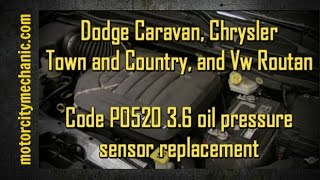
How to confirm: After verifying correct oil level and ruling out obvious wiring damage, the most definitive test is to check the actual oil pressure with a mechanical gauge. If the mechanical gauge shows good pressure while the code is present, the sensor is faulty. Many owners also confirm a bad sensor when the dash gauge shows a static, unchanging pressure reading (e.g. 99 PSI) while the engine is off. A scan tool showing voltage around 4.5V with the engine off 🎬 See how to diagnose the P0520 code on a Pentastar engine. also points to a bad sensor.
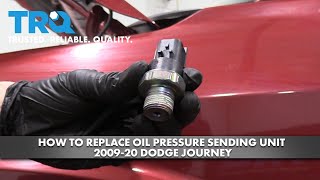
Typical fix: Replace the engine oil pressure sensor. On the 3.6L V6, this is a labor-intensive job requiring removal of the upper and lower intake manifolds to access the sensor on the oil cooler housing. On the 2.4L, the sensor is more accessible at the lower left side of the engine. 🎬 Watch this walkthrough for replacing the oil pressure sending unit.
Est. part cost: $25-$85 - Low or Incorrect Engine Oil 🟡 Medium Probability
How to confirm: Check the engine oil level using the dipstick. Ensure the oil is at the full mark and its condition is good (not sludgy or milky). Verify that the oil viscosity used matches the manufacturer's specification (e.g., 5W-20 or 5W-30 for the 3.6L, depending on the year).
Typical fix: Perform an oil and filter change using the correct grade of oil as specified in the owner's manual.
Est. part cost: $40-$90 - Wiring or Connector Issue ⚪ Low Probability The sensor wiring on the 3.6L V6 is located in the hot engine valley, which can make it susceptible to heat damage and oil contamination over time. The connector itself can become brittle and fail. Some owners report that the factory electrical system uses undersized wiring and insufficient grounds, which can contribute to electrical issues.
How to confirm: Visually inspect the wiring harness and connector leading to the oil pressure sensor for any signs of damage, corrosion, or oil saturation. Check for continuity and proper voltage at the connector using a multimeter. The circuit resistance should be below 5.0 Ohms, and there should be a 5V reference signal.
Typical fix: Repair or replace the damaged section of the wiring harness or clean/replace the connector pigtail.
Est. part cost: $5-$50
Rare But Worth Checking
- Failing Oil Pump or Clogged Oil Passages: While rare, this is a serious mechanical failure. If a mechanical gauge test confirms low oil pressure, the engine should not be run. This could be caused by a bad oil pump or sludge blocking oil passages. On the 3.6L, this can sometimes be related to a failure in the dual-stage oil pump, which may set a P06DD code.
- Faulty Powertrain Control Module (PCM): This is extremely rare and should only be considered after all other possibilities (sensor, wiring, and actual oil pressure) have been thoroughly ruled out.
Diagnosis Steps
- Check the engine oil level and condition. Top off or change the oil if necessary.
- Scan the vehicle for any other trouble codes that may be present. Note any codes like P0521, P0522, or P06DD.
- With the ignition on and engine off, use a scan tool to view the oil pressure sensor voltage and pressure reading. A reading of ~4.5V and high pressure (e.g., 99 PSI) indicates a likely sensor or circuit fault. A healthy sensor should read close to 0 PSI and a low voltage (e.g., ~0.4V).
- Visually inspect the oil pressure sensor's wiring and connector for damage, corrosion, or oil saturation.
- Connect a mechanical oil pressure gauge to the engine to verify the actual oil pressure. Compare the reading to the manufacturer's specifications.
- If mechanical pressure is good but the code persists, the oil pressure sensor is almost certainly faulty and should be replaced.
- If mechanical pressure is low, a serious internal engine problem exists (e.g., oil pump, clogged passages) that requires professional diagnosis. Do not run the engine.
- If the sensor and mechanical pressure are both good, test the sensor circuit. Check for 5V reference, good ground, and signal wire integrity. Resistance on the supply and ground circuits should be below 5.0 Ohms.
Parts You'll Likely Need
- Engine Oil Pressure Sensor
(OEM #68145662AB)— This is the most common failure point for this code on this vehicle, as confirmed by TSB 18-034-14 REV. A. This part number supersedes the earlier, more failure-prone part (68145662AA).
Trusted brands: Mopar, Standard Motor Products, NTK
OEM price range: $55-$85
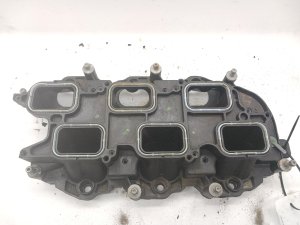
Aftermarket price range: $18-$58 - Upper and Lower Intake Manifold Gaskets (for 3.6L V6) — For the 3.6L V6 engine, the intake manifolds must be removed to access the oil pressure sensor. It is critical to replace the gaskets during reassembly to prevent vacuum leaks.
Trusted brands: Mopar, Fel-Pro, Mahle
OEM price range: $40-$70
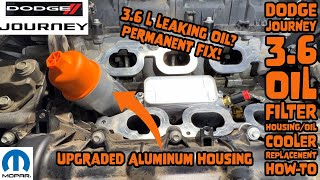
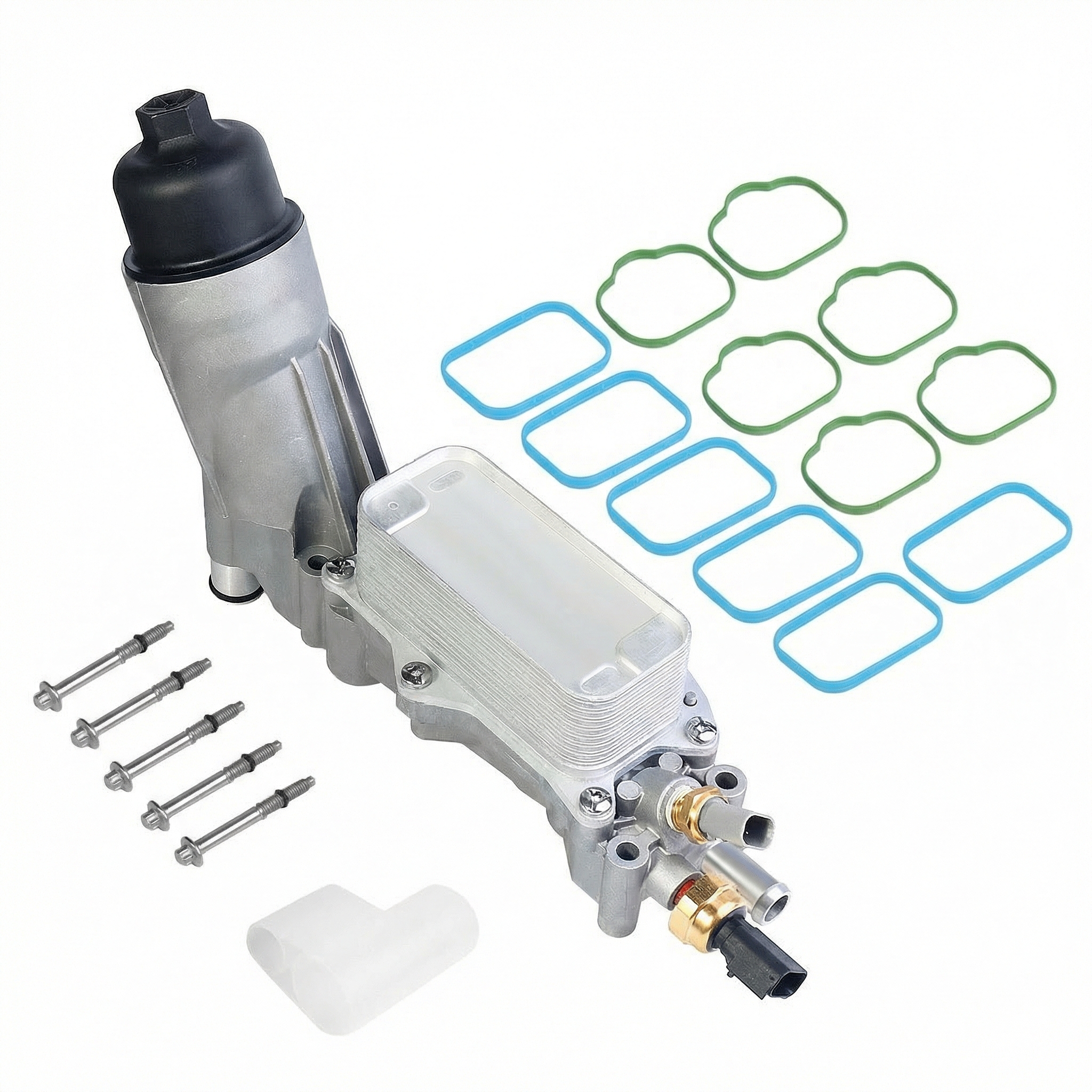
Aftermarket price range: $20-$40 - Oil Filter Housing / Cooler Assembly (for 3.6L V6) — Often replaced as a complete unit on the 3.6L V6. The original plastic housing is prone to cracking and causing oil/coolant leaks. Since the labor to access it is identical to replacing just the sensor, it is highly recommended to replace the entire assembly to prevent future leaks. Upgraded aluminum versions 🎬 Watch: Step-by-step guide to replacing the oil cooler housing. are available in the aftermarket.
Trusted brands: Mopar, Dorman (including aluminum versions)
OEM price range: $150-$250
Aftermarket price range: $100-$200
Related Codes That Often Appear With This One
- P0521 — This code indicates 'Engine Oil Pressure Sensor/Switch Range/Performance', suggesting the sensor is providing a reading that is erratic or out of its expected performance range, which often precedes a complete circuit failure (P0520).
- P0522 — This code for 'Engine Oil Pressure Sensor/Switch Circuit Low' can appear if the sensor circuit shorts to ground, which is one of the failure modes that triggers a general P0520 fault. It is often seen in tandem with P0520.
- P06DD — This code relates to the dual-stage oil pump being stuck in low pressure mode. A failing oil pump can cause a true low-pressure condition that the sensor correctly reports, triggering P0520 as a secondary symptom. Conversely, some forum users report that a faulty oil cooler/sensor assembly can sometimes trigger a P06DD code, making diagnosis complex.
Technical Service Bulletins (TSBs) & Recalls
- 18-034-14 REV. A: Addresses a Malfunction Indicator Lamp (MIL) with code P0520. It applies to 2013-2014 Journeys with the 2.4L and 3.6L engines (among many other Chrysler vehicles). The bulletin instructs technicians to replace the original oil pressure sensor with a revised part.
Platform-Specific Known Issues
- On the 3.6L Pentastar V6, the oil pressure sensor is located on the oil filter/cooler housing, which sits in the valley of the engine underneath the intake manifolds. This location makes replacement a 3-5 hour job.
- A Technical Service Bulletin (TSB #18-034-14 REV. A) was issued for the 2013-2014 Dodge Journey (and many other Chrysler/Dodge models) for the P0520 code, indicating a known problem with the original sensor on both the 2.4L and 3.6L engines.
- Due to the high labor cost to access the sensor on the 3.6L V6, it is highly recommended to replace the entire oil filter housing assembly, not just the sensor. The plastic housings are a known failure point for cracks and leaks.
- Some experienced DIYers have developed a shortcut method for the 3.6L V6, replacing the sensor from the side without removing the intake manifolds. This requires special tools like a specific oil pressure switch socket and swivel extensions, and is considered an advanced technique.
Mechanic-Grade Diagnostic Values
- Sensor signal voltage with key on, engine off (KOEO) — expected: Approx. 0.3-0.5 Volts. Failure: A reading of approx. 4.5V indicates a faulty sensor or open circuit.
- Sensor signal voltage rationality check (PCM check after engine shutoff) — expected: Between 0.29V and 0.78V. Failure: A voltage outside this range after shutdown can trigger the P0520 code, indicating the sensor is stuck or has drifted.
- Resistance of the 5-Volt Supply and Sensor Ground circuits — expected: Below 5.0 Ohms. Failure: Resistance higher than 5.0 Ohms indicates excessive resistance in the circuit that needs to be repaired.
- Resistance to ground on the Signal and 5-Volt Supply circuits — expected: Above 100 Ohms. Failure: Resistance below 100 Ohms indicates a short to ground in the circuit.
Scan Tool Commands That Help
- Generic OBD-II Scanner / wiTECH: Live Data: 'Engine Oil Pressure Sensor Voltage' and 'Engine Oil Pressure' — This is the primary method for diagnosis. With the key on and engine off, a faulty sensor often reads high voltage (~4.5V) and high pressure (~99 PSI), while a good sensor reads low voltage (~0.4V) and 0 PSI. This allows for quick confirmation of sensor failure without mechanical testing.
Wiring & Ground Locations
- Oil Pressure Sensor Connector (3-Pin) — On the sensor itself, located in the engine valley on the 3.6L V6 or the lower left side of the engine on the 2.4L.. The connector pinout is: 5-Volt Reference, Signal, and Ground. Knowing the pinout allows for targeted testing of voltage supply, ground integrity, and the signal wire back to the PCM.
- G101 — Located at the left end of the dash.. This is a primary ground point for multiple engine performance circuits, including the oil pressure sensor circuit. A poor connection here can cause erratic sensor readings.
- Main Engine to Chassis Grounds — A key ground runs from the negative battery post stud on the driver's strut tower to the engine block. Another exists on the passenger side engine mount to the passenger strut tower.. Owners and mechanics have noted that the factory grounding system can be inadequate. Poor grounding can cause a host of electrical issues, including intermittent and incorrect sensor readings. Upgrading these main grounds with heavier gauge wire is a known preventative fix for electrical gremlins on this platform.
Real Owner Repair Stories
- YouTube user 'Nick's Garage' (2013 Dodge Durango 3.6L V6 (same engine family)) — P0520 code returned shortly after a mobile mechanic replaced the entire oil filter housing assembly, which included a new sensor.
❌ Tried (didn't work) Replacing the entire oil filter housing assembly with a new unit that included new sensors.
✅ What actually fixed it The brand new oil pressure sensor that came with the new housing assembly was faulty out of the box. The technician confirmed this by plugging in another new, separate sensor and watching the scan tool voltage drop from 4.5V to ~0.4V with the engine off. Replacing just the sensor again with a known-good one resolved the code. - RamForum.com user 'spdfrkaby' (2013 Ram 1500 5.7L (different engine, but demonstrates a common FCA sensor issue)) — P0520 code, low oil pressure reading (12-15 PSI) on startup that would sometimes correct itself after a restart.
❌ Tried (didn't work) Replacing the oil pressure sensor with an aftermarket (BWD brand) sensor.
✅ What actually fixed it The aftermarket sensor was faulty or incompatible. Replacing the sensor a second time with a genuine OEM Mopar part (05149062AB) resolved the issue completely, with idle pressure returning to the correct 50+ PSI range.
When the Usual Fixes Don't Work
- While the vast majority of P0520 codes on this platform are fixed by replacing the sensor, there are documented cases where the fix is more complex. One technician encountered a vehicle where a brand new sensor, included in a complete oil cooler assembly, was defective from the factory, causing the code to persist until the 'new' sensor was itself replaced. In other cases across the FCA lineup, users have found that only OEM Mopar sensors will work correctly, while some aftermarket brands continue to cause erratic readings and codes. These instances highlight the importance of verifying the fix with scan tool data and using high-quality parts.
OEM Part Supersession History
68145662AA→68145662AB— The original 'AA' sensor was prone to premature failure, leading to the P0520 code. The 'AB' revision is a more durable part released to address this common issue, as noted in TSB 18-034-14 REV. A.
Helpful Videos
Used OEM Parts in Stock



New Aftermarket Parts Available


The information in this article is provided for general reference and educational purposes only. Vehicle specifications, procedures, and part compatibility can vary by production date, trim level, and region. Always consult your vehicle's factory service manual and verify part numbers before purchasing or performing repairs. Safety-critical components such as airbags, seat belts, and braking systems should be installed by a qualified professional.
- Dodge JOURNEY:
- 🎬 Helpful Videos
- 🛍️ Shop This Part
- What's Unique About the 2013-2014 Dodge JOURNEY
- Diagnostic Flowchart
- Symptoms You May Notice
- Most Likely Causes
- Rare But Worth Checking
- Diagnosis Steps
- Parts You'll Likely Need
- Related Codes That Often Appear With This One
- Technical Service Bulletins (TSBs) & Recalls
- Platform-Specific Known Issues
- Mechanic-Grade Diagnostic Values
- Scan Tool Commands That Help
- Wiring & Ground Locations
- Real Owner Repair Stories
- When the Usual Fixes Don't Work
- OEM Part Supersession History
- 🎟️ Get 5% Off