

P0507 on 2004-2012 Volvo S40: Causes for High Idle RPM and How to Fix It
On a 2004-2012 Volvo S40, code P0507 is most often caused by a vacuum leak from a failed PCV system (oil trap/breather box) or a dirty/faulty electronic throttle body. A high-pitched squeal or howl from the engine is a tell-tale sign of PCV failure. A PCV diaphragm repair kit can cost under $20, while cleaning the throttle body is a low-cost first step.
- P0507 on a Volvo S40 means the idle is too high, and the most likely cause is a vacuum leak.
- Before spending money on parts, check the PCV system. A loud squeal or a dipstick that's hard to pull out are tell-tale signs of failure.
- The second most common fix is cleaning the electronic throttle body to remove carbon buildup.
- This code is often paired with P0171 (System Too Lean), which reinforces the diagnosis of a vacuum leak.
- This is a very manageable DIY repair for many owners, with the most common parts being relatively inexpensive.
What's Unique About the 2004-2012 Volvo S40
The 2004-2012 Volvo S40 is built on the P1 platform, sharing its DNA with the C30, V50, C70, and some Ford/Mazda models. Its 5-cylinder engine uses an Electronic Throttle Module (ETM) instead of an older Idle Air Control (IAC) valve. A very common and well-documented failure point on these engines is the Positive Crankcase Ventilation (PCV) system, also known as the oil trap or breather box, which is integrated into the oil filter housing. When the PCV diaphragm tears, it creates a massive vacuum leak, which is a primary cause for the P0507 code on this specific vehicle.
Symptoms You May Notice
- Check Engine Light is on
- Engine idle speed is higher than normal (e.g., 1000-1500 RPM in Park).
- Fluctuating or surging idle speed, especially when stopping or in Park.
- A loud, high-pitched whistling, squealing, or howling noise from the engine bay, especially at idle (indicative of a PCV failure). The noise will stop if the oil dipstick is pulled or the oil filler cap is loosened.
- Rough or unstable idle.
- Potential for stalling when coming to a stop if the idle is erratic.
- Strong vacuum suction on the oil dipstick, making it difficult to remove while the engine is running.
- Replacing the throttle body without first checking for a much cheaper and more common PCV system failure.
- Replacing O2 sensors, as they may throw codes as a result of the lean condition caused by the vacuum leak, but are not the root cause.
- Assuming a generic vacuum leak when the signature squeal of a PCV failure is present.
Most Likely Causes
- Failed PCV System (Oil Trap/Breather Box) 🔴 High Probability The rubber diaphragm inside the PCV oil filter housing is known to tear over time, creating a significant unmetered air leak. This is a well-documented, high-frequency failure on Volvo's 5-cylinder engines used in the P1 platform.
How to confirm: With the engine running, a loud whistling or 'tea kettle' squealing sound will be present. The definitive test is to try and remove the oil dipstick or oil filler cap; a strong vacuum will hold it in place and a 'whoosh' of air will be heard when it's finally removed. The engine idle may stumble or the squealing noise will stop, confirming a crankcase vacuum leak from the PCV system.
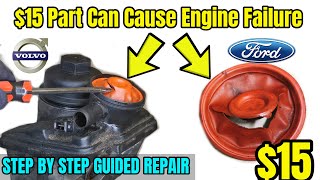
Typical fix: Replace the torn PCV diaphragm. Volvo dealers replace the entire oil filter housing assembly. A much cheaper and very common DIY fix is to replace only the diaphragm and cap, which are available from aftermarket suppliers like RKX, IPD, and others. The plastic_cap is pried off, the old diaphragm and spring are removed, and the new parts are installed.
Est. part cost: $15-$30 for a diaphragm kit, $150-$250 for a complete OEM oil filter housing assembly. - Dirty or Faulty Electronic Throttle Body (ETB) 🟡 Medium Probability Carbon and oil vapor from the PCV system can build up on the throttle plate and bore, preventing the plate from closing completely. This allows extra air to leak past, raising the idle.
How to confirm: Remove the air intake hose leading to the throttle body and visually inspect for a thick ring of black carbon buildup around the throttle plate and bore.
Typical fix: Clean the throttle body thoroughly with a dedicated throttle body cleaner and a soft cloth or brush. Do not spray cleaner directly into the electronic components. After cleaning or replacement, some vehicles may require an idle relearn procedure or a software adaptation using a Volvo-specific scan tool like VIDA.
Est. part cost: $5-$15 for cleaner, $300-$500 for a new throttle body. - Vacuum Leak (Other than PCV) 🟡 Medium Probability With age, rubber and plastic vacuum hoses, intake manifold gaskets, and the brake booster hose can crack or become disconnected, allowing unmetered air into the engine.
How to confirm: Listen for hissing sounds around the engine. A professional mechanic will use a smoke machine to pump smoke into the intake system, which will visibly escape from the site of the leak. A DIY method is to carefully spray short bursts of brake cleaner, starting fluid, or a water mist around potential leak areas; a change in idle RPM indicates you've found the leak.
Typical fix: Replace the cracked hose or failed gasket. A common culprit can be the short vacuum hose near the throttle body.
Est. part cost: $10-$100
Rare But Worth Checking
- Faulty Mass Airflow (MAF) Sensor: While not a primary cause, a MAF sensor that is dirty or failing can provide incorrect airflow readings to the ECM, which can contribute to idle control problems. This would typically be accompanied by other performance issues and codes.
- Leaking Fuel Injector Seals: The O-rings that seal the fuel injectors to the intake manifold can become hard and brittle with age, creating small vacuum leaks.
Diagnosis Steps
- Read the code with an OBD-II scanner and note any other codes present, especially P0171.
- With the engine running, listen for a loud, high-pitched whistling or squealing noise, which strongly points to a PCV system failure.
- Perform a check on the PCV system by carefully attempting to remove the oil dipstick while the engine is idling. If there is strong vacuum resistance and the noise stops when the dipstick is removed, the PCV diaphragm is torn.
- If no obvious PCV noise is present, inspect all visible vacuum lines for cracks, disconnection, or brittleness. Pay close attention to hoses connected to the intake manifold and brake booster.
- If no leaks are found visually, perform a smoke test to definitively locate any unmetered air leaks.
- Remove the intake pipe to the throttle body and inspect it for heavy carbon buildup. If dirty, clean it thoroughly using throttle body cleaner and a rag. Do not spray directly onto the electronics or move the throttle plate aggressively on an electronic throttle body.
- After cleaning, allow the vehicle to idle for several minutes to allow the ECM to relearn the new idle position. If issues persist, a software reset/relearn at a dealership using VIDA may be required.
- If the problem persists, monitor MAF sensor readings with a scan tool to ensure they are within specification.
Parts You'll Likely Need
- PCV Oil Trap Breather Diaphragm Kit
(OEM #31338685 (This is for the full housing; aftermarket diaphragm kits are widely available))— This is the most frequent cause of P0507 on this platform due to the high failure rate of the internal diaphragm, which creates a large vacuum leak. Replacing just the diaphragm is a very common and cost-effective repair.
Trusted brands: Volvo (OEM Housing), URO Parts (Housing), Rein (Housing), RKX (Diaphragm Kit), iPD (Diaphragm Kit)
OEM price range: $180-$250 (Full Housing)
Aftermarket price range: $15-$30 (Diaphragm Kit), $70-$120 (Full Housing) - Throttle Body Cleaner — Cleaning a carbon-fouled throttle body is a common, low-cost fix that can restore proper idle by allowing the throttle plate to close completely.
Trusted brands: CRC, WD-40, Gumout
Aftermarket price range: $5-$15 - Electronic Throttle Body
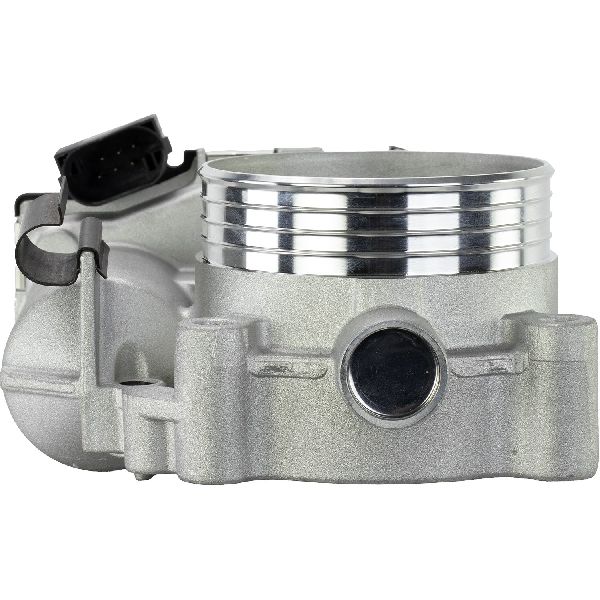
(OEM #30711554 (Bosch P/N: 0280750131))— If cleaning does not resolve the issue and the unit is electronically faulty, replacement is necessary. This is less common than a simple cleaning or a PCV failure. Note that a software update/re-adaptation by a dealer may be required after installation.
Trusted brands: Bosch (OEM supplier), Cardone (remanufactured), Genuine Volvo
OEM price range: $400-$500
Aftermarket price range: $250-$350
Related Codes That Often Appear With This One
- P0171 — System Too Lean (Bank 1). This code is very common with P0507 because a vacuum leak allows unmetered air into the engine, creating a lean air/fuel mixture that the O2 sensors detect.
Platform-Specific Known Issues
- The PCV system on the Volvo 5-cylinder engine is a known weak point. The diaphragm inside the oil filter housing assembly is not sold separately by Volvo, requiring replacement of the whole unit. However, the aftermarket has responded with inexpensive diaphragm-only repair kits that make for a quick and cheap DIY fix.
- Note that for early P1 models (approx. 2004-2005), there may be a different PCV valve design. It is important to verify if your oil filter housing has an electrical connector (for the PTC nipple) before ordering parts.
Technical Service Bulletins (TSBs) & Recalls
- TSB Bulletin #KC-187: While issued for larger Volvo chassis, this bulletin notes that DTC P0507 can trigger the Malfunction Indicator Lamp (MIL) on various emissions systems (US14+OBD13, OBD15, and OBD16), reinforcing that this code is a primary trigger for emissions-related diagnostic warnings across the manufacturer's lineup.
Mechanic-Grade Diagnostic Values
- Mass Airflow (MAF) Sensor Reading at Idle — expected: 2 to 7 grams/second (g/s) depending on engine size. A 2.4L/2.5L 5-cylinder should be around 2.5-4 g/s.. Failure: A reading significantly lower than expected can indicate a vacuum leak downstream of the sensor (like a PCV failure), as unmetered air is entering the engine that the MAF isn't measuring.
- Throttle Position Sensor (TPS) Voltage at Idle — expected: Approximately 0.59 - 0.6V with the throttle closed (at idle).. Failure: A voltage that is significantly higher at idle, or does not climb smoothly and linearly to ~4.5V when the throttle is opened, indicates a faulty TPS or a throttle plate that is not closing properly.
Scan Tool Commands That Help
- Volvo VIDA (Vehicle Information and Diagnostics for Aftersales): ECM > Advanced > Adaptation of throttle unit — This function should be used after cleaning or replacing the electronic throttle body. It resets the learned adaptations and forces the ECM to relearn the throttle plate's closed and open positions. Failure to do this can result in a continued high or erratic idle even after the physical repair.
Wiring & Ground Locations
- ECM (Engine Control Module) — The ECM is located in the engine bay, typically near the firewall. It is the central computer for engine management.. All sensor data for idle control (MAF, TPS, etc.) is processed by the ECM. While rare, wiring faults or poor grounds at the ECM connectors can cause erratic sensor readings and lead to idle control issues.
- Throttle Body Connector — Connected directly to the electronic throttle body at the front of the intake manifold.. This connector provides power and transmits signals for the throttle plate motor and the integrated throttle position sensors. Corrosion or loose pins in this connector can cause a loss of communication or incorrect readings, directly impacting idle control.
Real Owner Repair Stories
- VolvoForums user 'tromptista' (2001 Volvo S40, 137,000 miles) — P0507 code, high idle at 1100 RPM in Park, 950 RPM in gear. Needed to pass smog.
❌ Tried (didn't work) Replaced spark plugs, Replaced O2 sensors, Cleaned throttle body, Cleaned MAF sensor, Performed an 'idle relearn' procedure, Performed a hard battery reset, Sprayed carb cleaner around hoses to find a vacuum leak (no reaction found)
✅ What actually fixed it The user did not post a final resolution, but other users strongly suggested a vacuum leak was still the most likely cause, specifically mentioning a small rubber hose near the throttle body known to fail.
OEM Part Supersession History
30788494, 31338684→31338685— Standard part evolution and consolidation by Volvo for the PCV oil filter housing assembly.
Heads up: The primary incompatibility is based on engine serial number, not part number supersession. Engines built before serial number 3285662 (approx. 2004-2005) may use a different PCV design. It is critical to check if the original housing has an electrical PTC nipple connector before ordering.
Model Year Variations Within This Range
- 2004-2005 (early models): Early P1 platform cars with the 5-cylinder engine may have a different PCV oil filter housing design. The key difference is the presence of an electrical connector for a PTC heating element on the breather hose nipple. It is crucial to visually inspect the existing part before ordering a replacement housing or diaphragm kit to ensure compatibility.
Diagnostic Flowchart
Other Known Issues on This Vehicle
Issues unrelated to this code that are worth knowing about as an owner of this generation:
- Clogged Sunroof Drains Causing CEM Failure 🔴 High — Very common, especially on vehicles frequently parked outdoors. Can occur at any mileage. (Ref: No recall, but it is a widely documented issue. The drains can become clogged, causing water to overflow into the passenger footwell and damage the Central Electronic Module (CEM), leading to widespread, bizarre electrical failures.)
- Premature Wheel Bearing Failure 🟠 Medium — Commonly reported between 60,000 and 120,000 miles.
- Leaking Power Steering Hoses/Reservoir 🟠 Medium — Common with age; power steering fluid can leak from the reservoir or high-pressure lines onto the alternator below, causing alternator failure.
- Cracked Coolant Expansion Tank 🟠 Medium — The plastic tank can develop hairline cracks with age and heat cycles, leading to coolant loss. This is a risk as the P1 platform lacks a low coolant level sensor.
- A/C Compressor Clutch Gap Widening 🟡 Low — A common issue where the A/C stops working in hot weather. The clutch gap increases over time, preventing engagement. Often fixable by removing shims ('bread clip fix') instead of replacing the entire compressor.
Used vs. New Parts: Buying Guide for This Vehicle
When a used part is the smart pick: A used Electronic Throttle Body (ETB) from a junkyard can be a cost-effective option, especially if it's from a low-mileage, rear-ended vehicle. Since it's an electronic component, its function can be verified before purchase if the donor car is intact.
Donor-vehicle mileage cap: roughly under 100000 miles for the part to have meaningful remaining life.
What to inspect on the donor part:
- For a throttle body, check for a clean throttle plate and bore. Heavy carbon buildup may suggest a hard life.
- Ensure the electrical connector pins are straight and free of corrosion.
- Ask for the VIN of the donor car to verify compatibility and check its history if possible.
- Avoid parts from vehicles that show signs of flood damage or engine fires.
OEM-only on this vehicle (don't cheap out):
- PCV Diaphragm: This is a wear item made of rubber. Never buy a used one. Always buy a new aftermarket diaphragm kit or a new complete housing assembly.
Aftermarket brands forum-validated for this vehicle:
- PCV Diaphragm Kits: RKX, iPD USA are well-regarded in Volvo communities for providing a cost-effective fix.
- PCV Housing Assembly: Mann+Hummel is the Original Equipment Supplier (OES) to Volvo. Buying a Mann-branded part is equivalent to OEM quality. Rein is also a reputable OES-level brand.
- Throttle Body: Bosch is the OEM for the throttle body. Buying a Bosch-branded part is the same as getting it from a Volvo dealer.
Brands owners have reported issues with on this vehicle:
- Be cautious with unbranded, 'white box' electronic parts like throttle bodies or MAF sensors from online marketplaces, as their quality control and longevity can be highly variable.
Real Owner Stories
Aggregated from forums and TSBs cited above. Mileages and costs reflect what owners reported in those sources.
2005 Volvo S40 P1
Symptoms: PCV system might be failing; observing symptoms related to high idle and vacuum issues.
What fixed it: Replacing the PCV diaphragm/oil filter housing assembly.
Source hint: Reddit r/Volvo thread titled '2005 P1 S40 PCV system might be failing'
Volvo S40
Symptoms: P0171 and P0507 codes appearing together with idle issues.
What fixed it: Addressed vacuum leaks/PCV system failure.
Source hint: Swedespeed.com thread titled 'p0171-and-p0507-codes.610999/'
Related OBD-II Codes
Frequently Asked Questions
Why is there a loud whistling noise coming from my S40's engine bay at idle?
Do I have to replace the entire oil filter housing assembly on my 2005 S40 to fix P0507?
Is the PCV system on my early 2004 S40 the same as later models?
Can a dirty throttle body cause the high idle on my Volvo 5-cylinder engine?
Will I need a special tool like VIDA after cleaning the throttle body?
Are there any other common vacuum leak points on the S40 besides the oil trap?
Helpful Videos
Used OEM Parts in Stock


New Aftermarket Parts Available

The information in this article is provided for general reference and educational purposes only. Vehicle specifications, procedures, and part compatibility can vary by production date, trim level, and region. Always consult your vehicle's factory service manual and verify part numbers before purchasing or performing repairs. Safety-critical components such as airbags, seat belts, and braking systems should be installed by a qualified professional.
- Volvo S40:
- 🎬 Helpful Videos
- 🛍️ Shop This Part
- What's Unique About the 2004-2012 Volvo S40
- Symptoms You May Notice
- Most Likely Causes
- Rare But Worth Checking
- Diagnosis Steps
- Parts You'll Likely Need
- Related Codes That Often Appear With This One
- Platform-Specific Known Issues
- Technical Service Bulletins (TSBs) & Recalls
- Mechanic-Grade Diagnostic Values
- Scan Tool Commands That Help
- Wiring & Ground Locations
- Real Owner Repair Stories
- OEM Part Supersession History
- Model Year Variations Within This Range
- Diagnostic Flowchart
- Other Known Issues on This Vehicle
- Used vs. New Parts: Buying Guide for This Vehicle
- Real Owner Stories
- 2005 Volvo S40 P1
- Volvo S40
- Related OBD-II Codes
- Frequently Asked Questions
- 🎟️ Get 5% Off