

P0507 on 2012-2018 Ford Focus 2.0L: High Idle Causes and Fixes
On a 2012-2018 Ford Focus, code P0507 is most often caused by a faulty canister purge valve, which is covered by a major recall (18S32). A stuck-open purge valve creates a vacuum leak, causing a high idle and often difficulty starting after refueling. A dirty throttle body or other vacuum leaks are also common causes. The purge valve is an inexpensive part (around $30-$70) and is a common DIY fix.
- First, check if your Focus is covered by Safety Recall 18S32 for the canister purge valve; the repair could be free at a dealership.
- The most likely cause of P0507 on this car is a faulty canister purge valve, which is a relatively cheap and easy part to replace yourself.
- If the purge valve isn't the issue, the next most probable causes are a simple vacuum leak or a dirty throttle body, both of which are common maintenance items.
- Do not assume you need an expensive new throttle body; cleaning it often resolves the high idle issue.
What's Unique About the 2012-2018 Ford Focus

The 2012-2018 Focus is highly prone to a faulty canister purge valve (CPV). This part is the subject of a major safety recall (18S32, NHTSA 18V735) because when it sticks open, it creates a constant vacuum leak that can cause a high idle (P0507), stalling, erratic fuel gauge readings, and even deformation of the plastic fuel tank. While vacuum leaks and dirty throttle bodies cause this code on many cars, the faulty CPV is a very well-documented, high-probability cause specific to this generation of Ford Focus and its platform mates.
Symptoms You May Notice
- Check Engine Light is on
- Engine idle is higher than normal (e.g., 1000-1700 RPM when warm).
- Rough or fluctuating idle, sometimes described as 'hunting'.
- Engine may stall when coming to a stop, especially after refueling.
- Difficulty starting the engine, especially after filling the gas tank.
- Increased fuel consumption.
- Erratic or inaccurate fuel gauge readings.
- Strong fuel smell from the exhaust.
- Replacing the throttle body assembly when it only needs cleaning.
- Replacing the fuel pump, when the symptoms (especially stalling, fuel gauge issues, and hard starts after refueling) are actually caused by the canister purge valve recall issue.
Most Likely Causes

- Faulty Canister Purge Valve (CPV) 🔴 High Probability A stuck-open purge valve is a very common failure on this platform, leading to Ford Safety Recall 18S32. It allows unmetered fuel vapor and air into the intake manifold, raising the idle speed. This is a known design flaw.
How to confirm: With the engine running, disconnect the electrical connector and the vapor line from the purge valve. Place your finger over the port on the valve; if you feel suction, the valve is stuck open and must be replaced. Another key symptom is difficulty starting or a rough, stumbling idle immediately after filling the gas tank.
Typical fix: Replace the canister purge valve and its associated tube assembly. 🎬 See this step-by-step walkthrough for replacing the purge valve assembly. Check if your vehicle's VIN is covered under recall 18S32, as the repair (PCM reprogram and potential CPV replacement) may be performed by a dealer at no cost. Even if the recall was performed, the part can fail again.
Est. part cost: $30-$70 - Vacuum Leak 🟡 Medium Probability Hoses can become brittle and crack over time. Common leak points include the PCV hoses, intake manifold gaskets, and the air intake tube itself, particularly in the flexible folds.
How to confirm: Listen for a hissing sound around the engine bay at idle. A common DIY method is to spray brake cleaner or a similar flammable substance near suspected leak points with the engine running; a change in idle RPM indicates you've found the leak. A mechanic can perform a smoke test, which involves feeding pressurized smoke into the intake system to visually identify the source of the leak.
Typical fix: Replace the cracked hose or faulty gasket.
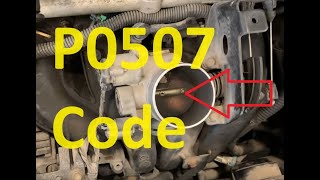
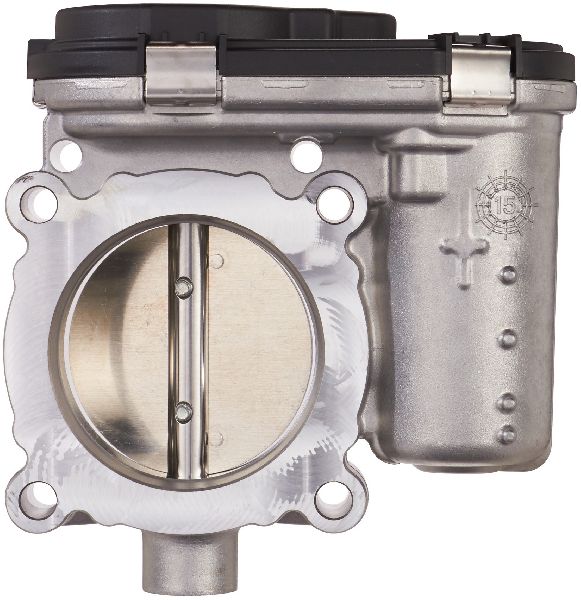
Est. part cost: $10-$100 - Dirty Throttle Body 🟡 Medium Probability The 2.0L is a Gasoline Direct Injection (GDI) engine, which can be prone to carbon buildup. Deposits can form around the throttle plate, preventing it from closing completely at idle.
How to confirm: Remove the air intake tube connected to the throttle body and visually inspect the throttle plate and bore for black carbon deposits.
Typical fix: Clean the throttle body bore and plate with a dedicated throttle body cleaner and a soft cloth or brush. Do not use carburetor cleaner. After cleaning, an idle relearn procedure may be necessary.
Est. part cost: $10-$20 (for cleaner) - Faulty PCV Valve ⚪ Low Probability
How to confirm: Inspect the PCV valve and its hoses for cracks or blockage. A valve that is stuck open will create a vacuum leak, contributing to high idle.
Typical fix: Replace the PCV valve.
Est. part cost: $20-$50
Rare But Worth Checking
- Faulty Mass Airflow (MAF) Sensor: A dirty or failing MAF sensor can send incorrect airflow data to the PCM, causing idle issues. Cleaning the sensor with a dedicated MAF sensor cleaner can sometimes resolve the problem.
- Failing Powertrain Control Module (PCM): This is extremely rare, but a software glitch or internal hardware failure in the PCM can cause incorrect idle control commands. The 18S32 recall includes a mandatory PCM software update to better detect CPV failure. This should only be considered after all other possibilities have been exhausted.
Diagnosis Steps

- Check for Recalls: Use your VIN to check for open recalls on the Ford owner website or NHTSA database, specifically Safety Recall 18S32 for the canister purge valve.
- Scan for Other Codes: Use an OBD-II scanner to see if any other codes are present. Codes like P1450 or P2196 strongly point towards the canister purge valve.
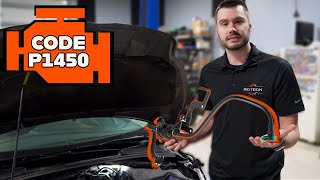
- Test the Canister Purge Valve: This is the most likely culprit. With the engine idling, disconnect the vapor line from the purge valve. If you feel vacuum suction from the valve's port, it is stuck open and needs to be replaced. Also note any difficulty starting after refueling. 🎬 Watch: How to quickly test and repair the P1450 code.
- Inspect for Vacuum Leaks: Listen for hissing noises. Carefully check all vacuum lines, the PCV hose, and the intake air duct for cracks or loose connections. A smoke test is the most definitive way to find a leak.
- Inspect and Clean the Throttle Body: Remove the air intake hose from the throttle body. If significant carbon buildup is visible, clean it using throttle body cleaner and a soft rag. Do not force the throttle plate open manually on this electronic throttle body.
- Inspect PCV System: Check the PCV valve and hoses for damage or blockages.
- Perform Idle Relearn: After cleaning the throttle body or replacing components, an idle relearn procedure is recommended. A common method is to let the engine idle for one minute, then turn the A/C on and let it idle for another minute, then put it in drive (with foot on brake) and idle for a final minute before driving. Disconnecting the battery for 15-20 minutes can also force the PCM to relearn.
Parts You'll Likely Need

- Vapor Canister Purge Valve / Tube Assembly
(OEM #BV6Z-9D289-E (replaces BV6Z-9D289-D, BV6Z-9D289-B))— This is the most common cause of P0507 on the 2012-2018 Focus due to a high failure rate and an associated recall. The part is an assembly including the valve and hoses.
Trusted brands: Motorcraft, Dorman (e.g., 911-779), BWD (e.g., CP894)
OEM price range: $50-$90
Aftermarket price range: $30-$60 - Throttle Body Gasket — May be needed if the throttle body is removed for a thorough cleaning.
Trusted brands: Fel-Pro, Motorcraft
OEM price range: $10-$20
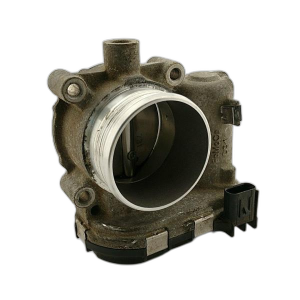
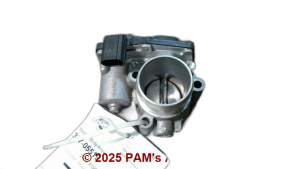
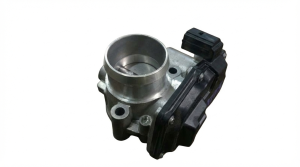
Aftermarket price range: $5-$15 - Throttle Body Assembly — Rarely needed. Only required if the electronic motor fails or the unit is damaged and cleaning does not solve the issue.
Trusted brands: Motorcraft, Hitachi
OEM price range: $200-$350
Aftermarket price range: $150-$250
Related Codes That Often Appear With This One
- P1450 — This code for 'Unable to Bleed Up Fuel Tank Vacuum' is frequently seen with a faulty canister purge valve, which is a primary cause of P0507 on this vehicle. The stuck-open valve causes excessive vacuum that the system cannot bleed off.
- P0456 — This code indicates a small EVAP leak. A faulty canister purge valve can be the source of this leak, linking it to the high idle condition of P0507.
- P2196 — O2 Sensor Signal Biased/Stuck Rich. The un-commanded fuel vapors from the stuck purge valve can cause a rich condition, which is detected by the upstream oxygen sensor, often triggering this code alongside P0507.
Technical Service Bulletins (TSBs) & Recalls

- 18S32 / 19S22 (NHTSA Campaign 18V735): Recall for faulty Canister Purge Valve (CPV) and required PCM reprogramming. This is the primary document related to this issue.
Platform-Specific Known Issues
- Safety Recall 18S32 (NHTSA ID 18V735): Ford issued a recall for a faulty canister purge valve (CPV) that can stick open. This causes excessive vacuum in the fuel system, leading to high idle (P0507), stalling while driving, inaccurate fuel gauge readings, and potential fuel tank deformation. The fix involves a PCM software update to better detect the fault and, if diagnostic trouble codes are present, replacement of the CPV. In some cases, the fuel tank and other components may also be replaced if they are damaged. Owners were advised to keep the fuel tank at least half full until the repair was performed.
Mechanic-Grade Diagnostic Values
- Mass Airflow (MAF) Sensor Reading at Idle — expected: 2.0 to 7.0 grams/second (g/s) for a 2.0L engine.. Failure: A reading significantly lower than 2.0 g/s at idle can indicate a vacuum leak downstream of the MAF sensor (like a stuck purge valve), as unmetered air is entering the engine that the sensor isn't measuring. A reading that is excessively high (e.g., 80 g/s) could indicate a faulty sensor or major wiring issue.
- Short Term Fuel Trim (STFT) at Idle — expected: Close to 0%, typically within +/- 10%.. Failure: High positive fuel trims (e.g., +25%) at idle are a strong indicator of a vacuum leak. The PCM is adding a large amount of fuel to compensate for the extra, unmetered air introduced by the leak. When RPMs are raised to ~2500, the STFT should decrease towards 0% if a vacuum leak is the cause, as the leak becomes a smaller percentage of the total air intake.
- Canister Purge Valve (CPV) Signal Voltage — expected: When the valve is commanded OFF (closed), the signal wire voltage should be equal to battery voltage (~12V). When the ECU commands the valve ON (open) via a PWM signal, it pulls the circuit to ground, so the voltage will drop to near 0V.. Failure: If the voltage on the signal wire is always at or near 0V, it could indicate a short to ground. If the voltage doesn't change when commanded by a scan tool, it points to a wiring issue, a faulty PCM driver, or a bad valve coil.
Scan Tool Commands That Help
- Ford IDS / FORScan / High-End Scan Tool: EVAP Purge Valve Command (or similar name) — This bidirectional control allows the technician to command the canister purge valve open and closed while the engine is running. This is a definitive test; you can command the valve closed and see if the high idle resolves. If the idle remains high even when the valve is commanded closed, it confirms the valve is mechanically stuck open.
Wiring & Ground Locations
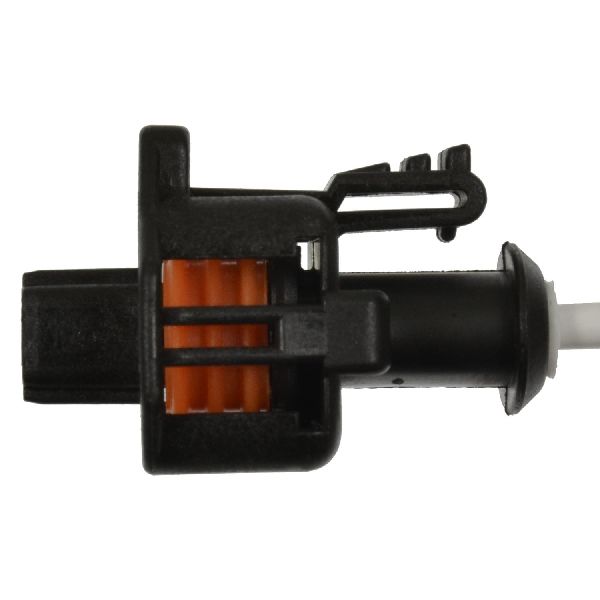
- Canister Purge Valve Connector — On the back of the engine, near the firewall, often under a heat shield. The valve is part of a tube assembly that runs to the intake manifold.. This 2-pin connector provides power and control to the purge valve solenoid. One pin should have battery voltage with the key on, and the other is the ground-side switched wire controlled by the PCM. Checking for voltage here is a key step in determining if the valve, wiring, or PCM is at fault.
Real Owner Repair Stories
- NHTSA ODI #11509589 — An owner reported a check engine light with codes P1450 and P0507. Technicians diagnosed a leaking fuel tank and recommended a new fuel pump, noting the tank was likely damaged from excessive vacuum applied due to the EVAP system failure.
- NHTSA ODI #11024843 — A driver experienced rough idling at a stopping position, stalling, and the car cutting off in traffic while shifting down. A diagnostic scan revealed code P0507, which was associated with the idle air control system and throttle body.
- NHTSA ODI #11440617 — A shop found a combination of error codes including P1450, P2195 (O2 sensor signal biased), and P0507 (Idle air control system RPM higher than expected) during a diagnostic inspection.
- Reddit user in r/FocusST (Ford Focus ST (2.0L GTDI engine)) — Code P0507, throttle stuck at ~2000 RPM, fluctuating between 1k-2k RPM after touching the gas.
❌ Tried (didn't work) A shop suggested cleaning the throttle body, but the owner was skeptical.
✅ What actually fixed it The owner found a vacuum leak on their aftermarket sound symposer delete plate. A bolt that was supposed to plug a vacuum port had fallen out, creating a massive vacuum leak. Temporarily sealing the leak resolved the high idle. - Reddit user in r/FordFocus (2014 Ford Focus with 5-speed manual) — P0507, erratic/rough idle when coming to a stop or using the clutch. Idle would rise to 1200 RPM, then drop below 500 RPM and fluctuate, causing shaking.
❌ Tried (didn't work) Cleaned the throttle body., Replaced the Mass Air Flow sensor.
✅ What actually fixed it The user did not post a final resolution, but another user suggested the most likely cause was a vacuum leak in the flexible intake tube after the MAF sensor or a faulty PCV valve.
When the Usual Fixes Don't Work
- While the canister purge valve is the most common cause, it is not the only one. A real-world example from a Focus ST owner showed that a vacuum leak from a missing bolt on an aftermarket symposer delete plate caused the exact symptoms of P0507. This highlights the importance of checking the entire intake path for leaks, especially on modified vehicles, before assuming the purge valve is the culprit.
OEM Part Supersession History
BV6Z-9D289-D→BV6Z-9D289-E— Ford parts are often superseded due to design revisions for improved reliability or manufacturing efficiency. Given the high failure rate of the original purge valves, this change likely involves improved materials or internal valve design to prevent sticking.
Heads up: BV6Z-9D289-E is the correct and current replacement for -D. A newer part number, BV6Z-9D289-R, is specified for PZEV (Partial Zero-Emission Vehicle) models in some documentation.
Model Year Variations Within This Range
- 2012-2014 vs 2015-2018: The Ford Focus received a facelift for the 2015 model year, which included revised styling and interior updates. However, the primary 2.0L GDI engine and its associated emissions components, including the canister purge valve and throttle body, remained fundamentally the same. Therefore, the causes and diagnostic procedures for P0507 are consistent across the entire 2012-2018 generation.
Diagnostic Flowchart
Real Owner Stories
Aggregated from forums and TSBs cited above. Mileages and costs reflect what owners reported in those sources.
Ford Focus
Symptoms: Experienced a P0507 code along with the car refusing to start after filling up the gas tank, which the owner called the 'biggest give away'.
What fixed it: Replaced the EVAP canister purge valve.
Source hint: Reddit r/FordFocus - Update P0507 Code
2015 Ford Focus
Symptoms: Experienced high idle and rich fuel trims, triggering a collection of codes including P0507, P144A, and P2196.
What fixed it: Diagnosed and resolved by fixing a purge solenoid that was stuck open.
Source hint: Focus Fanatics Forum - ScannerDanner Forum Discussion
2014 Ford Focus 5 speed
Symptoms: Experienced a high, fluctuating idle hovering around 1200 RPM.
What fixed it: Identified as likely being caused by a vacuum leak in the intake hose after the MAF sensor or a faulty PCV valve.
Source hint: Reddit r/FordFocus - P0507 code 2014 Ford Focus 5 speed
Related OBD-II Codes
Frequently Asked Questions
Is there a recall for the P0507 code on my 2012-2018 Ford Focus?
My Focus struggles to start after getting gas and has a P0507 code. What does this mean?
Will Ford replace my fuel tank under Recall 18S32?
How can I test the canister purge valve on my 2.0L Focus at home?
I cleaned the throttle body on my Focus to fix P0507, but the idle is still high. What's next?
Can a bad PCV valve cause a P0507 on the Focus?
Helpful Videos

Used OEM Parts in Stock

New Aftermarket Parts Available


The information in this article is provided for general reference and educational purposes only. Vehicle specifications, procedures, and part compatibility can vary by production date, trim level, and region. Always consult your vehicle's factory service manual and verify part numbers before purchasing or performing repairs. Safety-critical components such as airbags, seat belts, and braking systems should be installed by a qualified professional.
- Ford Focus:
- 🎬 Helpful Videos
- 🛍️ Shop This Part
- What's Unique About the 2012-2018 Ford Focus
- Symptoms You May Notice
- Most Likely Causes
- Rare But Worth Checking
- Diagnosis Steps
- Parts You'll Likely Need
- Related Codes That Often Appear With This One
- Technical Service Bulletins (TSBs) & Recalls
- Platform-Specific Known Issues
- Mechanic-Grade Diagnostic Values
- Scan Tool Commands That Help
- Wiring & Ground Locations
- Real Owner Repair Stories
- When the Usual Fixes Don't Work
- OEM Part Supersession History
- Model Year Variations Within This Range
- Diagnostic Flowchart
- Real Owner Stories
- Ford Focus
- 2015 Ford Focus
- 2014 Ford Focus 5 speed
- Related OBD-II Codes
- Frequently Asked Questions
- 🎟️ Get 5% Off