

P0507 on 2012-2018 Audi A7 3.0T: Causes and Fixes for High Idle RPM
On the Audi A7 3.0T, code P0507 is most often caused by a failed PCV valve (crankcase breather), creating a large internal vacuum leak. This is a well-documented, common failure point for this engine, often occurring between 60,000-80,000 miles. Replacing the PCV valve is the typical fix and requires removing the supercharger, making it a labor-intensive job.
- P0507 on an Audi A7 3.0T almost always points to a failed PCV valve.
- A strong vacuum on the oil filler cap at idle is the key symptom of a bad PCV valve.
- The repair is labor-intensive because the PCV valve is located under the supercharger.
- Always replace the supercharger gaskets when performing this repair.
- Other potential causes like vacuum leaks or a dirty throttle body should be considered if the PCV valve checks out.
What's Unique About the 2012-2018 Audi A7

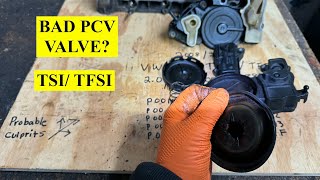
The Audi 3.0T Supercharged V6 is particularly known for PCV (Positive Crankcase Ventilation) valve failures. This component, also called an oil separator, is located under the supercharger assembly. When its internal diaphragm tears, it creates a massive internal vacuum leak, which is a primary cause of the P0507 code on this specific engine. While vacuum leaks and throttle body issues can cause this code on any car, the PCV valve is the first and most likely suspect on the 3.0T platform, a fact corroborated by countless owner experiences and repair guides.
Symptoms You May Notice
- Check Engine Light is on
- Engine idle speed is high (e.g., 1000-1200 RPM)
- Rough or fluctuating idle
- Loud whistling or sucking noise from the engine bay, especially when warm, often described as a 'honking' sound.
- Jerky or harsh shifting, particularly when going from Park to Drive
- Increased fuel consumption
- Extreme vacuum when trying to remove the oil filler cap with the engine running.
- Replacing the throttle body when it only needs to be cleaned and adapted.
- Replacing Mass Airflow (MAF) or O2 sensors without first checking for vacuum leaks. A lean condition caused by a leak is the root cause, and the O2 sensor codes (P0171/P0174) are a symptom, not the cause.
- Assuming a generic vacuum leak when the high-vacuum oil cap test points directly to the PCV valve.
Most Likely Causes

- Failed PCV Valve (Crankcase Breather/Oil Separator) 🔴 High Probability The diaphragm inside the PCV valve is a known weak point on the 3.0T engine; it is prone to tearing over time, creating a significant internal vacuum leak. This is a common failure item, often occurring between 60,000 and 80,000 miles. Audi has released multiple updated versions of this part, but failures persist.
How to confirm: With the engine running at idle, try to remove the oil filler cap. If there is extreme vacuum suction holding the cap down, making it very difficult to remove, the PCV diaphragm has failed. When the cap is eventually removed, the engine's idle may stumble or stall, and the whistling noise may stop. This is the definitive diagnostic test for this issue.
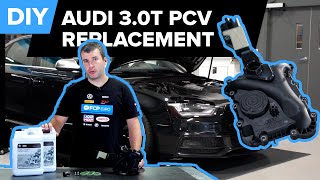
Typical fix: Replace the entire PCV valve assembly. Since this part is located under the supercharger, the supercharger must be removed for access. This is a labor-intensive job, typically 3-5 hours. While the supercharger is off, it is highly recommended to also replace the thermostat, supercharger gaskets, and consider cleaning the intake ports for carbon buildup and changing the supercharger oil.
Est. part cost: $150-$300 - Vacuum Leak (Other than PCV) 🟡 Medium Probability In addition to the PCV, other plastic and rubber components in the engine bay can become brittle and crack with age and heat cycles. Common failure points include the brake booster vacuum line and various smaller vacuum hoses connected to the intake manifold.
How to confirm: Listen for hissing sounds around the engine bay. A smoke test is the most effective method to definitively locate a vacuum leak. This involves injecting pressurized smoke into the intake system and observing where it escapes. Pay close attention to hose connections and gaskets.
Typical fix: Replace the cracked hose, fitting, or failed gasket. The specific part will be identified by the smoke test. Common culprits include small plastic fittings that crumble upon inspection.
Est. part cost: $10-$150 - Dirty or Faulty Throttle Body ⚪ Low Probability Carbon can build up around the throttle plate, preventing it from closing completely at idle. This allows a small amount of unmetered air to enter the engine, which can raise the idle speed.
How to confirm: Remove the intake tube connected to the throttle body and visually inspect the throttle plate and bore for black carbon deposits. The buildup is often on the back side of the plate.
Typical fix: Clean the throttle body thoroughly with a dedicated throttle body cleaner and a soft brush or microfiber towel. Do not spray cleaner directly into the electronics. After cleaning and reinstallation, a throttle body adaptation must be performed using a compatible diagnostic tool like VCDS (VAG-COM) or an equivalent professional scanner to reset its learned values.
Est. part cost: $10-$20 (for cleaner)
Rare But Worth Checking
- Leaking Supercharger Intercooler Cores: The 3.0T engine has two air-to-water intercoolers located within the supercharger housing. If they develop a coolant leak, it can sometimes affect idle stability and cause running issues, though this more commonly presents as mysterious coolant loss or high intake air temperatures.
- Leaking Water Pump or Coolant Shut-off Valve: On the 3.0T, a failing water pump or an associated coolant valve can leak coolant into the vacuum system, which can damage vacuum-actuated solenoids and cause erratic idle behavior. This is a known issue on the platform but is less likely to be the primary cause of P0507 alone.
Diagnosis Steps

- Scan the ECU for any other stored fault codes. The presence of P0171, P0174, or P2279 strongly corroborates a vacuum leak.
- With the engine idling, listen for a distinct whistling or sucking sound. A failed PCV diaphragm on the 3.0T often creates a loud, high-pitched noise from the top of the engine.
- Perform the oil cap test: With the engine running, carefully try to remove the oil filler cap. If it is held on by strong vacuum and is difficult to lift, the PCV valve has almost certainly failed. The engine note will likely change or stumble when the cap is removed.
- If the PCV test is inconclusive, perform a smoke test on the intake system to identify any other potential vacuum leaks from cracked hoses or bad gaskets.
- Inspect the throttle body for heavy carbon buildup by removing the intake hose.
- Using a diagnostic tool like VCDS, check live data to monitor the requested idle RPM vs. the actual RPM. Also, check fuel trim values (short-term and long-term), which will likely be high (positive) if a vacuum leak is present.
Parts You'll Likely Need

- PCV Valve / Crankcase Breather / Oil Separator
(OEM #06E103547AH (or latest revision). Previous revisions include 06E103547H, 06E103547S, 06E103547AB, 06E103547Q, 06E103547L, 06E103547T, 06E103547AE.)— This is the most common failure point on the 3.0T engine that causes the P0507 code. The internal diaphragm fails, creating a large vacuum leak. It is critical to use the latest available OEM revision to ensure the most robust design.
Trusted brands: Audi Genuine, Vaico, URO Parts
OEM price range: $250-$300
Aftermarket price range: $150-$220 - Supercharger Gaskets
(OEM #06E129717F (x2))— These are one-time use gaskets and must be replaced any time the supercharger is removed to access the PCV valve.
Trusted brands: Audi Genuine, Elring
OEM price range: $60-$90
Aftermarket price range: $40-$60 - Thermostat
(OEM #06E121168D (or latest revision))— The thermostat is another common failure item located under the supercharger. It is highly recommended to replace it proactively while the supercharger is removed for the PCV job to save on future labor costs.
Trusted brands: Audi Genuine, Mahle
OEM price range: $100-$150
Aftermarket price range: $70-$100
Related Codes That Often Appear With This One
- P0171 / P0174 — These codes indicate "System Too Lean" in engine banks 1 and 2. A vacuum leak, which is the primary cause of P0507, allows unmetered air into the engine, creating a lean air/fuel mixture that the ECU detects via the oxygen sensors.
- P2279 — This code means "Intake Air System Leak." It is often stored alongside P0507, as both point directly to unmetered air entering the engine. Audi has issued TSB 2033573/10 for the 3.0T engine, which directly links P0507 and P2279 to a faulty PCV valve.
- P0300-P0306 — These are cylinder misfire codes. A significant vacuum leak can disrupt the air/fuel ratio so much that it causes incomplete combustion, leading to misfires at idle or under light load.
Technical Service Bulletins (TSBs) & Recalls
- TSB 2033573/10: This Technical Service Bulletin is specific to the 3.0T engine and addresses DTCs P2279 (Intake Air System Leak) and P0507 (Idle Speed Control RPM Higher than Expected). It directly identifies a faulty crankcase pressure regulating valve (PCV) as the cause and instructs technicians to replace the valve.
- TSB 2040644 / 17 15 62: While for the 4.0T engine, this TSB addresses a whistling noise, P2279, and P0507 caused by a leaking crankcase breather module. The diagnostic principle is directly applicable and confirms this is a known failure pattern for Audi's V-engines of this era.
Platform-Specific Known Issues
- PCV Relocation Kits: Due to the high failure rate and difficult location of the PCV valve, some owners in the enthusiast community have developed PCV relocation kits. These kits move the PCV valve to a more accessible location outside of the supercharger valley, making future replacement a much simpler task. This is a modification for advanced users but is a testament to the prevalence of the issue.
- Coolant in the Valley: When removing the supercharger for the PCV job, it is common to find the engine valley pooled with coolant. This is typically from a slow leak at the thermostat housing or the PCV valve itself, which has coolant passages. This should be cleaned thoroughly before reassembly.
Mechanic-Grade Diagnostic Values
- Long-Term Fuel Trim at Idle (VCDS Block 032) — expected: Typically within +/- 5%. Failure: A large positive value (e.g., +9% or higher) indicates the ECU is adding significant fuel to compensate for unmetered air from a vacuum leak.
- Throttle Valve Angle at Idle (VCDS Block 003) — expected: Approximately 2-3 degrees after adaptation.. Failure: A higher angle at idle could indicate carbon buildup preventing the plate from closing fully.
- Camshaft Phase Position (VCDS Block 093) — expected: 0 to -2 degrees for a healthy timing chain system.. Failure: Values of -4 degrees or more suggest significant timing chain stretch, which could potentially affect idle stability, although it's not a primary cause of P0507.
- Engine Idle Speed Deviation (ECU Setpoint) — expected: Actual engine speed should be close to the target idle speed.. Failure: The P0507 code is set when the actual engine speed is more than 200 RPM above the target for a specified time.
Scan Tool Commands That Help
- VCDS (VAG-COM) or OBDEleven: Throttle Body Adaptation (TBA) — This is mandatory after cleaning or replacing the throttle body. The ECU's learned values for the throttle plate's position are erased and must be relearned. To perform, go to [Engine - 01] -> [Basic Settings - 04] -> Select Group 060 for drive-by-wire cars. Turn basic settings ON; you will hear the throttle body cycle and the status will change to 'ADP. OK'.
- VCDS (VAG-COM): Check Fuel Trims — Use Measuring Value Blocks (MVB) 032 and 033 to check long-term and short-term fuel trims. High positive fuel trims confirm the engine is running lean, strongly suggesting a vacuum leak is the root cause of the high idle.
Wiring & Ground Locations
- Throttle Body Connector — Connected directly to the throttle body, located at the rear of the supercharger on the driver's side.. Damage to the wiring or a corroded/loose connector can cause erratic throttle plate behavior, though this is a rare cause for P0507. The harness contains pins for the motor control and dual throttle position sensors.
- Engine Wiring Harness Chafe Point — The main engine wiring harness can sometimes rub against the ECM/TCM bracket, the driver-side upper control arm, or the shock tower bolt.. While not a direct cause of P0507, harness chafing can lead to various electrical issues, including short circuits or open circuits in sensor wiring, which could theoretically contribute to erratic engine behavior. A visual inspection of these areas is prudent if electrical issues are suspected.
- Main Engine Ground — A primary ground strap is typically located on the frame rail in the engine bay, often near the driver's side shock tower.. A poor engine ground can cause a host of bizarre and hard-to-diagnose electrical problems, including issues with sensor readings and actuator functions. While unlikely to be the sole cause of P0507, verifying the ground is clean and tight is a fundamental step in any electrical diagnosis.
Real Owner Repair Stories
- Reddit user /u/Flimsy-Fan7612 (Audi S5 B8.5 (3.0T engine, similar to A7)) — P0507 code, loss of power, and poor MPG after a DIY PCV replacement.
❌ Tried (didn't work) The initial PCV replacement was the cause of the new problem.
✅ What actually fixed it The user performed a smoke test and found a new vacuum leak coming from under the supercharger, near the oil filter housing. The issue was an improper seal during the PCV reinstallation, likely a pinched or misplaced supercharger gasket, causing a new vacuum leak that triggered the P0507. The fix required removing the supercharger again to correct the seal.
OEM Part Supersession History
06E103547E, 06E103547P→06E103547AC (for early B8/C7 models, approx. 2010-2012)— Design revision to improve durability and address early failure patterns.
Heads up: The early and late PCV designs for the C7 generation are not directly interchangeable without changing associated breather tubes.06E103547N, 06E103547AD→06E103547AF (for C7.5 CREC engines, approx. 2016+)— Updated design for the facelifted CREC engine, which has different mounting points and connections.
Heads up: This part is specific to the CREC engine and is not backward compatible with the earlier CGXB/CTUA engines found in 2012-2015 models.Multiple older revisions (Q, H, S, L, T, AB, AE)→06E103547AH (Latest general revision for many 3.0T engines)— Continuous improvement to the diaphragm material and valve design to reduce failure rates.
Heads up: Always verify the correct part number for your specific VIN. While many revisions are physically similar, there can be subtle differences in vacuum porting or coolant passages.
Model Year Variations Within This Range
- 2016-2018 (C7.5 Facelift): The engine was updated to the CREC version. This engine features a dual-injection system (both direct and port injection), a different supercharger with a bolt-on pulley (vs. the earlier press-on pulley), and a different PCV valve design (PN 06E103547AF). While the PCV is still a failure point, the part number is different from pre-facelift models.
- 2012-2015 (C7 Pre-Facelift): These models use the CGXB or CTUA engine code. They utilize a press-on supercharger pulley and an earlier series of PCV valves (e.g., 06E103547AC). The fundamental cause of P0507 (PCV failure) is the same, but the specific parts differ from the later C7.5 models.
Diagnostic Flowchart
Other Known Issues on This Vehicle
Issues unrelated to this code that are worth knowing about as an owner of this generation:
- Water Pump and Thermostat Failure 🔴 High — Common failure item, especially on pre-2013 models. Often fails between 50k-100k miles. Failure can lead to overheating. (Ref: Multiple part revisions exist. A class action investigation was initiated for some model years due to premature failures.)
- Timing Chain Tensioner Rattle 🟠 Medium — A brief 1-2 second rattle on cold starts is considered normal by Audi but can be alarming. It's caused by oil pressure bleed-down in the tensioners. While full chain failure is not as common on the 3.0T as on other VAG engines, worn tensioners can become an issue at high mileage (100k+ miles). (Ref: TSB 2039995/2 was released for rattling noises, providing updated tensioner parts.)
- Carbon Buildup on Intake Valves 🟠 Medium — As a direct-injection engine, fuel does not wash over the intake valves. Over time (typically 60k-100k miles), carbon deposits can build up, restricting airflow and causing reduced performance and misfires.
- Exhaust Flex Pipe Failure 🟡 Low — The flexible joints in the downpipes can crack or fray over time, causing a loud exhaust leak noise from the front of the vehicle. More common on higher mileage cars or tuned vehicles.
Used vs. New Parts: Buying Guide for This Vehicle
When a used part is the smart pick: For this specific repair, buying a used PCV valve is strongly discouraged. It is a high-failure wear-and-tear item, and a used part has an unknown history and is likely to fail soon, if it hasn't already. The labor to replace it is significant, making it a poor economic choice. Used parts may be considered for structural components like a throttle body housing (if the electronics are swapped) or brackets, but not for the primary failure items.
Donor-vehicle mileage cap: roughly under 20000 miles for the part to have meaningful remaining life.
What to inspect on the donor part:
- For any part under the supercharger, a used part is a gamble.
- If considering a used throttle body, ensure the throttle plate moves smoothly with no binding and that the electrical connector pins are clean and straight.
- Verify the part number on the used component matches the required part for your vehicle's specific year and engine code (CREC vs. pre-CREC).
OEM-only on this vehicle (don't cheap out):
- PCV Valve / Oil Separator: Due to the high failure rate of even OEM parts, using a known-bad aftermarket brand or a used part is a significant risk given the 3-5 hours of labor required for replacement. Stick with a Genuine Audi part of the latest revision.
Aftermarket brands forum-validated for this vehicle:
- Mahle (For Thermostat): Mahle is an OEM supplier for many German brands and is widely considered a reliable alternative to Genuine Audi for parts like the thermostat.
- Elring (For Gaskets): Elring is a reputable OEM supplier for gaskets and seals.
Brands owners have reported issues with on this vehicle:
- URO Parts (for PCV): While URO offers a lower-cost alternative, forum discussions often contain mixed reviews regarding the longevity of their PCV diaphragms for this specific application. Given the labor involved, the risk may not be worth the savings.
Real Owner Stories
Aggregated from forums and TSBs cited above. Mileages and costs reflect what owners reported in those sources.
2013 Audi S4 3.0T — ~70000 miles
Symptoms: Whistling, high idle, and lean codes. The failure is documented as a common occurrence between 60,000 and 80,000 miles.
What fixed it: Replacement of the PCV/AOS (Oil Separator) assembly.
Source hint: Audizine - Thread: 'Official B8/B8.5 S4/S5/Q5/SQ5 3.0T PCV/AOS Failure Thread'
2012 Audi A7 3.0T — ~75000 miles
Symptoms: User was replacing a water pump and asked if they should address the PCV while the supercharger was already off.
What fixed it: Preventative replacement of the PCV valve while the supercharger was removed for other service.
Source hint: Reddit r/Audi - Thread: '3.0T engine, supercharger off, should I do the PCV?'
2006 Audi A4
Symptoms: P0507 code accompanied by a rough idle and misfire codes.
What fixed it: Checking and addressing the PCV system for vacuum-related issues.
Source hint: AudiForums.com - Thread: 'P0507, Rough Idle'
Related OBD-II Codes
Frequently Asked Questions
Is there an official Audi TSB for the P0507 code on the 3.0T engine?
I hear a loud whistling/honking sound from my A7 engine bay; is this related to P0507?
How can I quickly check if my PCV valve is causing the high idle?
The shop says they need to remove the supercharger to fix P0507. Is this correct?
Should I replace other parts while fixing the PCV valve?
Is there a way to prevent the PCV valve from failing again in the future?
Helpful Videos
Used OEM Parts in Stock


New Aftermarket Parts Available


The information in this article is provided for general reference and educational purposes only. Vehicle specifications, procedures, and part compatibility can vary by production date, trim level, and region. Always consult your vehicle's factory service manual and verify part numbers before purchasing or performing repairs. Safety-critical components such as airbags, seat belts, and braking systems should be installed by a qualified professional.
- Audi A7:
- 🎬 Helpful Videos
- 🛍️ Shop This Part
- What's Unique About the 2012-2018 Audi A7
- Symptoms You May Notice
- Most Likely Causes
- Rare But Worth Checking
- Diagnosis Steps
- Parts You'll Likely Need
- Related Codes That Often Appear With This One
- Technical Service Bulletins (TSBs) & Recalls
- Platform-Specific Known Issues
- Mechanic-Grade Diagnostic Values
- Scan Tool Commands That Help
- Wiring & Ground Locations
- Real Owner Repair Stories
- OEM Part Supersession History
- Model Year Variations Within This Range
- Diagnostic Flowchart
- Other Known Issues on This Vehicle
- Used vs. New Parts: Buying Guide for This Vehicle
- Real Owner Stories
- 2013 Audi S4 3.0T — ~70000 miles
- 2012 Audi A7 3.0T — ~75000 miles
- 2006 Audi A4
- Related OBD-II Codes
- Frequently Asked Questions
- 🎟️ Get 5% Off