

OBD-II Code P0503: Vehicle Speed Sensor 'A' Intermittent/Erratic/High
The Ultimate Guide to Diagnosing and Fixing P0503
- P0503 indicates an unstable speed signal, requiring immediate inspection of the primary vehicle speed sensor, its wiring harness, or the ABS wheel speed sensors.
- Do not drive with an active P0503 code; erratic transmission shifts destroy internal clutch packs, turning a $150 sensor replacement into a $3,000 transmission rebuild.
- Start diagnosis by scanning all modules for ABS codes and performing a physical 'wiggle test' on the sensor wiring, which reveals the root cause in over 50% of intermittent cases.
- Never replace the speed sensor without first checking the magnetic tip for metal shavings and verifying the connector pins are free of green corrosion.
What Does P0503 Mean?

P0503 means the Powertrain Control Module (PCM) receives an unstable, nonsensical, or dropping signal from the Vehicle Speed Sensor (VSS). This sensor dictates the speedometer, automatic transmission shift points, cruise control, and anti-lock braking systems (ABS). The 'intermittent, erratic, or high' designation means the signal is jumpy, noisy, or spiking, making it untrustworthy to the PCM.
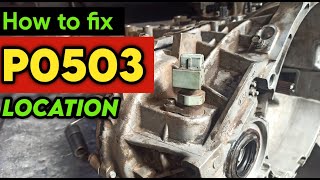
Technical definition: Vehicle Speed Sensor 'A' Intermittent/Erratic/High. 🎬 Watch: A quick overview of the P0503 code and its causes. The PCM sets this DTC when the primary Vehicle Speed Sensor (VSS 'A') signal fluctuates rapidly, drops out, or introduces electrical noise that contradicts other sensor data like engine RPM and wheel speed. A signal dropout lasting more than 500 milliseconds while the vehicle moves above 10 mph triggers this code.
Can I Drive With P0503?
Yes, But With Caution. Driving is possible but unsafe. This fault causes dangerously unpredictable transmission shifting, an incorrect speedometer, and disables critical safety features like ABS and traction control. Prolonged driving with erratic shifting causes premature wear on internal transmission components, turning a $150 sensor issue into a $3,000 transmission rebuild.
Common Causes

- Faulty Vehicle Speed Sensor (VSS) (Very Common) — Internal electronics or the magnetic coil degrade over time, especially on vehicles over 100,000 miles, causing noisy signals. Sensor replacement resolves over 60% of cases.
- Damaged or Corroded Wiring/Connectors (Common) — Heat, road debris, and moisture degrade the wiring harness. Chafing, melting, or corroded pins cause intermittent shorts or opens.
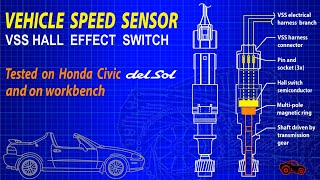
- Poor Ground Connection (Common) — A corroded, loose, or broken ground wire for the VSS circuit introduces electrical noise and signal instability. Always check grounds before replacing parts. 🎬 See how to perform professional Hall Effect tests on your sensor.
- Contamination on the Sensor or in Bore (Less Common) — Metal shavings from normal transmission wear stick to the magnetic VSS tip, disrupting its field. Transmission fluid leaking into the sensor bore also attenuates the signal.
- Damaged Reluctor/Tone Ring (Less Common) — The VSS reads a toothed ring to measure speed. A cracked, rusted, or debris-covered ring produces an erratic signal.
- Damaged VSS Drive Gear (Less Common) — On older vehicles, the VSS uses a plastic drive gear. Worn or stripped teeth prevent the sensor from spinning consistently.
- Incorrect Tire or Wheel Size (Rare) — Installing tires significantly different from factory specifications creates a mismatch between the VSS and ABS wheel speed sensors, confusing the PCM.
- Aftermarket Electronics Interference (Rare) — Poorly installed remote starters, alarms, or high-powered stereos create electromagnetic interference that disrupts the sensitive VSS signal.
- Faulty Instrument Cluster (Rare) — On certain vehicles, the VSS signal routes through the instrument cluster before reaching the PCM. Circuitry faults within the cluster corrupt the signal.
- Faulty Powertrain Control Module (PCM) (Very Rare) — Main computer failure is extremely uncommon. Consider this only after exhaustively ruling out the sensor, wiring, tone ring, and grounds.
Symptoms

- Erratic or Bouncing Speedometer — The speedometer needle jumps, reads incorrectly, or intermittently drops to zero while driving.
- Harsh or Incorrect Transmission Shifting — The automatic transmission relies on the VSS to time shifts. A bad signal causes rough, delayed, or failed shifts, often forcing the transmission into 'limp mode'.
- ABS and Traction Control Warning Lights On — Safety systems disable themselves and illuminate warning lights when they detect an unreliable VSS signal.
- Cruise Control Not Working — Cruise control requires a steady speed signal. An intermittent signal disengages the system or prevents activation entirely.
- Stalling or Rough Idle — Erratic speed inputs disrupt idle control systems, causing stalling when coming to a stop.
- Rev Limiter Engaging Prematurely — A faulty signal tricks the engine computer into thinking the vehicle is stationary, activating the rev limiter at a lower RPM.
- Increased Fuel Consumption — Inaccurate speed signals corrupt fuel delivery calculations, reducing fuel efficiency.
- Check Engine Light is On (also visible on scanner) — The PCM detects the fault and illuminates the Malfunction Indicator Lamp (MIL).
Diagnostic Flowchart
Tap your situation to follow the diagnostic path that matches what you're seeing on this code.
Common Fixes & Costs
- Replace Vehicle Speed Sensor (VSS)
— Parts: $25-$150, Labor: $100-$250, ~1.2 hr book time
(DIY)
2008 Ford F-150: OEM Motorcraft DY1215 / 9L3Z-9E731-A (Alt: Duralast SU8829 ($67), Standard Motor Products SC351 ($45))
2010 Jeep Grand Cherokee: OEM Mopar 04799061AB (Alt: Delphi SS11424 ($23), Duralast SU1289 ($45))
2011 Chevrolet Silverado 1500: OEM ACDelco 213-1701 / GM 19302667 (Alt: Dorman 917-637 ($40), Delphi SS11824 ($35)) - Repair or Replace Wiring/Connector
— Parts: $10-$50, Labor: $120-$300, ~2 hr book time
(Intermediate)
Universal: OEM N/A (Pigtail connectors are vehicle-specific) (Alt: Dorman, Standard Motor Products (S-series connectors)) - Replace Wheel Speed Sensor
— Parts: $40-$150, Labor: $100-$250, ~1 hr book time
(DIY)
2010 Jeep Grand Cherokee (Rear): OEM Mopar 56044144AD (Alt: Duralast SU1089 ($50), Bosch 0265007928 ($43))
2011 Chevrolet Silverado 1500 (Front): OEM ACDelco 84356647 / GM 15157952 (Alt: Duralast SU9433 ($60), Delphi SS10302 ($36)) - Clean VSS Magnetic Tip and Bore — Parts: $0, Labor: $60-$120, ~0.8 hr book time (DIY)
- Replace Hub Bearing Assembly (with integrated sensor/tone ring) — Parts: $150-$500, Labor: $250-$450, ~2.5 hr book time (Advanced)
Used vs. New Parts: Buying Guide
When a used part is worth it: Buying a used Vehicle Speed Sensor or Wheel Speed Sensor rarely makes sense. The part is an electronic wear item, and the minimal cost savings do not justify the risk of premature failure and repeated labor costs.
Donor-vehicle mileage cap: roughly under 40000 miles for the part to have meaningful remaining life.
Donor quality checklist:
- Only consider a used sensor from a wrecked, very low-mileage vehicle.
- Avoid sensors from rust-belt vehicles; corrosion is a primary failure mode.
- Ensure the part number is an exact match, including superseded numbers.
Decision logic:
- If The part is a VSS or Wheel Speed Sensor → Buy a new OEM or high-quality aftermarket part. The low cost does not justify the risk of a used one.
- If The required part is a complete hub assembly with an integrated sensor → A low-mileage used hub assembly is acceptable if the new OEM part is prohibitively expensive, though a new aftermarket hub is usually better.
- If The vehicle is over 15 years old and a new part is unavailable → A tested, used part from a reputable salvage yard is an acceptable last resort.
Warranty tradeoff: Used sensors typically carry a 30-day warranty. New aftermarket sensors offer 1-year to limited lifetime warranties. New OEM parts carry a 12-month/12,000-mile warranty.
Worst-case if a used part fails: $200-$400 if a used sensor fails, requiring repeat labor for diagnosis and replacement.
What Happens If You Wait — Timeline
- 0-1 month: Intermittent Check Engine Light, occasional speedometer bounce, or delayed shift. Cruise control randomly disengages. Fault is triggered by bumps or specific temperatures. (MPG impact: 0-2%% · Added cost: $0)
- 1-3 months: Check Engine Light stays on. Speedometer is consistently erratic, and transmission shifts become harsh. ABS and Traction Control disable themselves. (MPG impact: 3-8%% · Added cost: $20-$60 in wasted fuel due to inefficient shifting.)
- 3-6 months: Driving becomes unsafe due to severe, unpredictable shifting. Constant harsh shifts cause accelerated wear on internal transmission clutch packs and solenoids. (MPG impact: 5-15%% · Added cost: $200-$500 in early transmission wear.)
- 6+ months: Catastrophic transmission damage. Accumulated stress from violent shifts leads to internal mechanical failure, requiring a complete rebuild. (MPG impact: 10-20%% · Added cost: $2500-$5000+)
Cost of Not Fixing It
- 0-1 month: Unsafe driving conditions due to erratic shifting and disabled ABS/Traction Control. Decreased fuel economy due to inefficient transmission shifting. (Added cost: $20-$50 in wasted fuel)
- 1-6 months: Increased wear on transmission clutch packs and solenoids from harsh, unsynchronized shifts, leading to premature transmission failure. (Added cost: $1800-$4500 for transmission repair or replacement)
- 6+ months: Catastrophic transmission failure. Constant stress from erratic shifting causes internal mechanical damage, requiring a complete transmission rebuild. (Added cost: $2500-$5000+)
Diagnosis Steps

- Scan All Modules for Codes
Use an OBD-II scanner to read codes from the Engine (ECM), Transmission (TCM), and ABS modules. ABS or wheel speed sensor codes (e.g., C0035-C0050) pinpoint the exact failing sensor on modern vehicles.
Tools: OBD-II Scanner (Beginner) - Visually Inspect Wiring and Connectors
Locate the VSS and meticulously inspect its electrical connector and wiring harness. Look for corroded pins, loose connections, or wires rubbing against the chassis or exhaust.
Tools: Flashlight, Mirror (Beginner) - Monitor Live VSS Data
Observe the 'Vehicle Speed' PID on a scan tool while driving. The reading must be smooth and match the speedometer. Spikes, freezes, or sudden drops to zero confirm a signal fault.
Tools: Advanced OBD-II Scanner (Intermediate) - [PRO TIP] Perform a Harness Wiggle Test
With a scan tool graphing the VSS signal, carefully wiggle and flex the VSS wiring harness from the sensor to the PCM. If the signal drops or spikes during flexing, you have located the wiring break.
Tools: Advanced OBD-II Scanner, Assistant (Advanced) - Inspect the VSS and Reluctor Ring
Remove the VSS. Clean accumulated metal shavings off its magnetic tip. Inspect the reluctor/tone ring inside the mounting hole for broken teeth, heavy rust, or warping.
Tools: Wrench/Socket Set, Rag, Flashlight (Intermediate) - Test Sensor's Electrical Circuit (3-Wire Hall-Effect)
Test the connector with the key on, engine off. Verify a 5V reference voltage, a solid ground (less than 0.1V), and a signal wire. Backprobe the signal wire while rotating the wheel; voltage must toggle between 0V and 5V.
Tools: Digital Multimeter (DMM) (Advanced) - Test Sensor's Electrical Circuit (2-Wire Magnetic)
Check internal resistance using a multimeter (typically 400-1,600 Ω). Set the multimeter to AC volts and spin the wheel; it must produce an AC voltage that increases with speed (e.g., 0.5 - 2.5V AC at 20 mph).
Tools: Digital Multimeter (DMM) (Advanced) - Check for Correct Tire Size
Confirm the installed tires match the manufacturer's recommended size. Significant size differences cause conflicts between VSS and ABS sensor readings.
Tools: None (Beginner) - [PRO TIP] Analyze VSS Signal with an Oscilloscope
A 3-wire sensor produces a clean 0-5V square wave. A 2-wire sensor produces a clean AC sine wave. Noise, glitches, or misshapen patterns point directly to a faulty sensor or tone ring.
Tools: Oscilloscope, Jack and Jack Stands (Advanced)
When This Code Triggers (Freeze-Frame Conditions)
- Engine Coolant Temp: 185-205°F (Fully warmed up, indicating the fault is not related to cold operation.)
- Engine RPM: 1800-3000 RPM (Steady cruise or light acceleration, not during idle or heavy load.)
- Vehicle Speed: 40-65 mph (Highway or arterial road speeds where a stable signal is expected.)
- Engine Load: 25-55% (Maintaining speed on a flat road or slight incline.)
Related Codes
- P0500 — P0500 is a general VSS malfunction. P0503 specifically points to an 'intermittent/erratic' signal, directing focus toward loose connections, wiring damage, or a noisy sensor rather than a dead one.
- P0501 — P0501 indicates a 'Range/Performance' issue, meaning the VSS reading is implausible compared to RPM. This points to incorrect tire size, whereas P0503 points to an electrically unstable signal.
- P0502 — P0502 means 'Low Input,' indicating a consistently low or absent signal (dead sensor or short to ground). P0503 is for a bouncing signal, while P0502 is for a flatlined signal.
- P0720 — P0720 is for the Output Speed Sensor (OSS) circuit. On many vehicles, the VSS and OSS are the same physical sensor. P0503 combined with P0720 confirms a fault with that specific sensor circuit.
Climate & Environmental Factors
- Cold Weather: Temperatures below 32°F (0°C) freeze moisture inside the sensor or connector, causing temporary malfunctions. Wiring insulation also becomes brittle and cracks.
- High Humidity and Rain: Heavy rain or deep puddles force water into non-sealed connectors, causing rapid pin corrosion and signal degradation.
- Road Salt (Winter Climates): Saltwater accelerates the corrosion of wiring harnesses, connector pins, and ground points, especially on exposed transmission or differential sensors.
How to Talk to a Mechanic About This Code
Say this: "I have a P0503 code and my speedometer is erratic. I'd like a diagnostic that includes checking for related ABS codes, inspecting the VSS wiring and connector, and viewing the live speed sensor data before replacing any parts."
This signals you understand P0503 is often an electrical or wiring issue, not just a bad sensor. It directs the mechanic to perform a thorough diagnosis to find the root cause, preventing them from just swapping the most obvious part.
Avoid saying:
- 'My check engine light is on, can you fix it?'
- 'My speedometer is acting funny, just replace the sensor.'
- 'Just do whatever you think is best.'
Questions to ask before authorizing the repair:
- Did you find any other codes in the ABS or transmission modules?
- Did you test the sensor's signal with a multimeter or oscilloscope to confirm it's faulty?
- Did you perform a 'wiggle test' on the wiring harness to check for intermittent shorts or opens?
- If the wiring is the problem, will the repair be a new pigtail connector with heat-shrink splices or just electrical tape?
Where to Take It: Dealer vs Independent vs Chain
- Dealer:
Recommended only if a known TSB or recall exists, or if the vehicle is under warranty. Otherwise, it is not cost-effective.
Best for: Vehicles under powertrain warranty., Known manufacturer-specific issues requiring a software update (like the Ford F-150 recall)., Complex electrical issues on newer European vehicles.
Downsides: Highest labor rates, typically 1.5-2x more than independent shops., May default to replacing a larger assembly (like a full hub) when only a sensor or wire is needed. (Typical cost: +50% vs. baseline) - Independent Shop:
Best fit for most P0503 cases. An experienced independent technician efficiently diagnoses wiring, sensor, or tone ring issues without the high dealer cost.
Best for: Most out-of-warranty vehicles., Diagnosing intermittent electrical faults., Cost-effective repairs on common domestic and Asian vehicles.
Downsides: Diagnostic skill varies. Vet shops based on reviews and ASE certifications in electrical systems. (Typical cost: +0% vs. baseline) - Chain Shop:
Use with caution. Acceptable if you have already diagnosed a bad sensor, but AVOID for initial diagnosis of an intermittent P0503 code.
Best for: Simple, clear-cut part replacements when you are certain the sensor itself has failed.
Downsides: Technician skill varies dramatically., Often lack the advanced diagnostic tools or time needed for a proper intermittent electrical fault diagnosis., High pressure to upsell services. (Typical cost: -10% vs. baseline)
When to Walk Away From the Repair
If the estimated repair cost exceeds 40-50% of the car's private-party value, seriously consider selling the car as-is or trading it in.
- Car worth $4000, fix is $350: Fix it. This is a low-cost repair that restores safety and drivability.
- Car worth $5000, fix is $2500: Walk away. If the code was ignored and caused transmission damage, the repair cost is 50% of the car's value. Cut your losses.
- Car worth $15000, fix is $800: Fix it. Even if the repair requires an expensive hub bearing assembly, the cost is well below the threshold.
What Scan Tool You Need for This Code
Minimum: A scanner that reads live data and ABS module codes.
A basic $20 code reader only shows 'P0503'. It cannot display the live speed signal, which is essential for diagnosing an intermittent fault. Without seeing the signal drop out in real-time, you are just guessing.
Budget: BlueDriver Pro or Foxwell NT301 (~$100) — These scanners display and graph live data, including vehicle speed. This allows you to watch the VSS signal as you drive or wiggle wires to find the fault. BlueDriver also reads ABS codes.
Mid-range: Autel AL619 or Innova 5610 (~$100-350) — These handheld scanners explicitly include ABS system diagnostics, critical for modern cars where a wheel speed sensor causes the P0503 code. They offer robust live data graphing and read manufacturer-specific codes.
Professional: Autel MaxiCOM MK808S or Xtool D7 (~$450-600) — Provides full-system, bidirectional diagnostics. These tools command the ABS module to perform self-tests and provide OEM-level data, making a difficult diagnosis much faster.
How to Clear the Code After You Fix It
- Use an OBD-II scan tool to clear the P0503 and related codes from all modules (ECM, TCM, ABS).
- Perform a drive cycle to allow the vehicle's readiness monitors to run.
- Monitor live VSS data on the scan tool during the drive cycle to confirm a smooth, consistent signal.
Drive cycle (~20 minutes): Start the vehicle cold. Drive in a mix of city and highway conditions, including 5 minutes at 55 mph and multiple stop-and-go sequences. Allow the vehicle to reach full operating temperature to simulate a typical commute.
Readiness monitors affected: Comprehensive Component Monitor (CCM), Catalyst Monitor, Evaporative System Monitor
Before emissions retest: drive at least 50 miles to fully set monitors.
Watch out for:
- Disconnecting the battery clears the code but erases all readiness monitors, guaranteeing an emissions test failure.
- The code returns immediately if the root cause (often a wiring issue) was not properly fixed.
- Ignoring related codes in the ABS or TCM modules leads to overlooking the true source of the problem.
Will This Fail Emissions / State Inspection?
Yes — this code typically fails an OBD-II emissions inspection.
- California: A P0503 code causes an automatic smog check failure. The Check Engine Light must be off and all readiness monitors set to 'Ready'.
- New York: An active P0503 code is an automatic failure during the OBD-II scan. The MIL must be commanded off by the PCM to pass.
- Texas: In emissions-testing counties, a P0503 code results in a failed test. The vehicle cannot pass until repaired and cleared.
Most Commonly Affected Vehicles
- Jeep Grand Cherokee / Wrangler (2005-2015) — High incidence on WK/JK models. Off-road use accelerates sensor contamination and wiring damage. Often related to the 42RLE or 545RFE transmissions.
- Ford F-150 / Expedition (2004-2010) — Very common due to VSS failure from heat cycling in 4R70W/4R75W transmissions. Check the VSS on the transmission or rear differential.
- Chevrolet / GMC Silverado / Sierra / Tahoe (2003-2012) — Frequently occurs on high-mileage trucks with 4L60E or 4L80E transmissions. The sensor is located on the transmission tail shaft.
- Honda Accord / Civic (2008-2017) — Often related to the VSS located on the transmission casing. Erratic speedometer readings are typically resolved by VSS replacement.
- Hyundai / Kia Elantra, Sonata, Optima, Sorento (2011-2018) — Triggers P0503 from failures in either the transmission-mounted VSS or one of the four ABS wheel speed sensors.
- BMW 3-Series (E90), 1-Series (E82) (2006-2013) — Caused by a failing rear wheel speed sensor, which serves as the primary VSS input for the engine computer. Non-OEM sensors cause persistent issues.
- Ford Focus, Mondeo, Fiesta, Transit (2000-2015) — Widely reported across this range, linked to the sensor on the gearbox or a failing wheel speed sensor.
- Volkswagen Golf, Passat, Polo, Touran (2001-2014) — Frequently linked to the sensor on the gearbox (transaxle).
Manufacturer-Specific Notes
- Jeep: Off-road use packs mud and water around the sensor and wiring on the transmission or differential, causing rapid corrosion and intermittent signal faults.
- Ford: For 2014 F-150s, NHTSA Recall 24V424000 addresses an intermittent loss of signal from the transmission output shaft speed sensor causing abrupt downshifts. The fix is a PCM software update.
- Subaru: Older models utilize two speed sensors (front and rear). An intermittent signal from one causes P0503 alongside severe binding in the all-wheel-drive system.
- Toyota: The VSS signal routes from the ABS ECU to the instrument cluster, then to the main engine ECU. A fault in the ABS ECU or the cluster triggers P0503.
- General Motors: Bulletin PIP5403A notes some 2016-2017 models set P0503 after a wheel spin event without an actual fault. The fix requires clearing the code and awaiting a software update.
Real Owner Stories
2008 Ford F-150 at 115K miles - The 'Easy' Fix
Check Engine Light illuminated. Speedometer bounced between 40-60 mph at a steady speed, transmission shifted harshly, and cruise control failed.
What they tried:
- Owner initially suspected a major transmission problem.
Outcome: A visual inspection revealed the transmission-mounted VSS was the cause. The sensor was replaced for $45 and 30 minutes of labor. The code cleared and did not return.
Lesson: Don't assume the worst. An erratic speedometer and harsh shifting are classic P0503 symptoms that often point to a simple sensor replacement, not a transmission rebuild.
2012 Jeep Wrangler at 85K miles - A Misdiagnosis Story
After off-roading, the ABS, Traction Control, and Check Engine lights illuminated. The speedometer worked intermittently.
What they tried:
- Mechanic immediately replaced the transmission-mounted VSS. The code returned within a day.
Outcome: A second shop scanned all modules and found a code for the left front wheel speed sensor circuit. The wiring harness had been snagged by trail debris. Repairing the wire for $150 fixed the issue permanently.
Lesson: Always scan all modules before replacing parts. On modern cars, P0503 is frequently caused by a faulty ABS wheel speed sensor or its wiring, not a transmission-mounted VSS.
2011 Hyundai Sonata at 130K miles - The Unusual Root Cause
P0503 appeared with no obvious symptoms. The speedometer was accurate, and the transmission shifted normally.
What they tried:
- Owner cleared the code, but it returned. Inspected VSS wiring and found no issues. Prepared to replace the sensor.
Outcome: During a 'wiggle test', the signal dropped out only when wiggling the main connector at the PCM. A pin in the connector had backed out slightly. Reseating the pin resolved the code.
Lesson: For intermittent electrical codes, the fault can be far from the sensor. A 'wiggle test' of the entire harness, including main computer connectors, is a crucial diagnostic step.
How to Prevent This Code From Triggering
- Apply Dielectric Grease to Connectors (Anytime a sensor is replaced or disconnected.) — Dielectric grease protects electrical connectors from moisture, dirt, and road salt, preventing the pin corrosion that causes intermittent P0503 signals.
- Secure Wiring Harnesses (During any under-vehicle service.) — Ensuring wiring is properly secured away from hot exhaust or moving suspension parts prevents chafing and physical damage.
- Regular Underbody Washes (Monthly, especially in winter climates.) — Washing the undercarriage removes corrosive road salt and brine, preventing accelerated degradation of wiring and ground points.
- Periodic Transmission Fluid Service (As recommended by the vehicle manufacturer.) — Clean fluid protects transmission-mounted sensors from contamination and seal damage.
Frequently Asked Questions
Can I still drive my car with a P0503 code?
You can, but it is unsafe. The code causes dangerous shifting behavior, an inaccurate speedometer, and disables safety systems like ABS. Fix it promptly to avoid safety risks and transmission damage.
How much does it cost to fix a P0503 code?
A simple sensor replacement costs between $150 and $400, while wiring repairs run $120 to $300. If the sensor is integrated into a wheel hub bearing, expect $400 to $900 per wheel. Transmission-mounted sensors on newer trucks can reach $800 due to intensive labor.
What's the most common mistake when fixing a P0503?
The most common mistake is immediately replacing the Vehicle Speed Sensor without testing the circuit. The 'intermittent' nature of P0503 frequently points to a wiring or connector problem, which is a cheaper fix. Always inspect the wiring, connectors, and grounds first.
My car doesn't have a VSS on the transmission. Where is it?
Most modern cars lack a single transmission VSS and instead average the readings from the four ABS wheel speed sensors. In these vehicles, P0503 stems from a faulty wheel speed sensor, damaged wiring, or a cracked tone ring. Scan the ABS module to pinpoint the exact wheel.
Can a bad battery cause a P0503 code?
Yes, a weak battery or a failing alternator providing unstable voltage causes widespread electrical glitches. This triggers a P0503 code alongside other seemingly unrelated sensor faults. Always verify your battery rests above 12.4V and the alternator outputs 13.5V-14.5V.
I replaced the sensor but the code came back. What now?
If a new sensor fails to clear the code, the problem lies in the wiring harness, the connector, or a damaged tone ring. Perform a 'wiggle test' on the harness while monitoring live data to locate the break. Ensure you used an OEM sensor, as cheap aftermarket units frequently cause persistent faults.
Can a bad ground cause a P0503 code?
Absolutely; a poor ground connection introduces electrical noise that corrupts the sensor's signal. This unstable ground directly causes the 'erratic' or 'intermittent' condition described by P0503. Clean and tighten the ground points for both the sensor circuit and the PCM.
Key Takeaways
- P0503 indicates an unstable speed signal, requiring immediate inspection of the primary vehicle speed sensor, its wiring harness, or the ABS wheel speed sensors.
- Do not drive with an active P0503 code; erratic transmission shifts destroy internal clutch packs, turning a $150 sensor replacement into a $3,000 transmission rebuild.
- Start diagnosis by scanning all modules for ABS codes and performing a physical 'wiggle test' on the sensor wiring, which reveals the root cause in over 50% of intermittent cases.
- Never replace the speed sensor without first checking the magnetic tip for metal shavings and verifying the connector pins are free of green corrosion.
Helpful Videos

The information in this article is provided for general reference and educational purposes only. Vehicle specifications, procedures, and part compatibility can vary by production date, trim level, and region. Always consult your vehicle's factory service manual and verify part numbers before purchasing or performing repairs. Safety-critical components such as airbags, seat belts, and braking systems should be installed by a qualified professional.
- 🎬 Helpful Videos
- What Does P0503 Mean?
- Can I Drive With P0503?
- Common Causes
- Symptoms
- Diagnostic Flowchart
- Common Fixes & Costs
- Used vs. New Parts: Buying Guide
- What Happens If You Wait — Timeline
- Cost of Not Fixing It
- Diagnosis Steps
- When This Code Triggers (Freeze-Frame Conditions)
- Related Codes
- Climate & Environmental Factors
- How to Talk to a Mechanic About This Code
- Where to Take It: Dealer vs Independent vs Chain
- When to Walk Away From the Repair
- What Scan Tool You Need for This Code
- How to Clear the Code After You Fix It
- Will This Fail Emissions / State Inspection?
- Most Commonly Affected Vehicles
- Manufacturer-Specific Notes
- Real Owner Stories
- 2008 Ford F-150 at 115K miles - The 'Easy' Fix
- 2012 Jeep Wrangler at 85K miles - A Misdiagnosis Story
- 2011 Hyundai Sonata at 130K miles - The Unusual Root Cause
- How to Prevent This Code From Triggering
- Frequently Asked Questions
- Can I still drive my car with a P0503 code?
- How much does it cost to fix a P0503 code?
- What's the most common mistake when fixing a P0503?
- My car doesn't have a VSS on the transmission. Where is it?
- Can a bad battery cause a P0503 code?
- I replaced the sensor but the code came back. What now?
- Can a bad ground cause a P0503 code?
- Key Takeaways
- 🎟️ Get 5% Off