

P0500 on 2008-2013 Mazda 6: Vehicle Speed Signal Causes and Fixes
On a 2008-2013 Mazda 6, code P0500 is almost always caused by a faulty ABS wheel speed sensor or its wiring. The vehicle speed signal comes from the ABS module, not a traditional transmission sensor. Expect to pay $40-$90 for an aftermarket sensor and diagnose which wheel is the culprit before buying.
- P0500 on this car means there's a problem in the ABS system, not the transmission.
- The most likely cause is a bad wheel speed sensor or its wiring harness rubbing on a moving part.
- You need a scan tool that can read live ABS data to see which wheel is at fault.
- Replacing a seized sensor can be difficult and may require drilling.
- If all sensors and wiring are good, check the power and ground connections at the ABS module itself before replacing it.
What's Unique About the 2008-2013 Mazda 6
The key difference for this platform is the absence of a traditional, transmission-mounted Vehicle Speed Sensor (VSS). The entire system is integrated into the ABS. This means a P0500 code requires diagnosing the ABS system, not the transmission. Owners often find the problem is a single failed wheel speed sensor or, very commonly, a wire that has rubbed through near the wheel well.
Symptoms You May Notice
- Check Engine Light is on
- ABS warning light is on
- Traction Control (TCS/DSC) warning light is on
- Speedometer does not work or is erratic
- Cruise control is inoperative
- Transmission may shift harshly or erratically
- Replacing a non-existent Vehicle Speed Sensor on the transmission.
- Replacing the wrong wheel speed sensor because a proper ABS scan was not performed.
- Replacing the instrument cluster when the issue is the signal it's receiving.
Most Likely Causes
- Damaged Wheel Speed Sensor Wiring 🔴 High Probability The wiring harness is routed near moving suspension and axle components, making it susceptible to chafing and breaking over time. Clips holding the harness can fail, allowing the wire to contact the axle or wheel.
How to confirm: Visually inspect the full length of the wiring for each of the four wheel speed sensors. Look for exposed copper wire, breaks, or areas where the harness has rubbed against the axle or frame. A Reddit user with a Mazda 6 confirmed finding an exposed wire rubbing on the axle was the cause of their P0500 code after a retaining clip failed. A YouTube video of a similar Mazda repair shows this exact failure mode.
Typical fix: Repair the damaged section of wire with solder and heat shrink, or replace the entire sensor and harness assembly if the damage is severe. Secure the repaired harness away from moving parts with zip ties.
Est. part cost: $5-$15 for wiring repair supplies - Failed ABS Wheel Speed Sensor 🔴 High Probability Sensors are exposed to harsh conditions (water, salt, debris) at the wheels, leading to electronic failure or corrosion over time.
How to confirm: Use an advanced scan tool to read live data from the ABS module. Drive the vehicle and observe the speed readings from all four sensors. The sensor that reads 0 MPH or has an erratic signal while the others read correctly is the one that has failed. A basic scanner may only show P0500, while a more capable one can reveal a specific 'C' code (e.g., C0031) pointing directly to the faulty wheel circuit.
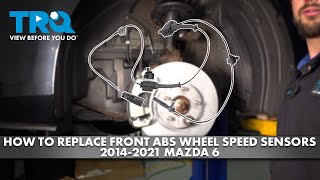
Typical fix: Replace the faulty wheel speed sensor. 🎬 Watch this step-by-step Mazda 6 wheel speed sensor replacement guide The sensor is typically held in by a single 10mm bolt, but can become seized in the steering knuckle from corrosion, potentially requiring it to be drilled out.
Est. part cost: $40-$90 for an aftermarket sensor, $100-$180 for an OEM sensor. - Failed ABS Control Module ⚪ Low Probability While less common, electronic failure of the module can occur due to moisture intrusion or internal faults. A loss of the 12V power feed to the module can also cause failure.
How to confirm: If all four wheel speed sensors and their wiring test good, but the PCM still receives no speed signal (and U-codes for communication loss like U0121 are present), the ABS module is the likely suspect. This was noted in an NHTSA complaint for a similar Mazda platform. [ODI #10895729] Confirm the module is receiving switched 12V power before condemning it.
Typical fix: Replace and program the ABS control module. This often requires specialized tools like FORScan or the dealer's IDS software to write the vehicle's As-Built data to the new module.
Est. part cost: $300-$800+ for a new or remanufactured module.
Rare But Worth Checking
- Damaged Tone Ring / Failing Wheel Bearing: The tone ring is part of the wheel hub assembly. If it becomes cracked, swollen with rust, or filled with debris, it can cause an erratic signal. A failing wheel bearing can introduce excessive play, disrupting the gap between the sensor and tone ring, also causing a bad signal. This is usually diagnosed after a sensor replacement doesn't fix the issue on a specific wheel.
- Powertrain Control Module (PCM) Failure: This is extremely rare. Before condemning the PCM, all other possibilities, including the CAN bus wiring between the ABS module and PCM, must be exhaustively checked.
Diagnosis Steps
- Connect an OBD-II scanner capable of reading ABS module codes and live data.
- Check for any codes in the PCM and the ABS module. Note any 'C' or 'U' codes in addition to the P0500.
- If a 'C' code points to a specific wheel sensor, proceed to inspect that sensor and its wiring first.
- If no other codes are present, access the live data stream for the ABS module.
- Safely drive the vehicle while an assistant monitors the data from all four wheel speed sensors.
- Identify any sensor that reads 0 MPH, is intermittent, or reads differently from the others. That is the suspect circuit.
- Visually inspect the wiring harness for the suspect wheel sensor from the sensor connector back as far as possible. Pay close attention to areas where it might rub against the axle, suspension components, or inner wheel well.
- If wiring is damaged, repair it. If wiring is intact, test the sensor itself (see Specific Diagnostic Values).
- If the sensor tests bad, replace the wheel speed sensor. Be aware they can seize in the knuckle and require significant effort or even drilling to remove.
- If a new sensor does not resolve the issue on one corner, inspect the tone ring on the wheel hub/axle for damage or excessive rust.
- If all four sensors provide a clean, matching signal to the ABS module but P0500 persists, check for power and ground at the ABS module connector. If power/ground is good, the issue may be the ABS module's output or the CAN bus wiring to the PCM.
- Clear all codes and perform a test drive to confirm the repair.
Parts You'll Likely Need
- Front ABS Wheel Speed Sensor
(OEM #GS3L-43-73X (Front Left), GS3L-43-70X (Front Right))— This is the most common component to fail, causing a loss of signal from one wheel and triggering the P0500 code in the PCM.
Trusted brands: Bosch, NTK, Duralast, Beck/Arnley, Holstein
OEM price range: $100-$180
Aftermarket price range: $40-$90 - Rear ABS Wheel Speed Sensor
(OEM #GS3L-43-72Y (Rear Left), GS3L-43-71Y (Rear Right))— The rear sensors are also exposed to the elements and can fail or have their wiring damaged, leading to a P0500 code.
Trusted brands: Dorman, Standard Motor Products, Holstein
OEM price range: $120-$200
Aftermarket price range: $50-$100
Related Codes That Often Appear With This One
- U0121 — This code means 'Lost Communication With ABS Control Module.' If it appears with P0500, it strongly suggests the problem is the ABS module itself or its power/ground connections, as seen in NHTSA complaint #10895729.
- C0031, C0034, C0037, C003A — These are ABS-specific codes that point to a fault in a particular wheel speed sensor circuit (e.g., C0031 for Left Front, C0034 for Right Front, C0037 for Left Rear, C003A for Right Rear). A scan tool that can read ABS codes is necessary to see these.
Platform-Specific Known Issues
- The wiring for the wheel speed sensors is a known weak point, with chafing being a common cause of failure, especially if the retaining clips break.
- Sensors can become seized in the steering knuckle due to corrosion, potentially breaking during removal and complicating the repair. Soaking with penetrating oil is recommended, but drilling may be required.
Mechanic-Grade Diagnostic Values
- Wheel Speed Sensor Resistance — expected: 900 - 2000 Ohms (1.3 - 1.7 kOhms is a common range for Mazda).. Failure: A reading of infinite resistance (open circuit) or zero resistance (short circuit). However, a sensor can pass a resistance test and still be faulty.
- Wheel Speed Sensor AC Voltage Output — expected: Greater than 0.1 - 0.2 Volts AC while spinning the wheel by hand at about half a revolution per second.. Failure: No AC voltage is generated while spinning the wheel. This is a more definitive test for a failed sensor than resistance.
Scan Tool Commands That Help
- FORScan: ABS Module Configuration (As-Built) — Used after installing a new or used ABS module to load the vehicle-specific configuration data. This data can be downloaded from Ford/Motorcraft's service site using the VIN.
- FORScan: ABS Service Functions -> ABS Module Reset — After programming a new module, a reset may be required to clear configuration problem flags and initialize the system.
- Mazda IDS (Dealer Tool): Programmable Module Installation (PMI) — This is the dealer-level procedure to replace an ABS module, which saves configuration from the old module and writes it to the new one.
- Mazda IDS (Dealer Tool): Chassis -> ABS/DSC Sensor Initialization — After module replacement, this function is used to initialize the sensors and calibrate the system.
Wiring & Ground Locations
- Main Engine Bay Grounds — Under the driver's side headlight, there is a ground point where multiple wires attach to the frame.. A poor ground at this central location can cause intermittent issues for multiple electronic modules, including the ABS controller.
- ABS Module Area Grounds — There are several ground points on the chassis near the ABS module itself.. The ABS module requires a clean, solid ground to function. A corroded or loose ground here can directly cause communication codes (U-codes) and P0500.
- Starter/Transmission Ground — A large ground cable is located near the starter motor on the transmission case.. This is a primary ground path for the powertrain and chassis. While less likely to be the sole cause for P0500, ensuring it's clean and tight is critical for overall electrical system health.
Real Owner Repair Stories
- Reddit user, r/mazda6 (Mazda 6 (generation not specified, but behavior is identical)) — Dashboard lit up with warning lights, P0500 code stored.
❌ Tried (didn't work) Initial diagnosis pointed to a bad sensor.
✅ What actually fixed it Upon inspection, the user found an exposed wire on the driver's side harness that was rubbing on the axle because a retaining clip had failed. Replacing the sensor/harness assembly resolved the code, though one bolt snapped during the repair. - Mazdas247 forum user 'Geezer000' (2003 Mazda Protege (similar ABS-based speed signal architecture)) — P0500 code, ABS and brake lights on, speedometer inoperative.
❌ Tried (didn't work) Checking instrument cluster signals., Searching for a transmission-mounted VSS.
✅ What actually fixed it The user diagnosed a lack of power at the ABS HU/CM (module). The original black/blue wire from the fuse box was faulty. The final fix was to bypass the faulty wire and run a new, secondary 12V switched power wire directly to the ABS module, which restored all function.
When the Usual Fixes Don't Work
- In some cases, the common fixes (sensor or wiring) will not resolve the P0500 code. One documented instance on a similar Mazda platform involved a complete loss of power to the ABS module. After confirming sensors and wiring were good, the owner discovered a break in the 12V switched power wire between the fuse box and the module. Bypassing the broken wire with a new one fixed the issue completely, restoring the speedometer and clearing all warning lights. This highlights the importance of checking the module's power and ground connections before condemning the module itself.
Diagnostic Flowchart
Other Known Issues on This Vehicle
Issues unrelated to this code that are worth knowing about as an owner of this generation:
- Sticky / Melting Dashboard Surface 🟠 Medium — Very common, especially in vehicles exposed to high heat and humidity. Can begin appearing after 5-7 years. (Ref: Mazda issued a warranty extension program (SSPA0) to cover replacement for 10 years with no mileage limit for this specific condition.)
- Engine Oil Consumption 🟠 Medium — Frequently reported by owners, sometimes requiring adding a quart of oil between changes. Mazda considers consumption up to 0.8L per 1000km (approx. 1 quart per 750 miles) to be within specification.
- Abnormal Engine Ticking Noise 🟡 Low — A ticking noise from the engine, particularly when cold, is often attributed to failing hydraulic valve lash adjusters. It is more common on higher mileage (100k+ miles) vehicles.
- Front Subframe Corrosion 🔴 High — Common in regions that use road salt. Rust can perforate the right side of the front cross-member. (Ref: Mazda issued a recall for this issue to inspect and either apply a rust-proofing compound or replace the subframe.)
- Spiders in EVAP Canister Vent Line 🟡 Low — An unusual but documented issue where a specific type of spider can build a web in the EVAP vent line, causing a blockage. (Ref: Mazda issued recalls (e.g., NHTSA campaign 11V083000) to install a spring in the vent line to prevent spider intrusion.)
Used vs. New Parts: Buying Guide for This Vehicle
When a used part is the smart pick: For the ABS Control Module (HU/CM), a used part is a viable option when a new OEM unit is prohibitively expensive (often over $1,500) or on long-term backorder. For the individual wheel speed sensors, buying new aftermarket is recommended as they are relatively inexpensive wear items.
Donor-vehicle mileage cap: roughly under 120000 miles for the part to have meaningful remaining life.
What to inspect on the donor part:
- Verify the part number on the used ABS module EXACTLY matches the one on your original module.
- Inspect the electrical connector pins for any signs of corrosion or damage.
- Purchase from a reputable seller that offers a short-term warranty or return policy.
Aftermarket brands forum-validated for this vehicle:
- For wheel speed sensors: Bosch, NTK, Dorman, Standard Motor Products (SMP), Holstein are all commonly used with good results.
Brands owners have reported issues with on this vehicle:
- Ultra-cheap, unbranded sensors from online marketplaces can have higher failure rates or cause erratic readings right out of the box.
Real Owner Stories
Aggregated from forums and TSBs cited above. Mileages and costs reflect what owners reported in those sources.
2008-2013 Mazda 6 2.5L
Symptoms: The owner found a P0500 code and discovered an exposed wire on the driver's side.
What fixed it: The cause was a failed retaining clip that allowed the sensor wire to rub against the axle, exposing the copper. Repairing the wire and securing it resolved the issue.
Source hint: reddit.com/r/mazda6/comments/v3j5h0/p0500_abs_speed_sensor_location/
Related OBD-II Codes
Frequently Asked Questions
Does my 2008-2013 Mazda 6 have a vehicle speed sensor on the transmission?
Why is my speedometer erratic and my ABS light on at the same time?
Is there a recall for the front subframe on my Mazda 6?
My dashboard is becoming sticky and shiny; is this a known issue?
Can I use a basic code reader to find out which wheel sensor is bad?
What is the 'spider recall' I heard about for this car?
Helpful Videos
We Have This Part in Stock


The information in this article is provided for general reference and educational purposes only. Vehicle specifications, procedures, and part compatibility can vary by production date, trim level, and region. Always consult your vehicle's factory service manual and verify part numbers before purchasing or performing repairs. Safety-critical components such as airbags, seat belts, and braking systems should be installed by a qualified professional.
- Mazda 6:
- 🎬 Helpful Videos
- 🛍️ Shop This Part
- What's Unique About the 2008-2013 Mazda 6
- Symptoms You May Notice
- Most Likely Causes
- Rare But Worth Checking
- Diagnosis Steps
- Parts You'll Likely Need
- Related Codes That Often Appear With This One
- Platform-Specific Known Issues
- Mechanic-Grade Diagnostic Values
- Scan Tool Commands That Help
- Wiring & Ground Locations
- Real Owner Repair Stories
- When the Usual Fixes Don't Work
- Diagnostic Flowchart
- Other Known Issues on This Vehicle
- Used vs. New Parts: Buying Guide for This Vehicle
- Real Owner Stories
- 2008-2013 Mazda 6 2.5L
- Related OBD-II Codes
- Frequently Asked Questions
- 🎟️ Get 5% Off