

OBD-II Code P0497: Evaporative Emission System Low Purge Flow
The Ultimate 2026 Guide to Diagnosing and Fixing P0497
- Test the EVAP purge valve first, as a stuck-closed solenoid causes over 70% of P0497 codes and costs under $150 to replace.
- Stop 'topping off' your gas tank immediately; forcing liquid fuel past the auto-shutoff saturates the charcoal canister and causes a $300-$900 replacement.
- Do not replace your gas cap to fix a P0497 code, because loose caps cause EVAP leak codes (like P0455), not low-flow restriction codes.
- Expect an automatic emissions test failure and a 1-3% drop in fuel economy until you clear the blockage in the EVAP system.
What Does P0497 Mean?

Your car's Powertrain Control Module (PCM) detected insufficient vapor flow from the charcoal canister to the engine. The Evaporative Emission (EVAP) system traps gasoline fumes in a charcoal canister. During driving, the PCM opens a purge valve, allowing engine vacuum to pull these fumes into the intake manifold to burn. P0497 signifies this vapor flow is weaker than expected, indicating a restriction or blockage.
Technical definition: The official SAE/OBD-II definition is 'Evaporative Emission System Low Purge Flow.' This DTC triggers when the PCM commands the EVAP purge valve to open but does not detect the expected vacuum drop via the Fuel Tank Pressure (FTP) sensor. The PCM concludes there is a restriction and sets P0497.
Can I Drive With P0497?
Yes, But With Caution. Yes, you can drive with a P0497 code. It does not cause immediate engine damage or leave you stranded. However, ignoring it guarantees an emissions test failure, reduces fuel economy by 1-3%, and releases harmful pollutants. The primary risks are environmental and financial, specifically wasted fuel and failed inspection fees.
Common Causes

- Faulty EVAP Purge Valve/Solenoid (Very Common) — The purge valve, an electronically controlled solenoid, gets stuck closed or clogged with carbon, preventing it from opening to allow vapor flow.
- Clogged or Saturated Charcoal Canister (Common) — Consistently 'topping off' the gas tank forces liquid fuel into the canister, saturating the charcoal media. This turns the canister into a dense brick that blocks vapor flow.
- Blocked or Kinked EVAP Hoses/Lines (Common) — The rubber or plastic lines carrying fuel vapors between the canister, purge valve, and intake manifold crack, kink, or get blocked by debris.
- Faulty EVAP Vent Valve/Solenoid (Less Common) — The vent valve allows fresh air into the canister to facilitate purging. If stuck closed, no fresh air enters, preventing vapors from being pushed into the engine.
- Purge Valve Circuit/Connector Fault (Less Common) — The wiring harness or electrical connector for the purge valve corrodes or breaks, preventing the PCM from commanding the valve to open.
- Moisture or Debris in the EVAP System (Rare) — Water enters through a faulty vent valve and freezes in cold climates, or insects (like spiders) build nests in vent lines, creating a physical blockage.
- Faulty Fuel Tank Pressure (FTP) Sensor (Rare) — The sensor reporting pressure changes to the PCM fails, incorrectly indicating that pressure isn't dropping. This usually triggers sensor-specific codes like P0452.
- Faulty Powertrain Control Module (PCM) (Very Rare) — The PCM suffers a software glitch or hardware failure, misinterpreting sensor data. Consider this only after exhausting all other possibilities.
Symptoms

- Check Engine Light is On — The light triggers as soon as the PCM's self-test of the EVAP system fails.
- Failed Emissions Test — P0497 causes an automatic failure of the EVAP system readiness monitor, making it impossible to pass an OBD-II emissions inspection.
- Faint Fuel Smell — You notice a slight smell of raw gasoline near the rear or engine bay, as the system cannot process trapped vapors.
- Slightly Reduced Fuel Economy — Because fuel vapors captured in the canister are not burned in the engine, overall fuel efficiency decreases by 1-3%.
- Rough Idle — A malfunctioning EVAP system contributes to a slightly rough or stumbling idle, especially after a cold start.
- Audible Hissing or Vacuum Noise — A hissing sound under the hood indicates a cracked vacuum line or a struggling purge valve.
Diagnostic Flowchart
Tap your situation to follow the diagnostic path that matches what you're seeing on this code.
Common Fixes & Costs
- Replace EVAP Purge Valve/Solenoid — Parts: $30-$150, Labor: $50-$150, ~0.8 hr book time (DIY)
- Replace Charcoal Canister — Parts: $200-$600, Labor: $100-$300, ~1.5 hr book time (Intermediate)
- Repair or Replace EVAP Hoses/Lines — Parts: $20-$80, Labor: $80-$200, ~1.2 hr book time (Intermediate)
- Replace EVAP Vent Valve/Solenoid — Parts: $40-$120, Labor: $75-$150, ~1.0 hr book time (Intermediate)
- Replace Fuel Tank Pressure (FTP) Sensor — Parts: $50-$150, Labor: $100-$250, ~1.8 hr book time (Advanced)
DIY vs Professional
- Replace EVAP Purge Valve/Solenoid — Beginner:
- Repair or Replace EVAP Hoses/Lines — Beginner:
- Replace EVAP Vent Valve/Solenoid — Beginner:
- Replace Charcoal Canister — Beginner:
- Replace Fuel Tank Pressure (FTP) Sensor — Beginner:
Used vs. New Parts: Buying Guide
When a used part is worth it: For electronic parts like the purge valve, always buy new. For a large mechanical part like a charcoal canister, a used part from a low-mileage, non-corroded donor vehicle is a cost-effective option if the new price is prohibitive.
Donor-vehicle mileage cap: roughly under 60000 miles for the part to have meaningful remaining life.
Donor quality checklist:
- Verify the donor vehicle was not scrapped for an emissions-related failure.
- Inspect the part for cracks, heavy rust, or signs of fuel saturation.
- Match the OEM part number exactly, as variations exist even within the same model year.
Decision logic:
- If Part is an electronic solenoid (Purge Valve, Vent Valve). → Always buy new. The low cost of new parts outweighs the risk of a faulty used part.
- If Part is a Charcoal Canister and the vehicle is over 100K miles. → A used canister from a donor with under 60K miles is a reasonable choice to save money.
- If Part is a simple hose or line. → Buy new bulk hose material. Used rubber hoses are likely as old and brittle as the one you are replacing.
Warranty tradeoff: Used parts from salvage yards typically offer a 30-90 day warranty. New aftermarket parts usually come with a 1-year to limited lifetime warranty. New OEM parts carry a 1-year/12,000-mile warranty.
Worst-case if a used part fails: $150-300 if a used part fails shortly after installation, requiring repeat labor costs and the purchase of another part.
What Happens If You Wait — Timeline
- 0-2 months: Check Engine Light is on. The code P0497 is stored. No noticeable symptoms other than the light. Vehicle automatically fails an OBD-II emissions test. (MPG impact: 0-1%% · Added cost: $0)
- 2-6 months: A slight decrease in fuel economy becomes noticeable. A faint fuel smell is present after parking. The car continues to fail emissions tests. (MPG impact: 1-3%% · Added cost: $20-$60 in wasted fuel and potential emissions re-inspection fees.)
- 6-12 months: Continued operation with a clogged canister or stuck valve puts minor stress on other EVAP components. The chance of a secondary code (like P0455) appearing increases. (MPG impact: 2-4%% · Added cost: $75-$200 in wasted fuel, fees, and potentially more complex diagnostic charges.)
- 12+ months: No direct catastrophic engine damage occurs. The primary long-term impact is financial and environmental. Costs accumulate from wasted fuel and repeated failed inspections. (MPG impact: 2-4%% · Added cost: $200+ annually in wasted fuel and fees.)
Cost of Not Fixing It
- 0-3 months: Guaranteed failure of any OBD-II emissions test. A 1-3% decrease in fuel economy. Release of harmful VOCs into the atmosphere. (Added cost: $10-$30 in wasted fuel.)
- 3-12 months: Continued emissions test failures. The stuck purge valve or clogged canister causes related EVAP codes (like P0455) to appear, complicating diagnosis. (Added cost: $50-$150 in wasted fuel and re-inspection fees.)
- 12+ months: No direct engine damage occurs. The primary long-term costs are repeated failed inspections, wasted fuel, and environmental impact. (Added cost: $200+ annually in fuel and fees.)
Diagnosis Steps

- Scan for Codes and Review Freeze Frame Data
Use an OBD-II scanner to confirm P0497 is the active code. Check for related codes (e.g., P0498, P0455, P145C). Review the freeze frame data to see the engine conditions when the code triggered.
Tools: OBD-II Scanner (Beginner) - Functionally Test the Purge Valve
Locate the purge valve in the engine bay. With the engine off, disconnect the hoses and blow through it. It is normally closed, so no air should pass. Next, use a bidirectional scan tool or a 9V battery to command it open. You should hear a click and be able to blow through it. If it fails either test, replace it.
Tools: Pliers, 9V battery with leads or a bidirectional scan tool (Intermediate) - Visually Inspect Hoses and Wiring
Perform a thorough visual inspection of the EVAP system. Trace the vapor lines from the engine bay purge valve back to the canister. Look for obvious cracks, kinks, disconnected hoses, or corroded electrical connectors at the purge and vent valves.
Tools: Flashlight (Beginner) - Measure Purge Valve Coil Resistance
With the purge valve disconnected, set a multimeter to Ohms (Ω). Measure the resistance between the two electrical pins on the valve. A healthy valve reads between 15 and 30 Ohms. An infinite reading (OL) means an open circuit, while a zero reading indicates a short. In either case, replace the valve.
Tools: Multimeter (Intermediate) - Electrically Test the Purge Valve Circuit
Disconnect the purge valve connector. With the engine running, use a multimeter to check for battery voltage on the power wire. Connect a test light between the power and ground wires. Use a scan tool to command the purge valve on. The test light should illuminate or pulse. If missing, there is a wiring issue.
Tools: Multimeter, test light, bidirectional scan tool (Advanced) - Check for Blockages in Purge Lines
Disconnect the main purge line from both the purge valve and the charcoal canister. Use low-pressure compressed air to blow through the line. If air doesn't flow freely, the line is blocked. Check for black charcoal pellets at the end of the hose, which indicates a failed canister.
Tools: Air compressor with blow gun, safety glasses (Intermediate) - Inspect the Charcoal Canister and Vent Valve
Inspect the canister for physical damage or fuel saturation. Shake it; a rattling sound means the internal charcoal disintegrated. Locate the vent valve and test its operation. It is normally open and closes when voltage is applied.
Tools: Jack and jack stands, basic hand tools (Advanced) - Perform a Professional Smoke Test
A smoke machine forces low-pressure smoke with UV dye into the EVAP service port. If there is a blockage, the smoke will not flow through the system and exit the vent valve. The machine's flow meter clearly indicates a 'no flow' condition, confirming a restriction.
Tools: EVAP smoke machine with flow meter (Advanced) - [PRO TIP] Analyze Live Data PIDs
Using an advanced scan tool, monitor the Fuel Tank Pressure (FTP) sensor PID. With the engine at idle, command the purge valve to open. You should see the FTP sensor reading drop, indicating vacuum is being pulled. If the voltage does not change, it confirms a no-flow condition.
Tools: Advanced bidirectional scan tool (Advanced) - [PRO TIP] Test the Fuel Tank Pressure (FTP) Sensor
The FTP sensor is a 3-wire sensor. With the key on, engine off, back-probe the connector. You should find a 5-volt reference wire, a ground wire, and a signal wire reading approximately 2.5 volts at atmospheric pressure. If the signal voltage is stuck high or low regardless of pressure, the sensor is faulty.
Tools: Multimeter, back-probe kit (Advanced)
When This Code Triggers (Freeze-Frame Conditions)
- Engine Coolant Temp: Below 122°F (50°C) at startup (Cold start, engine off for 6-8+ hours)
- Fuel Level: 15-85% (approx. 1/4 to 3/4 tank) (Not full and not empty)
- Ambient Air Temp: 40-95°F (4-35°C) (Within a moderate temperature range for the test to run.)
- Vehicle Speed: 45-65 mph (Steady-state cruise for several minutes.)
Related Codes
- P145C — This is a Honda/Acura-specific code for 'EVAP System Purge Flow Malfunction.' If you have both P0497 and P145C, the purge valve is almost certainly the problem.
- P0496 — The opposite of P0497. P0496 means vapor is flowing when it shouldn't be (purge valve stuck open). P0497 means vapor is NOT flowing when it should be (stuck closed or blocked).
- P0455 — This code means 'EVAP System Leak Detected (Large Leak).' A completely blocked canister prevents the system from drawing a vacuum, which the PCM misinterprets as a massive leak.
- P0441 — This code means 'EVAP System Incorrect Purge Flow.' It is a general error triggered by either low flow or unwanted flow. P0497 is specific to a low flow condition.
- P0498 — This indicates an electrical fault with the vent valve. A vent valve that cannot open prevents fresh air from entering the system, directly causing the P0497 low flow condition.
Climate & Environmental Factors
- Insect Intrusion (Spiders): Yellow Sac spiders are attracted to the hydrocarbons in fuel vapor. They build thick webs inside EVAP vent lines, creating a physical blockage that prevents fresh air from entering the system, directly causing a P0497 code.
- Cold Climates: Moisture entering the EVAP system through a faulty vent valve freezes in sub-zero temperatures. An ice blockage in a vapor line acts as a restriction, triggering P0497 until it thaws.
- High Humidity: Ambient humidity has a negligible direct effect on the EVAP system, which is a sealed network designed to manage fuel vapor, not water vapor.
How to Talk to a Mechanic About This Code
Say this: "I have a P0497 code for 'EVAP low purge flow'. I'd like to book a diagnostic. I know this is a restriction code, not a leak code, so please don't just replace the gas cap. I'd like you to test the purge valve and check for blockages in the system."
This signals you understand the specific nature of P0497. It steers the mechanic away from incorrect 'fixes' like a gas cap and directs them toward the most likely causes, saving diagnostic time.
Avoid saying:
- 'My check engine light is on, can you look at it?'
- 'I think it's my gas cap, can you replace it?'
- 'Just fix whatever's wrong.'
Questions to ask before authorizing the repair:
- Did you functionally test the purge valve? Did it click and allow air to pass when commanded open?
- If the purge valve was good, did you perform a smoke test with a flow meter to confirm a blockage downstream?
- If you are recommending a charcoal canister replacement, can you show me evidence of fuel saturation or charcoal pellets in the lines?
- What is the warranty on the parts and labor for this repair?
Where to Take It: Dealer vs Independent vs Chain
- Dealer:
A safe, but expensive, option. Recommended if you have a known manufacturer-specific issue or if other shops failed to diagnose it.
Best for: Vehicles under warranty, Specific manufacturer issues like the Chevy Volt TSB for P0497, Complex diagnostics involving proprietary software
Downsides: Highest labor rates ($150-$250+ per hour), Often recommends replacing multiple parts as a 'kit' when only one has failed (Typical cost: +50% vs. baseline) - Independent Shop:
Best fit for most drivers. A trusted independent mechanic easily diagnoses and repairs the common causes of P0497 at a reasonable cost.
Best for: Most out-of-warranty vehicles, Common codes like P0497 where the fixes are well-documented
Downsides: Quality and diagnostic equipment vary greatly; vet shops by reviews and ASE certifications. (Typical cost: +0% vs. baseline) - Chain Shop:
Use with caution. Acceptable if you are certain the purge valve is the issue. AVOID for deeper diagnosis, as they replace parts unnecessarily without finding the root cause.
Best for: Simple, clear-cut repairs like replacing an easily accessible purge valve.
Downsides: Technician skill varies widely., High pressure to upsell services., Lacks advanced diagnostic tools like a smoke machine with a flow meter. (Typical cost: -10% vs. baseline)
When to Walk Away From the Repair
If the estimated repair cost exceeds 40-50% of the car's private-party value, seriously consider selling or trading it in instead of repairing it.
- Car worth $10000, fix is $250: Fix it. A simple purge valve replacement is a minor cost compared to the vehicle's value.
- Car worth $4000, fix is $900: Borderline. An expensive charcoal canister replacement is a significant percentage of the car's value. Get a second opinion before proceeding.
- Car worth $2500, fix is $1500: Walk away. The repair cost is over 50% of the car's value. It's not a sound financial decision.
What Scan Tool You Need for This Code
Minimum: A scanner with live data and bidirectional control for the EVAP system.
A basic $20 code reader only tells you the P0497 code exists. To properly diagnose it, you must command the purge and vent valves to open and close and watch the fuel tank pressure sensor's live data. A simple reader cannot perform these essential tests.
Budget: BlueDriver Pro (~$90) — Reads and clears codes, provides detailed repair reports, and shows live data for the Fuel Tank Pressure sensor. It lacks full bidirectional control, but its live data helps narrow down the issue.
Mid-range: Foxwell NT510 Elite / XTOOL D7 (~$150) — Offers bidirectional control, allowing you to command the purge and vent solenoids on and off directly from the tool. This is the most critical feature for accurately testing the EVAP system.
Professional: Autel MaxiCOM MK808 / Launch X431 (~$500-1200) — Provides full OEM-level bidirectional control, initiates the vehicle's specific EVAP system self-test, and offers advanced topology mapping. This is professional-grade equipment.
Rent vs buy: Buy. The free 'Loan-A-Tool' programs at auto parts stores provide basic code readers, not the bidirectional scanners needed for this job. The cost to rent advanced scanners approaches the price of buying a midrange tool.
How to Clear the Code After You Fix It
- Use an OBD-II scan tool to clear the code.
- Ensure the fuel tank is between 1/4 and 3/4 full.
- Perform the specific EVAP drive cycle for your vehicle.
Drive cycle (~20 minutes): The EVAP monitor runs only under specific conditions. Cold start the vehicle (engine off for 6+ hours). Let it idle for 3 minutes. Drive at a steady speed between 45-65 mph for 15 minutes, avoiding sharp turns. Park with the engine off for 30 minutes. Repeat if necessary.
Readiness monitors affected: Evaporative System (EVAP), Catalyst (CAT)
Before emissions retest: drive at least 100 miles to fully set monitors.
Watch out for:
- Disconnecting the battery clears the code but resets all readiness monitors, guaranteeing an emissions test failure until they complete.
- The EVAP monitor is notoriously difficult to set, requiring specific temperatures, fuel levels, and driving patterns.
- The code returns immediately if the underlying mechanical or electrical fault remains unfixed.
Will This Fail Emissions / State Inspection?
Yes — this code typically fails an OBD-II emissions inspection.
- California: An active P0497 code causes an automatic smog check failure. A pending or active P0497 code prevents the catalyst monitor from running, leading to a failure.
- New York: The NYS DMV emissions inspection includes an OBD-II scan. An illuminated Check Engine Light and an active P0497 code result in an automatic failure.
- Texas: In the 17 Texas counties requiring emissions testing, a vehicle fails the OBD-II test if the Check Engine Light is on due to P0497.
Most Commonly Affected Vehicles
- Honda Accord, Civic, CR-V, Fit, Odyssey (2005-2016) — Extremely common issue, almost always caused by a failed purge valve solenoid. Often throws code P145C simultaneously.
- Acura MDX, TL, TSX (2004-2014) — Shares the same EVAP system design as Honda. P0497 is a frequent code, typically resolved by replacing the purge valve.
- Chevrolet Volt (2011-2015) — A known issue addressed by GM TSB PIP4891H. The code is almost always caused by overfilling the fuel tank, which saturates the charcoal canister and ruins the purge valve.
- Honda Pilot (2009-2015) — The purge valve is the primary failure point. Before replacing the expensive canister, always test the purge valve first.
- Chevrolet / GMC Traverse, Acadia, Equinox (2009-2017) — P0497 is caused by either the purge valve in the engine bay or the vent valve on the canister. If P0455 is also present, the vent valve is the likely culprit.
- Ford Focus, Fusion, Escape (2010-2018) — While these models are known for purge valves sticking open (P0496), a stuck-closed valve causing P0497 is also a common repair.
- Volkswagen / Audi Jetta, Golf, A4 (2008-2016) — The purge valve, known as the 'N80 valve', is a very common failure item that directly leads to a P0497 code.
- Subaru Forester, Impreza, Crosstrek (2012-2018) — The charcoal canister and vent valve are located above the rear subframe, making access difficult and increasing labor costs significantly.
Manufacturer-Specific Notes
- Honda/Acura: On virtually all models from the mid-2000s to mid-2010s, P0497 is synonymous with a failed purge valve solenoid. The presence of code P145C makes this diagnosis almost certain.
- Chevrolet (Volt): Per TSB PIP4891H, P0497 on a Gen 1 Volt is a direct consequence of overfilling the fuel tank. The official repair requires replacing both the purge valve and the charcoal canister.
- Mazda/Suzuki/Toyota: Several manufacturers issued recalls for EVAP vent lines being clogged by Yellow Sac spider webs. The dense webs create a blockage that causes a P0497 code.
- Subaru: Subaru has a history of offering extended warranties on emissions components beyond the federally mandated period. Owners of older vehicles should check for model-specific emissions warranty extensions.
Real Owner Stories
2014 Honda CR-V with 120K miles
Check Engine Light came on with code P0497 and P145C, but no other drivability issues.
What they tried:
- Replaced gas cap at the suggestion of a shop, but the code returned.
- Replaced the EVAP purge valve solenoid.
Outcome: Replacing the purge valve solenoid resolved both codes. The repair took less than an hour.
Lesson: On a modern Honda with P0497 and P145C, the purge valve is the culprit. Don't waste money on a gas cap for a low-flow code.
2015 Chevy Volt with 95K miles
Check Engine Light with P0497 appeared after a fuel pump nozzle failed to shut off, spilling fuel.
What they tried:
- Initially suspected the purge valve.
- Found GM TSB PIP4891H, which warns that overfilling the tank saturates the charcoal canister.
Outcome: The correct repair required replacing BOTH the charcoal canister and the purge valve, then blowing out all EVAP lines with compressed air.
Lesson: On a Gen 1 Chevy Volt, P0497 is a direct result of 'topping off' the fuel tank. You must replace the canister and purge valve together to fix it permanently.
2011 Honda CR-V with unknown mileage
Owner had P0497 and P145C. Car had a low idle and would shudder at a stop.
What they tried:
- Replaced the EVAP purge solenoid, but the codes and symptoms remained.
- Checked the spark plugs and ignition coils.
Outcome: The cause was a failing ignition coil. The slight engine instability was misread by the ECU, triggering the EVAP codes. Replacing the bad coil fixed the shudder and cleared all codes.
Lesson: If the classic fixes for P0497 don't work and you have subtle performance issues like a rough idle, consider other engine management inputs.
Mazda6 (multiple years)
Recurrent P0497 code with no other obvious cause. All valves and hoses were in good condition.
What they tried:
- Standard diagnosis revealed nothing.
Outcome: The cause was a spider web from a Yellow Sac spider built inside the EVAP vent line. Mazda issued a recall to install a filter to prevent spiders from nesting in the vent line.
Lesson: Don't underestimate environmental factors. Insect intrusion is a known cause of P0497. Inspect the vent valve and hoses for blockages from pests.
How to Prevent This Code From Triggering

- NEVER 'top off' your fuel tank (Every fill-up) — Topping off forces liquid fuel into the charcoal canister, saturating the charcoal media. This creates a blockage that is a primary cause of P0497 and requires expensive canister replacement.
- Use a high-quality fuel filter (Per manufacturer's service interval) — A clean fuel filter prevents contaminants from reaching the fuel system, reducing the chance of debris clogging sensitive components like the purge valve solenoid.
- Inspect EVAP hoses periodically (Annually or during other under-hood maintenance) — Visually check for cracks, hardening, or loose connections in the rubber and plastic EVAP lines. Catching a deteriorating hose early prevents a future P0497 code.
- Clean the EVAP vent valve filter (Every 60,000 miles, or if driving in dusty/muddy conditions) — The vent valve filter gets clogged with dust, mud, or spider webs. A clogged filter restricts airflow, preventing the system from purging correctly.
Frequently Asked Questions
My mechanic says to replace the gas cap first for P0497. Is this correct?
No. A loose gas cap causes an EVAP leak code (like P0455), not a low flow restriction code like P0497. Replacing the gas cap will not fix this issue.
I replaced the purge valve and the P0497 code came back. What's next?
The restriction is elsewhere in the system. Check for blockages in the hoses between the valve and the canister, inspect the charcoal canister for fuel saturation, and test the EVAP vent valve.
What is the difference between code P0497 and P0496?
They are opposites. P0497 means vapor is restricted when it should be flowing, usually due to a stuck-closed purge valve. P0496 means vapor is flowing when it shouldn't be, usually because the purge valve is stuck open.
Can I clean an EVAP purge valve instead of replacing it?
Cleaning a purge valve with carburetor cleaner is rarely a long-term fix. The internal solenoid coil or spring usually fails mechanically or electrically. Given the $30-$100 cost of a new valve, replacement is the only reliable repair.
Why did the code appear right after I got gas?
The PCM runs the EVAP self-test under specific conditions, often shortly after refueling. If a pre-existing problem like a stuck valve or clogged canister exists, the test fails and triggers the light.
What is 'topping off' and why does it cause P0497?
'Topping off' means squeezing extra gas into the tank after the pump nozzle automatically shuts off. This forces liquid gasoline into the vapor-only charcoal canister, ruining the charcoal and creating a dense blockage that directly causes P0497.
What does the clicking noise from my engine bay mean?
A rhythmic clicking from the purge valve is normal when a warm engine is running, indicating the valve is cycling to purge vapors. If you have a P0497 code, the absence of this clicking means the valve is electrically dead or stuck.
Key Takeaways
- Test the EVAP purge valve first, as a stuck-closed solenoid causes over 70% of P0497 codes and costs under $150 to replace.
- Stop 'topping off' your gas tank immediately; forcing liquid fuel past the auto-shutoff saturates the charcoal canister and causes a $300-$900 replacement.
- Do not replace your gas cap to fix a P0497 code, because loose caps cause EVAP leak codes (like P0455), not low-flow restriction codes.
- Expect an automatic emissions test failure and a 1-3% drop in fuel economy until you clear the blockage in the EVAP system.
Helpful Videos
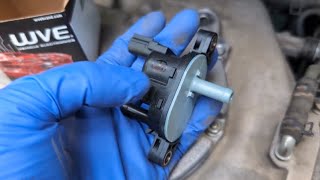

The information in this article is provided for general reference and educational purposes only. Vehicle specifications, procedures, and part compatibility can vary by production date, trim level, and region. Always consult your vehicle's factory service manual and verify part numbers before purchasing or performing repairs. Safety-critical components such as airbags, seat belts, and braking systems should be installed by a qualified professional.
- 🎬 Helpful Videos
- What Does P0497 Mean?
- Can I Drive With P0497?
- Common Causes
- Symptoms
- Diagnostic Flowchart
- Common Fixes & Costs
- DIY vs Professional
- Used vs. New Parts: Buying Guide
- What Happens If You Wait — Timeline
- Cost of Not Fixing It
- Diagnosis Steps
- When This Code Triggers (Freeze-Frame Conditions)
- Related Codes
- Climate & Environmental Factors
- How to Talk to a Mechanic About This Code
- Where to Take It: Dealer vs Independent vs Chain
- When to Walk Away From the Repair
- What Scan Tool You Need for This Code
- How to Clear the Code After You Fix It
- Will This Fail Emissions / State Inspection?
- Most Commonly Affected Vehicles
- Manufacturer-Specific Notes
- Real Owner Stories
- 2014 Honda CR-V with 120K miles
- 2015 Chevy Volt with 95K miles
- 2011 Honda CR-V with unknown mileage
- Mazda6 (multiple years)
- How to Prevent This Code From Triggering
- Frequently Asked Questions
- My mechanic says to replace the gas cap first for P0497. Is this correct?
- I replaced the purge valve and the P0497 code came back. What's next?
- What is the difference between code P0497 and P0496?
- Can I clean an EVAP purge valve instead of replacing it?
- Why did the code appear right after I got gas?
- What is 'topping off' and why does it cause P0497?
- What does the clicking noise from my engine bay mean?
- Key Takeaways
- 🎟️ Get 5% Off