

P0496 on 2013-2020 Land Rover Range Rover: EVAP High Purge Flow Causes & Fixes
On a 2013-2020 Range Rover, code P0496 is frequently caused by a software bug in the Powertrain Control Module (PCM), not a faulty part. Multiple Technical Service Bulletins confirm this. A software update at a dealership is the most common fix. If software is ruled out, the next most likely cause is a faulty EVAP purge valve stuck open.
- For a 2013-2020 Range Rover with code P0496, your first call should be to a dealer to check for software updates.
- Avoid replacing any parts, especially the purge valve, until you have confirmed that the vehicle's PCM software is up to date.
- A simple change in habit—waiting at least 15 seconds after turning off the engine before refueling—may prevent the code from recurring until you can get the software updated.
- If software is ruled out, the most likely physical failure is a purge valve stuck open, which is a relatively simple and inexpensive part to test and replace.
What's Unique About the 2013-2020 Land Rover RANGE ROVER

Unlike most vehicles where P0496 almost always points to a bad purge valve, on the 2013-2020 (L405) Range Rover, the issue is very often a software glitch. Multiple Technical Service Bulletins (TSBs) from Land Rover confirm that the PCM's software is overly sensitive and can incorrectly set this code. One TSB, which became Customer Satisfaction Program N747, specifically notes the code can be set if refueling occurs within 15 seconds of engine shut-off. This makes checking for a software update a critical first step, saving owners from the cost of replacing parts that aren't actually broken.
Diagnostic Flowchart

Tap your situation to follow the diagnostic path that matches what you're seeing on this vehicle.
Symptoms You May Notice

- Check Engine Light is on
- Difficulty starting immediately after refueling
- Slightly rough or unstable idle
- A faint smell of fuel near the vehicle
- Replacing the gas cap. A P0496 code is for improper *flow*, not a system *leak* (like codes P0455, P0456, or P0442). A bad gas cap causes leak codes, not flow codes.
- Replacing the purge valve without first checking for software updates. Given the number of TSBs, the software is a more likely culprit on this specific vehicle. Many owners have replaced the valve only to have the code return, requiring a dealer visit for the software flash anyway.
Most Likely Causes

- Powertrain Control Module (PCM) Software Glitch 🔴 High Probability Land Rover has issued multiple Technical Service Bulletins (TSBs) for this generation, stating that the PCM software is too sensitive and can falsely trigger P0496. TSB SSM74799 addresses this for 2020 models with the AJ126 engine. More broadly, Customer Satisfaction Program N747 covers 2017-2020 models where the code can be set if refueling occurs within 15 seconds of engine shut-off.
How to confirm: Contact a Land Rover dealership or a qualified independent shop with JLR diagnostic tools (like Pathfinder or TOPIx Cloud). Provide your VIN and ask them to check for open campaigns like N747 or available PCM software updates related to TSBs SSM74799 or LTB01302NAS1.
Typical fix: The PCM needs to be reprogrammed (reflashed) with the updated software. This must be done by a dealer or a specialist with the correct JLR equipment.
Est. part cost: $0 (if covered by campaign/warranty) to $400 - Faulty EVAP Canister Purge Valve 🟡 Medium Probability This is the most common mechanical cause for P0496 on any vehicle. The valve can get stuck open due to internal failure or debris, allowing un-commanded vapor flow.
How to confirm: Locate the valve in the engine bay, typically mounted near the intake manifold. 🎬 Watch this walkthrough for locating and replacing the L405 valve With the engine off, disconnect the hoses and try to blow through it; it should be closed and not allow air to pass. 🎬 See how to test your purge valve without any tools You can also use a hand vacuum pump to see if it holds a vacuum. If it fails either test, it's bad. A bi-directional scanner can also command the valve to open and close to test functionality.
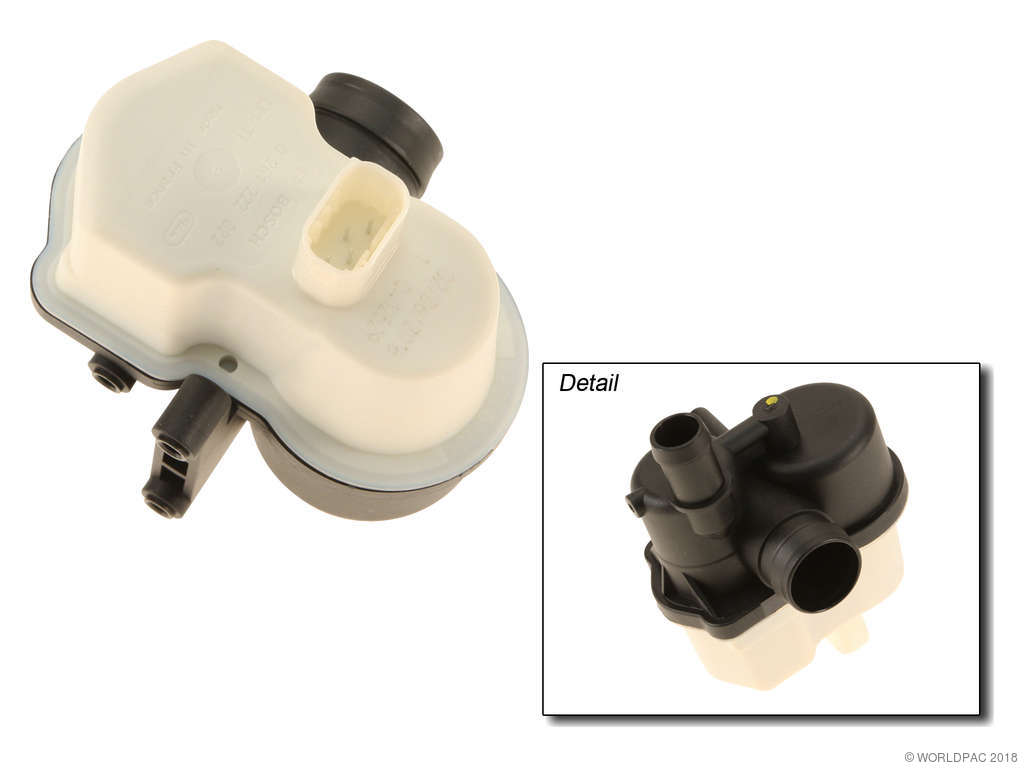
Typical fix: Replace the purge valve. This is often sold as a valve itself. The OEM part is made by Bosch.
Est. part cost: $50-$150 - Cracked EVAP System Hose ⚪ Low Probability A Land Rover TSB mentions that the hose from the DMTL pump to the EVAP canister can deteriorate and crack over time, causing various EVAP codes.
How to confirm: Visually inspect all EVAP hoses for cracks, especially the hose mentioned in TSB LTB01007NAS2. A smoke test, where a mechanic pumps smoke into the EVAP system, is the most effective way to find small leaks.
Typical fix: Replace the cracked hose. The specific part number for the hose mentioned in the TSB is LR089869.
Est. part cost: $40-$80
Rare But Worth Checking
- Faulty Fuel Tank Pressure (FTP) Sensor: The FTP sensor is what the PCM uses to monitor the pressure (or vacuum) in the EVAP system. If the sensor provides an incorrect reading, the PCM might think there is a flow issue when there isn't one. This is less common than a purge valve or software issue.
- Blocked EVAP Canister: If the charcoal canister becomes saturated with fuel (often from overfilling the gas tank) or if the internal filter breaks down, it can cause blockages or send charcoal pellets into the purge valve, forcing it open and causing a P0496 code.
Diagnosis Steps
- Read the trouble codes with an OBD-II scanner.
- Crucial Step for this Vehicle: Contact a Land Rover dealer with your VIN. Ask them to check for any open campaigns like N747 or available PCM software updates related to TSBs LTB01302NAS1 or SSM74799. If an update is available, this is the most likely fix and should be performed first.
- If no software update is needed, locate the EVAP purge valve on the engine. On the V8 and V6 engines, it is typically on the driver's side, near the intake manifold.
- Inspect the valve's electrical connector and wiring for any damage or corrosion.
- With the engine off, disconnect the hoses from the purge valve. Attempt to blow air through the valve. It should be closed and block airflow. If air passes through, the valve is stuck open and must be replaced.
- If the valve seems okay, inspect the EVAP hoses connected to it for any visible cracks or loose connections. Trace them as far as you can.
- If the valve and hoses appear fine, the next step is a professional smoke test to definitively check for leaks in the entire EVAP system.
- If no leaks are found, the issue may be a faulty Fuel Tank Pressure sensor or a failing charcoal canister, which would require further, more complex diagnostics.
Parts You'll Likely Need
- EVAP Canister Purge Valve
(OEM #LR172648)— This is the most common mechanical part to fail that causes a P0496 code. It gets stuck open, allowing fuel vapor to flow when it shouldn't. The part number LR172648 supersedes the older number LR010749.
Trusted brands: Bosch (OEM), Land Rover (Genuine)
OEM price range: $100-$180
Aftermarket price range: $50-$90 - PCM Software Update — A software glitch is a very common, documented cause for this code on this specific vehicle, and an update is often the required fix per multiple TSBs.
OEM price range: $150-$400
Aftermarket price range: N/A
Related Codes That Often Appear With This One
- P0497 — This code for 'EVAP System Low Purge Flow' is the direct counterpart to P0496 and relates to the same components, often pointing to a blockage or a valve stuck closed.
- P0442 — This code for a 'Small EVAP System Leak' can sometimes appear with P0496 if there is a physical crack in a hose that affects both pressure and flow readings. A user on Reddit with a 2016 LR4 reported this exact combination.
- P0456 — Similar to P0442, this code for a 'Very Small EVAP System Leak' can be caused by a cracked hose that might also contribute to the P0496 fault.
Technical Service Bulletins (TSBs) & Recalls
- Range Rover_N881_18APR25: Notes that DTC P0496 can be stored if refueling happens within 15 seconds of engine off, requires PCM software update.
- SFCC-14MAR19-Sli: States P0496 can be caused by a software bug even when the purge valve tests as good.
- SSM74799: Another bulletin for 2020 models with the AJ126 engine, stating P0496 requires a PCM calibration update.
- LTB01302NAS1, SSM74279: General bulletins noting the occurrence of P0496.
- SSM71658: Defines P0496 as 'EVAP SYSTEM HIGH PURGE FLOW' and lists it with other related EVAP codes.
- LTB01007NAS2: Mentions cracked EVAP hoses on 2015-2016 models causing EVAP faults.
- N747: Customer Satisfaction Program launched in Jan 2023 for 2017-2020 models to update PCM software to fix P0496 caused by refueling habits.
Platform-Specific Known Issues
- A software bug can cause the Malfunction Indicator Lamp (MIL) to illuminate with DTC P0496 if the vehicle is refueled within 15 seconds of turning the engine off. The fix is a PCM software update under Customer Satisfaction Program N747.
- Another software bug can cause P0496 to be stored even when the purge valve self-test passes, again pointing to a required PCM update, as noted in TSB SFCC-14MAR19-Sli.
- Some 2015-2016 models were subject to a TSB for a cracked EVAP hose from the DMTL pump to the canister, which could cause various EVAP-related DTCs.
- For 2020 models with the AJ126 engine, TSB SSM74799 specifically calls for a PCM calibration update to resolve a P0496 code.
Mechanic-Grade Diagnostic Values
- Purge Valve Connector - Power Pin — expected: Battery voltage (approx. 12V) with ignition on.. Failure: 0V indicates a problem with the power supply circuit or fuse.
- Purge Valve Connector - ECU Control Pin — expected: Battery voltage when inactive (open circuit inside ECU), drops to near 0V when the ECU commands the valve to open (provides ground). This is a pulse-width modulated (PWM) signal.. Failure: Voltage that never drops indicates a wiring issue or faulty ECU driver. Voltage stuck at 0V indicates a short to ground in the wiring.
- Wiring Harness Continuity — expected: Low resistance, typically under 2.0 Ohms, between the component connector and the PCM connector pin.. Failure: High resistance (over 5 Ohms) or an open circuit (OL) indicates a broken wire or corroded connection.
Hidden / Shadow Codes Worth Checking
- P0496-00: The '-00' suffix is a JLR-specific symptom byte. For this DTC, it indicates the monitor failed because the system diagnosed an excessive pressure drop between the fuel tank and the purge valve. (see via Most comprehensive OBD-II scanners and professional tools like JLR Pathfinder/SDD will display this suffix.)
Scan Tool Commands That Help
- JLR Pathfinder: Manual Patch 'MP_PF_ER_J0023', followed by 'Update ECU' for the PCM. — This specific patch and reflash procedure is the prescribed fix for TSB SSM74799, which addresses P0496-00 on 2020 models with the AJ126 engine.
- Advanced Bi-Directional Scanner (e.g., iCarsoft CR Pro+, Autel, Snap-on): EVAP Purge Solenoid Activation Test / Bi-Directional Control. — To manually command the purge valve to open and close while the engine is running. This allows a technician to verify if the valve is physically responding to commands and to check for vacuum flow changes, helping to isolate a stuck valve from a control-side problem.
Wiring & Ground Locations
- Purge Valve Connector — On the EVAP purge valve itself, located in the engine bay, typically on the driver's side near the intake manifold for V6/V8 engines.. This is the primary point for electrical testing. It's a 2-wire connector where one pin should have battery voltage (key on) and the other is the ground signal switched by the PCM.
- Main Engine/Chassis Grounds — Key locations include a heavy gauge cable from the battery negative terminal to the chassis/frame, and another from the frame to the engine block. Also check for smaller ground studs on the inner fenders in the engine bay.. A poor engine or PCM ground can cause erratic behavior in electronically controlled components like the purge valve, leading to incorrect operation and false codes. Verifying these main grounds are clean and tight is a crucial step in diagnosing any electrical fault.
- A-Pillar Earth Headers — Behind the plastic kick panels in the driver and passenger footwells. These are common grounding points for various interior and control modules.. If the PCM or a related circuit grounds at one of these headers, corrosion or a loose connection here could cause the P0496 code. This is a secondary check if direct circuit testing is inconclusive.
"I Checked Everything" — The Actual Cause
- According to Land Rover TSB SFCC-14MAR19-Sli, it is possible for the P0496 code to be stored in the PCM even when the fuel tank leak test routine and the purge valve self-test both return passing results. This indicates a scenario where a smoke test would find no leaks and the valve would appear to function correctly, yet the code persists. The actual cause in this documented case is a software bug, and the required fix is a PCM software update.
OEM Part Supersession History
LR010749→LR172648— Part has been updated or replaced by the manufacturer. LR172648 is the current Genuine Land Rover part number.Multiple (e.g., 8W939C915AA, 9W839B593AA, AJ811695)→LR172648— These are older Jaguar/Land Rover part numbers for the same component that have been consolidated or superseded over time.
Heads up: While these older parts may be physically identical, LR172648 is the latest revision and should be used for repairs.
Model Year Variations Within This Range
- 2017-2020: These model years are covered by Customer Satisfaction Program N747, which addresses P0496 being falsely triggered by refueling within 15 seconds of engine shutoff. The fix is a specific PCM software update.
- 2020 (with AJ126 engine): These models are specifically called out in TSB SSM74799, which requires a PCM calibration update via a manual patch in the JLR Pathfinder software to resolve a P0496-00 fault.
Helpful Videos
Used OEM Parts in Stock


New Aftermarket Parts Available


The information in this article is provided for general reference and educational purposes only. Vehicle specifications, procedures, and part compatibility can vary by production date, trim level, and region. Always consult your vehicle's factory service manual and verify part numbers before purchasing or performing repairs. Safety-critical components such as airbags, seat belts, and braking systems should be installed by a qualified professional.
- Land Rover RANGE ROVER:
- 🎬 Helpful Videos
- 🛍️ Shop This Part
- What's Unique About the 2013-2020 Land Rover RANGE ROVER
- Diagnostic Flowchart
- Symptoms You May Notice
- Most Likely Causes
- Rare But Worth Checking
- Diagnosis Steps
- Parts You'll Likely Need
- Related Codes That Often Appear With This One
- Technical Service Bulletins (TSBs) & Recalls
- Platform-Specific Known Issues
- Mechanic-Grade Diagnostic Values
- Hidden / Shadow Codes Worth Checking
- Scan Tool Commands That Help
- Wiring & Ground Locations
- "I Checked Everything" — The Actual Cause
- OEM Part Supersession History
- Model Year Variations Within This Range
- 🎟️ Get 5% Off