

P0496 on 2005-2013 Chevrolet Corvette: Causes, Symptoms, and Fixes for EVAP Flow
On a 2005-2013 C6 Corvette, code P0496 is almost always caused by a stuck-open EVAP purge solenoid valve located on the passenger side of the engine. This allows un-metered fuel vapors to enter the intake, causing a hard start after refueling. It is a simple, 15-minute DIY fix with a part cost of approximately $25-$50.
- P0496 on a C6 Corvette almost always means you need a new EVAP purge solenoid valve.
- The most common symptom, besides the Check Engine Light, is the engine struggling to start after you get gas.
- This is a simple and inexpensive DIY repair that takes about 15 minutes.
- If replacing the purge valve doesn't fix it, the next steps are to check for a contaminated charcoal canister or wiring issues.
What's Unique About the 2005-2013 Chevrolet Corvette
For the C6 generation Corvette (2005-2013), the P0496 code is exceptionally common and almost always points directly to a single, easy-to-replace part: the EVAP purge solenoid valve. Unlike in some other vehicles where diagnosis can be complex, the Corvette community has well-documented that the primary symptom is a hard start immediately after refueling, which is a tell-tale sign of this specific valve failing in the open position. The valve's location on the passenger-side cylinder head, just under the engine cover, makes it one of the easier repairs for this platform.
Symptoms You May Notice
- Check Engine Light is illuminated.
- Difficulty starting the engine, especially right after refueling. The car may crank for an extended period or sputter to life as if it's flooded.
- Rough or unstable idle, sometimes stalling at stops.
- A slight decrease in fuel economy due to the un-metered vapor.
- A whooshing sound from the gas tank area when opening the cap, caused by the constant vacuum.
- In some cases, other lean condition codes like P0171 and P0174 may accompany P0496 due to the vacuum leak.
- Replacing the gas cap when the purge valve is the actual issue.
- Replacing the rear EVAP vent solenoid near the fuel tank. This part (which typically causes code P0449) has a different function, which is to allow fresh air into the system for testing, whereas the purge solenoid controls vapor flow to the engine.
- Assuming a major fuel system problem like a weak fuel pump, when the symptoms are isolated to post-refueling starts.
Most Likely Causes
- Faulty EVAP Purge Solenoid Valve 🔴 High Probability This is a very common failure item on many GM vehicles of this era that use the LS-series engines, including the Corvette. The valve gets stuck open, either partially or fully, allowing un-commanded fuel vapor into the intake manifold. This creates a vacuum leak that the fuel tank pressure sensor detects, triggering the code.
How to confirm: Disconnect the electrical connector and the EVAP line from the purge valve. Start the engine. Place your fingertip over the valve's inlet port (where the line was connected). If you feel any suction/vacuum with the electrical connector unplugged, the valve is stuck open and must be replaced. This is a definitive test.
Typical fix: Replace the EVAP purge solenoid valve. It is located on the passenger side cylinder head, held in place by a single 10mm bolt and is easily accessible after removing the engine cover.
Est. part cost: $25-$50
Rare But Worth Checking
- Damaged or Loose Gas Cap: While a bad gas cap typically causes a small leak code (like P0442 or P0455), it's the easiest thing to check first. Ensure it is tight and the seal is not cracked or damaged. However, for P0496, this is rarely the root cause.
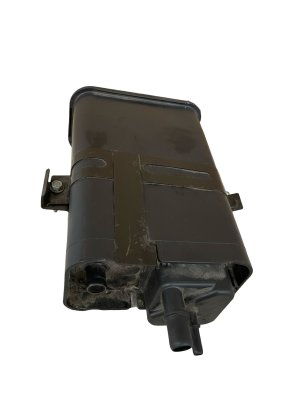
- Clogged EVAP Charcoal Canister: This can happen if you frequently 'top off' your fuel tank after the pump clicks off, forcing liquid gasoline into the canister which is designed only for vapor. This can cause charcoal pellets to break free and get sucked into the EVAP lines, potentially jamming the purge solenoid open. If you replace a purge valve and it fails again quickly, suspect a contaminated canister.
- Leaking EVAP Hoses or Lines: A crack or break in one of the EVAP system hoses could potentially cause a vacuum issue, though it's less likely to manifest as P0496 compared to a leak code. A visual inspection or smoke test would be needed to confirm.
- Faulty Fuel Tank Pressure (FTP) Sensor: In very rare cases, the FTP sensor itself can fail and give an incorrect reading, making the ECM believe there is flow when there isn't. This is uncommon and should only be considered after the purge valve has been confirmed to be working correctly.
Diagnosis Steps
- Read the code with an OBD-II scanner to confirm P0496 is present. Note any other codes like P0171/P0174.
- Check the gas cap. Ensure it is tightened until it clicks and inspect the rubber seal for cracks or damage.
- Locate the EVAP purge solenoid valve on the front of the passenger-side cylinder head, beneath the plastic engine cover.
- Disconnect the electrical connector from the valve.
- Disconnect the EVAP line that runs from the valve toward the rear of the car. This usually has a green quick-connect tab.
- Start the engine. With the engine idling, carefully check for vacuum at the port on the valve where the line was just removed. You can use your fingertip or a vacuum gauge.
- If any vacuum is present, the purge valve is faulty and needs to be replaced. This is the most likely outcome.
- If no vacuum is present, the valve is likely functioning correctly. The issue may be a faulty fuel tank pressure (FTP) sensor, a wiring problem, or a leak elsewhere in the system, which would require more advanced diagnostics like a smoke test.
Parts You'll Likely Need
- Vapor Canister Purge Solenoid Valve
(OEM #12597567)— This is the most common failure point for the P0496 code on this vehicle. It gets stuck open, causing the symptoms described.
Trusted brands: ACDelco (OEM - Service P/N 214-1680), Dorman (P/N 911-030), Standard Motor Products (P/N CP612)
OEM price range: $35-$50
Aftermarket price range: $25-$40
Related Codes That Often Appear With This One
- P0171 (System Too Lean Bank 1)
- P0174 (System Too Lean Bank 2)
- P0442 (EVAP System Small Leak Detected)
- P0455 (EVAP System Large Leak Detected)
Technical Service Bulletins (TSBs) & Recalls
- While no TSB is specific to the C6 Corvette for P0496, GM has issued several related bulletins for other vehicles with similar engines. For example, TSB 17-NA-409 mentions P0496 on 3.6L LFX engines and attributes it to contamination causing the purge valve to stick. Special Coverage Adjustment N222369620 for 2019-2020 models also identifies P0496 as a primary code for a faulty purge valve. These documents confirm GM's awareness of this failure mode.
- Manufacturer TSB Bulletin #PIP6037A notes that P0496 can also fail due to damaged purge solenoid valve O-rings.
- Additionally, Bulletin #PIP5284A advises technicians that if P0496 continues to set after performing standard diagnostics, the customer's specific drive cycle may be contributing to the concern.
Platform-Specific Known Issues
- Repeated Failures Due to Charcoal Canister Debris: Some owners have reported replacing the purge valve only for the P0496 code to return a few months later. This can be caused by charcoal particles from a deteriorating EVAP canister being drawn through the lines and contaminating the new valve, causing it to stick. One user on ChevroletForum.com suggested adding a small in-line fuel filter before the purge valve as a preventative measure if the canister is suspected of shedding material.
Mechanic-Grade Diagnostic Values
- EVAP Purge Solenoid Coil Resistance — expected: Approximately 14-30 Ohms. Failure: A reading of infinity (open circuit) or zero (short circuit) indicates a failed solenoid coil.
- Fuel Tank Pressure (FTP) Sensor Voltage — expected: Signal varies between 0.1V (high pressure) and 4.9V (high vacuum). With the engine off and gas cap removed, it should read around 1.5V-2.5V depending on altitude.. Failure: The P0496 code sets when the ECM detects a vacuum greater than 10 inches of H2O (approx. 2.49 kPa) for 5 seconds when the purge valve is commanded closed. This corresponds to a higher voltage reading when it should be neutral.
- Long Term Fuel Trim (LTFT) — expected: Within +/- 10% at idle.. Failure: A stuck-open purge valve acts as a vacuum leak, forcing the ECM to add fuel. This will cause LTFT values to become highly positive, often exceeding +10% and climbing towards +15% or higher as the ECM compensates.
Scan Tool Commands That Help
- Tech2 / GDS2 or equivalent professional scanner: EVAP System Test > Purge/Seal — This bidirectional command allows a technician to manually close the EVAP vent solenoid and command the purge solenoid on and off. It is used to verify if the purge solenoid is physically stuck open. With the system sealed and the purge solenoid commanded OFF, the Fuel Tank Pressure sensor reading should remain stable. If it begins to show a vacuum, it confirms the purge solenoid is leaking.
- Tech2 / GDS2 or equivalent professional scanner: EVAP Purge Solenoid Duty Cycle Control — This allows for manually commanding the purge solenoid to a specific percentage (e.g., 25%, 50%) while monitoring fuel trims. A functional system will show short-term fuel trims immediately reacting to the change in vapor flow. No reaction could indicate a clogged line or a non-responsive solenoid.
Wiring & Ground Locations
- G106 — Passenger side of the engine block, above the starter.. This is a primary ground for the Powertrain Control Module (PCM/ECM). A poor connection here can cause erratic behavior from any sensor or solenoid controlled by the ECM, including the EVAP purge solenoid. Technicians warn to disconnect the battery before servicing this ground to avoid shorting against the nearby starter positive lug.
- ECM Connector C1, Pin 24 — At the Engine Control Module (ECM).. This pin receives the signal from the Fuel Tank Pressure (FTP) sensor via a Dark Green wire. This is the primary input the ECM uses to detect the unwanted vacuum that triggers P0496. Probing this wire is essential for diagnosing a faulty sensor or wiring issue.
- ECM Connector C1, Pin 54 — At the Engine Control Module (ECM).. This pin provides the ground-side control for the EVAP Canister *Vent* Solenoid via a White wire. While not the purge solenoid, a fault in the vent solenoid circuit (e.g., stuck closed) can cause the system to pull a vacuum during self-tests, potentially complicating diagnosis.
- Underhood Fuse Block, Fuse #13 — In the fuse block located in the engine compartment.. This 25A fuse, often labeled MRRTD, provides power to the rear EVAP vent solenoid on some model years. A blown fuse here will set a P0449 code but is important to check as part of a comprehensive EVAP system diagnosis.
Real Owner Repair Stories
- CorvetteForum user 'joshawa1982' (C6 Corvette (year not specified)) — P0496 Check Engine Light.
❌ Tried (didn't work) Replaced the front EVAP purge solenoid., Replaced the rear EVAP vent solenoid/canister., Resetting the computer multiple times.
✅ What actually fixed it The user's problem was not resolved in the thread, which serves as a critical real-world example that throwing the two most common parts at the P0496 code does not guarantee a fix. The next logical steps suggested by other members were to check for a clogged charcoal canister from overfilling the gas tank or to perform a smoke test to find a leak in a line. - CorvetteForum user 'offshoretechman' (2005 C6 Corvette Coupe) — P0449 Check Engine Light (EVAP Vent Solenoid Circuit).
❌ Tried (didn't work) Initially assumed it was the solenoid itself.
✅ What actually fixed it The root cause was a faulty electrical plug/connector for the vent solenoid, not the solenoid itself. The dealer wired in a new connector to resolve the code. This is a high-value story as it demonstrates that a component's circuit can fail at the connector, a fault that is often overlooked.
Documented NHTSA Reports
- An owner reported in NHTSA ODI #11710113 that their vehicle experienced rough running and a "Reduced Engine Power" warning while traveling at 60 mph uphill, with P0496 appearing alongside P0171, P0299, P0300, P0442, and P0449.
- NHTSA ODI #11606943 describes a situation where a vehicle continued to have a rough idle even after the purge solenoid was replaced for code P0496, indicating the engine was still not 100 percent fixed.
- In NHTSA ODI #11088522, a technician diagnosed a stuck open EVAP purge solenoid setting the SES light with codes P0300 and P0496; further testing revealed Bank 1 injectors were out of specification.
"I Checked Everything" — The Actual Cause
- A smoke test is designed to find physical leaks in the EVAP hoses and components. However, it will not identify the root cause of a P0496 if the issue is electrical or an incorrect sensor reading. For example, a faulty Fuel Tank Pressure (FTP) sensor that is electrically skewed to read vacuum when there is none will pass a smoke test. Similarly, a bad electrical connector or a wiring short that holds the purge solenoid open would not be found with a smoke test, as the solenoid itself is the source of the 'leak' and is functioning as commanded by the faulty circuit.
When the Usual Fixes Don't Work
- While the vast majority of P0496 codes on the C6 Corvette are fixed by replacing the EVAP purge solenoid, there are documented cases where this does not solve the problem. In one instance, a vehicle owner replaced both the purge solenoid and the rear vent solenoid, yet the code persisted. This indicates the problem was likely further upstream (a clogged charcoal canister from fuel overfill) or within the wiring/sensor system, such as a faulty Fuel Tank Pressure sensor giving false readings or a damaged wire in the harness. This underscores the importance of performing the simple vacuum test on the old solenoid before replacement, and if it passes, moving on to more advanced electrical and system diagnostics rather than continuing to replace parts.
OEM Part Supersession History
12597567→12610560, which was then superseded by 12737252— GM often supersedes parts to improve reliability, change suppliers, or make minor design updates. The repeated failure of this valve suggests the supersessions were likely attempts to improve its durability.
Heads up: All listed part numbers are considered interchangeable for this application, with the latest number being the recommended service replacement.
Model Year Variations Within This Range
- 2005 vs. 2006-2013: The 2005 Corvette uses an E40 ECM, while later models use the E38 or E67 ECMs. The physical connectors and pinout locations for sensor inputs and solenoid controls can differ between these ECMs. A technician performing electrical diagnostics must use the correct wiring diagram for the specific model year, as a pinout for a 2005 will not match a 2008.
Diagnostic Flowchart
Used vs. New Parts: Buying Guide for This Vehicle
When a used part is the smart pick: For this specific repair, a used part is NOT recommended. The EVAP purge solenoid is a known high-failure-rate item, and the cost of a new OEM or quality aftermarket part is low.
What to inspect on the donor part:
- Not applicable as a used part is not advised.
OEM-only on this vehicle (don't cheap out):
- While not strictly 'OEM-only', using an ACDelco (OEM) purge valve is highly recommended for best fit and longevity. Some complex electronic sensors like the Fuel Tank Pressure sensor are also best sourced from OEM to avoid calibration issues.
Aftermarket brands forum-validated for this vehicle:
- ACDelco (OEM)
- Dorman
- Standard Motor Products (SMP)
Brands owners have reported issues with on this vehicle:
- No specific brands were consistently cited as problematic in owner forums, but unbranded, low-cost parts from online marketplaces carry a higher risk of premature failure or incorrect operation.
Real Owner Stories
Aggregated from forums and TSBs cited above. Mileages and costs reflect what owners reported in those sources.
2005-2013 Corvette C6
Symptoms: Check Engine Light with P0496, and the car struggles to crank or makes a mechanical 'clunk' sound after refueling.
What fixed it: The owner was advised that a malfunctioning EVAP system, specifically the purge valve solenoid, was the likely cause of the hard starting issue.
Source hint: CorvetteForum.com thread titled 'P0496 EVAP Purge Valve Solenoid'
Corvette C6
Symptoms: The P0496 check engine light kept coming back on, even after replacing both the front and rear emissions canisters/sensors.
What fixed it: The owner learned that replacing those parts was a diagnostic dead end, and the actual problem was likely the EVAP purge valve located on the passenger side cylinder head, which had not yet been replaced.
Source hint: CorvetteForum.com thread titled 'P0496'
Chevrolet (model not specified)
Symptoms: The P0496 code and Check Engine Light returned just two months after replacing the EVAP Purge Solenoid Valve.
What fixed it: The initial fix was replacing the purge valve. The repeat failure suggests the root cause may be a deteriorating charcoal canister contaminating the new valve, a known issue mentioned on ChevroletForum.com.
Source hint: Chevrolet Forum
Related OBD-II Codes
Frequently Asked Questions
Where is the EVAP purge solenoid valve located on my C6 Corvette?
Why is my Corvette so hard to start right after I put gas in it?
I replaced the purge valve for P0496, but the code came back. What's going on?
How can I be sure the purge valve is the problem before I buy a new one?
Are there any official GM recalls or TSBs for P0496 on the 2005-2013 Corvette?
My scanner shows P0171 and P0174 along with P0496. Are these codes related?
Used OEM Parts in Stock
New Aftermarket Parts Available


The information in this article is provided for general reference and educational purposes only. Vehicle specifications, procedures, and part compatibility can vary by production date, trim level, and region. Always consult your vehicle's factory service manual and verify part numbers before purchasing or performing repairs. Safety-critical components such as airbags, seat belts, and braking systems should be installed by a qualified professional.
- Chevrolet Corvette:
- 🛍️ Shop This Part
- What's Unique About the 2005-2013 Chevrolet Corvette
- Symptoms You May Notice
- Most Likely Causes
- Rare But Worth Checking
- Diagnosis Steps
- Parts You'll Likely Need
- Related Codes That Often Appear With This One
- Technical Service Bulletins (TSBs) & Recalls
- Platform-Specific Known Issues
- Mechanic-Grade Diagnostic Values
- Scan Tool Commands That Help
- Wiring & Ground Locations
- Real Owner Repair Stories
- Documented NHTSA Reports
- "I Checked Everything" — The Actual Cause
- When the Usual Fixes Don't Work
- OEM Part Supersession History
- Model Year Variations Within This Range
- Diagnostic Flowchart
- Used vs. New Parts: Buying Guide for This Vehicle
- Real Owner Stories
- 2005-2013 Corvette C6
- Corvette C6
- Chevrolet (model not specified)
- Related OBD-II Codes
- Frequently Asked Questions
- 🎟️ Get 5% Off