

P0496 on 2020-2025 Buick Encore GX: EVAP High Purge Flow Causes and Fixes
On a 2020-2025 Buick Encore GX, code P0496 is almost always caused by a faulty vapor canister purge valve. Before buying the part (around $20-$60), check if your vehicle is covered by GM's Special Coverage N232395310, which extends the warranty for this exact issue to 15 years/150,000 miles for 2020-2021 models with the 1.2L or 1.3L engine.
- First, call a GM dealer with your VIN to check for coverage under Special Coverage N232395310. This could result in a free repair for 2020-2021 models.
- P0496 on the Encore GX is almost certainly a bad vapor canister purge valve (part #12666845).
- Symptoms often include a rough idle or difficulty starting the car right after you fill up the gas tank.
- This is a simple and inexpensive DIY repair that typically requires no tools and can be done in under 15 minutes.
- The same issue affects the 2021-2025 Chevrolet Trailblazer, which is the Encore GX's platform-mate.
What's Unique About the 2020-2025 Buick ENCORE GX

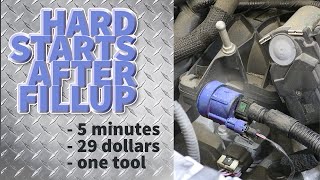
The Buick Encore GX and its sibling, the Chevy Trailblazer, are built on the same platform with shared 1.2L and 1.3L engines. This specific P0496 issue is so prevalent on these vehicles that General Motors has issued both a Technical Service Bulletin (TSB #PIP6037A) pointing to faulty O-rings on the purge solenoid and a Special Coverage program (N232395310). 🎬 Watch: Understanding the unique purge pump system on the Encore GX. This program extends the warranty on the purge pump/valve for many 2020-2021 Encore GX and 2021 Trailblazer models to 15 years/150,000 miles, officially acknowledging the high failure rate.
Diagnostic Flowchart

Tap your situation to follow the diagnostic path that matches what you're seeing on this vehicle.
Symptoms You May Notice

- Check Engine Light is on
- Difficulty starting the engine, especially after refueling. This happens because the stuck-open purge valve allows raw fuel vapors from the just-filled tank to be drawn into the intake manifold, creating an overly rich mixture that floods the engine.
- Rough or unstable idle
- Audible loud ticking or clicking noise from the engine bay, which is the sound of the faulty solenoid attempting to operate.
- Replacing the gas cap. While a loose or faulty gas cap can cause other EVAP codes (like P0455 or P0457), it does not cause P0496, which is about flow when none is commanded, not a system leak.
- Replacing the EVAP charcoal canister. The canister can become saturated with fuel as a *result* of a stuck-open purge valve, but it is rarely the root cause of the P0496 code itself. The canister should only be replaced if it is physically cracked or has been saturated with fuel after the root cause (the purge valve) has been fixed.
Most Likely Causes

- Faulty Vapor Canister Purge Valve / Solenoid 🔴 High Probability This is a well-documented failure point, acknowledged by GM through TSB PIP6037A and Special Coverage N232395310. The valve can get stuck open internally or its O-rings can fail, causing a leak. Even a tiny internal leak that allows air to pass is enough to trigger the code.
How to confirm: With the engine running, disconnect the EVAP hose from the purge valve. There should be no suction or vacuum felt at the valve's port. If vacuum is present, the valve is stuck open and is faulty. You can also remove the valve and try to blow through it; if any air passes, it is bad, as it should be normally closed.
Typical fix: Replace the vapor canister purge valve. For 2020-2021 models, first check with a GM dealer for coverage under Special Coverage N232395310 for a free repair.
Est. part cost: $15-$70
Rare But Worth Checking
- Faulty Fuel Tank Pressure (FTP) Sensor: A malfunctioning FTP sensor could incorrectly report vacuum in the tank, leading the computer to set a P0496 code even if the purge valve is working correctly. This is less common than a failed purge valve.
- Short in Purge Valve Wiring Harness: If the wiring that controls the purge valve is damaged and shorted to power, it could hold the valve open when it's supposed to be closed, mimicking a mechanical failure of the valve itself.
- Overfilling the Fuel Tank: Consistently 'topping off' the gas tank after the pump clicks off can force liquid fuel into the charcoal canister and EVAP lines, which are designed only for vapor. This can saturate the canister and damage the purge valve over time.
Diagnosis Steps
- Check with a GM dealer to see if your vehicle's VIN is covered under Special Coverage N232395310 for a free repair. This applies to many 2020-2021 models with the 1.2L or 1.3L engine.
- If not covered, locate the purge valve on the engine. It's a small black solenoid with two hoses and an electrical connector, typically mounted on or near the intake manifold.
- Start the engine and let it idle.
- Disconnect the electrical connector from the purge valve. This ensures it is not being commanded open by the computer.
- Carefully disconnect the vapor line that runs from the purge valve towards the back of the vehicle (to the charcoal canister).
- Place your finger over the port on the purge valve where you just removed the hose. If you feel any suction, the valve is leaking internally and must be replaced.
- If no vacuum is felt, the problem may be more complex, such as an intermittent electrical issue or a faulty Fuel Tank Pressure sensor, and may require more advanced diagnostics with a scan tool that can read live data.
Parts You'll Likely Need
- Vapor Canister Purge Solenoid Valve
(OEM #12666845)— This valve is the primary cause of code P0496 on this vehicle. It fails by sticking open or developing a leak in its internal seals or O-rings. This part is used across a wide range of GM vehicles.
Trusted brands: ACDelco, GM Genuine Parts
OEM price range: $17-$40
Aftermarket price range: $20-$70
Technical Service Bulletins (TSBs) & Recalls

- PIP6037A: Communicates that DTC P0496 may be set due to damaged purge solenoid valve O-rings.
- N232395310: This is a Special Coverage program, not a standard TSB, that extends the warranty for the purge pump failure causing this code on specific 2020-2021 models.
Platform-Specific Known Issues
- GM Special Coverage N232395310: Extends the warranty on the evaporative emissions purge pump to 15 years or 150,000 miles for 2020-2021 Encore GX models with the 1.2L (LIH) or 1.3L (L3T) engine. It also covers the 2021 Chevy Trailblazer. This directly addresses the P0496 code, and owners of affected vehicles can get a free repair at a GM dealership.
- TSB #PIP6037A: This bulletin notes that P0496 can be set due to damaged O-rings on the purge solenoid valve, leading to a vacuum leak. It advises technicians to inspect the O-rings before replacing the entire valve assembly.
Mechanic-Grade Diagnostic Values
- Fuel Tank Pressure (FTP) with engine idling at 1,200-1,500 RPM, purge valve disconnected, and vent valve commanded closed. — expected: -0.9 to +0.9 mm Hg (-0.5 to +0.5 in. H2O). Failure: A reading outside the specified range indicates a leaking purge valve.
- Fuel Tank Pressure (FTP) during a non-purge condition. — expected: Less than 10 inches of H2O vacuum.. Failure: The ECM will set code P0496 if it detects a vacuum greater than 10 in. H2O (2.49 kPa) for 5 seconds.
- EVAP Purge Solenoid Coil Resistance — expected: Typically between 20-40 Ω, but vehicle-specific data should be confirmed.. Failure: A reading far outside this range indicates a failed solenoid coil.
- Long-Term Fuel Trim at idle — expected: Close to 0% (+/- 5%). Failure: A high positive long-term fuel trim (e.g., +9% or higher) can be caused by the unmetered air leak from a stuck-open purge valve. The trim should correct towards 0% immediately after replacement.
Hidden / Shadow Codes Worth Checking
- P1467: On the Buick Encore GX, this code specifically points to a fault with the 'Evaporative Emission Purge Pump', a separate component from the more common purge solenoid/valve (P0496). (see via Standard OBD-II scanner. This code is also covered under the same Special Coverage N232395310 as P0496.)
Scan Tool Commands That Help
- GDS2 (or equivalent professional scan tool): Purge/Seal — This command seals the entire EVAP system by closing both the purge valve and the vent valve, allowing a technician to monitor the FTP sensor for vacuum decay or build-up to test for leaks.
- GDS2 (or equivalent professional scan tool): EVAP Service Bay Test — This is an automated test that runs the onboard EVAP diagnostic routine on command, rather than waiting for the specific cold start and drive cycle conditions to be met naturally. It can confirm if a leak is currently present.
- GDS2 (or equivalent professional scan tool): Purge Solenoid Activation Test (Open/Close) — This bidirectional control allows a technician to manually command the purge solenoid open and closed to listen for an audible click and verify its mechanical operation without having to remove it from the vehicle.
Real Owner Repair Stories
- YouTube channel 'TeamDIYNow' (2021 Buick Encore GX AWD 1.3L Turbo) — Check Engine Light with code P1467.
❌ Tried (didn't work) The owner did not report trying other fixes first, but directly addressed the P1467 code.
✅ What actually fixed it The owner replaced the 'Evaporative Emission Purge Pump' (not the purge valve/solenoid). He noted this part is covered under Special Coverage N232395310 and provided the updated part number (25207556) which superseded the original (12703879). - Reddit user PDub466 in r/AskAMechanic (2017 Buick Encore 1.4L Turbo (non-GX model, but principle applies)) — Check Engine Light with codes P0496 and P1101 (Intake Air Flow System Performance).
❌ Tried (didn't work) User was considering replacing the Mass Air Flow sensor due to the P1101 code.
✅ What actually fixed it A verified technician advised that the P0496 from a leaking purge valve creates an unmetered vacuum leak that the MAF sensor cannot account for, which in turn *causes* the P1101 code. The correct repair was to replace the purge valve to fix both codes, starting with the cause (P0496) before addressing the symptom (P1101).
OEM Part Supersession History
12703879→25207556— This is the part number supersession for the 'Evaporative Emission Purge Pump', which is associated with code P1467 but also covered under the Special Coverage that addresses P0496.
Model Year Variations Within This Range
- 2020-2021: Models in this range with the 1.2L or 1.3L engine are specifically called out in GM's Special Coverage N232395310, which extends the warranty for the purge pump/valve assembly to 15 years/150,000 miles. Later model years are not included in this specific program, though they are covered by TSB PIP6037A.
Helpful Videos
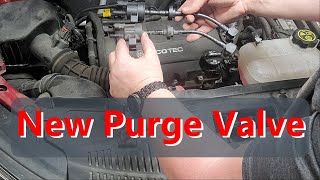
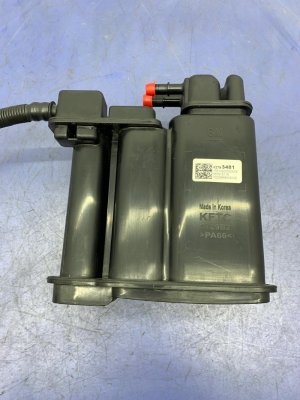
Used OEM Parts in Stock



New Aftermarket Parts Available


The information in this article is provided for general reference and educational purposes only. Vehicle specifications, procedures, and part compatibility can vary by production date, trim level, and region. Always consult your vehicle's factory service manual and verify part numbers before purchasing or performing repairs. Safety-critical components such as airbags, seat belts, and braking systems should be installed by a qualified professional.
- Buick ENCORE GX:
- 🎬 Helpful Videos
- 🛍️ Shop This Part
- What's Unique About the 2020-2025 Buick ENCORE GX
- Diagnostic Flowchart
- Symptoms You May Notice
- Most Likely Causes
- Rare But Worth Checking
- Diagnosis Steps
- Parts You'll Likely Need
- Technical Service Bulletins (TSBs) & Recalls
- Platform-Specific Known Issues
- Mechanic-Grade Diagnostic Values
- Hidden / Shadow Codes Worth Checking
- Scan Tool Commands That Help
- Real Owner Repair Stories
- OEM Part Supersession History
- Model Year Variations Within This Range
- 🎟️ Get 5% Off