

OBD-II Code P0494: Engine Fan Speed Low
The Ultimate 2026 Guide: What P0494 Means, Why It Triggers, and Exactly How to Fix It
- Code P0494 indicates the primary cooling fan is spinning at least 10% slower than commanded, creating an immediate risk of engine overheating in stop-and-go traffic.
- Always test the $20 cooling fan relay and inspect the fan control module before spending $300+ on a complete fan motor assembly replacement.
- Stop driving the vehicle immediately; operating with a compromised cooling fan risks a blown head gasket that costs between $1,500 and $4,000 to repair.
- Use a multimeter to perform a voltage drop test on the fan motor connector; readings above 0.5V on the power side indicate a wiring issue, not a bad motor.
What Does P0494 Mean?

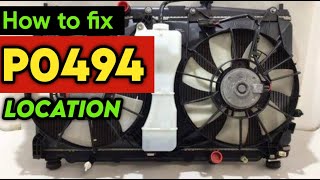
The Powertrain Control Module (PCM) detected the primary electric cooling fan is spinning significantly slower than commanded. The cooling fan pulls air through the radiator to dissipate heat when the vehicle is stationary or moving slowly. The PCM sets P0494 when actual fan speed drops more than 10% below the target for current operating conditions, such as engine temperature and A/C system pressure.
Technical definition: The official SAE/ISO definition is "Fan 1 Speed Low". 🎬 See this quick overview of the P0494 code and its causes. This indicates the Powertrain Control Module (PCM) determined the rotational speed of the primary cooling fan is below a calibrated threshold compared to the commanded speed. The PCM actively monitors fan performance and expects a specific RPM response to its duty cycle commands.
Can I Drive With P0494?
no_not_recommended. Driving is not recommended. A compromised cooling fan prevents effective engine cooling in low-speed traffic or hot weather. Driving more than a few miles risks severe engine overheating, leading to a blown head gasket or warped cylinder head costing $1,500 to $4,000+. The risk of catastrophic engine damage far outweighs the convenience of a short trip.
Common Causes

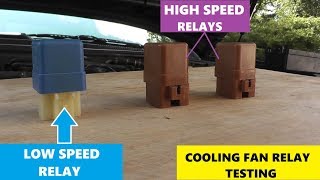
- Faulty Cooling Fan Relay (Very Common) — The cooling fan relay is a high-current switch powering the fan motor. Internal contacts burn or corrode over time, creating high resistance that delivers insufficient voltage to the fan, causing it to run slow.
- Failing Cooling Fan Motor / Assembly (Very Common) — The electric motor driving the fan blades wears out. Internal bearings seize, brushes wear down, or motor windings develop an open or short circuit, preventing the fan from reaching commanded speed.
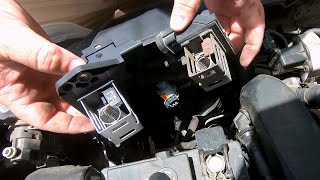
- Faulty Cooling Fan Control Module/Resistor (Common) — Modern vehicles use a dedicated control module or resistor block to manage fan speed via a Pulse-Width Modulated (PWM) signal. These modules fail from heat stress or water intrusion, sending weak or incorrect signals to the motor.
- Wiring or Connector Issues (Common) — The wiring harness is exposed to harsh conditions. Corrosion in connectors, frayed insulation, or a poor ground connection creates high resistance (voltage drop), starving the fan motor of the power required to spin at the correct speed.
- Low System Voltage (Less Common) — A weak battery or failing alternator causes overall system voltage to drop. When the fan is commanded on, the low voltage is insufficient for the motor to reach its target RPM.
- Faulty Engine Coolant Temperature (ECT) Sensor (Less Common) — The PCM uses the ECT sensor reading to dictate fan speed. If the sensor sends an inaccurate low-temperature reading, the PCM commands a lower fan speed than necessary for the actual engine temperature.
- Faulty Fan Clutch (Trucks/SUVs) (Less Common) — Trucks with large engines often use an electronically controlled viscous fan clutch instead of a fully electric fan. A failure in the clutch's internal mechanism or control solenoid prevents proper engagement.
- Physical Obstruction (Rare) — Road debris, a misaligned fan shroud, or ice buildup physically blocks the fan blades, preventing them from spinning freely.
- Failing Powertrain Control Module (PCM) (Very Rare) — The internal driver circuit within the PCM that controls the fan relay or module fails. This requires a PCM replacement or reflash and is considered a last resort after exhausting all other diagnostics.
Symptoms

- Engine Overheating at Low Speeds — The temperature gauge rises into the red zone when idling, in stop-and-go traffic, or climbing hills due to insufficient natural airflow through the radiator.
- Poor Air Conditioning Performance — A slow fan causes the A/C to blow cool but not cold air when stationary. The PCM often disables the A/C compressor entirely to protect the system when a fan fault is detected.
- Fan is Visibly Slow or Noisy — A whining or grinding noise emits from failing motor bearings, or the fan spins noticeably slower than usual when the engine is hot.
- Fan Stays On Continuously — A faulty control module or stuck relay causes the fan to run constantly at a low speed, even when the engine is cold.
- Check Engine Light is On (also visible on scanner) — The PCM illuminates the malfunction indicator lamp as soon as the fan speed drops below the 10% threshold.
Diagnostic Flowchart
Tap your situation to follow the diagnostic path that matches what you're seeing on this code.
Common Fixes & Costs
- Replace Cooling Fan Relay — Parts: $15-$50, Labor: $40-$60, ~0.5 hr book time (DIY)
- Replace Cooling Fan Control Module — Parts: $100-$450, Labor: $75-$200, ~1 hr book time (Intermediate)
- Replace Cooling Fan Assembly — Parts: $150-$600, Labor: $120-$450, ~1.5 hr book time (Intermediate)
- Repair Wiring or Connector — Parts: $20-$100, Labor: $150-$350, ~2 hr book time (Intermediate)
- Replace Powertrain Control Module (PCM) / TIPM — Parts: $600-$1200, Labor: $200-$350, ~1.5 hr book time (Professional)
Used vs. New Parts: Buying Guide
When a used part is worth it: A used OEM fan assembly from a low-mileage, accident-free vehicle provides better fitment and electronic compatibility than a cheap aftermarket alternative.
Donor-vehicle mileage cap: roughly under 60000 miles for the part to have meaningful remaining life.
Donor quality checklist:
- Verify the donor vehicle was not scrapped due to front-end damage.
- Match the part number exactly; modules and connectors vary by model year and trim.
- Inspect the plastic shroud for cracks and the fan blades for signs of impact.
Decision logic:
- If The failure is a simple relay or accessible control module → Always buy new. The cost is low and the reliability of a new electrical part is worth it.
- If The vehicle is over 10 years old and the budget is tight → A used OEM fan assembly is a better choice than a non-brand-name aftermarket unit.
- If The vehicle is newer or the part is known for high failure rates → Buy a new OEM or high-quality aftermarket part (e.g., Dorman, TYC) to get a longer service life and warranty.
Warranty tradeoff: Used parts from a salvage yard typically have a 30-90 day warranty. New aftermarket parts offer a 1-year to limited lifetime warranty. New OEM parts carry a 1-2 year warranty.
Worst-case if a used part fails: $250-$600 if a used or cheap aftermarket fan fails prematurely, requiring repeat labor costs.
What Happens If You Wait — Timeline
- 0-1 month: Check Engine Light is on. A/C performance is poor in traffic. Engine temperature creeps up at idle but cools down when driving at speed. (MPG impact: 0-2%% · Added cost: $0)
- 1-3 months: Engine noticeably overheats in stop-and-go traffic, potentially boiling over. The A/C system shuts down completely to protect itself. (MPG impact: 2-5%% · Added cost: $150-$300 (for a tow and diagnostic fee after an overheating event))
- 3-6 months: Repeated overheating incidents warp the cylinder head, causing head gasket failure. Coolant leaks externally or internally into the oil. (MPG impact: 5-10%% · Added cost: $1,500-$4,000 (for cylinder head resurfacing and head gasket job).)
- 6+ months: Catastrophic engine damage. A severely warped head, mixed oil and coolant, and damaged piston rings lead to complete engine failure. (MPG impact: 10-20%+% · Added cost: $4,000-$8,000+ (for a used or remanufactured engine replacement).)
Cost of Not Fixing It
- Immediate (0-1 month): Engine overheating in traffic, leading to potential breakdown. A/C system underperforms or shuts down completely. (Added cost: $150-$300 (for a tow and diagnostic fee))
- Short Term (1-3 months): Repeated overheating incidents cause coolant to boil over, damaging plastic components and leading to warped cylinder heads. (Added cost: $1,500-$4,000+)
- Long Term (3+ months): Catastrophic engine damage, such as a blown head gasket allowing coolant and oil to mix. This ruins bearings and requires complete engine replacement. (Added cost: $3,000-$8,000+)
Diagnosis Steps

- Verify Code and Review Freeze Frame Data
Use an OBD-II scanner to confirm P0494 and check for related codes (e.g., P0480). Analyze freeze-frame data for exact engine temperature, vehicle speed, and commanded fan duty cycle when the code triggered.
Tools: OBD-II Scanner (Beginner) - Test Basic Fan Operation
Start the engine and turn the A/C to maximum. This commands the cooling fan to turn on immediately. Observe if the fan starts, its apparent speed, and listen for grinding noises.
Tools: None (Visual Inspection) (Beginner) - Inspect Fan Fuses and Relays
Locate the main fan fuse and relay in the under-hood fuse box. Swap the fan relay with an identical non-essential relay (like the horn). If the fan now works correctly, the original relay is faulty.
Tools: Owner's Manual, Pliers (Beginner) - Perform a Visual Inspection
With the engine off and cool, check for debris obstructing the blades. Ensure the fan spins freely by hand. Inspect the wiring harness and connectors to the fan motor for melting, corrosion, or physical damage.
Tools: Flashlight (Beginner) - Test Power, Ground, and Voltage Drop
Disconnect the fan motor. Check for 12V+ on the power wire and good ground (<0.5 ohms) when commanded on. For a definitive test, perform a voltage drop test under load: >0.5V on the power side or >0.2V on the ground side indicates excessive resistance in the wiring.
Tools: Digital Multimeter with long leads (Intermediate) - Command Fan Speed with a Bidirectional Scan Tool
Use a bidirectional scanner to command the fan to run at 10%, 50%, and 90%. If speed changes but won't reach 100%, it points to voltage drop or a tired motor. No response suggests a control module or wiring fault.
Tools: Bidirectional Scan Tool (Advanced) - Analyze the PWM Control Signal
For vehicles with a fan control module, back-probe the PWM signal wire from the PCM using a lab scope. You should see a clean square wave (20-200 Hz). A missing or distorted waveform points to a PCM or wiring issue.
Tools: Lab Scope (Oscilloscope), Bidirectional Scan Tool (Professional) - Live Data PID Analysis
Monitor 'Commanded Fan Duty Cycle' versus 'Actual Fan RPM' simultaneously. If the commanded value is 90% but actual RPM is 800, and voltage drop tests passed, the fan motor is failing.
Tools: Advanced Scan Tool (Advanced)
When This Code Triggers (Freeze-Frame Conditions)
- Engine Coolant Temp: 195-220°F (90-104°C) (Engine is at or above normal operating temperature, triggering fan command.)
- RPM: 650-1200 RPM (Engine is idling or at low speed in traffic.)
- Engine Load: 20-40% (Low load conditions, such as idling with A/C on.)
- Vehicle Speed: 0-15 mph (Vehicle is stationary or in stop-and-go traffic, where fan assistance is critical.)
Related Codes
- P0480 — Indicates a general electrical fault (open or short) in the 'Fan 1 Control Circuit'. Diagnose P0480 first; fixing the circuit fault almost always clears the P0494 performance code.
- P0495 — The opposite code: 'Fan Speed High'. P0495 indicates a shorted relay or failed control module commanding the fan to run at maximum speed constantly.
- P0483 — 'Cooling Fan Rationality Check Malfunction' means the PCM detected unexpected fan action, like running when it shouldn't. It accompanies P0494 if behavior is erratic.
- P0529 — 'Fan Speed Sensor Circuit Intermittent'. If the vehicle uses a separate fan speed sensor, this code indicates an unreliable signal causing the PCM to incorrectly set P0494.
Climate & Environmental Factors
- Hot Climates: Vehicles in hot climates experience higher failure rates. The fan runs more often and longer, accelerating wear on the motor, control module, and relay.
- Cold Climates / Road Salt: Salt spray and moisture attack wiring harnesses, ground connections, and connectors, leading to high resistance and voltage drop.
- High Humidity: Humid environments accelerate corrosion on electrical contacts within relays and connectors, leading to intermittent high-resistance connections.
- High Altitude: Less dense air requires the cooling fan to spin faster or longer to achieve the same heat dissipation, placing more stress on the system over time.
How to Talk to a Mechanic About This Code
Say this: "I have a P0494 code and my engine is starting to overheat at idle. I need a diagnostic appointment to pinpoint the failure in the cooling fan circuit. Please check the fan relay, control module, and perform a voltage drop test at the fan motor connector before recommending a full fan assembly replacement."
This directs the technician to perform specific, logical diagnostic steps (testing the cheap parts first) and prevents them from immediately quoting the most expensive repair, saving you money on diagnostic time and parts.
Avoid saying:
- My check engine light is on, can you look at it?
- My car is overheating, I think I need a new radiator.
- Just fix whatever is wrong, I need it back today.
Questions to ask before authorizing the repair:
- What were the results of the voltage and ground tests at the fan motor connector?
- Did you test the fan motor directly by applying 12-volt power?
- Was the fan relay tested or swapped with a known good one?
- Can you show me the corroded connector or damaged wire that needs to be repaired?
- What is the warranty on the recommended part and the labor for this repair?
Where to Take It: Dealer vs Independent vs Chain
- Dealer:
Recommended only if your vehicle is under warranty or has a known, complex issue like a TIPM that independent shops hesitate to tackle.
Best for: Vehicles under warranty, Complex, vehicle-specific issues like a faulty TIPM on a Jeep/Dodge/Chrysler, Repairs related to a specific Technical Service Bulletin (TSB)
Downsides: Highest labor rates, often 1.5-2x more than independent shops., Defaults to replacing an entire assembly (e.g., full fan unit) when a smaller component repair is possible. (Typical cost: +50% vs. baseline) - Independent Shop:
Best choice for most P0494 situations. A competent independent technician diagnoses and repairs this common electrical fault effectively.
Best for: Most out-of-warranty P0494 repairs, Vehicles where common failure points (relay, motor, wiring) are the likely cause, Cost-conscious owners who want a good balance of expertise and value
Downsides: Quality and diagnostic skill vary; check reviews and look for ASE certifications., May lack access to the latest manufacturer software updates for PCM reflashing. (Typical cost: +0% vs. baseline) - Chain Shop:
AVOID for diagnosis. The risk of misdiagnosis and being sold expensive, unnecessary parts is high.
Best for: Simple, clear-cut jobs like a pre-diagnosed relay replacement.
Downsides: Diagnostic accuracy is highly variable., High pressure to upsell leads to recommendations for unnecessary part replacements., Technician skill level is inconsistent. (Typical cost: -10% vs. baseline)
When to Walk Away From the Repair
If the estimated repair cost exceeds 40-50% of the vehicle's private-party value, reconsider the investment.
- Car worth $4000, fix is $1800: Walk away. The repair cost is 45% of the car's value. This is too high for a single repair on an older vehicle.
- Car worth $12000, fix is $950: Fix it. The repair is less than 8% of the vehicle's value. This is a reasonable cost to keep a more valuable car running safely.
- Car worth $2500, fix is $1200: Borderline, but likely walk away. At 48% of the car's value, this repair is a very significant investment in a low-value car. Get a second opinion.
What Scan Tool You Need for This Code

Minimum: A code reader that displays live data for Engine Coolant Temperature (ECT) and other basic parameters.
A basic reader only shows the P0494 code. To diagnose this problem, you need bidirectional control to command the fan on and off directly from the scanner.
Budget: BlueDriver Pro or Ancel BD310 (~$90) — These Bluetooth scanners offer live data graphing. You can watch the Engine Coolant Temperature rise and see if the fan is commanded on. They provide access to freeze-frame data and repair reports.
Mid-range: Foxwell NT809BT or TopDon ArtiDiag Pro (~$350) — Ideal for a serious DIYer. These tools offer bidirectional control, allowing you to command the fan to turn on and off directly. This instantly tests the entire fan circuit (relay, module, and motor).
Professional: Autel MaxiCOM MK900 or XTOOL D8S (~$500-1200) — Provides full bidirectional control plus advanced features like ECU coding and topology mapping, crucial for diagnosing complex issues on newer vehicles where the BCM controls the fan.
Rent vs buy: Free rental scanners from auto parts stores lack live data and bidirectional control. Buying a mid-range scanner with bidirectional control offers the best long-term value and pays for itself by avoiding one misdiagnosis.
How to Clear the Code After You Fix It
- Reconnect the battery if it was disconnected for the repair.
- Use an OBD-II scan tool to clear the P0494 trouble code.
- Perform a complete drive cycle to allow the vehicle's readiness monitors to run.
Drive cycle (~30 minutes): Start with a cold engine (sat for 8+ hours). Idle for 2-3 minutes with A/C on. Drive for 15-20 minutes with a mix of city (stop-and-go) and highway (steady 55 mph for 5+ minutes) conditions. Allow the vehicle to cool down completely.
Readiness monitors affected: Catalyst Monitor, Evaporative (EVAP) System, O2 Sensor Monitor
Before emissions retest: drive at least 50 miles to fully set monitors.
Watch out for:
- Disconnecting the battery clears the code but resets all readiness monitors to 'Not Ready', causing an automatic emissions test failure.
- The code returns immediately if the underlying electrical or mechanical fault has not been properly repaired.
Will This Fail Emissions / State Inspection?
Yes — this code typically fails an OBD-II emissions inspection.
- California: An active Check Engine Light results in an automatic smog check failure. After repair, a full drive cycle must be completed to set all readiness monitors before a re-test.
- New York: For 1996+ gasoline vehicles, an illuminated Malfunction Indicator Lamp is an automatic failure. For 2001+ vehicles, only one readiness monitor can be 'Not Ready' to pass.
- Texas: An illuminated Check Engine Light on a 1996 or newer vehicle is an automatic failure. After clearing the code, you must drive 50-100 miles to reset readiness monitors.
Most Commonly Affected Vehicles
- Ford F-Super Duty (F-250, F-350) (2016-2019) — TSB SSM 47999 addresses 6.7L engines for inoperative fans with P0494. It directs technicians to use an updated diagnostic procedure to avoid unnecessarily replacing the fan clutch.
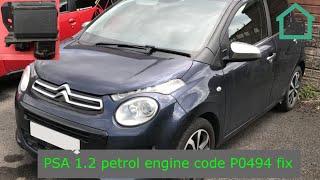
- Peugeot/Citroën Various (e.g., C1, 208, 308, DS4) (2010-2024) — The fan controller/resistor module is a frequent failure point. On pre-2012 models, it was located behind the bumper, making it highly vulnerable to water damage.
- Jeep/Dodge/Chrysler Grand Cherokee, Ram 1500, Various (2008-2016) — The Totally Integrated Power Module (TIPM) houses the fan relays and is a notorious failure point. Diagnosis requires testing outputs directly from the TIPM.
- Ford Fusion (2006-2020) — The cooling fan control module, mounted directly on the fan shroud, is a well-known failure item leading to fan speed issues.
- Chevrolet Equinox (2020-2024) — P0494 is often linked to aftermarket fan assemblies installed after collision repairs. Non-OEM fans fail to communicate correctly with the Body Control Module (BCM).
- Toyota Proace (2016-2024) — Sharing a platform with Peugeot/Citroën, it suffers from identical failures: a faulty fan control unit or a blown main fuse caused by a seized motor.
- Volkswagen Various Diesel Models (TDI) (2009-2015) — P0494 points to issues in the fan harness, the integrated fan control module, or the smaller of the two cooling fans failing.
- Dodge Grand Caravan (2011-2020) — The cooling fan relay within the TIPM is a primary source of the problem, alongside the fan motor assembly itself.
Manufacturer-Specific Notes
- Ford: For 2016-2019 Super Duty trucks (6.7L), TSB SSM 47999 advises technicians to use an updated diagnostic procedure to prevent the common misdiagnosis of replacing a perfectly good fan clutch.
- Peugeot/Citroën (PSA): The fan control resistor/module is the primary cause of P0494. On pre-2012 vehicles, its vulnerable position behind the front bumper led to frequent water damage.
- Chrysler/Dodge/Jeep: The Totally Integrated Power Module (TIPM) contains internal, non-serviceable relays for the cooling fan. When these fail and trigger P0494, the entire TIPM requires repair or replacement.
- General Motors (Chevrolet/GMC): The Body Control Module (BCM) plays a large role in fan control. Using an aftermarket cooling fan assembly after a collision repair triggers P0494 because the electronics do not communicate properly.
Real Owner Stories
2010 Peugeot 308 1.4Vti with multiple codes
Bought car as a non-runner. Check engine light on with P0494. Fan would not turn on with A/C activated. Temperature gauge rose slowly at idle.
What they tried:
- Suspected a bad timing chain due to other codes, but timing was correct.
- Replaced spark plugs and swapped coils.
- Replaced the thermostat, which cleared some codes but not P0494.
Outcome: Cleaning the fan control resistor module resolved the P0494 error. The fan began operating correctly afterward.
Lesson: On Peugeot models, the fan control resistor/module is a highly common failure point and should be checked before the fan motor itself.
2006 Mitsubishi Lancer with poor MPG and overheating
Owner experienced terrible fuel economy (20 MPG) and the car overheated in summer traffic. The radiator fan was not working.
What they tried:
- Identified that the fan was not activating when the engine got hot.
Outcome: Replacing a faulty engine coolant temperature (ECT) sensor fixed both the overheating and the poor gas mileage, with MPG jumping to over 30.
Lesson: A faulty ECT sensor causes P0494. If the sensor incorrectly tells the computer the engine is cold, the computer won't command the fan on, leading to overheating and a rich fuel mixture.
Dodge Grand Caravan with intermittent P0494
The check engine light for P0494 appeared intermittently. The fan worked sporadically. The owner was concerned about the cost of replacing the whole fan assembly.
What they tried:
- Suspected the TIPM (Totally Integrated Power Module) due to known Chrysler issues.
Outcome: Diagnostic steps confirmed the cooling fan relay was faulty. Since the relay is integrated into the TIPM, a full TIPM replacement or specialized repair was required.
Lesson: On Chrysler, Dodge, and Jeep vehicles, the fan relay is a common failure point soldered inside the main TIPM fuse box, making it a complex repair.
How to Prevent This Code From Triggering
- Clean debris from fan blades and shroud (Every 15,000 miles or annually) — Leaves and road debris physically obstruct the fan, causing imbalance and straining the motor.
- Wash the vehicle's undercarriage regularly (Monthly in salt-belt regions) — Road salt attacks the fan's wiring harness, connectors, and ground points, causing high resistance that leads to low voltage.
- Apply dielectric grease to electrical connectors (When replacing any cooling system component) — Dielectric grease blocks moisture and oxygen from corroding metal pins, ensuring a solid, low-resistance connection.
- Perform a coolant flush (Every 30,000 to 50,000 miles) — Clean coolant prevents the engine from running hotter than necessary, reducing runtime and stress on the cooling fan motor.
Frequently Asked Questions
Can a bad battery or alternator cause code P0494?
Yes. A weak battery or failing alternator causes low system voltage. The cooling fan motor requires significant electrical current, and low voltage prevents it from reaching target RPM, triggering P0494.
My mechanic replaced the fan motor, but the P0494 code came back. What's next?
This indicates a misdiagnosis where the electrical circuit supplying the motor is actually at fault. Perform a voltage drop test on the power and ground wires, test the fan relay, and inspect the control module. High-resistance connections are frequent culprits.
Is it safe to drive with code P0494?
No. Driving with a malfunctioning cooling fan puts your engine at immediate risk of overheating in traffic or warm weather. Overheating quickly leads to severe damage like a warped cylinder head, costing thousands to repair.
Will replacing the fan motor always fix P0494?
No. While the motor is a common cause, replacing it without a full diagnosis often wastes money. The actual problem is frequently a $20 relay, a corroded connector, or a faulty fan control module.
Why does my A/C stop working when code P0494 is active?
The A/C system must dissipate heat via the condenser located in front of the radiator. If the cooling fan runs too slowly, A/C system pressure gets too high. The PCM disables the A/C compressor to prevent catastrophic failure.
Can a blown fuse cause P0494?
A blown fuse typically causes a complete loss of power, resulting in a P0480 code because the fan won't run at all. However, a fuse with high resistance limits current and causes a low-speed condition. Always check fuses first.
How much does it cost to diagnose a P0494 code?
Most repair shops charge a standard diagnostic fee ranging from $125 to $200. This covers the technician's time to scan codes, analyze live data, and perform initial electrical tests to pinpoint the failure.
Key Takeaways
- Code P0494 indicates the primary cooling fan is spinning at least 10% slower than commanded, creating an immediate risk of engine overheating in stop-and-go traffic.
- Always test the $20 cooling fan relay and inspect the fan control module before spending $300+ on a complete fan motor assembly replacement.
- Stop driving the vehicle immediately; operating with a compromised cooling fan risks a blown head gasket that costs between $1,500 and $4,000 to repair.
- Use a multimeter to perform a voltage drop test on the fan motor connector; readings above 0.5V on the power side indicate a wiring issue, not a bad motor.
Helpful Videos

The information in this article is provided for general reference and educational purposes only. Vehicle specifications, procedures, and part compatibility can vary by production date, trim level, and region. Always consult your vehicle's factory service manual and verify part numbers before purchasing or performing repairs. Safety-critical components such as airbags, seat belts, and braking systems should be installed by a qualified professional.
- 🎬 Helpful Videos
- What Does P0494 Mean?
- Can I Drive With P0494?
- Common Causes
- Symptoms
- Diagnostic Flowchart
- Common Fixes & Costs
- Used vs. New Parts: Buying Guide
- What Happens If You Wait — Timeline
- Cost of Not Fixing It
- Diagnosis Steps
- When This Code Triggers (Freeze-Frame Conditions)
- Related Codes
- Climate & Environmental Factors
- How to Talk to a Mechanic About This Code
- Where to Take It: Dealer vs Independent vs Chain
- When to Walk Away From the Repair
- What Scan Tool You Need for This Code
- How to Clear the Code After You Fix It
- Will This Fail Emissions / State Inspection?
- Most Commonly Affected Vehicles
- Manufacturer-Specific Notes
- Real Owner Stories
- 2010 Peugeot 308 1.4Vti with multiple codes
- 2006 Mitsubishi Lancer with poor MPG and overheating
- Dodge Grand Caravan with intermittent P0494
- How to Prevent This Code From Triggering
- Frequently Asked Questions
- Can a bad battery or alternator cause code P0494?
- My mechanic replaced the fan motor, but the P0494 code came back. What's next?
- Is it safe to drive with code P0494?
- Will replacing the fan motor always fix P0494?
- Why does my A/C stop working when code P0494 is active?
- Can a blown fuse cause P0494?
- How much does it cost to diagnose a P0494 code?
- Key Takeaways
- 🎟️ Get 5% Off