

OBD-II Code P0492: Secondary Air Injection System Insufficient Flow (Bank 2)
What P0492 means, why it triggers, and how to fix it
- Code P0492 indicates insufficient airflow in the Bank 2 Secondary Air Injection system, causing an automatic emissions test failure but remaining safe for daily driving.
- Inspect the 40A/50A air pump fuse and the small rubber vacuum lines first, as these $10-$50 components cause over 50% of P0492 codes.
- Expect repair bills between $1,500 and $3,000 on 2009-2016 Audi, VW, and Porsche models due to severe carbon buildup clogging the internal cylinder head passages.
- Never replace a failed secondary air pump without also replacing the $50-$150 check valve, as a stuck-open valve allows exhaust moisture to destroy the new pump within months.
What Does P0492 Mean?

The Powertrain Control Module (PCM) detected the Secondary Air Injection (SAI) system isn't pumping enough fresh air into the Bank 2 exhaust. The SAI system runs for 30 to 90 seconds after a cold start to heat the catalytic converter faster, reducing emissions. Bank 2 is the engine side opposite cylinder #1. The PCM monitors this via oxygen sensors or a pressure sensor; if it doesn't see the expected pressure or oxygen change, it triggers P0492.
Technical definition: The official SAE/OBD-II definition is "Secondary Air Injection System Insufficient Flow (Bank 2)". This indicates the PCM determined airflow from the secondary air injection system to the Bank 2 side of the engine is below the calibrated specification required during a cold start.
Can I Drive With P0492?
Yes, But With Caution. Yes, you can drive the vehicle. This fault doesn't affect core engine operation or safety, but it guarantees an emissions test failure. Ignoring the code long-term risks a stuck-open check valve allowing hot exhaust gas to flow backward and destroy the air pump, turning a $50 repair into a $500 one. Fix the issue within a few months to pass emissions and prevent cascading system failures.
Common Causes

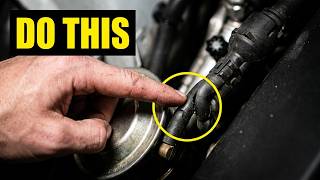
- Leaking or cracked vacuum hoses (Very Common) — The small rubber hoses controlling the air system's valves become brittle and crack over time. This creates vacuum leaks that prevent the valves from opening, representing the most frequent and cheapest-to-fix cause. 🎬 Watch: How to find and fix common BMW vacuum leaks.
- Blown air pump fuse or faulty relay (Common) — A blown fuse (typically 40A or 50A) or a bad relay cuts power to the air pump. Always verify these electrical basics before replacing expensive mechanical components.
- Failed or stuck-closed Secondary Air Check Valve (Combi Valve) (Common) — This one-way valve sticks due to carbon buildup or age, blocking airflow to the exhaust. 🎬 See how to test if your air injection check valve is stuck. If it fails open, it allows hot exhaust gas and moisture to flow backward, destroying the air pump.
- Failed Secondary Air Injection Pump (Common) — The electric pump motor burns out or seizes. This is almost always a secondary failure caused by a stuck-open check valve that allowed exhaust condensation to enter and rust the pump's internals.
- Clogged air passages in the cylinder head (Common) — Carbon completely blocks the small injection ports inside the cylinder head. This is a notorious, labor-intensive, and expensive failure on 2009-2016 Audi, VW, and Porsche models. 🎬 Watch this diagnostic walkthrough for Audi P0492 carbon buildup issues.
- Faulty Secondary Air Pressure Sensor (Less Common) — Systems with a dedicated pressure sensor rely on it to verify airflow. A failed sensor sends incorrect low-pressure readings to the PCM, triggering a false P0492 code even if the pump works perfectly.
- Damaged wiring or corroded connectors (Uncommon) — Frayed wires or corroded electrical connectors at the air pump, control solenoid, or pressure sensor interrupt the circuit, preventing system operation.
Symptoms
- Check Engine Light is on — The primary and often only symptom. The PCM illuminates the light because the emissions control system failed its self-test.
- Loud whining or vacuum cleaner noise on cold start — A failing air pump motor howls or whines for the first 30-90 seconds after a cold start. If you previously heard this noise and now hear nothing, the pump is dead.
- Failed emissions test — The vehicle automatically fails state smog inspections because the SAI system is a federally mandated emissions control device.
- Hissing sound from engine bay — A distinct hissing noise during a cold start indicates a cracked or disconnected vacuum line.
Diagnostic Flowchart
Tap your situation to follow the diagnostic path that matches what you're seeing on this code.
Common Fixes & Costs
- Replace Cracked Vacuum Hoses — Parts: $10-$50, Labor: $50-$150, ~0.8 hr book time (DIY)
- Replace Air Pump Fuse/Relay — Parts: $5-$40, Labor: $10-$50, ~0.2 hr book time (DIY)
- Replace Secondary Air Injection Check Valve
— Parts: $50-$150, Labor: $100-$300, ~1.5 hr book time
(Intermediate)
: OEM
: OEM - Replace Secondary Air Injection Pump
— Parts: $150-$400, Labor: $100-$250, ~1.5 hr book time
(Intermediate)
: OEM
: OEM - Clean Clogged Secondary Air Passages
— Parts: $20-$100 (gaskets), Labor: $1500-$3000, ~8 hr book time
(Professional)
: OEM
DIY vs Professional
- Replace Air Pump Fuse/Relay — Beginner:
Tools: Owner's manual, fuse puller or pliers. - Replace Cracked Vacuum Hoses — Beginner:
Tools: Pliers, flashlight, hose cutters. - Replace Secondary Air Injection Pump — Beginner:
Tools: Socket set, wrenches, pliers, jack and jack stands. - Replace Secondary Air Injection Check Valve — Beginner:
Tools: Socket set with extensions and universal joints, gasket scraper. - Clean Clogged Secondary Air Passages — Beginner:
Tools: Intake manifold removal tools, specialized wire brushes, chemical cleaners, borescope.
Used vs. New Parts: Buying Guide
When a used part is worth it: Buy a used OEM air pump from a low-mileage donor to save money. Never buy used check valves or vacuum hoses, as internal carbon buildup and brittle rubber make them worthless.
Donor-vehicle mileage cap: roughly under 60000 miles for the part to have meaningful remaining life.
Donor quality checklist:
- Avoid parts from high-humidity or rust-belt regions to minimize pre-existing moisture damage.
- Match the OEM part number exactly; electrical connectors vary significantly by model year.
Decision logic:
- If The part is a check valve, relay, or vacuum hose → Buy new. The low cost outweighs the high risk of a used part failing immediately.
- If The part is an expensive air pump and budget is tight → Buy a tested, used OEM pump with a 30-90 day warranty.
- If Reliability is the top priority → Buy a new OEM or high-quality aftermarket (e.g., Bosch, Pierburg) part.
Warranty tradeoff: Used auto recycler parts offer 30-90 day warranties. New aftermarket parts offer 1-year to lifetime warranties. New OEM parts carry a 1-year warranty.
Worst-case if a used part fails: $300 if a used pump fails, requiring repeat labor and a second replacement part.
What Happens If You Wait — Timeline
- 0-3 months: Code P0492 sets and the Check Engine Light illuminates. A vacuum line has a small leak, or the check valve is starting to stick. No performance symptoms are felt. (MPG impact: 0%% · Added cost: $0)
- 3-9 months: If the check valve is stuck open, exhaust moisture enters the air pump after every shutdown. Condensation corrodes the bearings, causing a loud whining noise on cold starts. (MPG impact: 0%% · Added cost: $0 (but the pump is actively dying))
- 9-18 months: The corroded air pump seizes completely. The whining noise stops. The pump motor blows its 40A fuse. You now have a failed pump compounding the original bad check valve. (MPG impact: 0%% · Added cost: $150-$400 (cost of the new air pump))
- 18+ months: The catalytic converter experiences accelerated aging because it isn't warming up quickly on cold starts, potentially triggering P0420/P0430 catalyst inefficiency codes years later. (MPG impact: 0%% · Added cost: $1200-$2500)
Cost of Not Fixing It
- 0-6 months: Guaranteed failure of state emissions/smog inspections. The active Check Engine Light masks new, potentially severe engine problems. (Added cost: $0)
- 6-18 months: If the root cause is a stuck-open check valve, exhaust moisture will destroy the secondary air pump, requiring a second, more expensive replacement part. (Added cost: $150-$400)
- 18+ months: Slightly accelerated aging of the catalytic converter occurs because it isn't heated to optimal operating temperature quickly during cold starts. (Added cost: $1200-$2500)
Diagnosis Steps
- Check Fuses and Relays
Locate the Secondary Air Injection pump fuse (often 40A-50A) and relay in the engine bay fuse box. Visually inspect the fuse. Swap the relay with an identical non-essential relay (like the horn) to see if the pump regains power.
Tools: Owner's manual, fuse puller or pliers (Beginner) - Inspect Hoses for Leaks
Trace all rubber and plastic hoses connected to the air pump and check valves. Look for cracks, breaks, or disconnected fittings. Pay strict attention to the fragile, small-diameter vacuum lines controlling the valves.
Tools: Flashlight (Beginner) - Listen for the Air Pump
Start the engine completely cold (sat for 8+ hours). Stand by the hood and listen for a vacuum-cleaner-like sound for the first 30-90 seconds. Silence means the pump has no power or is seized. A loud grinding means the bearings are shot.
Tools: Your ears (Beginner) - Test the Check Valve (Combi Valve)
With the engine cold, disconnect the large hose running from the air pump to the Bank 2 check valve. Start the engine. Feel the inlet of the check valve. If hot exhaust pulses OUT of the valve, it is stuck open and must be replaced immediately.
Tools: Pliers, flathead screwdriver (Intermediate) - Test the Air Pump Manually
Disconnect the electrical connector at the air pump. Use jumper wires to apply 12V directly from the battery to the pump's pins. If it runs smoothly, the motor is good, and the fault lies in the wiring, relay, or PCM command. If it sparks or does nothing, the pump is dead.
Tools: Jumper wires or power probe (Intermediate) - Perform a Smoke Test
Inject smoke from an automotive smoke machine into the secondary air system's vacuum lines. Smoke will escape from microscopic cracks or loose connections invisible to the naked eye, pinpointing vacuum leaks.
Tools: Automotive smoke machine (Intermediate) - Inspect for Clogged Passages
If the pump, valves, and hoses function perfectly, the internal cylinder head passages are clogged with carbon. Remove the check valve and insert a borescope to visually confirm the blockage. This requires professional cleaning.
Tools: Mechanic's borescope, basic hand tools (Advanced) - Check Pressure Sensor Voltage
For systems with an SAI pressure sensor, monitor its voltage with a multimeter. It should read a baseline (~0.5V) with the key on/engine off, and spike (e.g., >1.5V) when the pump activates. A stagnant voltage indicates a dead sensor.
Tools: Multimeter, back-probe pins (Advanced)
When This Code Triggers (Freeze-Frame Conditions)
- Engine Coolant Temp: 40-95°F (4-35°C) (The code only triggers during a cold start after the vehicle has sat for 6-8 hours.)
- RPM: 700-1200 RPM (Occurs at elevated idle within the first 90 seconds of starting the engine.)
- Engine Load: 20-40% (Low load condition immediately following a cold start.)
- Ambient Air Temp: 40-95°F (4-35°C) (The system test requires ambient and coolant temperatures to be within a few degrees of each other.)
Related Codes

- P0491 — Identical code for Bank 1. Seeing P0491 and P0492 together means the failure is in a shared component: the air pump, the pump's fuse/relay, or the main air supply hose before it splits.
- P0410 — A general 'Secondary Air Injection System Malfunction' code. P0492 is more specific (Bank 2 insufficient flow). Always diagnose using the more specific P0492 criteria.
- P0411 — Indicates 'Incorrect Flow Detected'. This triggers if flow occurs when it shouldn't (e.g., a stuck-open valve). Diagnosing P0411 focuses heavily on control solenoids and stuck valves.
- P1415 / P1416 — GM-specific codes for this fault (P1415 for Bank 1, P1416 for Bank 2). Advanced scanners display these instead of the generic P0492 on vehicles like the C5 Corvette.
Climate & Environmental Factors
- High Humidity / Moisture: Moisture intrusion is the #1 killer of SAI pumps. Normal exhaust condensation flows backward past a stuck-open check valve, rusting the pump's bearings and seizing the electric motor.
- Cold Climates: Freezing temperatures turn trapped condensation inside the air pump into ice, physically locking the impeller and blowing the 40A fuse on the next cold start.
- Short Trip Driving: Frequent trips under 15 minutes prevent the exhaust from getting hot enough to evaporate condensation, accelerating rust and carbon buildup in the SAI system.
How to Talk to a Mechanic About This Code
Say this: "I have a P0492 code for the secondary air system. Before replacing expensive parts like the air pump, please check the basics: the fuse, relay, and all vacuum lines for leaks. Also, test the check valve for proper one-way operation."
This directs the mechanic to follow a logical, cost-effective diagnostic path, preventing them from immediately quoting a $500 pump replacement without verifying the $10 fuse or $50 vacuum line.
Avoid saying:
- 'Just fix my check engine light'
- 'I think I need a new air pump'
- 'Whatever you think is best'
Questions to ask before authorizing the repair:
- Did you test the air pump directly with 12V power to confirm it runs?
- Did you check for exhaust backflow from the check valve when the pump is off?
- If you recommend a new pump, have you confirmed the check valve is good? I want to avoid the new pump failing from moisture.
- If you suspect clogged ports, what is the diagnostic labor cost to confirm with a borescope before I approve the full cleaning?
Where to Take It: Dealer vs Independent vs Chain
- Dealer:
Best for: Vehicles under warranty or covered by a specific TSB/extended warranty for this issue., Diagnosing and cleaning clogged cylinder head ports, as they have specialized tools (e.g., Audi's VAS6825).
Downsides: Highest labor rates, typically 1.5-2x more than an independent shop., May recommend replacing an entire assembly when only one component failed. (Typical cost: +50% vs. baseline) - Independent Shop:
Best overall fit. For German cars with suspected clogged ports, verify they have experience with that specific repair before committing.
Best for: Out-of-warranty vehicles where the cause is a common component like the pump, check valve, or vacuum lines., Brand-specialist indies (e.g., German auto specialists) offering dealer-level knowledge at a lower cost.
Downsides: Quality varies widely; check reviews., May lack the specialized tools for intensive clogged port cleaning. (Typical cost: +0% vs. baseline) - Chain Shop:
AVOID. The risk of misdiagnosis and paying for parts you don't need is very high.
Best for: Simple, unrelated maintenance like oil changes.
Downsides: Technicians often lack specialized knowledge for emissions system diagnosis beyond reading the code., High pressure to sell parts leads to misdiagnosis and unnecessary air pump replacements. (Typical cost: -10% vs. baseline)
When to Walk Away From the Repair
If the estimated repair cost exceeds 40% of the car's private-party value, seriously consider selling or trading it in rather than repairing it.
- Car worth $9000, fix is $450: Fix it. This is a minor repair cost compared to the car's value.
- Car worth $6000, fix is $2800: Walk away. The repair cost for clogged ports on this older German car is nearly 50% of its value. It's not economically sound.
- Car worth $3000, fix is $1300: Borderline. Get a second opinion and assess the car's overall health before proceeding.
What Scan Tool You Need for This Code
Minimum: A basic code reader retrieves P0492, but actual diagnosis requires a scanner that shows live data to watch O2 sensor response.
A simple code reader can't test components. To diagnose P0492, you need a bidirectional scanner to command the pump on and verify valve operation.
Budget: BlueDriver Pro (~$100) — Reads the code, provides freeze-frame data, and graphs live O2 sensor data to see if the system responds. Lacks full bidirectional control.
Mid-range: Foxwell NT510 Elite (~$180) — The sweet spot. Offers brand-specific bidirectional control, allowing you to command the SAI pump and solenoids on/off from the driver's seat to test function directly.
Professional: Autel MaxiCOM MK808S (~$450) — Provides full bidirectional control, OEM-level diagnostics, and special functions. Runs system-specific active tests for faster, accurate diagnosis.
Rent vs buy: Rent for free from an auto parts store to simply read the code. If you plan to diagnose the issue yourself, buying a mid-range scanner like the Foxwell is required to test the pump.
How to Clear the Code After You Fix It
- Use an OBD-II scan tool to clear the DTCs.
- Ensure the fuel tank is between 1/4 and 3/4 full.
- Let the vehicle sit overnight (8+ hours) to ensure a completely cold engine.
- Start the engine and let it idle for 3-5 minutes to run the SAI monitor.
Drive cycle (~20 minutes): The SAI monitor runs exclusively on a cold start. Let the car sit for 8 hours, start it, and idle for 5 minutes. To set remaining monitors, drive 15 minutes at steady highway speeds (45-60 mph).
Readiness monitors affected: Secondary Air System, Catalyst monitor, O2 sensor monitor
Before emissions retest: drive at least 50 miles to fully set monitors.
Watch out for:
- Disconnecting the battery clears the code but resets all monitors to 'Not Ready', causing an automatic emissions failure.
- Failing to let the vehicle 'cold soak' for 8 hours prevents the SAI monitor from running, keeping the system 'Not Ready'.
Will This Fail Emissions / State Inspection?
Yes — this code typically fails an OBD-II emissions inspection.
- California: An illuminated Check Engine Light is an automatic failure. After repairs, a full drive cycle must be completed to set the Secondary Air System monitor to 'Ready' before retesting.
- New York: Vehicles automatically fail the NYS emissions inspection if the Check Engine Light is on or if the Secondary Air monitor is 'Not Ready'.
- Texas: An illuminated Check Engine Light is an automatic failure. Vehicles 2001 and newer are allowed exactly one 'Not Ready' monitor to pass, but fixing the code is highly recommended.
Most Commonly Affected Vehicles

- Audi A4, S4, A6, Q5, Q7 (2009-2016) — Extremely common issue due to carbon buildup clogging the cylinder head air passages. Audi offered a 10-year/120,000-mile extended warranty for this specific defect on many 3.0T and 3.2L models.
- BMW 3-Series (E46, E90), 5-Series (E60), X3, X5 (2001-2013) — Prone to brittle vacuum lines breaking near the rear of the intake manifold. Check valve failures frequently lead to pump destruction from water intrusion.
- Porsche 911 (996, 997), Boxster, Cayenne (1999-2012) — Suffers from clogged ports requiring significant labor to clean. Cayenne air pumps are also known for internal plastic fan blades disintegrating and blocking the air passages.
- Toyota Tundra, Sequoia (2007-2014) — Air pumps and switching valves fail frequently and are buried under the intake manifold. Toyota issued Warranty Enhancement Program ZTQ extending coverage to 10 years/150,000 miles.
- Subaru Impreza WRX, Forester XT, Legacy GT (2006-2014) — The air pump valves stick open or closed, triggering this code. Subaru offered extended warranties for these specific components on turbocharged models.
- Volkswagen GTI, Jetta, Passat, Touareg (2008-2016) — Sharing engines with Audi, VW models suffer the identical carbon buildup issue in the cylinder head passages, requiring the same expensive cleaning procedure.
- Chevrolet Corvette (C5, including Z06) (1997-2004) — The Bank 2 (passenger side) check valve sticks due to carbon. It is notoriously difficult to access, requiring removal of the intake manifold to replace a $50 part.
- Ferrari 599, California (2007-2012) — P0491 and P0492 frequently appear together, pointing to a shared failure like the vacuum supply solenoid or the main air pump.
Manufacturer-Specific Notes
- Audi/Volkswagen: Carbon buildup in the cylinder head is the definitive cause for P0491/P0492 on 3.0T/3.2L engines. Technical Service Bulletin 01 16 55 outlines a specialized pressure-washing procedure (tool VAS6825) to clear the ports.
- BMW: Failures are a two-part chain reaction. The check valve fails, allowing moisture to corrode and seize the air pump. Replacing the pump without the valve guarantees a repeat failure.
- Toyota: Due to high failure rates and difficult access under the intake manifold, Toyota launched Customer Support Program ZTQ, extending warranty coverage on Tundra/Sequoia air pumps and valves to 10 years/150,000 miles.
- Chevrolet (Corvette C5): The Bank 2 check valve is buried behind the intake manifold. Replacing this simple valve requires removing the entire intake, turning a 30-minute job into a multi-hour project.
Real Owner Stories
2013 Audi S4 with P0491 & P0492
Owner had an intermittent check engine light. A scan revealed both P0491 and P0492. The dealer quoted $3,400 for the repair as the car was 10 days out of warranty.
Outcome: The root cause was clogged secondary air injection ports. The repair involves extensive labor to pressure wash the air passages, sometimes requiring removal of the front end.
Lesson: On Audi 3.0T engines, P0491/P0492 codes are almost always due to clogged carbon ports, not the pump itself. Replacing the pump alone is a costly misdiagnosis.
2007 BMW E93 328i SULEV at 190k miles
Check Engine Light with only code P0492. The car was out of warranty due to high mileage.
Outcome: The owner suspected a faulty Bank 2 oxygen sensor was failing to detect the airflow, even though no O2 sensor codes were present.
Lesson: If all mechanical components (pump, valve, hoses, passages) function perfectly, the fault lies with the sensor the PCM uses to verify airflow, even if that sensor hasn't thrown its own code.
2012 Audi C7 3.0 TFSI at 110k miles
After replacing the PCV, water pump, injectors, SAI pump, and all plastic lines, the owner started getting P0491/P0492 codes.
Outcome: The owner concluded the issue was clogged air passages in the engine block. The prior preventative work failed to address the pre-existing internal carbon buildup.
Lesson: On high-mileage German vehicles, replacing external system components won't solve the code if the internal cylinder head passages are blocked. The clog is the ultimate restriction.
How to Prevent This Code From Triggering
- Use Top Tier certified gasoline (Every fill-up) — High-quality fuels with robust detergents burn cleaner, reducing the carbon deposits that clog secondary air passages over time.
- Perform regular long-distance, highway drives (Monthly) — Sustained highway driving allows the exhaust to reach temperatures high enough to evaporate trapped condensation, preventing pump rust.
- Proactively replace the Secondary Air check valve(s) (Every 80,000 - 100,000 miles) — The check valve is a cheap gatekeeper. Replacing it proactively prevents it from sticking open and destroying the expensive air pump with exhaust moisture.
Frequently Asked Questions
Is it safe to drive with code P0492?
Yes. The system only operates for emissions control during cold starts and doesn't affect performance. However, you will fail state emissions tests.
Can I fix P0492 myself?
Yes, replacing cracked vacuum hoses, fuses, or accessible check valves are beginner-to-intermediate DIY tasks. However, cleaning clogged cylinder head passages requires professional tools and engine disassembly.
What are the most common mistakes when diagnosing P0492?
The biggest mistake is replacing a failed air pump without replacing the faulty check valve that caused it. A stuck-open valve allows exhaust moisture to quickly destroy the new pump.
My air pump was replaced, but the code came back. What's next?
The Bank 2 check valve likely failed open, or the internal cylinder head air passages are completely clogged with carbon. Clogged passages are the standard diagnosis for this scenario on Audi, VW, and Porsche models.
Will a P0492 code go away on its own?
No. The PCM requires a successful cold-start test to turn off the light. You must repair the underlying fault and clear the code with a scanner.
Why did I get both P0491 and P0492 codes at the same time?
Both codes indicate a failure in a shared component. Check the main air pump, the pump's fuse/relay, or the primary air supply hose before it splits to Bank 1 and Bank 2.
Key Takeaways
- Code P0492 indicates insufficient airflow in the Bank 2 Secondary Air Injection system, causing an automatic emissions test failure but remaining safe for daily driving.
- Inspect the 40A/50A air pump fuse and the small rubber vacuum lines first, as these $10-$50 components cause over 50% of P0492 codes.
- Expect repair bills between $1,500 and $3,000 on 2009-2016 Audi, VW, and Porsche models due to severe carbon buildup clogging the internal cylinder head passages.
- Never replace a failed secondary air pump without also replacing the $50-$150 check valve, as a stuck-open valve allows exhaust moisture to destroy the new pump within months.
Helpful Videos


The information in this article is provided for general reference and educational purposes only. Vehicle specifications, procedures, and part compatibility can vary by production date, trim level, and region. Always consult your vehicle's factory service manual and verify part numbers before purchasing or performing repairs. Safety-critical components such as airbags, seat belts, and braking systems should be installed by a qualified professional.
- 🎬 Helpful Videos
- What Does P0492 Mean?
- Can I Drive With P0492?
- Common Causes
- Symptoms
- Diagnostic Flowchart
- Common Fixes & Costs
- DIY vs Professional
- Used vs. New Parts: Buying Guide
- What Happens If You Wait — Timeline
- Cost of Not Fixing It
- Diagnosis Steps
- When This Code Triggers (Freeze-Frame Conditions)
- Related Codes
- Climate & Environmental Factors
- How to Talk to a Mechanic About This Code
- Where to Take It: Dealer vs Independent vs Chain
- When to Walk Away From the Repair
- What Scan Tool You Need for This Code
- How to Clear the Code After You Fix It
- Will This Fail Emissions / State Inspection?
- Most Commonly Affected Vehicles
- Manufacturer-Specific Notes
- Real Owner Stories
- 2013 Audi S4 with P0491 & P0492
- 2007 BMW E93 328i SULEV at 190k miles
- 2012 Audi C7 3.0 TFSI at 110k miles
- How to Prevent This Code From Triggering
- Frequently Asked Questions
- Is it safe to drive with code P0492?
- Can I fix P0492 myself?
- What are the most common mistakes when diagnosing P0492?
- My air pump was replaced, but the code came back. What's next?
- Will a P0492 code go away on its own?
- Why did I get both P0491 and P0492 codes at the same time?
- Key Takeaways
- 🎟️ Get 5% Off