

OBD-II Code P0483: Cooling Fan Rationality Check Malfunction
The Ultimate Guide to Diagnosing and Fixing P0483
- Code P0483 indicates the engine's cooling fan failed the PCM's rationality check, meaning it is spinning at the wrong speed or not at all.
- Over 80% of P0483 codes are caused by a dead fan motor, a blown 20A-40A cooling fan fuse, or a faulty fan relay.
- Stop driving immediately if the temperature gauge hits the red zone; ignoring P0483 causes a $1,500+ blown head gasket within days.
- When replacing an electro-viscous fan clutch on a diesel truck (like a Cummins or Duramax), use only OEM parts to prevent the code from returning due to incorrect RPM matching.
- A bi-directional scan tool is required to properly diagnose this code by commanding the fan on and off to isolate the circuit.
What Does P0483 Mean?

The Powertrain Control Module (PCM) detected a problem with the electric cooling fan system. It commanded the fan to turn on or off, but the fan did not behave as expected. This 'rationality check' fails when the fan's actual operation—or the resulting engine temperature—does not match the computer's command.
Technical definition: Code P0483 is defined as 'Cooling Fan Rationality Check Malfunction.' The PCM or Engine Control Module (ECM) detects a discrepancy between the commanded state of the cooling fan and the actual feedback from the fan circuit. This triggers based on unexpected voltage draw, a mismatch between commanded and actual fan speed, or a failure to see an expected drop in engine temperature after fan activation.
Can I Drive With P0483?
Yes, But With Caution. Yes, but only for short distances at highway speeds where natural airflow cools the engine. Avoid stop-and-go traffic, idling, and hot weather entirely. Ignoring this code causes severe engine overheating, leading to catastrophic damage like a blown head gasket ($1,500-$3,000+) or complete engine failure ($4,000+). The financial risk of continued driving far outweighs the cost of a timely diagnosis.
Common Causes

- Faulty Cooling Fan Motor or Fan Clutch Assembly (Very Common) — The electric motor that spins the fan blades wears out, shorts internally, or seizes. On trucks with electro-viscous clutches (like Dodge Ram and GM Sierra/Silverado), the clutch assembly fails, preventing it from engaging or spinning at the commanded speed.
- Defective Cooling Fan Relay or Control Module (Common) — Cooling fan relays burn out or stick open. Modern cars use complex fan control modules mounted near the radiator to vary fan speed; these fail from heat and electrical stress, causing incorrect fan operation.
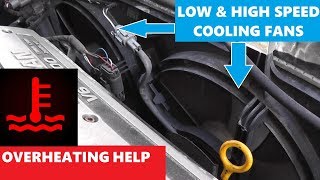
- Blown Fuse (Common) — A struggling fan motor draws excessive current, blowing the high-amperage fuse and cutting all power to the fan system to prevent a fire. 🎬 Watch: How to test your cooling fans, relays, and connections.
- Damaged Wiring or Loose Connectors (Common) — High-current wires leading to the fan assembly corrode, fray, or melt. A poor connection at the fan motor, relay, or module prevents the fan from receiving power or disrupts the feedback signal to the PCM.
- Inferior Quality Aftermarket Fan Clutch (Common) — On trucks with electro-viscous fan clutches (Cummins, Duramax), using a non-OEM replacement part causes the code to return immediately. Aftermarket units lack the correct internal fluid or valving to achieve the exact speed the PCM commands.
- Faulty Thermostat or Water Pump (Less Common) — On vehicles like Subarus, the rationality check is performance-based. If a stuck thermostat, failing water pump, or clogged radiator prevents the engine from cooling, the PCM sets P0483 even if the fan works perfectly.
- Faulty Engine Coolant Temperature (ECT) Sensor (Rare) — The PCM uses ECT sensor data to activate the fan. If the sensor reads cold when the engine is hot, the PCM fails to command the fan on, leading to overheating and a rationality check failure.
- Physical Obstruction or Damage (Rare) — Road debris lodged in the fan shroud prevents the blades from spinning. A broken fan blade causes an imbalance that the PCM detects as a speed error.
- Faulty Powertrain Control Module (PCM) (Very Rare) — PCM failure is extremely rare and should only be considered after ruling out all wiring, sensor, and component faults.
Symptoms

- Check Engine Light is On — The PCM detects the fault and illuminates the Malfunction Indicator Lamp (MIL) on the dashboard.
- Engine Overheating — The temperature gauge climbs into the red, especially when idling, in stop-and-go traffic, or in hot weather. This is the most serious symptom.
- Cooling Fan Does Not Run at All — The fan never turns on, even when the engine is hot and the A/C is on max. This indicates a failure in the power circuit, control circuit, or a seized motor.
- Cooling Fan Runs Constantly — The fan runs at high speed continuously, even when the engine is cold. This is a fail-safe mode triggered by the PCM when it detects a control circuit fault.
- Poor Air Conditioning Performance — The A/C blows warm when the vehicle is stationary. The cooling fan must pull air over the A/C condenser to dissipate heat; without it, the A/C fails.
- Loud or Unusual Fan Noise — A failing fan motor bearing creates a loud grinding noise. A broken blade causes a loud clicking or vibrating sound against the shroud.
Diagnostic Flowchart
Tap your situation to follow the diagnostic path that matches what you're seeing on this code.
Common Fixes & Costs
- Replace Cooling Fan Relay — Parts: $20-$70, Labor: $50-$100, ~0.5 hr book time (DIY)
- Replace Cooling Fan Assembly (Motor, Blade, and Shroud) — Parts: $150-$700, Labor: $150-$400, ~1.5 hr book time (Intermediate)
- Replace Electro-Viscous Fan Clutch (Trucks) — Parts: $250-$800, Labor: $150-$300, ~2 hr book time (Intermediate)
- Replace Cooling Fan Control Module — Parts: $150-$500, Labor: $100-$200, ~1 hr book time (Intermediate)
- Replace Thermostat — Parts: $20-$60, Labor: $150-$300, ~1.8 hr book time (Intermediate)
- Repair Damaged Wiring or Connectors — Parts: $10-$50, Labor: $120-$250, ~1.5 hr book time (Professional)
DIY vs Professional
- Replace Cooling Fan Relay — Beginner:
- Replace Cooling Fan Assembly — Beginner:
- Replace Electro-Viscous Fan Clutch (Trucks) — Beginner:
- Repair Damaged Wiring or Connectors — Beginner:
Used vs. New Parts: Buying Guide
When a used part is worth it: For a simple cooling fan assembly on a common, older vehicle (>10 years old) where budget is the primary concern. A used OEM assembly from a low-mileage vehicle is a cost-effective alternative to a new aftermarket part.
Donor-vehicle mileage cap: roughly under 80000 miles for the part to have meaningful remaining life.
Donor quality checklist:
- Verify the donor vehicle was not scrapped due to front-end collision or overheating issues.
- Inspect the part for physical damage, such as cracked blades, shroud, or melted connectors.
- Never buy a used electro-viscous fan clutch for a truck due to high failure rates.
Decision logic:
- If The failed part is an electro-viscous fan clutch on a truck. → Buy a new OEM part. The risk of a used or cheap aftermarket part failing is extremely high.
- If Vehicle is < 8 years old and the part is under $400 new. → Buy a new aftermarket or OEM part for the warranty and reliability.
- If Vehicle is > 15 years old and budget is tight. → A used assembly from a reputable salvage yard is acceptable.
Warranty tradeoff: Used parts typically come with a 30-90 day warranty covering the part only. New aftermarket parts offer 1-year to limited lifetime warranties. New OEM parts carry the manufacturer's warranty.
Worst-case if a used part fails: $300-$600 if a used part fails after installation, requiring repeat labor costs.
What Happens If You Wait — Timeline
- 0-1 month: Check Engine Light is on. Overheating occurs in heavy stop-and-go traffic on hot days. A/C performance is poor when stationary. (MPG impact: 0-2%% · Added cost: $0)
- 1-3 months: Overheating becomes frequent. The temperature gauge spikes into the red during city driving, forcing the driver to pull over. (MPG impact: 2-5%% · Added cost: $50-$150 in wasted fuel and potential tow bills.)
- 3-6 months: A severe overheating event warps the aluminum cylinder head, causing a head gasket failure. Symptoms include white exhaust smoke and coolant mixing with oil. (MPG impact: 10-20%+% · Added cost: $1,500 - $3,000 for a head gasket and cylinder head resurfacing job.)
- 6+ months: Coolant contaminates the engine oil, destroying bearings. The engine block cracks from extreme heat cycles, seizing completely. (MPG impact: N/A (vehicle is likely undrivable)% · Added cost: $4,000 - $10,000+ for a complete engine replacement.)
Cost of Not Fixing It
- 0-1 month: Intermittent overheating in traffic, poor A/C performance, and potential for blown fuses. High risk of getting stranded. (Added cost: $50-$200)
- 1-6 months: Severe overheating warps the cylinder head or causes a blown head gasket, allowing coolant and oil to mix. (Added cost: $1,500-$3,000+)
- 6+ months: Catastrophic engine failure. A warped or cracked engine block from extreme heat requires complete engine replacement. (Added cost: $4,000-$10,000+)
Diagnosis Steps

- Visual Inspection
With the engine off and cool, inspect the cooling fan, shroud, wiring, and connectors. Look for broken blades, lodged debris, melted wires, and corroded pins. Spin the fan by hand; if it is stiff or seized, the motor has failed.
Tools: Flashlight (Beginner) - Check Fuses and Relays
Locate the cooling fan fuse(s) and relay(s) in the fuse box. Pull the fuse and inspect for a blown filament. Swap the fan relay with an identical non-essential relay (like the horn) to test if the relay is faulty.
Tools: Owner's manual, fuse puller or pliers (Beginner) - Listen for Fan Activation
Start the engine and turn the A/C to the max setting. This commands the cooling fan to turn on immediately on most vehicles. If it does not turn on, the circuit or motor has failed.
Tools: None (Beginner) - Command Fan with a Scan Tool
Use a bi-directional scan tool to command the fan on at different speeds (e.g., 25%, 50%, 100%). This bypasses sensors to test the PCM's control. If the fan responds correctly, the issue is a sensor input or mechanical cooling system failure.
Tools: Bi-directional OBD-II scan tool (Intermediate) - Test for Power and Ground at the Fan Motor
Unplug the electrical connector at the fan motor. With the fan commanded ON via a scan tool or max A/C, use a multimeter to check for battery voltage (12-14V) and a solid ground (<0.5V) at the connector. If both are present, the fan motor has failed. If either is missing, the problem is upstream.
Tools: Multimeter (Intermediate) - Check Fan Speed Signal
On vehicles with variable-speed fans (Trailblazer, Duramax), use an advanced scan tool to view 'Commanded Fan Speed' and 'Actual Fan Speed'. A deviation greater than 1000 RPM confirms a failing fan clutch or motor assembly.
Tools: Advanced OBD-II scan tool (Advanced) - Test Fan Motor Current Draw
Use a DC clamp-on ammeter around the fan's power wire. A healthy motor draws a steady 5 to 30 amps. An unusually high initial draw or erratic running draw indicates internal motor failure.
Tools: DC clamp-on ammeter (Advanced) - Check PWM Control Signal
For variable-speed fans, back-probe the signal wire at the fan control module with a multimeter set to duty cycle (%). Command different speeds with a scan tool; the duty cycle should change (e.g., 10% to 90%). A missing signal points to a bad PCM or wiring.
Tools: Multimeter (with Duty Cycle %) (Professional) - Test ECT Sensor Resistance
Unplug the Engine Coolant Temperature (ECT) sensor and measure its resistance with a multimeter. Compare the reading to manufacturer specifications for the current temperature. An out-of-spec reading means the sensor is providing false data.
Tools: Multimeter, Infrared Thermometer, Service Manual (Advanced) - Verify Cooling System Performance
If electrical tests pass (especially on Subarus), check for a clogged radiator using an infrared thermometer to find cool spots. Verify the thermostat opens fully and the water pump circulates coolant. P0483 often flags the engine's inability to cool itself, not just an electrical fault.
Tools: Infrared thermometer (Professional)
When This Code Triggers (Freeze-Frame Conditions)
- Engine Coolant Temp: 212-230°F (100-110°C) (Engine is hot, fan has been commanded on to reduce temperature.)
- RPM: 600-800 (Idling in traffic, when natural airflow is minimal.)
- Commanded Fan Speed: 50-100% (PCM is requesting significant fan operation due to heat or A/C load.)
- Actual Fan Speed: 0 RPM or >1000 RPM deviation from commanded (The fan is not spinning or is spinning at a speed that does not match the PCM request.)
Related Codes
- P0480 — Indicates an electrical fault in the 'Fan 1 Control Circuit' (open or short). P0480 causes P0483 because a dead control circuit prevents rational fan operation. Diagnose P0480 first.
- P0481 — Indicates an electrical fault in the 'Fan 2 Control Circuit'. Follows the same logic as P0480 for vehicles with two fans or two-speed fans.
- P2509 — PCM Power Input Signal Intermittent. Commonly seen with P0483 on Dodge Cummins trucks. A failing fan clutch creates a short that pulls down the PCM's power supply. Unplug the fan clutch to test.
- P0526 — Fan Speed Sensor Circuit. Indicates a problem with the sensor reporting fan speed. This directly causes P0483 because the PCM cannot check performance without speed data.
Climate & Environmental Factors
- Hot Weather: Hot ambient temperatures and A/C usage place high demand on the cooling system, revealing pre-existing or intermittent problems with the fan, relay, or clutch.
- High Humidity / Road Salt: Moisture and salt accelerate corrosion on electrical connectors, fuse box terminals, and ground points, leading to high resistance and voltage-related faults.
- Cold Weather: The code is less likely to trigger in cold weather because the cooling fan is commanded on infrequently. A failure may exist but go unnoticed until spring.
How to Talk to a Mechanic About This Code
Say this: "I have a P0483 'Cooling Fan Rationality' code. Can you start by checking the fuses and relays, and then use a scan tool to command the fan on? I want to confirm if the fan motor is getting power and ground before replacing the assembly."
This signals you understand that P0483 requires a step-by-step diagnosis. It directs the mechanic to perform logical tests first, preventing them from simply 'shotgunning' an expensive fan assembly at the problem.
Avoid saying:
- 'Just fix whatever's wrong'
- 'My check engine light is on, can you look at it?'
- 'My car is overheating, I probably need a new fan.'
Questions to ask before authorizing the repair:
- Did you test the fan by commanding it on with a scan tool? What was the result?
- If the fan didn't run, did you confirm 12-volt power and a good ground at the connector?
- If you are recommending a fan assembly or clutch, is it an OEM part?
- Have you ruled out a simple blown fuse or a bad relay?
Where to Take It: Dealer vs Independent vs Chain
- Dealer:
Recommended for complex cases or warranty work. Overkill for a simple fan motor or relay failure.
Best for: Vehicles still under warranty., Complex issues like a Jeep TIPM failure or a recurring code on a Duramax/Cummins truck., Newer vehicles with integrated electronic modules requiring brand-specific programming.
Downsides: Highest labor rates, often 1.5-2x more than an independent shop., May default to replacing an entire expensive assembly when only one component failed. (Typical cost: +50% vs. baseline) - Independent Shop:
Best fit for most P0483 repairs. A good independent shop has the tools to diagnose the fan circuit correctly at a fair price.
Best for: Most out-of-warranty vehicles., Diagnosing and fixing common causes: bad fan motors, relays, wiring issues, and fan clutches., Better value for labor costs on straightforward replacements.
Downsides: Shop quality varies. Ensure the shop employs ASE-certified technicians., May lack specific software for integrated module programming. (Typical cost: +0% vs. baseline) - Chain Shop:
Use with caution. Acceptable for a simple relay swap, but AVOID for initial diagnosis of a P0483 code.
Best for: Simple, unambiguous repairs like swapping a fuse or an easily accessible relay.
Downsides: Technician skill varies dramatically; may lack experience for proper electrical diagnosis., High pressure to upsell leads to recommending expensive fan assembly replacements., Less likely to correctly diagnose vehicle-specific quirks. (Typical cost: -10% vs. baseline)
When to Walk Away From the Repair
If the estimated repair cost for the P0483 fault exceeds 40-50% of your car's current private-party value, consider selling the car as-is or trading it in.
- Car worth $3500, fix is $850: Fix it. The repair cost is roughly 24% of the car's value, preserving the vehicle's usability.
- Car worth $4000, fix is $1600: Borderline. At 40% of the vehicle's value, get a second opinion to confirm the diagnosis and cost before proceeding.
- Car worth $2000, fix is $1500: Walk away. The repair cost is 75% of the car's value. It is not economically sensible to invest this much into an aging vehicle.
What Scan Tool You Need for This Code

Minimum: A scan tool with bi-directional control (active test capability). This is essential for commanding the cooling fan on and off to test the entire circuit.
A basic $20 code reader only tells you the P0483 code exists. It cannot perform active tests to determine if the fan motor, relay, module, or wiring is the culprit, leading to guesswork.
Budget: BlueDriver Pro (~$90) — Reads and clears codes, provides freeze frame data, and offers limited active service features depending on the vehicle.
Mid-range: Foxwell NT510 Elite / XTOOL D7 (~$150) — Provides full bi-directional control, allowing you to command the cooling fan on/off directly. Reads manufacturer-specific codes and views live data for fan speed.
Professional: Autel MaxiCOM MK808S (~$400) — Offers comprehensive OE-level diagnostics with full bi-directional control to activate the fan and relays. Provides extensive live data graphing for complex faults.
Rent vs buy: Free 'loaner' scanners from auto parts stores are basic code readers without bi-directional control. Buying a midrange bi-directional scanner is a worthwhile investment for diagnosing P0483.
How to Clear the Code After You Fix It
- Use an OBD-II scan tool to clear the P0483 code.
- Reconnect the battery if it was disconnected for the repair.
- Perform a complete drive cycle to allow readiness monitors to run.
Drive cycle (~30 minutes): Start the engine cold and idle for 3 minutes with the A/C and rear defroster on. Turn off A/C and defroster, then drive for 15 minutes with mixed city/highway conditions, including steady speeds around 55 mph for 5 minutes. Allow the vehicle to cool completely.
Readiness monitors affected: Comprehensive Component Monitor, Catalyst Monitor, Evaporative System Monitor
Before emissions retest: drive at least 100 miles to fully set monitors.
Watch out for:
- Clearing the code resets all readiness monitors to 'Not Ready', causing an immediate emissions test failure.
- The code returns if the underlying mechanical or electrical fault (like a poor-quality aftermarket clutch) is not fixed.
Will This Fail Emissions / State Inspection?
Yes — this code typically fails an OBD-II emissions inspection.
- California: An illuminated Check Engine Light results in an automatic smog check failure. You must complete a full drive cycle to set readiness monitors before re-testing.
- New York: A vehicle with the Check Engine Light on automatically fails the NYS inspection. Only one readiness monitor is allowed to be 'Not Ready' to pass.
- Texas: In emissions-testing counties, an active Check Engine Light is an automatic failure. Drive the vehicle 50-100 miles to reset readiness monitors before re-inspection.
Most Commonly Affected Vehicles
- Dodge/Ram 2500/3500 with 5.9L/6.7L Cummins Diesel (2003-2018) — A failing electronic fan clutch shorts out the 5-volt reference circuit, triggering a P2509 code simultaneously and causing a no-start condition.
- Chevrolet/GMC Silverado/Sierra with 6.6L Duramax Diesel (2011-2016) — The electro-viscous fan clutch is a frequent failure point. The code triggers when commanded fan speed does not match actual speed by more than 1000 RPM. Using an OEM clutch is critical.
- Chevrolet Trailblazer / GMC Envoy (2002-2009) — The code sets when the difference between commanded and actual fan speed exceeds 1000 RPM. This is a highly common failure item on this platform.
- Volkswagen Jetta, Golf, Passat (2005-2015) — The code points to a failure of the integrated cooling fan control module or one of the two electric fans in the assembly.
- Ford Fusion, Flex, Taurus, Edge (2006-2019) — Prone to failures in the cooling fan control module, which is often sold as part of the complete fan assembly.
- Hyundai/Kia Elantra, Sonata, Optima (2011-2017) — Commonly caused by a failed cooling fan resistor, resulting in the fan only operating on high speed or not at all.
- Subaru Outback, Forester, Legacy, Impreza (1999-2012) — The PCM triggers P0483 if coolant temperature doesn't drop after fans activate. This is frequently caused by a clogged radiator or failing thermostat, not a bad fan.
- Jeep Grand Cherokee, Commander (2005-2010) — Issues with the high-speed cooling fan relay, integrated into the Totally Integrated Power Module (TIPM), are a common source requiring module repair.
Manufacturer-Specific Notes
- Dodge/Ram (Cummins): A failing fan clutch shorts internally, causing a voltage drop that makes the PCM lose power. This results in a P2509 code and a crank-no-start condition. Unplugging the fan clutch is the primary diagnostic step.
- General Motors (Chevy/GMC): The PCM actively monitors fan speed. P0483 sets if actual fan speed deviates from commanded speed by >1000 RPM. The PCM then commands the fan to full speed as a fail-safe, resulting in constant loud fan noise.
- Subaru: The rationality check is literal. The computer turns the fan on and expects engine temperature to drop. If it doesn't (due to a clogged radiator or bad thermostat), it sets P0483 even if the fan motor works perfectly.
- Jeep/Chrysler/Dodge (Gas): The fan relay is integrated and soldered into the Totally Integrated Power Module (TIPM). Relay failure requires sending the TIPM out for repair or purchasing a new unit.
- Ram (ProMaster): Recall B3C (NHTSA 25V-720) was issued for 2018-2025 fleet vehicles for premature fan motor bearing wear leading to fires. The fix replaces the cooling fan module and fuse.
Real Owner Stories
2005 Subaru WRX with intermittent P0483
Check Engine Light appeared during normal driving with A/C on. The main cooling fan was not spinning, but no overheating occurred.
What they tried:
- Checked fuses and relays, which were good.
- Physically flicking the main fan blade caused it to start spinning.
- Used under-dash diagnostic connectors to activate all relays and fans successfully.
Outcome: The owner concluded the main fan motor brushes were failing intermittently. The ability to force it on with a flick pointed to a component failure rather than a control issue.
Lesson: An intermittent fan motor failure is tricky. If the fan works sometimes or can be physically encouraged to start, the motor itself is worn out.
2007 Dodge Ram 5.9L Cummins with No-Start
Truck died suddenly and would not restart, throwing codes P0483 and P2509 (PCM Power Input Signal Intermittent).
What they tried:
- Identified that a failing electronic fan clutch shorts out, causing the PCM to lose power.
- Unplugged the fan clutch electrical connector at the bottom of the radiator.
Outcome: After unplugging the faulty fan clutch, the P2509 code cleared, and the truck started. The owner replaced the fan clutch assembly.
Lesson: On Dodge Cummins trucks, P0483 combined with P2509 and a no-start condition points to a failed fan clutch. Unplugging it is a quick diagnostic test.
1999 Subaru Forester with P0483 but no overheating
Check Engine Light came on with code P0483. The temperature gauge remained normal.
What they tried:
- Sought advice on a Subaru forum.
Outcome: A technician explained that on Subarus, the code triggers if the ECU doesn't see the expected drop in coolant temperature. The fix was replacing a restricted radiator and thermostat.
Lesson: On performance-based rationality checks, the code doesn't always mean the fan is bad. A clogged radiator or failing thermostat prevents cooling, triggering P0483.
2015 GMC Duramax LML with recurring P0483
Truck overheated when towing. The owner replaced the fan clutch with an aftermarket part, but P0483 persisted.
What they tried:
- Swapped relays with known good ones.
- Replaced the ECT sensor and cleaned electrical grounds.
- Verified wiring integrity back to the ECM.
Outcome: Extensive electrical diagnosis failed. The aftermarket fan clutch lacked the correct internal valving to match the commanded RPM, causing the rationality check to fail.
Lesson: For electro-viscous fan clutches on Duramax and Cummins trucks, cheap aftermarket replacements cause the code to return. Always use an OEM part.
How to Prevent This Code From Triggering
- Perform regular cooling system flushes. (Every 3-5 years or 50,000-100,000 miles.) — Old coolant becomes acidic and clogs the radiator, reducing cooling efficiency and triggering a performance-based P0483 code.
- Keep the radiator and A/C condenser fins clean. (Annually, or as needed.) — Accumulated bugs and debris block airflow, forcing the fan to run longer and harder, accelerating wear on the motor and relay.
- Periodically inspect fan wiring and connectors. (During any under-hood maintenance.) — High-current wiring is susceptible to heat damage. Catching frayed insulation or green corrosion early prevents high-resistance faults.
- Use dielectric grease on electrical connectors. (Whenever replacing a fan, relay, or module.) — Dielectric grease seals pins from moisture, preventing corrosion that causes intermittent voltage drops.
Frequently Asked Questions
Is it safe to drive with a P0483 code?
It is highly risky. You can manage short distances at highway speeds, but avoid traffic, idling, and hot weather. Ignoring the code causes severe engine overheating, leading to a blown head gasket or complete engine failure.
What are common misdiagnosis mistakes with P0483?
A frequent mistake is replacing an expensive fan assembly before checking fuses and relays. On trucks, replacing a failed fan clutch with a cheap aftermarket part causes the code to return. On Subarus, technicians replace good fans when the real problem is a clogged radiator.
I replaced the fan motor, but the code came back. What now?
The issue is in the control circuit or the replacement part itself. Ensure the replacement was an OEM equivalent, especially on trucks. Thoroughly test the cooling fan relay, control module, and wiring for high resistance.
Will a P0483 code clear itself?
Rarely. P0483 usually indicates a hard fault in a component like the fan motor or control module, which requires physical repair.
Can a bad thermostat cause a P0483 code?
Yes. On vehicles that check rationality based on cooling performance (like Subaru), a stuck thermostat prevents coolant circulation. The fan runs, but the engine temperature doesn't drop, triggering the code.
Why does my A/C blow warm with a P0483 code?
The air conditioning system requires the cooling fan to pull air across the condenser to release heat. If the fan fails, the A/C cannot cool the cabin effectively when stationary.
Can a car wash cause a P0483 code?
Yes, a high-pressure wash forces water into weathered electrical connectors for the fan motor or control module, causing a temporary short. Inspecting and drying these connectors is the first step.
Key Takeaways
- Code P0483 indicates the engine's cooling fan failed the PCM's rationality check, meaning it is spinning at the wrong speed or not at all.
- Over 80% of P0483 codes are caused by a dead fan motor, a blown 20A-40A cooling fan fuse, or a faulty fan relay.
- Stop driving immediately if the temperature gauge hits the red zone; ignoring P0483 causes a $1,500+ blown head gasket within days.
- When replacing an electro-viscous fan clutch on a diesel truck (like a Cummins or Duramax), use only OEM parts to prevent the code from returning due to incorrect RPM matching.
- A bi-directional scan tool is required to properly diagnose this code by commanding the fan on and off to isolate the circuit.
Helpful Videos

The information in this article is provided for general reference and educational purposes only. Vehicle specifications, procedures, and part compatibility can vary by production date, trim level, and region. Always consult your vehicle's factory service manual and verify part numbers before purchasing or performing repairs. Safety-critical components such as airbags, seat belts, and braking systems should be installed by a qualified professional.
- 🎬 Helpful Videos
- What Does P0483 Mean?
- Can I Drive With P0483?
- Common Causes
- Symptoms
- Diagnostic Flowchart
- Common Fixes & Costs
- DIY vs Professional
- Used vs. New Parts: Buying Guide
- What Happens If You Wait — Timeline
- Cost of Not Fixing It
- Diagnosis Steps
- When This Code Triggers (Freeze-Frame Conditions)
- Related Codes
- Climate & Environmental Factors
- How to Talk to a Mechanic About This Code
- Where to Take It: Dealer vs Independent vs Chain
- When to Walk Away From the Repair
- What Scan Tool You Need for This Code
- How to Clear the Code After You Fix It
- Will This Fail Emissions / State Inspection?
- Most Commonly Affected Vehicles
- Manufacturer-Specific Notes
- Real Owner Stories
- 2005 Subaru WRX with intermittent P0483
- 2007 Dodge Ram 5.9L Cummins with No-Start
- 1999 Subaru Forester with P0483 but no overheating
- 2015 GMC Duramax LML with recurring P0483
- How to Prevent This Code From Triggering
- Frequently Asked Questions
- Is it safe to drive with a P0483 code?
- What are common misdiagnosis mistakes with P0483?
- I replaced the fan motor, but the code came back. What now?
- Will a P0483 code clear itself?
- Can a bad thermostat cause a P0483 code?
- Why does my A/C blow warm with a P0483 code?
- Can a car wash cause a P0483 code?
- Key Takeaways
- 🎟️ Get 5% Off