

P0480 on 2012-2018 Ford Focus: Cooling Fan Circuit Causes and Fixes
P0480 on a 2012-2018 Ford Focus usually points to a faulty cooling fan control module, which is attached to the fan shroud. Other common causes are a bad fan relay or a blown fuse. Replacing the module or relay is a common, affordable DIY fix.
- P0480 on your Focus means the cooling fan circuit has a problem, which puts your engine at risk of overheating.
- The most likely cause is a bad cooling fan control module, located on the fan shroud. This part can often be replaced without buying a whole new fan assembly.
- Before buying parts, always check the simple things first: the cooling fan relay (R12) and related fuses (F32, Mega fuse #8) in the under-hood fuse box.
- Do not drive in heavy traffic or for long distances until this is fixed to avoid catastrophic engine damage from overheating.
What's Unique About the 2012-2018 Ford Focus

On the third-generation Ford Focus (Mk3), the cooling fan control module is a very common failure point that triggers the P0480 code. Unlike some vehicles where the module is a separate unit, on the Focus it is typically attached directly to the fan shroud, but can often be replaced without changing the entire fan assembly. Owner experiences frequently point to this module failing intermittently at first, causing confusion when the fan sometimes works (e.g., when the A/C is on) but fails to activate based on engine temperature alone, or runs continuously after the car is shut off.
Symptoms You May Notice
- Engine overheating, especially at idle or in slow-moving traffic.
- Temperature warning light illuminates on the dashboard.
- Cooling fan does not turn on when the engine is hot or when the A/C is activated.
- Cooling fan runs continuously, even after the engine is turned off, potentially draining the battery.
- Air conditioning (A/C) performance is poor or blows warm air, as the fan is needed to cool the A/C condenser.
- Check Engine Light is on.
- Replacing the entire cooling fan assembly when only the less expensive, bolt-on control module has failed.
- Replacing the coolant temperature sensor. While a faulty sensor can prevent the fan from turning on, it typically sets other codes (like P0117 or P0118) and is not a primary cause for P0480.
Most Likely Causes

- Faulty Cooling Fan Control Module (FCM) 🔴 High Probability This is a widely reported failure item on the 2012-2018 Focus platform, with numerous owner accounts on forums detailing this specific issue. The electronics within the module are known to fail over time due to heat and vibration.
How to confirm: Use a scan tool to command the fan on. If the fan doesn't run, check for power (Pin 1) and ground (Pin 2) at the module's connector. If power and ground are present but the fan doesn't operate, the module is the likely culprit. Many owners report the fan works with A/C on but not for engine temp, or vice-versa, pointing to an intermittent module failure.
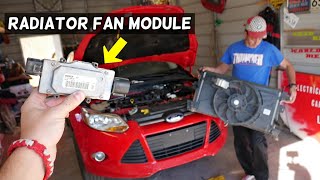
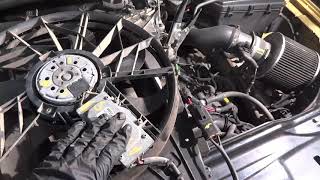
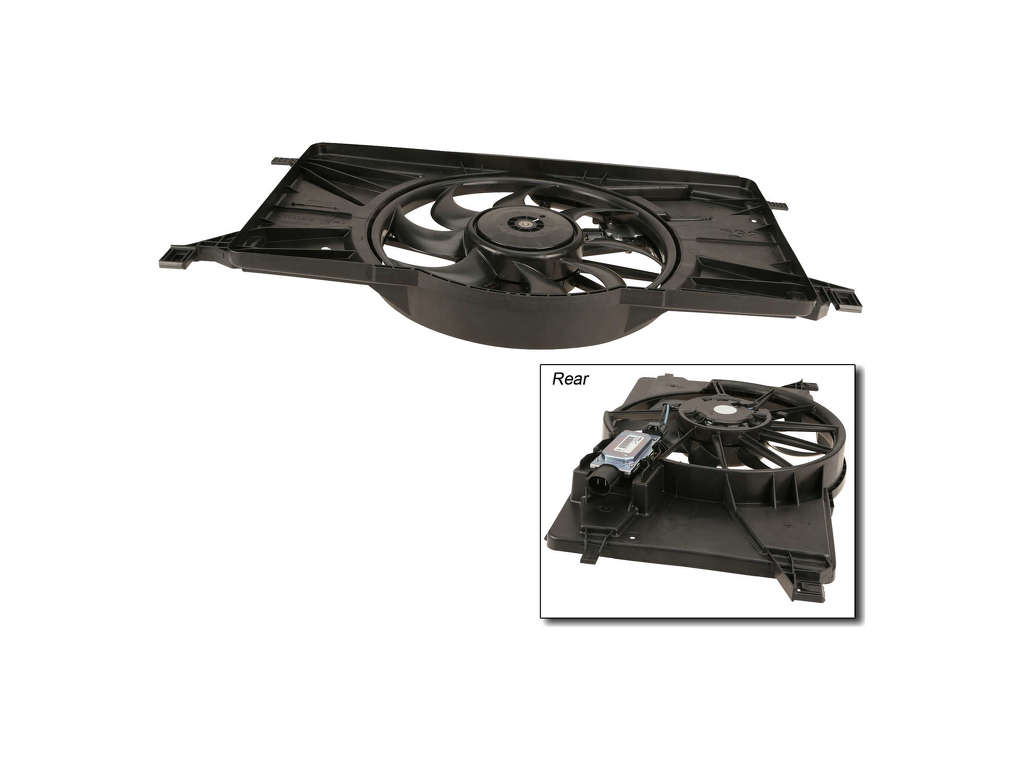
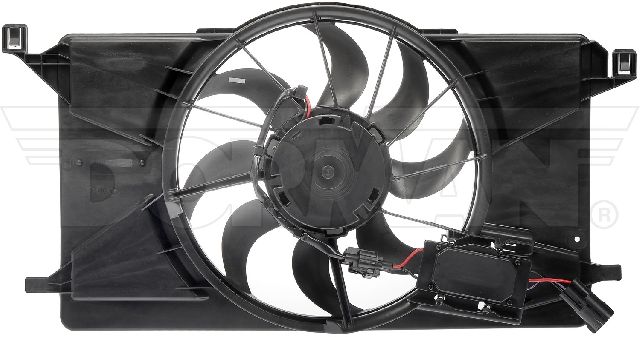
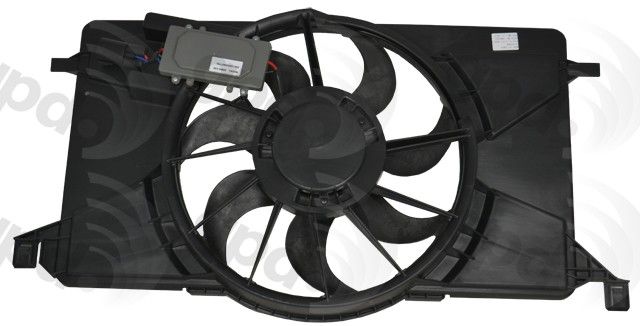
Typical fix: Replace the fan control module. It is located on the cooling fan shroud and can often be replaced separately from the fan assembly, sometimes without tools.
Est. part cost: $40-$100 - Failed Cooling Fan Relay 🟡 Medium Probability Relays are electromechanical switches that wear out over time from repeated use. It's a simple and inexpensive component to check.
How to confirm: Locate the cooling fan relay (R12) in the under-hood fuse box. Swap it with an identical relay from a non-critical system (like the rear defroster, R15) and see if the fan starts working.
Typical fix: Replace the faulty relay with a new one.
Est. part cost: $10-$25 - Blown Fuse 🟡 Medium Probability A short in the fan motor or wiring can cause a fuse to blow. A Ford Technical Service Bulletin for a similar platform (SSM 48895) notes that a fuse can open and cause a P0480 code. [⭐ MANUFACTURER TSB — highest authority] Owners report the large Mega/MIDI fuse can develop a hairline crack or hidden corrosion, causing an intermittent connection.
How to confirm: Visually inspect the fuses related to the cooling fan circuit in the under-hood fuse box. Specifically check the low-amperage fuse F32 and the large high-amperage Mega/MIDI fuse #8. Use a multimeter to test for continuity if a visual inspection is inconclusive. The Mega fuse should be removed for a thorough inspection, as corrosion can hide on the back side.
Typical fix: Replace the blown fuse. If the new fuse blows immediately, there is an underlying short circuit that must be diagnosed.
Est. part cost: $5-$20 - Damaged Wiring or Connectors ⚪ Low Probability Wires leading to the fan assembly are exposed to heat and vibration, which can cause them to fray, melt, or corrode over time. The connector itself can melt due to high resistance.
How to confirm: Visually inspect the wiring harness leading to the fan control module and fan motor. Check for melted plastic on the connector, corrosion in the pins, or broken/chafed wires, especially where the harness is clipped to the fan shroud or runs near hot engine components.
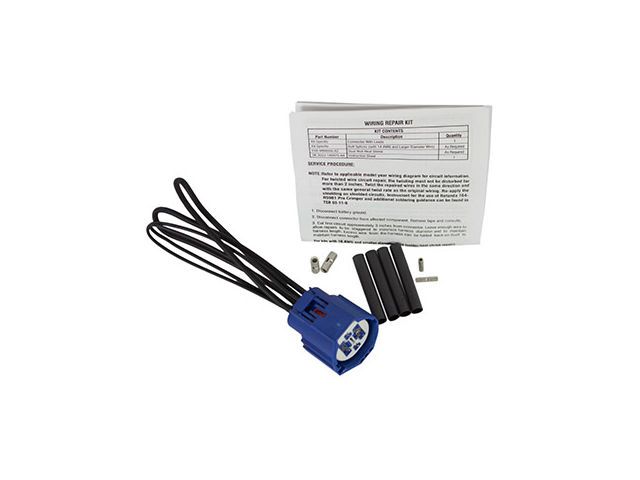
Typical fix: Repair the damaged section of the wiring harness or replace the connector pigtail.
Est. part cost: $10-$50
Rare But Worth Checking
- Failed Cooling Fan Motor: While less common than the control module, the fan motor itself can fail. If the module and relay are good, you can test the motor by applying 12V power directly to its terminals. If it doesn't spin, the motor is bad.
- Faulty Powertrain Control Module (PCM): This is the least likely cause. The PCM should only be considered after all other components in the fan control circuit (module, relay, fuses, wiring, and fan motor) have been tested and ruled out.
Diagnosis Steps

- Read the code with an OBD-II scanner to confirm P0480 is present.
- Visually inspect the cooling fan for any obstructions.
- Check the cooling fan fuses (low-amp F32, high-amp Mega/MIDI fuse #8) and the fan relay (R12) in the under-hood fuse box.
- Swap the fan relay (R12) with an identical one (e.g., R15 for the rear defroster) to quickly test the relay's function.
- If fuses and relays are good, use a bidirectional scan tool to command the cooling fan ON. Alternatively, turn the A/C to MAX, which should also command the fan on.
- If the fan does not run, disconnect the electrical connector at the fan control module. Test for battery voltage on Pin 1 and a good ground on Pin 2.
- If power and ground are present, the fan control module or the fan motor itself is likely faulty. The module is the more common failure point and can often be replaced separately.
- If power is not present at the connector, trace the wiring back from the module to the fuse box to find the open or short circuit. Pay close attention to the connector itself for signs of melting or corrosion.
Parts You'll Likely Need
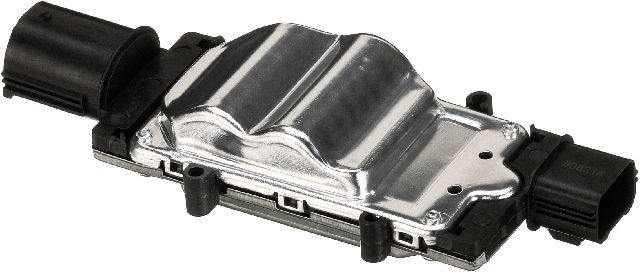
- Cooling Fan Control Module
(OEM #1137328464)— This is the most frequent point of failure for the P0480 code on this specific vehicle.
Trusted brands: Motorcraft, Dorman, Gates, Four Seasons
OEM price range: $90-$150
Aftermarket price range: $40-$100 - Cooling Fan Relay — A common and inexpensive part to fail. It's located in the under-hood fuse box at position R12.
Trusted brands: Motorcraft, Standard Motor Products
OEM price range: $15-$30
Aftermarket price range: $10-$20 - Cooling Fan Assembly
(OEM #CV6Z-8C607-P)— This part is needed if the fan motor itself has failed or if you prefer to replace the fan, shroud, and module as a single unit.
Trusted brands: Motorcraft, TYC, Spectra Premium
OEM price range: $250-$400
Aftermarket price range: $100-$200
Related Codes That Often Appear With This One
- P0481 — This code indicates a fault with the 'Fan 2 Control Circuit'. If the vehicle has a two-fan or two-speed system, a shared electrical problem like a faulty module or power supply could trigger both codes. [OWNER COMPLAINT]
- P0691 — This code is for 'Fan 1 Control Circuit Low'. It is a more specific version of P0480 and often points to a short to ground in the circuit or a failed control module. [⭐ MANUFACTURER TSB — highest authority]
Technical Service Bulletins (TSBs) & Recalls

- SSM 48895: While for a Ford Escape with a 2.0L engine, this TSB is relevant as it links P0480 to an open fuse (F34) on a similar powertrain platform. Note that fuse locations may differ on the Focus. [⭐ MANUFACTURER TSB — highest authority]
Platform-Specific Known Issues
- The cooling fan control module is known to fail intermittently, which can make diagnosis tricky. It may work when the A/C is on but not when triggered by engine temperature, or vice-versa.
- A cracked or corroded MIDI fuse (also called a Mega fuse) has been reported by some owners. The defect may not be visible without removing the fuse and can cause an intermittent open circuit.
- Owners on forums like Reddit's r/FocusST frequently confirm the fan control module as the primary culprit for P0480, with many successfully performing a DIY replacement using either an OEM or aftermarket part.
Mechanic-Grade Diagnostic Values
- Voltage at Fan Control Module Connector — expected: Pin 1: Battery Voltage (approx. 12V), Pin 2: Good Ground (near 0V). Failure: No voltage at Pin 1 or high voltage/resistance at Pin 2 indicates a problem in the wiring or fuse box.
- Voltage at Fan Relay (R12) Socket — expected: With key in RUN position, Pin 1 of the socket should have battery power from fuse F32.. Failure: No power at Pin 1 indicates a blown F32 fuse or a wiring issue upstream.
- Cooling Fan Relay Coil Resistance — expected: Typically 50-120 ohms across the control terminals.. Failure: A reading far outside this range, or an open/short circuit, indicates a failed relay.
Hidden / Shadow Codes Worth Checking
- P0480:13-2F: This is a Ford-specific DTC format that includes a subtype (:13) indicating an 'Circuit Open' fault. This provides more detail than the generic P0480 code. (see via This format is typically visible using dealer-level scan tools like Ford's IDS (Integrated Diagnostic System) or advanced aftermarket scanners like FORScan.)
Scan Tool Commands That Help
- FORScan, Ford IDS, or other professional bidirectional scanner: Cooling Fan Control Command (or similar name) — This is a critical diagnostic step. After checking fuses and relays, use this command to force the fan ON. If the PCM sends the command but the fan doesn't run, it helps isolate the problem to the final control circuit (module, wiring, or fan motor).
Wiring & Ground Locations
- Main Chassis Grounds — Two primary ground bolts are located on the chassis frame rail underneath the air intake box, in front of the battery on the driver's side.. While not exclusive to the fan circuit, these are the main grounding points for the vehicle's electrical system. Poor contact here due to paint or corrosion can cause a wide range of intermittent electrical faults, including issues with the PCM's ability to control modules like the FCM. Cleaning these grounds is a known fix for many unrelated electrical issues on this platform.
- R12 — In the under-hood fuse and relay box, next to the battery.. This is the primary relay that controls power to the cooling fan circuit. It is a common failure point.
- Mega Fuse #8 / F32 — Both are in the under-hood fuse box. F32 is a small blade-style fuse for the relay control circuit, while Mega Fuse #8 is a large, bolted-in fuse for the high-current motor circuit.. Fuse #8 provides main power to the fan motor via the control module, and F32 provides power for the relay's control coil. A failure of either will disable the fan.
Real Owner Repair Stories
- Reddit r/FocusST user CTXO7 (Ford Focus ST (2012-2018 generation)) — Check Engine Light with code P0480. The cooling fan did not spin when the car was started, but it did turn on when the A/C was activated. The car was not overheating.
❌ Tried (didn't work) Initially considered replacing the entire fan assembly as recommended by an auto parts store employee.
✅ What actually fixed it The community advised that the fan control module was the most likely failure. The user was informed that a module from any 2012-2018 Focus or 2013-2016 Escape would fit and that it could be replaced without tools. The implied fix was replacing only the module. - Reddit r/FocusST thread (Ford Focus ST) — Persistent P0480 code.
❌ Tried (didn't work) Replacing the Fan Control Module (FCM) four times, including three cheap aftermarket units and one junkyard OEM part., Unplugging the coolant temp sensor to force the fans on (did not work)., Swapping tunes.
✅ What actually fixed it Another user in the thread reported a similar issue that was resolved by swapping the fan relay (R12) with an identical relay from another circuit (rear defrost). The original relay had developed high internal resistance. A second user noted that the Mega fuse (#8) can develop corrosion on the back side, which is not visible without removing it for inspection. The final fix for the original poster was not stated, but these two solutions were the top suggestions after the FCM was repeatedly replaced.
When the Usual Fixes Don't Work
- While the fan control module is the most common cause of P0480, it is not the only cause. One owner reported replacing the module four separate times with both aftermarket and used OEM parts without resolving the code. This indicates that for some cases, the actual fault lies elsewhere in the circuit, such as a failing relay with high internal resistance, hidden corrosion on the main fuse, or a wiring issue. Simply replacing the most common part without proper diagnosis can lead to wasted time and money.
OEM Part Supersession History
cv6z8c607b, cv6z8c607g, cv6z8c607k, rf283, rf292, rf303→CV6Z-8C607-P— Part revisions and updates by the manufacturer.
Heads up: The new part number (CV6Z-8C607-P) is the correct replacement for the older numbers for the full assembly.1137328464→1137328567— Part revision for the fan control module.
Heads up: These part numbers are often listed as interchangeable for the 2013-2018 Ford Focus.
Model Year Variations Within This Range
- 2012-2018: The fan control module for the Focus is noted to be cross-compatible with the one found on the 2013-2016 Ford Escape, expanding options for sourcing used parts.
Diagnostic Flowchart
Other Known Issues on This Vehicle
Issues unrelated to this code that are worth knowing about as an owner of this generation:
- DPS6 'PowerShift' Automatic Transmission Failure 🔴 High — Extremely common across all model years. Symptoms include shuddering, hesitation, rough shifting, and complete loss of power. (Ref: Multiple warranty extensions and a class-action lawsuit (Vargas v. Ford) were issued, but the fundamental design flaws persist.)
- Faulty Canister Purge Valve (CPV) 🟠 Medium — Widespread issue causing rough idle, difficulty starting after refueling, and potential engine stalling. (Ref: Ford Safety Recall 18S32 / 19S22 (NHTSA 18V-735) was issued to reprogram the PCM and replace the valve if necessary.)
- Collapsed Passenger-Side Engine Mount 🟠 Medium — Common failure leading to excessive engine vibration felt in the cabin and steering wheel, especially at idle. (Ref: No specific recall, but it is a well-documented repair. The hydraulic mount wears out, causing the engine to sag and transfer vibrations directly to the chassis.)
- Malfunctioning Door Latches 🔴 High — Affects 2012-2015 models. The door may not close properly or could unlatch while driving. (Ref: Ford Safety Recall 16S30 / 20S30 was issued to replace the faulty door latch modules.)
Used vs. New Parts: Buying Guide for This Vehicle
When a used part is the smart pick: For the fan control module or the complete fan assembly, a used part from a reputable auto recycler or junkyard is a very common and cost-effective repair strategy mentioned by owners.
Donor-vehicle mileage cap: roughly under 80000 miles for the part to have meaningful remaining life.
What to inspect on the donor part:
- Inspect the electrical connector on the module/harness for any signs of melting, charring, or pin corrosion.
- If buying the full assembly, manually spin the fan blades to ensure the motor bearing is smooth and not seized.
- Check the plastic fan shroud for any cracks or broken mounting tabs.
OEM-only on this vehicle (don't cheap out):
- Cooling Fan Control Module
Aftermarket brands forum-validated for this vehicle:
- Bosch (often the original OEM supplier)
- Dorman
- Motorcraft (Ford's OEM brand)
Brands owners have reported issues with on this vehicle:
- Unbranded, low-cost 'Chinese' modules are specifically cited by owners as being unreliable, with one user going through three failed units before switching to an OEM part.
Real Owner Stories
Aggregated from forums and TSBs cited above. Mileages and costs reflect what owners reported in those sources.
2012-2018 Ford Focus 2.0L
Symptoms: When I turned on the car the fan didn't spin at all but when I turned on the ac the fan started spinning.
What fixed it: Replacing the Fan Control Module (FCM).
Source hint: Reddit (r/FocusST) thread titled 'P0480 fan 1 control circuit'
2012-2018 Ford Focus 2.0L
Symptoms: Intermittent connection issues caused by a large Mega/MIDI fuse that had a hairline crack and hidden corrosion not visible from the front.
What fixed it: Replacing the high-amperage Mega/MIDI fuse #8.
Source hint: vehicle_specific_issues
Related OBD-II Codes
Frequently Asked Questions
Does SSM 48895 apply to my 2012-2018 Ford Focus?
Can I replace just the Fan Control Module (FCM) on my Focus, or do I need a whole new fan assembly?
Why does my fan work when the A/C is on but the car still overheats at idle?
Which specific fuses and relays should I check for P0480 on this model?
Is there a trick to inspecting the Mega/MIDI fuse on the Focus?
Could my Focus's poor A/C performance be related to the P0480 code?
Helpful Videos



We Have This Part in Stock


The information in this article is provided for general reference and educational purposes only. Vehicle specifications, procedures, and part compatibility can vary by production date, trim level, and region. Always consult your vehicle's factory service manual and verify part numbers before purchasing or performing repairs. Safety-critical components such as airbags, seat belts, and braking systems should be installed by a qualified professional.
- Ford Focus:
- 🎬 Helpful Videos
- 🛍️ Shop This Part
- What's Unique About the 2012-2018 Ford Focus
- Symptoms You May Notice
- Most Likely Causes
- Rare But Worth Checking
- Diagnosis Steps
- Parts You'll Likely Need
- Related Codes That Often Appear With This One
- Technical Service Bulletins (TSBs) & Recalls
- Platform-Specific Known Issues
- Mechanic-Grade Diagnostic Values
- Hidden / Shadow Codes Worth Checking
- Scan Tool Commands That Help
- Wiring & Ground Locations
- Real Owner Repair Stories
- When the Usual Fixes Don't Work
- OEM Part Supersession History
- Model Year Variations Within This Range
- Diagnostic Flowchart
- Other Known Issues on This Vehicle
- Used vs. New Parts: Buying Guide for This Vehicle
- Real Owner Stories
- 2012-2018 Ford Focus 2.0L
- 2012-2018 Ford Focus 2.0L
- Related OBD-II Codes
- Frequently Asked Questions
- 🎟️ Get 5% Off