

OBD-II Code P0470: Exhaust Pressure Sensor 'A' Circuit Malfunction
The Ultimate P0470 Guide: What it means, why it triggers, and how to fix it for good.
- A clogged metal sensor tube causes over 50% of P0470 codes, making physical cleaning the mandatory first diagnostic step.
- Ignoring this code in a diesel vehicle disables DPF regeneration, leading to a clogged filter and a forced 10-20% reduction in engine power within 100 to 200 miles.
- Perform a Key On, Engine Off (KOEO) rationality check using a scan tool; the exhaust pressure sensor must read within 0.5 PSI of the MAP and BARO sensors.
- Never replace the exhaust pressure sensor without first verifying the 5-volt reference signal and ground at the connector to rule out a wiring failure.
What Does P0470 Mean?

The Powertrain Control Module (PCM) detects an electrical circuit fault with the exhaust pressure sensor. This sensor measures exhaust system pressure to control emissions, turbocharger boost, and diesel particulate filter (DPF) regeneration. A 'circuit malfunction' means the PCM receives an open, shorted, or out-of-range signal (outside the normal 0.5V to 4.5V operating window).
Technical definition: SAE/OBD-II defines P0470 as "Exhaust Pressure Sensor 'A' Circuit Malfunction". The PCM runs a rationality check at key-on, comparing the exhaust pressure sensor reading to the barometric pressure (BARO) and manifold absolute pressure (MAP) sensors. If the voltage drops below 0.25V, exceeds 4.75V, or the pressure reading is implausible for several seconds, the PCM triggers the code.
Can I Drive With P0470?
Yes, But With Caution. Yes, for short distances, but fix it immediately. Ignoring P0470 causes a 10-15% fuel economy drop and sluggish performance. In diesel vehicles, it disables DPF regeneration, causing a severely clogged filter and a forced engine derate ('limp mode') within 100-200 miles, adding $1,000-$2,500+ in repair costs.
Common Causes

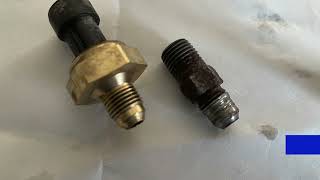
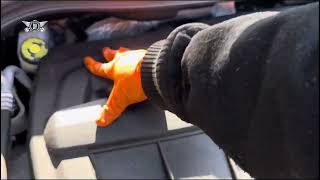
- Clogged sensor tube or port (Very Common) — Soot and carbon completely block the metal tube connecting the sensor to the exhaust manifold, preventing accurate pressure readings. This is the #1 cause on diesel engines. 🎬 Watch: The fastest way to fix P0470 on a Power Stroke.
- Faulty exhaust pressure sensor (Very Common) — The sensor fails internally due to extreme exhaust heat, age, and vibration, breaking the electrical circuit.
- Damaged or contaminated wiring (Common) — Wiring harnesses melt, chafe, or suffer water/salt intrusion at the connector, creating high resistance, shorts, or open circuits.
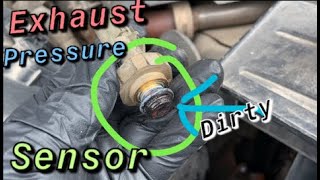
- Low-quality aftermarket sensor (Common) — Cheap sensors fail to meet strict OEM voltage specifications, causing the PCM to immediately flag them as faulty. 🎬 See how to replace the exhaust pressure sensor on a Cummins.
- Exhaust or intake leaks (Less Common) — Manifold leaks or boost leaks create pressure discrepancies that trick the PCM into flagging the sensor circuit.
- Blocked EGR System (Less Common) — A stuck EGR valve alters exhaust flow, causing illogical pressure readings that trigger P0470.
- Failed Powertrain Control Module (PCM) (Rare) — The PCM hardware fails or requires a software update to fix overly sensitive diagnostic parameters.
Symptoms

- Check Engine Light is on — The immediate and universal indicator of the fault.
- Reduced engine power (Limp Mode) — The vehicle accelerates poorly and restricts RPMs to prevent turbocharger damage.
- Poor fuel economy — Fuel consumption increases by 8-12% due to default PCM fueling strategies.
- Excessive black exhaust smoke — Visible soot during acceleration indicates improper turbo or EGR control.
- Inability to perform DPF regeneration (Diesel only) (scan-tool only — no driver-felt sign) — The PCM disables DPF self-cleaning, leading to rapid filter clogging and secondary codes like P2463.
- Failed emissions test (scan-tool only — no driver-felt sign) — Automatic failure during state inspections due to disabled emissions monitors.
Diagnostic Flowchart

Tap your situation to follow the diagnostic path that matches what you're seeing on this code.
Common Fixes & Costs
- Cleaning the exhaust pressure sensor tube and port — Parts: $5-$15, Labor: $100-$150, ~1 hr book time (DIY)
- Replacing the exhaust pressure sensor
— Parts: $50-$150, Labor: $100-$200, ~0.8 hr book time
(DIY)
Ford F-Series (6.7L Power Stroke): OEM BC3Z-9J460-D (Motorcraft DPFE-21) (Alt: Dorman 904-7123, Standard Motor Products FPS505)
Nissan Qashqai/Juke (1.5 dCi): OEM 22365-00QAK (Alt: Bosch 0281006059, NRF 708036)
Chevy/GMC (L5P Duramax): OEM 12677718 (ACDelco) (Alt: Dorman 904-712, Standard Motor Products EBP29) - Replacing the exhaust pressure sensor and tube together — Parts: $80-$220, Labor: $150-$250, ~1.5 hr book time (Intermediate)
- Repairing damaged wiring or replacing the connector pigtail — Parts: $15-$50, Labor: $120-$300, ~2 hr book time (Advanced)
- Professional Diagnosis — Parts: $0, Labor: $100-$200, ~1 hr book time (Pro)
Used vs. New Parts: Buying Guide
When a used part is worth it: Never. Buying a used exhaust pressure sensor guarantees premature failure due to prior heat cycling and internal wear.
Donor-vehicle mileage cap: roughly under 20000 miles for the part to have meaningful remaining life.
Donor quality checklist:
- Only pull from a low-mileage, wrecked vehicle.
- Avoid salt-belt vehicles due to connector corrosion.
- Match the OEM part number exactly.
Decision logic:
- If A new OEM or reputable aftermarket sensor costs under $200. → Buy new. Labor costs to replace a failed used sensor erase any savings.
- If The vehicle is a low-value beater and a used sensor is $20. → Accept the high risk of immediate failure if you proceed.
Warranty tradeoff: Salvage yards offer 30-day warranties. New OEM parts carry 1-2 year warranties, and premium aftermarket parts offer limited lifetime warranties.
Worst-case if a used part fails: $150-$300 in repeat diagnostic and labor fees when the used sensor fails.
What Happens If You Wait — Timeline
- 0-100 miles: Check Engine Light illuminates. Automatic DPF regeneration is disabled. (MPG impact: 0-5%% · Added cost: $0)
- 100-500 miles: Engine feels sluggish. DPF soot level exceeds the normal regeneration threshold. A DPF warning light appears. (MPG impact: 5-10%% · Added cost: $50-$100 in wasted fuel.)
- 1-2 weeks of continued driving: DPF becomes severely clogged. Vehicle enters 'limp mode'. A forced regeneration at a shop is mandatory. Backpressure strains turbocharger seals. (MPG impact: 10-20%% · Added cost: $200-$500 for a forced DPF regeneration.)
- 2+ weeks or immediate under high load: DPF blocks completely with hardened ash. Extreme backpressure destroys the turbocharger. Engine refuses to start. (MPG impact: 20-50%% · Added cost: $2,500-$7,000 for DPF and turbocharger replacement.)
Cost of Not Fixing It
- 0-1 month: Noticeable 8-12% drop in fuel economy and sluggish performance. In diesels, DPF regeneration halts, initiating filter clogging. (Added cost: $50-$150 in wasted fuel.)
- 1-3 months: The DPF severely clogs, triggering warning lights and requiring a forced regeneration at a shop. Increased backpressure stresses the turbocharger. (Added cost: $150-$300 for a forced DPF regeneration.)
- 3+ months: Catastrophic DPF failure occurs. The completely blocked filter causes a no-start condition and destroys turbocharger seals. (Added cost: $1,500-$4,000 for DPF replacement, plus $1,000-$2,500 for turbocharger damage.)
Diagnosis Steps
- Read Codes and Freeze Frame Data
Connect an OBD-II scanner. Confirm P0470 and note related codes (e.g., P0472, P2463). Analyze freeze frame data to identify engine conditions when the fault occurred.
Tools: OBD-II Scanner (Beginner) - Perform a KOEO Rationality Check
With Key On, Engine Off (KOEO), view live data. The Exhaust Pressure (EBP), MAP, and BARO sensors must read within 0.5 PSI of each other (approx. 14.7 PSI at sea level). A significant EBP deviation confirms a sensor or circuit failure.
Tools: OBD-II scanner with live data (Intermediate) - Visually Inspect Sensor, Tube, and Wiring
Locate the sensor on or near the exhaust manifold. Inspect for burnt wires, a cracked housing, or green/white corrosion inside the connector.
Tools: Flashlight (Beginner) - Inspect and Clean the Sensor Tube
Remove the metal tube connecting the sensor to the manifold. If air cannot pass freely, it is blocked. Clean it thoroughly using a flexible wire (like a speedometer cable) and brake cleaner. Verify the manifold port is also clear.
Tools: Wrenches, safety glasses, flexible wire, brake cleaner (Intermediate) - Test the 5V Reference and Ground
Disconnect the sensor. With KOEO, use a multimeter to verify a 5-volt reference signal from the PCM and less than 5 ohms of resistance on the ground wire. 0V on reference or >0.25V on ground indicates a wiring harness failure.
Tools: Multimeter, wiring diagram (Advanced) - Perform a 'Wiggle Test'
While monitoring live sensor voltage on a scanner, aggressively wiggle the wiring harness and connector. Voltage dropouts or spikes confirm an intermittent short or open wire.
Tools: OBD-II scanner with live data (Intermediate) - Test Sensor Signal Output
Reconnect the sensor. Backprobe the signal wire with the engine running. Voltage should sit at 0.8V-1.0V at idle and rise smoothly toward 4.5V as RPM increases. A stuck 0V or 5V reading means the sensor is dead.
Tools: Multimeter, backprobe pins (Advanced) - Use an Oscilloscope for Definitive Proof
Connect an oscilloscope to the signal wire. A healthy sensor displays a clean voltage curve matching RPM. Flat lines, extreme noise, or sudden dropouts confirm internal sensor failure.
Tools: Oscilloscope, backprobe pins (Expert)
When This Code Triggers (Freeze-Frame Conditions)
- Engine Coolant Temp: 170-210°F (77-99°C) (The fault triggers after the engine reaches full operating temperature.)
- Engine RPM: 1500-2500 RPM (Occurs during steady-state cruising when the PCM actively monitors sensor performance.)
- Engine Load: 25-60% (Sets under moderate, stable engine load rather than heavy acceleration.)
- Vehicle Speed: 45-65 mph (72-104 km/h) (Highway driving provides the stable environment required for PCM diagnostic checks.)
Related Codes
- P0471 — P0470 is a hard electrical fault (open/short). P0471 is a 'Range/Performance' code, meaning the sensor works but reads illogical pressures (e.g., high pressure when the engine is off). P0471 points to a partially clogged tube.
- P0472 — Indicates sensor circuit voltage is too low (below 0.25V). Caused by a short to ground, an open wire, or a dead sensor.
- P0473 — Indicates sensor circuit voltage is too high (above 4.75V). Caused by a short to power or an internal sensor failure outputting maximum voltage.
- P2463 — Indicates DPF restriction. P0470 prevents DPF regeneration, directly causing the soot buildup that triggers P2463.
Climate & Environmental Factors
- Freezing Temperatures: Condensation freezes inside the sensor or tube, causing temporary blockages at startup. Ford 6.0L Power Strokes require a specific PCM update (TSB 09-24-3) to fix false codes triggered by this.
- High Humidity and Road Salt: Accelerates severe corrosion inside the sensor's electrical connector, increasing circuit resistance and triggering P0470.
- High Altitude: Lower atmospheric pressure exposes sluggish sensors during the KOEO rationality check, triggering P0470 or P0471 when the EBP reading fails to match the BARO sensor.
How to Talk to a Mechanic About This Code
Say this: "I have a P0470 code. Please perform a KOEO rationality check and inspect the exhaust pressure sensor tube for blockages before quoting a sensor replacement."
This proves you know the most common cause is a clogged tube or wiring issue, preventing the shop from immediately upselling an unnecessary sensor replacement.
Avoid saying:
- 'Just fix whatever's wrong'
- 'My check engine light is on, can you look at it?'
- 'Go ahead and replace the exhaust sensor'
Questions to ask before authorizing the repair:
- Did you clean the sensor tube and the port on the manifold?
- What were the results of the KOEO rationality check between the EBP, MAP, and BARO sensors?
- Did you test the sensor connector for the 5-volt reference and ground?
- Are you installing an OEM sensor or an aftermarket brand?
Where to Take It: Dealer vs Independent vs Chain
- Dealer:
Recommended only for in-warranty vehicles or when a PCM software update is required.
Best for: Vehicles under powertrain or emissions warranty., Complex manufacturer quirks (e.g., Ford 6.0L TSBs, VW/Audi TDI issues)., PCM software updates.
Downsides: Highest labor rates., Tendency to replace entire assemblies rather than cleaning components. (Typical cost: +50% vs. baseline) - Independent Shop:
Best fit. A reputable diesel specialist sees this code daily and fixes it efficiently.
Best for: Out-of-warranty diesel trucks (Ford, Ram, Chevy/GMC)., Cost-effective tube cleaning and sensor replacement.
Downsides: May lack access to the latest manufacturer TSBs. (Typical cost: +0% vs. baseline) - Chain Shop:
AVOID. They will likely replace the sensor without cleaning the tube, guaranteeing the code returns.
Best for: Oil changes and tires.
Downsides: Technicians lack diesel emissions expertise., High pressure to swap parts without diagnosing clogged tubes. (Typical cost: -10% vs. baseline)
When to Walk Away From the Repair
If the total estimated repair cost exceeds 40% of your vehicle's private-party market value, seriously reconsider the investment.
- Car worth $8000, fix is $250: Fix it. This is a standard repair cost.
- Car worth $5000, fix is $3500: Walk away. The ignored code destroyed the DPF and turbo. The repair exceeds 70% of the vehicle's value.
- Car worth $30000, fix is $800: Fix it. Even a complex wiring repair is a fraction of the vehicle's value.
What Scan Tool You Need for This Code
Minimum: An OBD-II scanner that displays live sensor data (PIDs).
A $20 code reader cannot display live voltage and pressure data. Without live data, you cannot perform the KOEO rationality check or verify sensor output, leaving you guessing.
Budget: BlueDriver Pro (~$100) — Connects to your smartphone to provide live data graphing, enabling KOEO checks and wiggle tests.
Mid-range: Foxwell NT510 Elite (~$180) — A dedicated handheld unit offering faster processing and manufacturer-specific data points beyond generic OBD-II.
Professional: Autel MaxiCOM MK808 (~$500-1200) — Provides professional-level diagnostics, bidirectional controls, and access to all modules to rule out PCM failures.
Rent vs buy: Borrow a scanner from AutoZone for a one-time fix. Buy the BlueDriver if you own a diesel truck and plan to do your own maintenance.
How to Clear the Code After You Fix It
- Use an OBD-II scan tool to clear P0470 and related fault codes.
- Reconnect the battery if disconnected (this resets all readiness monitors).
- Perform a complete OBD-II drive cycle to run readiness monitors and confirm the fix.
Drive cycle (~20 minutes): A generic drive cycle requires a cold start (engine off 8+ hours), 3 minutes of idling, 10 minutes of mixed city driving (25-45 mph), and 10 minutes of steady highway cruising (55-60 mph). This operates the vehicle under the conditions needed to complete emissions self-tests.
Readiness monitors affected: Catalyst Monitor, EGR System Monitor, Oxygen (O2) Sensor Monitor, Comprehensive Component Monitor
Before emissions retest: drive at least 50 miles to fully set monitors.
Watch out for:
- Disconnecting the battery clears the code but resets monitors to 'Not Ready', causing an automatic emissions test failure.
- The code returns within two drive cycles if the root cause (e.g., clogged tube) remains unfixed.
- The EVAP monitor requires specific conditions, including a fuel level between 15-85%, to set.
Will This Fail Emissions / State Inspection?
Yes — this code typically fails an OBD-II emissions inspection.
- California: An active P0470 is an automatic smog check failure. All readiness monitors (except EVAP) must read 'Ready' before passing a re-test.
- New York: NYS OBD-II inspections automatically fail any vehicle with an illuminated Check Engine Light from P0470.
- Texas: In emissions-testing counties, P0470 causes an automatic failure. You cannot pass until readiness monitors are set post-repair.
Most Commonly Affected Vehicles
- Ford F-250/F-350 Power Stroke Diesel (6.0L, 7.3L, 6.7L) (1999-2023) — Notorious for soot-clogged sensor tubes (7.3L/6.0L) and wiring failures (6.7L). TSB 09-24-3 addresses false codes in freezing weather for 6.0L models.
- Nissan Qashqai / Juke / X-Trail 1.5 dCi Diesel (2014-2020) — Highly prone to clogged tubes. Mechanics frequently misdiagnose this by replacing the DPF differential pressure sensor instead. Disables cruise control.
- Chevrolet / GMC Silverado/Sierra 2500/3500 Duramax Diesel (L5P) (2017-2023) — Wiring harnesses chafe and short out due to tight, high-heat routing near the sensor.
- Dodge / Ram Ram 2500/3500 Cummins Diesel (2007-2024) — Suffers from soot-clogged exhaust manifold ports and internal sensor failures.
- Volkswagen / Audi Jetta, Golf, Passat, A3, A4 TDI (2009-2019) — Engine bay harness wiring issues and extreme sensitivity to non-OEM aftermarket sensors.
- Mercedes-Benz Sprinter BlueTEC Diesel (2019-2023) — Harness chafing near the sensor causes intermittent shorts.
- BMW 3 Series, 5 Series, X3, X5 Diesel (2010-2020) — Sensor failures trigger P0470 alongside complex DPF restriction codes.
- Toyota Tundra 5.7L Gasoline (2014-2023) — Vibration damages the sensor or loosens the connector on this specific gasoline application.
Manufacturer-Specific Notes
- Ford: 6.0L Power Strokes trigger false P0470 codes in freezing weather. TSB 09-24-3 updates the PCM calibration to fix this sensitivity. However, a soot-clogged tube remains the primary physical cause.
- Nissan: On 1.5 dCi engines, technicians routinely replace the DPF differential pressure sensor by mistake. The exhaust back pressure sensor is a separate component with a dedicated tube that clogs frequently.
- General Motors (Chevrolet/GMC): L5P Duramax (2017+) wiring harnesses route too close to heat sources, causing chafing and intermittent shorts. Inspect the harness loom thoroughly before replacing the sensor.
- VAG (VW/Audi): TDI PCMs reject cheap aftermarket sensors. Installing anything other than an OEM or Bosch OE-equivalent sensor guarantees the code returns immediately.
Real Owner Stories
2006 Ford F-250 6.0L Power Stroke at 101K miles
Check Engine Light illuminated with P0470 and a MAP sensor code.
What they tried:
- Replaced the MAP sensor, clearing its code.
- Replaced the exhaust backpressure sensor (EBPS), but P0470 returned.
- Cleaned the original sensor and reinstalled it; code returned.
- Installed a third sensor; P0470 returned.
- Cleaned the EBPS tube.
Outcome: The issue persisted after three sensors and a tube cleaning. The root cause was an electrical failure in the wiring harness preventing the 5V reference signal from reaching the sensor.
Lesson: Stop replacing parts. If a new sensor and clean tube fail, immediately test the 5V reference and ground circuits.
2010 Nissan Qashqai 1.5 dCi
Check Engine Light on with P0470. Mechanic misdiagnosed the issue.
What they tried:
- A mechanic mistakenly replaced the DPF differential pressure sensor.
Outcome: The code remained. The actual problem was a clogged tube leading to the correct exhaust back pressure sensor. Cleaning the correct tube resolved the code.
Lesson: Verify component locations. The DPF differential pressure sensor and the exhaust back pressure sensor are easily confused on Nissan 1.5 dCi engines.
1997 Ford 7.3L Power Stroke
Rough idle, hard starts, and P0470. The sensor had physically broken off its bracket.
What they tried:
- Replaced the broken sensor, bracket, and tube.
- Code vanished for a week, then returned.
Outcome: The fitting on the exhaust manifold itself was completely clogged with carbon. Cleaning the manifold port permanently resolved the issue.
Lesson: A new tube is useless if the exhaust manifold port is blocked. Always clean the manifold fitting when servicing the tube.
How to Prevent This Code From Triggering
- Clean the exhaust pressure sensor tube (Every 30,000 miles (48,000 km)) — Eliminates the gradual soot buildup that causes over half of all P0470 codes.
- Use high-quality diesel fuel and additives (Every fill-up) — Cleaner combustion produces less soot, reducing the load on the DPF and sensor tube.
- Ensure regular highway driving for diesel vehicles (At least 20-30 minutes weekly) — Sustained highway speeds generate the exhaust heat required for passive DPF regeneration, preventing extreme backpressure.
- Use low-ash engine oil (API CK-4/FA-4) (Per manufacturer's schedule) — Reduces incombustible ash that permanently clogs the DPF and alters exhaust pressures.
Frequently Asked Questions
What is the most common misdiagnosis for P0470?
The most common mistake is replacing the exhaust pressure sensor without cleaning the metal connecting tube. A clogged tube is the primary cause, and a new sensor cannot fix a physical blockage. On Nissan models, mechanics also frequently confuse this with the DPF differential pressure sensor.
I replaced the sensor and cleaned the tube, but the code came back. What now?
If a new OEM sensor and a clean tube fail to clear the code, the fault lies in the electrical circuit. Inspect the wiring harness and pigtail connector for corrosion, damage, or loose pins. Perform a 'wiggle test' on the harness while monitoring live scanner data to locate intermittent shorts.
Can I just clean the exhaust pressure sensor?
You can clean the sensor port, but never spray harsh chemicals or compressed air directly into the sensor body, as this destroys the internal diaphragm. Focus your cleaning efforts entirely on the metal tube leading to the sensor. If the sensor itself fails internally, it requires replacement.
Will this code cause me to fail an emissions test?
Yes, an active P0470 code causes an automatic emissions test failure because it directly impairs the vehicle's emissions control system.
Is this a problem for gasoline engines too?
Yes, though it is far more common on turbocharged diesel engines. Gasoline engines with turbochargers or specific EGR systems, such as the 5.7L Toyota Tundra, also utilize this sensor and trigger this code.
What's the difference between P0470 and P0471?
P0470 indicates a hard electrical circuit fault, such as a dead sensor, short, or open wire. P0471 indicates a 'range/performance' issue, meaning the sensor sends a signal, but the pressure reading is illogical compared to other engine sensors.
Can a bad EGR valve cause a P0470 code?
Yes, indirectly. A stuck EGR valve alters exhaust system pressure. If the PCM detects an exhaust pressure reading that contradicts the commanded EGR position, it flags the sensor circuit.
Can a bad battery cause P0470?
A weak battery or failing alternator causes low system voltage, which occasionally triggers false electrical codes like P0470. However, this is rarely the root cause. If the code returns after installing a fully charged battery, the sensor circuit is the actual culprit.
Key Takeaways
- A clogged metal sensor tube causes over 50% of P0470 codes, making physical cleaning the mandatory first diagnostic step.
- Ignoring this code in a diesel vehicle disables DPF regeneration, leading to a clogged filter and a forced 10-20% reduction in engine power within 100 to 200 miles.
- Perform a Key On, Engine Off (KOEO) rationality check using a scan tool; the exhaust pressure sensor must read within 0.5 PSI of the MAP and BARO sensors.
- Never replace the exhaust pressure sensor without first verifying the 5-volt reference signal and ground at the connector to rule out a wiring failure.
Helpful Videos

The information in this article is provided for general reference and educational purposes only. Vehicle specifications, procedures, and part compatibility can vary by production date, trim level, and region. Always consult your vehicle's factory service manual and verify part numbers before purchasing or performing repairs. Safety-critical components such as airbags, seat belts, and braking systems should be installed by a qualified professional.
- 🎬 Helpful Videos
- What Does P0470 Mean?
- Can I Drive With P0470?
- Common Causes
- Symptoms
- Diagnostic Flowchart
- Common Fixes & Costs
- Used vs. New Parts: Buying Guide
- What Happens If You Wait — Timeline
- Cost of Not Fixing It
- Diagnosis Steps
- When This Code Triggers (Freeze-Frame Conditions)
- Related Codes
- Climate & Environmental Factors
- How to Talk to a Mechanic About This Code
- Where to Take It: Dealer vs Independent vs Chain
- When to Walk Away From the Repair
- What Scan Tool You Need for This Code
- How to Clear the Code After You Fix It
- Will This Fail Emissions / State Inspection?
- Most Commonly Affected Vehicles
- Manufacturer-Specific Notes
- Real Owner Stories
- 2006 Ford F-250 6.0L Power Stroke at 101K miles
- 2010 Nissan Qashqai 1.5 dCi
- 1997 Ford 7.3L Power Stroke
- How to Prevent This Code From Triggering
- Frequently Asked Questions
- What is the most common misdiagnosis for P0470?
- I replaced the sensor and cleaned the tube, but the code came back. What now?
- Can I just clean the exhaust pressure sensor?
- Will this code cause me to fail an emissions test?
- Is this a problem for gasoline engines too?
- What's the difference between P0470 and P0471?
- Can a bad EGR valve cause a P0470 code?
- Can a bad battery cause P0470?
- Key Takeaways
- 🎟️ Get 5% Off