

OBD-II Code P0469: Purge Flow Sensor Circuit Intermittent
The Ultimate Guide to Diagnosing and Fixing P0469
- A faulty EVAP purge valve or its integrated flow sensor causes over 70% of P0469 codes, making it the primary target for diagnosis.
- An active P0469 code triggers an automatic OBD-II emissions test failure, preventing vehicle registration renewal in states that require testing.
- Inspect the purge valve's electrical connector for green or white corrosion before buying parts, as a simple $10 wiring repair often resolves this intermittent circuit fault.
- Stop fueling your vehicle at the gas pump's first click to prevent liquid gasoline from saturating the charcoal canister, which leads to a $300+ replacement.
What Does P0469 Mean?
Your car's Powertrain Control Module (PCM) detects an unstable signal from the EVAP purge flow sensor. This sensor measures fuel vapor pulled from the charcoal canister into the engine. An intermittent signal means the PCM loses communication, the reading jumps unpredictably, or the flow data contradicts expected operating conditions.
Technical definition: Evaporative Emission System Purge Flow Sensor Circuit Intermittent.
Can I Drive With P0469?
Yes, But With Caution. You can drive with this code, as it does not cause immediate drivability problems. However, ignoring it reduces fuel economy and guarantees an emissions test failure. If a stuck-open purge valve creates a consistently rich fuel mixture, it overheats and damages the catalytic converter over time, a repair costing between $800 and $2,500.
Common Causes
- Faulty EVAP Purge Valve or Purge Flow Sensor (Very Common) — The purge flow sensor, often integrated into the purge valve, is the primary cause. Internal electronics fail and send erratic signals, or the valve mechanically sticks.
- Damaged Wiring or Corroded Connectors (Common) — Sensor wires fray, pinch, or break from heat and vibration. Connector pins corrode from moisture and road salt, causing an intermittent connection.
- Cracked or Disconnected EVAP Hoses (Common) — Rubber EVAP hoses become brittle and crack. A loose or cracked hose alters system pressure, which the sensor interprets as an intermittent fault.
- Software Calibration Error (Less Common) — Manufacturers release PCM software updates to refine EVAP monitor sensitivity. Outdated calibration misinterprets normal sensor fluctuations as a fault.
- Clogged or Saturated Charcoal Canister (Less Common) — A charcoal canister clogged with dust or saturated with liquid fuel restricts vapor flow, causing the purge flow sensor to report irregular readings.
- Water/Debris Intrusion in Vent Solenoid (Less Common) — The EVAP canister vent solenoid ingests water and dirt, causing internal corrosion. This mechanical binding leads to irregular system pressure flagged as an intermittent sensor fault.
- Faulty Fuel Tank Pressure Sensor (Rare) — The PCM uses the fuel tank pressure (FTP) sensor to monitor EVAP integrity. A failing FTP sensor sending erratic data tricks the PCM into flagging the purge flow circuit.
- Faulty Powertrain Control Module (PCM) (Rare) — The computer itself has a faulty internal circuit or driver for the purge flow sensor. Consider this only after ruling out wiring, sensors, and TSBs.
Symptoms
- Check Engine Light On — The PCM stores the trouble code and illuminates the dashboard light to alert the driver.
- Hard Starting After Refueling — A stuck-open purge valve floods the engine with excess fuel vapors after filling the gas tank, causing extended cranking.
- Rough or Unstable Idle — An erratically opening purge valve introduces an unplanned vacuum leak or an overly rich mixture, causing the engine to stumble.
- Failed Emissions Test — An active P0469 code triggers an automatic failure of an OBD-II emissions test, preventing vehicle registration renewal.
- Slight Fuel Odor — A faint smell of gasoline occurs around the vehicle if the EVAP system fails to contain and purge fuel vapors properly.
- Reduced Fuel Economy (also visible on scanner) — The PCM fails to manage the air-fuel mixture efficiently without reliable purge flow data, dropping efficiency by 1-2 MPG.
Diagnostic Flowchart
Tap your situation to follow the diagnostic path that matches what you're seeing on this code.
Common Fixes & Costs
- Replace EVAP Purge Valve/Solenoid — Parts: $30 - $120, Labor: $80 - $200, ~0.8 hr book time (DIY)
- Repair Damaged Wiring or Clean Connector — Parts: $10 - $50, Labor: $100 - $250, ~1.5 hr book time (Intermediate)
- Replace Cracked EVAP Hoses — Parts: $20 - $100, Labor: $50 - $150, ~0.7 hr book time (DIY)
- PCM Software Update — Parts: $0, Labor: $80 - $150, ~1 hr book time (Pro Only)
- Replace Charcoal Canister — Parts: $150 - $550, Labor: $100 - $250, ~1.2 hr book time (Intermediate)
DIY vs Professional
- Replace EVAP Purge Valve/Solenoid — Beginner:
Tools: Basic hand tools (socket set, pliers). - Repair Damaged Wiring or Clean Connector — Beginner:
Tools: Multimeter, wire strippers, soldering iron or quality crimp connectors, heat shrink tubing, terminal cleaning tools, dielectric grease. - Replace Cracked EVAP Hoses — Beginner:
Tools: Pliers, hose pick, new hose clamps. - PCM Software Update — Beginner:
Tools: Manufacturer-specific diagnostic tool (e.g., GM MDI, Ford VCM). - Replace Charcoal Canister — Beginner:
Tools: Jack and jack stands, socket set, pliers, safety glasses.
Used vs. New Parts: Buying Guide
When a used part is worth it: Buying used is not recommended for a simple electronic part like a purge valve. The savings are minimal compared to the risk of receiving a defective part. Aftermarket new parts often have a lifetime warranty.
Donor-vehicle mileage cap: roughly under 50000 miles for the part to have meaningful remaining life.
Donor quality checklist:
- Match the part number exactly; even slight variations fail to work.
- Avoid parts from online marketplaces like Amazon, as quality is highly inconsistent.
- Prefer known aftermarket brands like Dorman, Standard Motor Products, or Bosch over no-name parts.
Decision logic:
- If The part is under $75 new (OEM or quality aftermarket) → Buy new. The small savings from a used part aren't worth the risk and lack of warranty.
- If Vehicle is over 150,000 miles and budget is extremely tight → A used OEM part from a reputable salvage yard with a short-term warranty is a viable, but risky, option.
- If OEM part is on national backorder with no ETA → A quality aftermarket part is the best choice; a used part is a last resort.
Warranty tradeoff: Used parts typically have a 30-90 day warranty. Many aftermarket brands offer a one-year or lifetime warranty. OEM parts purchased from and installed by a dealer carry a 1-2 year warranty.
Worst-case if a used part fails: $150-$300 if a used or cheap aftermarket part fails shortly after installation, requiring repeat labor costs plus the price of another part.
What Happens If You Wait — Timeline
- 0-1 month: Check Engine Light illuminates with code P0469. The light may turn off and on. The vehicle fails an emissions test. (MPG impact: 0-2%% · Added cost: $0)
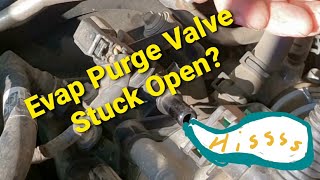
- 1-4 months: A stuck-open valve causes a slight drop in fuel economy (1-2 MPG). Occasional hard starting after refueling 🎬 Watch: This quick test confirms if your purge valve is stuck. or a slightly rough idle occurs. (MPG impact: 2-5%% · Added cost: $20-$60 in wasted fuel)
- 4-12 months: A continuously stuck-open purge valve creates a persistent rich fuel mixture. This forces the catalytic converter to work overtime, degrading its internal precious metals. (MPG impact: 3-7%% · Added cost: Risk of catalytic converter damage begins. Potential cost: $800+.)
- 12+ months: Sustained high temperatures cause a complete meltdown of the catalytic converter's internal substrate, creating a major exhaust blockage and severe loss of power. (MPG impact: 10-25%+% · Added cost: $800 - $2,500 for catalytic converter replacement, plus potential secondary sensor damage.)
Cost of Not Fixing It
- 0-1 month: Automatic emissions test failure and a potential 1-2 MPG drop in fuel economy. (Added cost: $20-$50 per month in extra fuel costs.)
- 1-6 months: A consistently rich fuel mixture begins to overheat and degrade the catalytic converter. (Added cost: Negligible, but risk of major expense is growing.)
- 6+ months: Sustained rich conditions lead to complete failure of the catalytic converter, requiring replacement. (Added cost: $800 - $2,500)
Diagnosis Steps
- Check for Technical Service Bulletins (TSBs)
Search online for TSBs related to code P0469 for your specific vehicle. Manufacturers release software updates or known fixes for common problems, saving significant diagnostic time.
Tools: Internet access (Beginner) - Scan for Codes and Review Freeze Frame Data
Use an OBD-II scanner to confirm P0469 is active and check for related EVAP codes (e.g., P0496, P0455). Review freeze frame data to see exact engine conditions when the fault occurred.
Tools: OBD-II Scanner (Beginner) - Visually Inspect Wiring, Connectors, and Hoses
Locate the purge flow sensor/valve. Inspect its electrical connector for corrosion, bent pins, or a loose fit. Follow the wiring harness for cracking or melting. Check connected vacuum hoses for cracks or blockages.
Tools: Flashlight, Mirror (Beginner) - Perform a 'Wiggle Test'
With the engine running and a scan tool displaying live data for the purge flow sensor, gently wiggle the wiring harness and connector. Wild voltage fluctuations indicate an intermittent short or open circuit.
Tools: Hands, OBD-II Scanner (Intermediate) - Test Mechanical Valve Function
Remove the purge valve. With the valve de-energized, blow through it; it must remain closed. Apply vacuum to the inlet port with the engine running and valve commanded off; it must hold vacuum. If it leaks, replace it.
Tools: Hand-held vacuum pump (optional), Your mouth (Intermediate) - [PRO TIP] Test Purge Solenoid Resistance 🎬 See this deep dive on how to test a purge solenoid.
Disconnect the purge valve's electrical connector. Measure resistance between the two pins using a multimeter set to Ohms. Most solenoids read between 12 and 130 Ohms. A reading of infinity (OL) or near zero requires replacement.
Tools: Multimeter (Advanced) - [PRO TIP] Test Sensor Voltage with a Multimeter
Backprobe the sensor's connector with a multimeter. Verify the reference wire has 5 volts and the ground wire is near 0 volts. Start the engine and monitor the signal wire. Sudden drops to 0V or spikes to 5V indicate an electrical fault.
Tools: Multimeter, Scan Tool, Backprobe Kit (Advanced) - [PRO TIP] Analyze Live Data PIDs
Monitor the 'EVAP Purge Commanded' percentage and 'Purge Flow Sensor' voltage PIDs. Command the purge valve to open at various percentages. The flow sensor reading must change smoothly and proportionally.
Tools: Advanced Bi-Directional Scan Tool (Advanced) - Perform an EVAP Smoke Test
Force low-pressure UV-dyed smoke into the EVAP system. Smoke escaping from cracks, seals, or valves pinpoints physical leaks causing erratic flow readings.
Tools: EVAP Smoke Machine, UV Light (Advanced) - [PRO TIP] Analyze Sensor Waveform with an Oscilloscope
Connect an oscilloscope to the sensor's signal and ground wires. A good sensor produces a clean DC voltage signal. Excessive noise, sharp dropouts, or jagged spikes confirm an intermittent circuit problem.
Tools: Oscilloscope (Scope) (Advanced)
When This Code Triggers (Freeze-Frame Conditions)
- Engine Coolant Temp: 170-220°F (Fully warmed up.)
- RPM: 1200-3000 RPM (Cruise / steady throttle.)
- Vehicle Speed: 45-65 mph (Steady highway driving.)
- Fuel Level: 15-85% (Not full and not empty.)
Related Codes
- P0496 — This code for 'EVAP Flow During a Non-Purge Condition' is a very common companion to P0469. It means flow is detected when the purge valve should be closed.
- P0465, P0466, P0467, P0468 — These codes are specific circuit faults for the Purge Flow Sensor, indicating general malfunction, range/performance issues, low input, and high input. They point to the same sensor and wiring as P0469.
- P0455 / P0456 — These codes indicate a large or small leak in the EVAP system. A physical leak causes abnormal flow readings, triggering the P0469 circuit code intermittently.
- P0442 — This code indicates a 'Small Leak' in the EVAP system. A small physical leak causes erratic flow that the PCM interprets as an intermittent sensor circuit fault.
Climate & Environmental Factors
- Road Salt & Humidity: Moisture and salt accelerate corrosion on the purge flow sensor's electrical connector and nearby wiring. This corrosion creates an unstable electrical connection, defining an 'intermittent' circuit fault.
- Cold Weather: Extreme cold makes rubber and plastic EVAP hoses brittle and susceptible to cracking. A small crack introduces a leak, causing erratic flow readings that trigger P0469.
- Dusty / Dirty Environments: Dust ingested by the EVAP system's fresh air intake clogs the canister vent solenoid and charcoal canister. GM issued TSB #23-NA-073 for Silverado models with this exact issue.
- High Altitude: Changes in barometric pressure at high altitudes affect the pressure differentials the EVAP system expects during self-tests, occasionally causing sensitive systems to set codes.
How to Talk to a Mechanic About This Code
Say this: "I have a P0469 code, which is for an intermittent purge flow sensor circuit. I'd like to schedule a diagnostic that includes checking the wiring and connector for corrosion or damage before assuming it's the purge valve. Please also check for any relevant TSBs for my vehicle."
This signals you understand it is an electrical/intermittent issue and want a proper diagnosis, not just a reflexive part replacement. It directs the technician to the most common and cheapest failure points first.
Avoid saying:
- 'Just fix whatever's wrong'
- 'My check engine light is on, can you look at it?'
- 'Whatever you recommend'
Questions to ask before authorizing the repair:
- What diagnostic steps did you take to isolate the cause?
- Did you find the issue in the wiring, the connector, or the sensor/valve itself?
- If you're recommending a part replacement, can you explain why it failed the electrical or mechanical test?
- What is the warranty on this specific repair and the new part?
Where to Take It: Dealer vs Independent vs Chain
- Dealer:
Recommended if your vehicle is under warranty or has a known TSB. Otherwise, it is a costly option for a common code.
Best for: Vehicles under warranty, Checking for and performing TSB software updates, Complex, model-specific EVAP systems (e.g., newer Fords with 'Blocking Valves')
Downsides: Typically the highest labor rate., May prefer to replace a larger assembly rather than perform a wiring repair. (Typical cost: +50% vs. baseline) - Independent Shop:
Best fit for most cases. A reputable independent shop has the diagnostic tools and experience to fix P0469 correctly without high dealer labor rates.
Best for: Out-of-warranty vehicles where cost is a factor., Accurate diagnosis of electrical and mechanical faults.
Downsides: Quality varies greatly; vet the shop's reviews and look for ASE certifications., May not have access to the newest manufacturer-specific TSBs or software. (Typical cost: +0% vs. baseline) - Chain Shop:
Use with caution. Acceptable if the diagnosis is straightforward. AVOID if the problem is intermittent and requires true electrical diagnosis.
Best for: Simple, obvious fixes like replacing an easily accessible purge valve.
Downsides: Technician skill varies dramatically., Less likely to perform in-depth electrical diagnosis for an 'intermittent' fault; defaults to replacing parts unnecessarily. (Typical cost: -10% vs. baseline)
When to Walk Away From the Repair
If the estimated repair cost for the P0469 fault exceeds 40-50% of your car's private-party value, pause and evaluate the car's overall health before proceeding.
- Car worth $4000, fix is $500: Fix it. The repair cost is a small fraction of the car's value.
- Car worth $12000, fix is $750: Fix it. This is a reasonable cost and well below the threshold.
- Car worth $2500, fix is $1500: Walk away. This cost suggests a rare, worst-case scenario like a failed PCM plus other components. Get a second opinion before proceeding.
What Scan Tool You Need for This Code
Minimum: A scanner that reads and graphs live data, specifically the PIDs for 'EVAP Purge Commanded' and the purge flow sensor's voltage or flow rate.
A basic $20 code reader only shows the P0469 code. It cannot show the live sensor signal, which is essential for diagnosing an 'intermittent' electrical fault during a wiggle test.
Budget: BlueDriver Pro (~$100) — Connects to your smartphone via Bluetooth to read codes, view freeze-frame data, and graph live data PIDs. Sufficient for watching the sensor signal during a wiggle test to confirm a wiring issue.
Mid-range: Foxwell NT510 Elite / Innova 5610 (~$150-250) — Adds bidirectional control. Allows you to command the purge valve to open and close directly from the scan tool, confirming if the valve responds and if the sensor reading changes accordingly.
Professional: Autel MaxiCOM MK808BT (~$450-550) — Offers full bidirectional control, access to manufacturer-specific PIDs, and runs complete EVAP system self-tests. The faster processor and larger screen make graphing live data much easier for tricky intermittent faults.
Rent vs buy: If this is a one-time diagnosis, auto parts stores have a free loaner tool program. Buy a scanner only if you plan on doing your own diagnostics more than once or twice a year.
How to Clear the Code After You Fix It
- Use an OBD-II scan tool to clear the code
- Perform a complete EVAP drive cycle
Drive cycle (~30 minutes): Start with a cold engine (sat for 8+ hours). Let it idle for 2-3 minutes. Drive at a steady speed of 45-65 mph for 10-15 minutes. Perform several slow decelerations. Repeat over several trips for the EVAP monitor to set to 'Ready'.
Readiness monitors affected: EVAP System Monitor, Catalyst monitor, O2 sensor monitor
Before emissions retest: drive at least 50 miles to fully set monitors.
Watch out for:
- Disconnecting the battery clears codes but resets all readiness monitors to 'Not Ready', guaranteeing an emissions test failure.
- The code returns if the root cause is not fixed; clearing it is not a repair.
- Failing to meet specific drive cycle conditions (fuel level, ambient temperature, cold soak) prevents the EVAP monitor from running.
Will This Fail Emissions / State Inspection?
Yes — this code typically fails an OBD-II emissions inspection.
- California: An illuminated check engine light is an automatic failure. All readiness monitors must be 'Ready', with the exception of the EVAP monitor on some vehicles. Drive 50-100 miles after a repair for monitors to reset.
- New York: A vehicle fails the mandatory OBD-II emissions inspection if the check engine light is on for an EVAP-related code like P0469.
- Texas: In the 17 counties requiring emissions testing, an illuminated check engine light is an automatic failure.
Most Commonly Affected Vehicles
- Chevrolet / GMC / Cadillac Silverado, Impala, XTS, Traverse, various (2004-2020) — Prone to a stuck-open purge valve, triggering the related P0496 code and intermittent readings for P0469. GM issued special coverage extension N232395300 for this part on some models, extending the warranty to 15 years or 150,000 miles.
- Ford F-150, EcoSport, Ranger, various (2018-2022) — Ford SSM 50306 notes this code sets without a faulty purge valve. Technicians must perform specific leak tests before replacing parts, as the newer 'Blocking Valve' often fails instead.
- Volkswagen Jetta, Golf, Sportwagen (with 1.4T Engine) (2017-2022) — The N80 purge valve frequently sticks. On the 1.4T engine, this valve sits under the intake manifold, making the repair labor-intensive and pushing costs to $250-$500.
- Hyundai / Kia Accent, Rio, various (2005-2012) — Known for canister close valve and purge control solenoid failures. A faulty vent valve causes the system to fail pressure tests, leading to various EVAP codes.
- Dodge / Ram Ram 1500 / 2500 (2005-2016) — Persistent EVAP codes require a professional smoke test to find the root cause, which is often a leak in an unexpected location.
- Subaru Outback, Forester, various (2002-2020) — Purge control valves fail from carbon buildup or stick open, directly leading to purge flow-related codes.
- Nissan Rogue, Maxima, Altima (2004-2020) — Prone to failures of both the engine bay purge valve and rear vent valve. A failing vent valve is a common cause of EVAP codes after refueling.
- Toyota Corolla, Camry, RAV4 (2000-2022) — Susceptible to related EVAP codes like P0441 from bad purge valves or cracked hoses. Diagnosis follows a similar path to P0469.
Manufacturer-Specific Notes
- General Motors: This fault is almost always a bad purge valve stuck open. GM issued Special Coverage N232395300 for faulty purge valves on certain 2019-2020 models (extends warranty to 15yr/150k miles) and N232395310 for purge pumps on 2020-2021 models.
- Ford: Ford SSM 50306 states many canister purge valves returned under warranty work correctly. Technicians must perform specific scan tool tests before replacing the valve, as the issue is often the newer 'Blocking Valve'.
- Volkswagen: On the 1.4T engine, a P0496 code guarantees a failed N80 purge valve. Per VW Tech Tip 01-19-06TT, a smoke test will not find this fault; you must check for vacuum at the valve's inlet port at idle.
- Various Asian Imports: The definition for P0469 on some Asian vehicles specifies 'EVAP System High Purge Flow,' pointing directly to a valve stuck open rather than an intermittent electrical fault.
Real Owner Stories
2019 Chevy Traverse with P0496 & rough idle
The check engine light illuminated, and the car ran rough and stalled at idle. The owner received a notice from GM about a potential purge valve issue.
Outcome: The issue fell under GM's Special Coverage N232395300, extending the purge valve warranty to 15 years or 150,000 miles. The dealer replaced the part for free.
Lesson: Always check for recalls and special coverage bulletins before paying for repairs. A free dealer repair saves hundreds.
Ford EcoSport with P0496 and hard start after fueling
The car struggled to start after filling the gas tank. The check engine light revealed code P0496, pointing to a purge valve issue.
Outcome: The owner replaced just the solenoid portion of the purge valve assembly using a $13 Bosch part, resolving the hard starting and clearing the code.
Lesson: Do not confuse the engine bay purge valve with the rear vent valve. Confirm the exact part location before buying replacements.
2020 Lincoln Corsair 2.0L with P0469 and hard starts
The car became difficult to start after refueling, and the scanner showed P0469.
Outcome: The owner paused to seek confirmation on the correct part number before proceeding, avoiding a potentially incorrect installation.
Lesson: Call a dealership parts department with your VIN to get the exact OEM part number before ordering aftermarket replacements.
How to Prevent This Code From Triggering
- Stop fueling at the first click (Every fill-up) — Consistently overfilling the gas tank forces liquid gasoline into the charcoal canister. This saturates the charcoal, ruining its ability to absorb vapors and leading to costly canister replacement.
- Inspect and clean electrical connectors (Every 30,000 miles or during other engine maintenance) — Corrosion causes the intermittent circuit fault. Disconnecting the purge valve connector, cleaning the pins, and applying dielectric grease prevents moisture and road salt from causing a bad connection.
- Regularly inspect EVAP hoses (Annually, especially in harsh climates) — Rubber and plastic hoses become brittle over time. A quick visual inspection for cracking or loose fittings catches potential leaks before they trigger a code.
- Check your gas cap seal (Every few months) — A worn or cracked gas cap seal causes EVAP leak codes. Ensuring it is clean and seals tightly is a simple, free preventive measure for the whole system.
Frequently Asked Questions
What are the most common mistakes when diagnosing P0469?
The most common mistake is replacing parts without proper diagnosis. Many immediately replace the purge valve or gas cap when the actual issue is a corroded connector or a known software update. Always test the electrical circuit first.
Can a bad gas cap cause a P0469 code?
A loose gas cap causes EVAP leak codes (like P0455), but rarely causes a P0469 circuit code. P0469 points to an electrical signal integrity issue with the sensor, not a system-wide pressure leak. Checking the gas cap remains a fast, free first step.
How much does it cost to diagnose this code?
A professional diagnostic fee to accurately identify a P0469 code ranges from $100 to $165. This service prevents the unnecessary cost of replacing perfectly good parts.
Where is the purge flow sensor located?
Location varies by vehicle. You will usually find it mounted on or near the engine's intake manifold, featuring two hoses and an electrical connector. On some vehicles, it sits near the charcoal canister underneath the car.
What is the difference between a purge valve and a vent valve?
The purge valve (normally closed) sits in the engine bay and opens to draw fuel vapors into the engine. The vent valve (normally open) sits near the charcoal canister and closes to seal the EVAP system for pressure testing.
Will this code go away on its own?
The Check Engine Light turns off temporarily if the computer receives a stable reading, but the code remains stored. The light will return until you permanently fix the underlying electrical or mechanical problem.
Why does my car run rough or have trouble starting after I get gas?
This indicates a purge valve stuck open. When you refuel, displaced fuel vapor pushes directly into the engine instead of the canister. This creates a rich fuel mixture that causes hard starting and rough idling.
Can a weak battery cause EVAP codes?
Yes, a weak battery causes various electrical issues, including EVAP codes. Low system voltage forces modules to receive erratic sensor data, triggering intermittent circuit codes like P0469. Test your battery if you experience multiple electrical glitches.
Key Takeaways
- A faulty EVAP purge valve or its integrated flow sensor causes over 70% of P0469 codes, making it the primary target for diagnosis.
- An active P0469 code triggers an automatic OBD-II emissions test failure, preventing vehicle registration renewal in states that require testing.
- Inspect the purge valve's electrical connector for green or white corrosion before buying parts, as a simple $10 wiring repair often resolves this intermittent circuit fault.
- Stop fueling your vehicle at the gas pump's first click to prevent liquid gasoline from saturating the charcoal canister, which leads to a $300+ replacement.
Helpful Videos

The information in this article is provided for general reference and educational purposes only. Vehicle specifications, procedures, and part compatibility can vary by production date, trim level, and region. Always consult your vehicle's factory service manual and verify part numbers before purchasing or performing repairs. Safety-critical components such as airbags, seat belts, and braking systems should be installed by a qualified professional.
- 🎬 Helpful Videos
- What Does P0469 Mean?
- Can I Drive With P0469?
- Common Causes
- Symptoms
- Diagnostic Flowchart
- Common Fixes & Costs
- DIY vs Professional
- Used vs. New Parts: Buying Guide
- What Happens If You Wait — Timeline
- Cost of Not Fixing It
- Diagnosis Steps
- When This Code Triggers (Freeze-Frame Conditions)
- Related Codes
- Climate & Environmental Factors
- How to Talk to a Mechanic About This Code
- Where to Take It: Dealer vs Independent vs Chain
- When to Walk Away From the Repair
- What Scan Tool You Need for This Code
- How to Clear the Code After You Fix It
- Will This Fail Emissions / State Inspection?
- Most Commonly Affected Vehicles
- Manufacturer-Specific Notes
- Real Owner Stories
- 2019 Chevy Traverse with P0496 & rough idle
- Ford EcoSport with P0496 and hard start after fueling
- 2020 Lincoln Corsair 2.0L with P0469 and hard starts
- How to Prevent This Code From Triggering
- Frequently Asked Questions
- What are the most common mistakes when diagnosing P0469?
- Can a bad gas cap cause a P0469 code?
- How much does it cost to diagnose this code?
- Where is the purge flow sensor located?
- What is the difference between a purge valve and a vent valve?
- Will this code go away on its own?
- Why does my car run rough or have trouble starting after I get gas?
- Can a weak battery cause EVAP codes?
- Key Takeaways
- 🎟️ Get 5% Off