

P0463 on 2016-2021 Volkswagen Golf: Causes and Fixes for Fuel Level Sensor Faults
P0463 on a VW Golf means the fuel gauge is unreliable because of a high voltage signal from the fuel level sensor. The most common fix is replacing the fuel level sending unit, which is part of the in-tank fuel pump assembly. Expect to pay $250-$450 for the part.
- P0463 means your Golf's fuel gauge is not working correctly due to an electrical fault in the fuel level sensor circuit.
- The most likely cause is a failed fuel level sending unit, which is located inside the fuel tank and typically accessed from under the rear seat.
- You can still drive the car, but you risk running out of gas. It's best to track your mileage using the trip odometer until the repair is made.
- The repair involves replacing the sending unit, which is often part of the main fuel pump assembly. This is a manageable DIY job for those comfortable working with fuel system components.
What's Unique About the 2016-2021 Volkswagen GOLF

On the Mk7 and Mk7.5 Golf platform, the fuel level sensor is an integrated part of the fuel pump assembly located inside the fuel tank. Access is typically under the rear seat, making replacement a moderately difficult DIY job. The provided NHTSA technical service bulletins (TSBs) confirm that this code is a known issue for VW, often appearing alongside code P2068, which points to a fault in the secondary fuel level sensor ('B' circuit) on all-wheel-drive models like the Golf R and Alltrack. [VIN4APIN20201021] This suggests a potential issue with the overall fuel sending unit assembly or related wiring.
Diagnostic Flowchart
Tap your situation to follow the diagnostic path that matches what you're seeing on this vehicle.
Generation note: This range covers the Volkswagen Golf Mk7 (2016-2017) and the facelifted Mk7.5 (2018-2021). Both generations are built on the same MQB platform, and their fuel systems are fundamentally identical, so the causes and repair procedures for P0463 are the same across this year range. A known difference is the security code required to access instrument cluster adaptations via VCDS/OBDeleven, with pre-2018 models often using '20103' and 2018+ models using '47115'.
Symptoms You May Notice
- Check Engine Light is on.
- Fuel gauge reads full, regardless of the actual fuel level.
- Fuel gauge reads empty or fluctuates erratically.
- Low fuel warning light may be constantly on or flashing. 🎬 Watch: A quick overview of P0463 causes and common fixes.
- In some cases, the engine may stall if the ECU cannot determine the fuel level, though this is less common.
- Replacing the instrument cluster without first testing the fuel level sensor and wiring.
- Replacing the entire fuel pump when only the sending unit has failed (though they are often sold as one assembly).
- Assuming the issue is with the primary pump on an AWD model when the P2068 code indicates the secondary (left side) sender is the one with the fault.
Most Likely Causes

- Faulty Fuel Level Sending Unit 🔴 High Probability The sending unit contains a float and a variable resistor that can wear out or fail over time, causing incorrect voltage readings. Contaminants in the fuel can also damage the sensitive resistor contacts, leading to a short or open circuit that the PCM interprets as a high input signal.
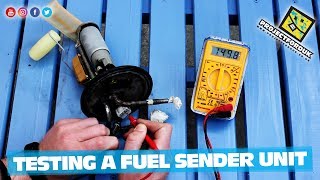
How to confirm: Access the fuel pump assembly under the rear seat. Disconnect the sensor and measure its resistance with a multimeter while manually moving the float arm. The resistance should change smoothly. 🎬 See how to test a fuel sender unit with a multimeter. For the FWD Golf's primary sensor (part of the pump assembly), the expected resistance range is approximately 53 Ohms at full and 291 Ohms at empty. If the reading jumps, is infinite (open), or zero (shorted), the unit is bad.
Typical fix: Replace the fuel level sensor. On most VW Golf models, this sensor is integrated with the fuel pump module and is replaced as a single assembly.
Est. part cost: $250-$450 - Damaged Wiring or Corroded Connector 🟡 Medium Probability The wiring harness leading to the fuel tank can be susceptible to damage or corrosion, especially at the connector on top of the fuel pump assembly which is located under the rear seat and can be exposed to moisture or physical stress.
How to confirm: Visually inspect the wiring harness and the connector on top of the fuel tank for any signs of chafing, breaks, or green/white corrosion. Use a multimeter to check for continuity and proper reference voltage (typically 5V) and ground at the connector.
Typical fix: Repair the damaged section of wire or clean/replace the corroded connector.
Est. part cost: $10-$50 - Stuck Fuel Level Float ⚪ Low Probability The float arm can potentially get caught or stuck in the full position due to debris in the tank or slight deformation of internal components, though this is less common than electrical failure. This is more likely if the fuel tank has been damaged by an impact.
How to confirm: After removing the fuel pump assembly, visually inspect the float and its arm to see if it moves freely through its full range of motion without binding.
Typical fix: Free the stuck float. If the arm is bent or damaged, the entire sending unit assembly will likely need to be replaced.
Est. part cost: $0-$450
Rare But Worth Checking
- Faulty Instrument Cluster: While rare, the instrument cluster itself can fail, leading to an incorrect fuel gauge reading. This is usually accompanied by other gauge or display problems and should only be considered after the sensor and wiring have been ruled out.
- Faulty Powertrain Control Module (PCM): A failure within the PCM is extremely unlikely but possible. This is a last resort diagnosis and should be performed by a professional after all other possibilities have been exhausted.
Diagnosis Steps

- Scan the vehicle's computer for P0463 and any other related codes, like P2068 or B103E1B. [2, 10, VIN4APIN20201021]
- Check the fuel gauge. Does it read full, empty, or fluctuate? Note the behavior.
- Gain access to the top of the fuel tank, usually by removing the rear seat cushion.
- Visually inspect the electrical connector on top of the fuel pump assembly for corrosion or damage.
- With the key on, disconnect the connector and check for the correct reference voltage (typically 5V) and ground at the connector.
- If wiring seems okay, remove the fuel pump/sending unit assembly from the tank. Be careful, as the system may be pressurized.
- Test the fuel level sensor by measuring its resistance while moving the float arm up and down. The resistance should change smoothly, from ~291 Ohms (empty) to ~53 Ohms (full) for the primary FWD sensor. Any dead spots or open/short readings indicate a failure.
- If the sensor fails the resistance test, it needs to be replaced. If the sensor tests good, the problem is likely in the wiring or, rarely, the instrument cluster or PCM.
Parts You'll Likely Need
- Fuel Pump Module Assembly (FWD)
(OEM #5Q0919051BH, 5Q0919051BM)— For Front-Wheel Drive models, this assembly contains the fuel pump and the primary fuel level sensor ('A' circuit). It is the most common failure point for P0463. The internal variable resistor wears out, causing the high circuit voltage.
Trusted brands: Genuine VW, Bosch, VDO, Vemo
OEM price range: $300-$450
Aftermarket price range: $200-$350 - Fuel Level Sensor / Sending Unit (AWD, Left Side)
(OEM #5Q0919673AC, 5Q0919673H)— For All-Wheel Drive models (Golf R, Alltrack) that also show a P2068 code, this is the secondary ('B' circuit) sensor on the left side of the saddle tank. It often fails in a similar manner to the primary sensor.
Trusted brands: Genuine VW/Audi
OEM price range: $150-$250
Aftermarket price range: $100-$180
Related Codes That Often Appear With This One
- P2068 — P2068 is 'Fuel Level Sensor 'B' Circuit High'. VWs with all-wheel drive (like the Golf R or Alltrack) have a saddle-style tank with two fuel level sensors to measure fuel on both sides. Sensor 'A' (P0463) is part of the main fuel pump on the right side, while Sensor 'B' (P2068) is a separate sender on the left side. The appearance of both codes is mentioned in VW TSBs and strongly points to an issue affecting the entire fuel sending system, though often one sensor fails first. [VIN4APIN20201021]
- P0461 — This code indicates 'Fuel Level Sensor 'A' Circuit Range/Performance'. It can appear alongside P0463 if the sensor's signal is erratic and not just stuck high, indicating intermittent connection issues or a failing resistor track on the sender.
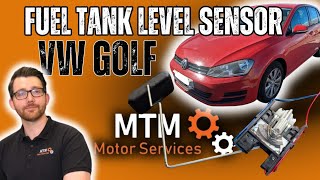
- B103E1B — This is a VW-specific Body Control Module (BCM) or Instrument Cluster code for 'Fuel level sensor 1 Resistance too high'. It is the direct companion to the generic P0463 code and will often be found when scanning with a VW-specific tool like VCDS. 🎬 Watch this step-by-step walkthrough for replacing the Golf fuel sensor.
Technical Service Bulletins (TSBs) & Recalls
- VIN4APIN20201021: Notes customer complaints of MIL-on with P0463 and P2068.
- VIN4APIN20221025: Lists P0463 as a possible fault code stored in ECM memory.
- VIN4APIN20201112: Also notes customer complaints of MIL-on with P0463 and P2068.
Platform-Specific Known Issues
- Volkswagen has issued multiple Technical Service Bulletins (TSBs) that mention P0463 as a potential fault code on this platform, often in conjunction with P2068, indicating a known pattern of fuel level sending unit issues. [VIN4APIN20201021, VIN4APIN20221025, VIN4APIN20201112]
- On AWD models (Golf R, Alltrack), the saddle-shaped fuel tank requires two level sensors. The primary sensor (A) is with the pump on the right, and the secondary sensor (B) is on the left. It is common for one or both to fail, throwing P0463 and/or P2068.
Mechanic-Grade Diagnostic Values
- Primary Fuel Level Sensor (FWD) Resistance — expected: Approximately 53 Ω when full, 291 Ω when empty. The reading should be smooth when moving the float.. Failure: Readings are infinite (open circuit), zero, or jump erratically.
- VCDS Live Data - Fuel Level — expected: In the Instrument Cluster (Address 17), measuring blocks will show fuel level in liters for each sensor.. Failure: The value for Sensor 1 (for P0463) will be static or show an illogical value that doesn't change when fuel is added.
Hidden / Shadow Codes Worth Checking
- B103E1B: Fuel level sensor 1: Resistance too high. This is a manufacturer-specific code stored in the Instrument Cluster (17) or Body Control Module (09) that directly corresponds to the generic OBD-II code P0463. (see via A VW-specific scan tool like VCDS (VAG-COM) or OBDeleven is required. Generic OBD-II readers may not see this code.)
Scan Tool Commands That Help

- VCDS or OBDeleven: Instrument Cluster (17) -> Measuring Blocks / Advanced Measuring Values — Use this to view the live fuel level readings in liters from Sensor 1 and Sensor 2 (if AWD). This helps confirm if the computer is receiving an incorrect, static value from the sensor before physically removing it.
- VCDS or OBDeleven: Instrument Cluster (17) -> Adaptation -> Offset for tank calibration values — This is NOT for fixing a P0463 code, but for fine-tuning the gauge's accuracy after a repair or if it's slightly off. It requires a security access code (e.g., 20103 for pre-MY18, 47115 for MY18+). Attempting to fix a hardware fault (P0463) with this adaptation will not work.
Wiring & Ground Locations
- Fuel Pump Connector — On top of the fuel pump assembly, accessible by removing the rear passenger-side seat cushion and a black circular cover.. This is the primary connection point for the fuel level sensor. Corrosion or damage here can cause an open or short, leading to the 'Circuit High' fault. The positive lead is typically the pin closest to the fuel feed line.
- Main Engine Bay Ground Point — On the bulkhead (firewall) behind the battery, typically a stud with multiple brown wires attached.. While the fuel pump has a local ground, a poor main vehicle ground can cause floating voltages and unpredictable electrical issues across multiple systems, including the instrument cluster and sensor readings. Checking this point is a good practice for any electrical fault.
Real Owner Repair Stories
- MHH Auto forum user (Volkswagen Golf Mk7 (year not specified)) — Fuel gauge always showed empty, and a VCDS scan revealed code B103E1B (Resistance too high).
❌ Tried (didn't work) Checking wiring between the sensor and the instrument cluster (wiring was okay)., Performing an actuator test on the dash gauge (it worked fine).
✅ What actually fixed it The user replaced the fuel gauge sender unit, but the problem persisted. They then swapped in a used instrument cluster, and the gauge started working correctly, indicating the original instrument cluster was the source of the fault.
OEM Part Supersession History
5Q0919051N→5Q0919051BH— Standard part revision by the manufacturer for the FWD fuel pump assembly.5Q0919673AC→5Q0919673H— Standard part revision by the manufacturer for the AWD left-side fuel sending unit.
Model Year Variations Within This Range
- 2016-2017 vs 2018-2021: The security access code required to enter 'Adaptation' in the Instrument Cluster (17) with tools like VCDS or OBDeleven changed. Pre-facelift models (before MY2018) typically use '20103', while facelift models (MY2018+) often use '47115'. This is critical for performing any gauge calibration adjustments.
Helpful Videos

Used OEM Parts in Stock


New Aftermarket Parts Available

The information in this article is provided for general reference and educational purposes only. Vehicle specifications, procedures, and part compatibility can vary by production date, trim level, and region. Always consult your vehicle's factory service manual and verify part numbers before purchasing or performing repairs. Safety-critical components such as airbags, seat belts, and braking systems should be installed by a qualified professional.
- Volkswagen GOLF:
- 🎬 Helpful Videos
- 🛍️ Shop This Part
- What's Unique About the 2016-2021 Volkswagen GOLF
- Diagnostic Flowchart
- Symptoms You May Notice
- Most Likely Causes
- Rare But Worth Checking
- Diagnosis Steps
- Parts You'll Likely Need
- Related Codes That Often Appear With This One
- Technical Service Bulletins (TSBs) & Recalls
- Platform-Specific Known Issues
- Mechanic-Grade Diagnostic Values
- Hidden / Shadow Codes Worth Checking
- Scan Tool Commands That Help
- Wiring & Ground Locations
- Real Owner Repair Stories
- OEM Part Supersession History
- Model Year Variations Within This Range
- 🎟️ Get 5% Off