

P0463 on 2016-2017 Nissan Quest: Fuel Level Sensor Circuit High Input Causes and Fixes
On a 2016-2017 Nissan Quest with the 3.5L V6 engine, code P0463 is almost always caused by a failed fuel level sensor (Part No. 25060-1JA0A) inside the gas tank. Your fuel gauge will be inaccurate, likely stuck on Full. A critical Nissan Technical Service Bulletin (NTB22-026) confirms the sensor can be replaced separately from the entire fuel pump assembly, saving over a thousand dollars in parts cost.
- P0463 on your Quest means the fuel gauge is not to be trusted.
- The most likely culprit is a failed fuel level sensor, a known issue for this van.
- You can save over $1,000 by replacing only the sensor (Part No. 25060-1JA0A), not the whole fuel pump assembly, as per Nissan TSB NTB22-026.
- The repair can be done by a confident DIYer in an afternoon, as the sensor is accessible through a panel under the rear seat without dropping the fuel tank.
What's Unique About the 2016-2017 Nissan QUEST
The 2016-2017 Nissan Quest belongs to the fourth generation (RE52), which shares its D platform with other Nissans like the Pathfinder and Murano. This issue is common enough across these platforms that Nissan issued Technical Service Bulletin NTB22-026. The key takeaway from this TSB is that the fuel level sensor is a known failure point and, importantly, it can be replaced separately from the much more expensive fuel pump assembly. This is a crucial distinction, as replacing the entire assembly can cost over $1,500, whereas the sensor alone is a fraction of that price.
Diagnostic Flowchart
Tap your situation to follow the diagnostic path that matches what you're seeing on this vehicle.
Symptoms You May Notice
- Check Engine Light is on.
- Inaccurate fuel gauge (may be stuck on Full, Empty, or fluctuate wildly).
- Low fuel warning light may be on or flashing, even with a full tank.
- Fuel gauge drops to Empty after a fill-up and may or may not recover after some driving.
- Replacing the entire fuel pump assembly when only the sensor is needed. The TSB specifically notes that the sensor can be replaced separately and warranty claims for replacing the whole assembly for this issue will be charged back.
- Replacing the instrument cluster before thoroughly testing the sensor and its circuit.
Most Likely Causes
- Faulty Fuel Level Sensor (Sending Unit) 🔴 High Probability This is a known issue confirmed by Nissan TSB NTB22-026, which applies to many Nissan models from this era. The sensor's internal variable resistor wears out or develops an open spot, causing an open circuit which the PCM reads as high voltage.
How to confirm: After accessing the sensor, test its resistance with a multimeter while moving the float arm. The resistance should change smoothly from approximately 4-6 Ohms (full) to 73-85 Ohms (empty). An infinite (OL) reading indicates an open circuit and a failed sensor, which is the typical cause for P0463.
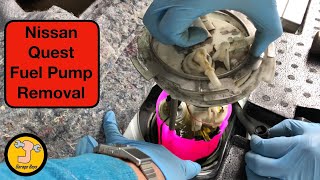
Typical fix: Replace the fuel level sensor. The sensor is located on the fuel pump module inside the fuel tank. The Quest has an access panel under the rear seats, avoiding the need to drop the fuel tank. 🎬 See how to access and remove the Quest fuel pump.
Est. part cost: $100-$200 - Damaged Wiring or Corroded Connectors 🟡 Medium Probability The wiring and connector on top of the fuel tank are exposed to some moisture and road debris, which can lead to corrosion or damage over time, causing an open or short in the circuit.
How to confirm: Visually inspect the wiring harness and connector leading to the fuel pump assembly for any signs of corrosion, breaks, or loose pins. Use a multimeter to check for continuity and proper voltage at the connector. A forum user on GMTNation noted that even when connectors 'look good', they can have internal faults.
Typical fix: Repair or replace the damaged section of the wiring harness or clean/replace the corroded connector.
Est. part cost: $10-$50 - Poor Ground Connection ⚪ Low Probability
How to confirm: Locate the fuel pump/tank ground strap or wire and inspect it for corrosion or looseness. Test the resistance between the sensor's ground pin and the chassis; it should be very low, ideally less than 1 ohm.
Typical fix: Clean the grounding point on the chassis and re-secure the ground wire/strap.
Est. part cost: $1-$5
Rare But Worth Checking
- Faulty Instrument Cluster: This is very rare. The instrument cluster can fail internally, causing it to misinterpret the signal from the fuel level sensor. This would typically be accompanied by other gauge or display issues.
- Faulty Powertrain Control Module (PCM): This is extremely unlikely and should only be considered after all other possibilities, including wiring and the sensor itself, have been exhaustively ruled out. A faulty PCM would likely present other, more serious codes and drivability issues.
Diagnosis Steps
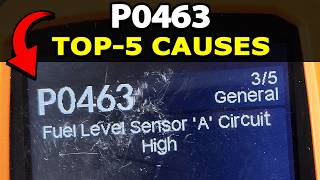
- Confirm the P0463 code is present using an OBD-II scanner. 🎬 Watch: A professional guide to diagnosing the P0463 engine code.
- Check for any other related fuel system codes (P0460, P0461, P0462).
- Gain access to the fuel pump assembly via the access panel under the rear driver's side passenger seat.
- Disconnect the electrical connector and inspect it for any corrosion or damage.
- With the key on, use a multimeter to check for the correct reference voltage being sent to the sensor (typically 5V).
- If voltage is correct, remove the fuel pump assembly to access the fuel level sensor. You may need a special tool to remove the lock ring, though some attempt it with a hammer and screwdriver (not recommended due to spark risk).
- Test the resistance of the fuel level sensor by moving the float arm up and down. The reading should be smooth and within the manufacturer's specified range (approx. 4-85 Ohms). An open circuit (infinite resistance) confirms a failed sensor.
- If the sensor tests good, thoroughly inspect the wiring between the fuel tank and the PCM for any breaks, shorts, or high resistance.
Parts You'll Likely Need
- Fuel Level Sensor
(OEM #25060-1JA0A)— This is the most common cause of code P0463 on this vehicle, as confirmed by Nissan's own service bulletin. Multiple OEM parts dealers confirm this part number fits the 2011-2017 Quest.
Trusted brands: Nissan (OEM), Hitachi, Delphi, Dorman
OEM price range: $120-$175
Aftermarket price range: $90-$140
Related Codes That Often Appear With This One
- P0460 — This code for 'Fuel Level Sensor Circuit / Slosh' indicates general irrational sensor behavior and is often set alongside other fuel level sensor codes as the component fails. It is also mentioned in TSB NTB22-026.
- P0461 — This code for 'Fuel Level Sensor Circuit Range/Performance' points to the sensor signal being out of the expected range, which is a common precursor or companion to a P0463 fault. It is also mentioned in TSB NTB22-026.
- P0462 — This code for 'Fuel Level Sensor Circuit Low Input' is the opposite of P0463. Seeing both codes could indicate an intermittent wiring problem or a sensor that is failing erratically. It is also mentioned in TSB NTB22-026.
Technical Service Bulletins (TSBs) & Recalls
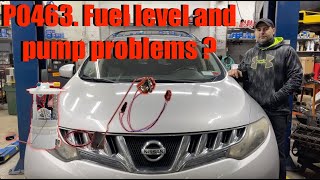
- NTB22-026: Published April 5, 2022, this TSB applies to a wide range of 2016-2022 Nissan vehicles. It states that if codes P0460, P0461, P0462, or P0463 are present due to a faulty sensor, only the sensor should be replaced, not the entire fuel pump assembly. 🎬 Watch this walkthrough on replacing just the fuel sender unit. It warns that warranty claims for the full assembly will be charged back.
Platform-Specific Known Issues
- Nissan Technical Service Bulletin NTB22-026 explicitly covers P0463 and advises that the fuel level sensor can be replaced separately from the fuel pump assembly. Ignoring this TSB and replacing the entire assembly can increase the repair cost from ~$400 to over $1,700 according to some estimates.
Mechanic-Grade Diagnostic Values
- Fuel Level Sensor Resistance — expected: Smoothly sweeps between ~4.3-6.3 Ohms (Full) and ~73.3-84.8 Ohms (Empty). Half tank should read ~27.7-34.3 Ohms.. Failure: A reading of infinite resistance (OL) indicates an open circuit. Readings that are stuck, jump erratically, or are outside the specified range indicate a failed sensor.
Scan Tool Commands That Help
- On-Board Diagnostics (No Tool Required): Instrument Cluster Self-Diagnostic Test — Use this test to verify if the instrument cluster gauges are mechanically functional. If the fuel gauge needle performs a full sweep during the test, it confirms the gauge motor is working, pointing the diagnosis back towards the sensor, wiring, or PCM. The procedure typically involves holding the trip reset button while turning the ignition to 'ON', then pressing it again to initiate the test.
Wiring & Ground Locations
- Fuel Tank Ground Strap — A wire or strap connecting the metal fuel tank or the fuel pump assembly directly to the vehicle's chassis/body.. A corroded, loose, or broken ground strap is a common cause of high resistance in the fuel level sensor circuit. This high resistance can be interpreted by the PCM as a high voltage signal, directly triggering a P0463 code. Thoroughly inspecting and cleaning this connection is a critical diagnostic step.
Real Owner Repair Stories
- YouTube channel 'sdp', video 'Fuel Gauge Fix P0463 WHAT?!!' (Nissan with a two-sensor system, similar to Quest platform relatives.) — P0463 code, inaccurate fuel gauge.
❌ Tried (didn't work) Initial diagnosis pointed to sensor 'A'.
✅ What actually fixed it The user removed the fuel level sensor and inspected it under a microscope, discovering the resistor strips were visibly 'burned up' and 'swollen'. This physical damage created the open/high resistance condition. Replacing the faulty sensor assembly resolved the code. - YouTube channel 'Car Problems Urdu', video 'Nissan Fuel Gauge Not Reading Accurately' (Nissan vehicle with under-seat fuel pump access.) — Fuel gauge not working, warning light on.
✅ What actually fixed it Upon removing the fuel sending unit, the technician discovered that one side of the plastic arm/bracket holding the float assembly was broken. This caused the float to sit at an incorrect angle, providing a false reading. The technician repaired the broken plastic piece, re-secured the float arm, and reinstalled the unit, which fixed the gauge reading.
Helpful Videos
We Have This Part in Stock


The information in this article is provided for general reference and educational purposes only. Vehicle specifications, procedures, and part compatibility can vary by production date, trim level, and region. Always consult your vehicle's factory service manual and verify part numbers before purchasing or performing repairs. Safety-critical components such as airbags, seat belts, and braking systems should be installed by a qualified professional.
- Nissan QUEST:
- 🎬 Helpful Videos
- 🛍️ Shop This Part
- What's Unique About the 2016-2017 Nissan QUEST
- Diagnostic Flowchart
- Symptoms You May Notice
- Most Likely Causes
- Rare But Worth Checking
- Diagnosis Steps
- Parts You'll Likely Need
- Related Codes That Often Appear With This One
- Technical Service Bulletins (TSBs) & Recalls
- Platform-Specific Known Issues
- Mechanic-Grade Diagnostic Values
- Scan Tool Commands That Help
- Wiring & Ground Locations
- Real Owner Repair Stories
- 🎟️ Get 5% Off