

P0463 on 2016-2018 Nissan NV200: Fuel Level Sensor Circuit High Causes and Fixes
On a 2016-2018 Nissan NV200, code P0463 is almost always caused by a failed fuel level sensor. Nissan issued a Technical Service Bulletin (NTB22-026) confirming the sensor can be replaced separately from the entire fuel pump assembly, which saves significant money. The repair is aided by a factory access panel in the cargo floor. Expect the part to cost between $80 and $160.
- P0463 on your NV200 means the fuel level sensor has almost certainly failed.
- Your fuel gauge will not be reliable; track your mileage to avoid running out of gas until it's fixed.
- You do NOT need to replace the entire fuel pump assembly. Nissan has specified that only the sensor (a much cheaper part) should be replaced.
- The repair can often be done through an access panel in the cargo area, making it a manageable DIY job for those with intermediate skills.
What's Unique About the 2016-2018 Nissan NV200
For the NV200, Nissan has officially acknowledged this common issue through Technical Service Bulletin NTB22-026. The bulletin specifically instructs technicians to replace only the faulty fuel level sensor rather than the entire, more expensive fuel pump assembly, and warns that warranty claims for the full assembly will be rejected. This is a key piece of information that can save owners hundreds of dollars in parts and prevents misdiagnosis. Furthermore, most NV200s have a dedicated access panel in the cargo floor, allowing for sensor replacement without the significant labor of dropping the fuel tank.
Diagnostic Flowchart
Tap your situation to follow the diagnostic path that matches what you're seeing on this vehicle.
Symptoms You May Notice
- Check Engine Light is on
- Fuel gauge is stuck on full or empty
- Fuel gauge fluctuates erratically
- Low fuel warning light may be on constantly
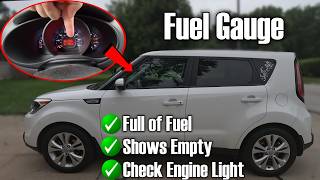
- Difficulty predicting fuel consumption. 🎬 Watch: Understanding the causes and fixes for the P0463 code.
- Replacing the entire fuel pump assembly. The provided TSB NTB22-026 specifically warns against this, as only the fuel level sensor is typically at fault and can be replaced separately. Nissan states that warranty claims for the entire assembly for this code will be charged back.
Most Likely Causes
- Faulty Fuel Level Sensor (Sending Unit) 🔴 High Probability This is a known failure point acknowledged by Nissan in TSB NTB22-026. The internal variable resistor within the sensor wears out or breaks, creating an open circuit condition that the PCM reads as high voltage.
How to confirm: Access the fuel pump connector and measure the resistance across the sensor's pins. An infinite resistance reading (OL) indicates a failed, open sensor. A good Nissan sensor should read approximately 4-6 Ohms when the float is in the 'Full' position and 80-85 Ohms when in the 'Empty' position, with the resistance changing smoothly as the float arm moves. 🎬 See how to test and replace the fuel level sensor. A scan tool will also show a constant high voltage (near 5V) from the sensor.
Typical fix: Replace the fuel level sensor. It is located on the fuel pump assembly inside the fuel tank and can be accessed via a panel in the cargo floor.
Est. part cost: $80-$160 - Damaged Wiring or Connector 🟡 Medium Probability The wiring harness leading to the fuel tank is exposed to road debris and moisture, which can lead to corrosion or physical damage over time, causing an open circuit. A recall (13V-521 / PM374) for an incorrectly routed Fuel Tank Temperature sensor harness highlights the potential for wiring issues in this same area.
How to confirm: Visually inspect the wiring harness and the connector on top of the fuel tank for any signs of corrosion (green/white powder), chafing, or broken wires. Perform a continuity test on the signal and ground wires from the PCM to the sensor connector.
Typical fix: Repair the damaged section of the wiring harness or replace the corroded connector. A pigtail connector kit is often available for this repair.
Est. part cost: $10-$50 - Poor Ground Connection ⚪ Low Probability The fuel tank's chassis ground strap can corrode or become loose, creating high resistance in the circuit. Body ground points (like M57 and M69 mentioned in wiring diagrams) can also be a source of failure.
How to confirm: Locate the ground strap from the fuel tank/pump assembly to the vehicle's frame. Check for corrosion or looseness. Measure the resistance between the sensor's ground pin and a clean chassis ground; it should be very low, ideally less than 5 ohms.
Typical fix: Clean the contact points and re-secure the ground strap or replace the strap if it's heavily corroded.
Est. part cost: $5-$20
Rare But Worth Checking
- Instrument Cluster or PCM Fault: This is extremely rare. Before considering replacing these expensive components, all other possibilities, especially the sensor and wiring, must be exhaustively ruled out. Some diagnostic procedures include a gauge sweep test to check cluster functionality.
Diagnosis Steps
- Read the trouble codes with an OBD-II scanner and confirm P0463 is present. Note any other related codes.
- Observe the fuel gauge with the key on. Note if it reads full, empty, or behaves erratically.
- Use a scan tool with live data to monitor the 'Fuel Level Sensor' voltage. A reading stuck near 5 volts confirms the 'High Input' condition.
- Gain access to the fuel pump assembly connector. On the NV200, this is under an access panel in the cargo floor, typically behind the passenger or driver's seat, covered by a metal plate.
- Inspect the connector and nearby wiring for any visible damage, corrosion, or loose pins.
- With the connector unplugged and key on, verify that the correct reference voltage and a good ground are present at the harness-side of the connector.
- Using a multimeter set to Ohms, measure the resistance across the two pins for the fuel level sensor on the pump assembly side. An open circuit (OL or infinite resistance) confirms a failed sensor. A good sensor should read between ~4 and ~85 ohms depending on float position.
- If the sensor tests good, perform a continuity test on the signal and ground wires between the pump connector and the PCM to rule out a wiring issue.
Parts You'll Likely Need
- Fuel Level Sensor
(OEM #25060-9SM0A)— This is the most common failure point for code P0463 on this vehicle, as confirmed by Nissan's TSB. It fails internally, causing an open circuit. This part number supersedes 25060-3LM0A and 25060-3LM0B.
Trusted brands: Nissan (OEM), Bosch, Delphi
OEM price range: $105-$150
Aftermarket price range: $75-$120
Related Codes That Often Appear With This One
- P0461 — This code for 'Fuel Level Sensor Circuit Range/Performance' can be triggered by the same erratic signals from a failing sensor that cause P0463.
- P0462 — This code for 'Fuel Level Sensor Circuit Low Input' might appear intermittently if a damaged wire is shorting to ground as well as having an open circuit condition.
- P0460 — This code for 'Fuel Level Sensor Circuit Malfunction' is a general fault that can accompany the more specific P0463 code, and is also mentioned in TSB NTB22-026.
Technical Service Bulletins (TSBs) & Recalls
- NTB22-026: States that for fuel level issues resulting in codes P0460, P0461, P0462, or P0463, the fuel level sensor can be replaced separately, and warranty claims for replacing the entire fuel pump assembly will be scrutinized and likely charged back.
- NTB21-004A: Also provides service information and part numbers for replacing the fuel level sensor separately on 2013-2021 NV200 models.
Platform-Specific Known Issues
- A recall was issued for some 2013-2021 NV200 models for an incorrectly routed Fuel Tank Temperature (FTT) sensor harness that could become damaged. While this recall primarily addresses a stalling risk, the harness is in the same area as the fuel level sensor wiring and could potentially be related to circuit faults.
- The presence of a fuel pump access panel in the cargo floor is a major advantage for this repair. On many NV200s, it is located behind the passenger or driver's seat under the cargo mat/floor. This avoids the labor-intensive process of dropping the entire fuel tank. 🎬 Watch this walkthrough on how to replace the fuel pump assembly.
Mechanic-Grade Diagnostic Values
- Fuel Level Sensor Resistance (Full) — expected: 4-6 Ohms. Failure: Reading outside this range, or an open circuit (OL).
- Fuel Level Sensor Resistance (Empty) — expected: 80-85 Ohms. Failure: Reading outside this range, or an open circuit (OL). An OL reading at any point in the float's travel indicates a bad sensor.
- Fuel Level Sensor Circuit Ground Resistance — expected: < 5 Ohms. Failure: Resistance higher than 5 Ohms indicates a poor ground connection at the chassis or in the harness.
- Live Scan Tool Data - Fuel Level Sensor Voltage — expected: Variable voltage that changes with fuel level (e.g., ~0.5V Empty to ~4.5V Full).. Failure: A fixed voltage reading stuck near 5.0V, which does not change when the vehicle is rocked to slosh fuel.
Scan Tool Commands That Help
- Nissan CONSULT or advanced bidirectional scanner: Instrument Cluster Self-Diagnostic / Gauge Sweep — Use this command to verify the physical fuel gauge in the dashboard is working correctly. It commands the gauge to sweep through its full range of motion. If the gauge sweeps correctly, it proves the instrument cluster is likely not the source of the problem, pointing the diagnosis back toward the sensor or wiring.
Wiring & Ground Locations
- Fuel Pump / Sending Unit Connector — On top of the fuel pump assembly, accessed via the service panel in the cargo floor.. This is the primary connection point for the sensor. Corrosion, moisture, or a loose pin in this connector is a common cause of the open circuit that triggers P0463.
- Ground Point M57 — Located in the right-side kick panel area inside the cabin.. This is a known body ground point. While less common, a corroded or loose connection here can cause high resistance in the fuel level sensor circuit, leading to a P0463 code.
- Ground Point B19 — Located at the base of the right 'B' pillar (the pillar behind the front passenger door).. Wiring diagrams show this as a chassis ground point. A fault here could affect various systems, including the fuel sending unit's ground path.
- Underhood Ground Point — The 2013-2020 Body Builder's Guide shows permissible accessory ground locations on the bulkhead in the engine bay.. While not the primary ground for the fuel system, it highlights Nissan's specific instructions for grounding. The guide explicitly warns against grounding directly to the battery negative terminal, as it can interfere with the vehicle's power management system.
OEM Part Supersession History
25060-3LM0A, 25060-3LM0B→25060-9SM0A— The supersession to a single, updated part number for all 2013-2021 models suggests the new part is a more reliable design intended to fix the widespread failure of the original sensors.
Model Year Variations Within This Range
- 2016-2018 (and earlier): Vehicles from these model years were likely built with the original, less reliable fuel level sensors (25060-3LM0A/B). While the failure can occur on any year, these earlier models are more likely to experience the issue as the original parts age. The repair for all years uses the same updated part (25060-9SM0A).
Helpful Videos



We Have This Part in Stock


The information in this article is provided for general reference and educational purposes only. Vehicle specifications, procedures, and part compatibility can vary by production date, trim level, and region. Always consult your vehicle's factory service manual and verify part numbers before purchasing or performing repairs. Safety-critical components such as airbags, seat belts, and braking systems should be installed by a qualified professional.
- Nissan NV200:
- 🎬 Helpful Videos
- 🛍️ Shop This Part
- What's Unique About the 2016-2018 Nissan NV200
- Diagnostic Flowchart
- Symptoms You May Notice
- Most Likely Causes
- Rare But Worth Checking
- Diagnosis Steps
- Parts You'll Likely Need
- Related Codes That Often Appear With This One
- Technical Service Bulletins (TSBs) & Recalls
- Platform-Specific Known Issues
- Mechanic-Grade Diagnostic Values
- Scan Tool Commands That Help
- Wiring & Ground Locations
- OEM Part Supersession History
- Model Year Variations Within This Range
- 🎟️ Get 5% Off