

P0463 on 2016-2022 Nissan Maxima: Fuel Level Sensor Circuit High Causes and Fixes
This code almost always indicates a failed fuel level sensor inside the gas tank, causing an inaccurate fuel gauge. For this Maxima, Nissan issued a bulletin (NTB22-026) confirming the sensor can be replaced separately from the expensive fuel pump assembly, making the repair much cheaper.
- P0463 on a 2016-2022 Maxima means your fuel gauge is likely wrong because of a 'circuit high' fault from the fuel level sensor.
- The most probable cause is a failed fuel level sensor in the gas tank, often due to worn or burned internal contacts.
- A Nissan TSB (NTB22-026) confirms you can replace just the sensor, not the whole fuel pump assembly, saving significant money.
- The repair is moderately difficult for a DIYer (3/5) and involves accessing the top of the fuel tank, usually under the back seat. A special tool for the lock ring is recommended.
- Driving is safe, but you can't trust your fuel gauge, so track your mileage to avoid running out of gas.
What's Unique About the 2016-2022 Nissan MAXIMA
For the 2016-2022 Nissan Maxima, the key difference regarding code P0463 is a positive one 🎬 Watch: A quick overview of P0463 causes and common fixes. for owners. Nissan issued Technical Service Bulletin NTB22-026, which explicitly states that if codes like P0463 are present due to a faulty sensor, only the fuel level sensor needs to be replaced, not the entire fuel pump module. The bulletin warns that warranty claims for replacing the entire assembly for this issue will be charged back, underscoring the cost-saving nature of this specific repair path.
Diagnostic Flowchart
Tap your situation to follow the diagnostic path that matches what you're seeing on this vehicle.
Symptoms You May Notice
- Check Engine Light is on
- Fuel gauge is inaccurate or stuck on full
- Fuel gauge reading erratically or dropping to empty after a fill-up.
- Low fuel warning light stays on or flashes
- Difficulty knowing the actual fuel level, leading to a risk of running out of gas
- Replacing the entire fuel pump assembly. The TSB for the Maxima explicitly warns against this, as only the sensor is usually needed.
- Replacing the instrument cluster before thoroughly testing the sensor and wiring.
- Mistaking the P0463 code for an unrelated system issue, such as a catalytic converter, due to a lack of understanding of the code's meaning.
Most Likely Causes
- Faulty Fuel Level Sensor (Sending Unit) 🔴 High Probability This is a common failure point across many Nissan models. The TSB NTB22-026 specifically addresses this part failing. The failure often occurs because the electrical contacts on the sensor's variable resistor become worn, corroded, or burned from the slider arm's repeated movement, causing a loss of smooth signal.
How to confirm: Access the sensor and test its resistance with a multimeter while moving the float arm. The resistance should change smoothly without any dead spots. A visual inspection under magnification may reveal burned or worn contact points on the resistor board.
Typical fix: Replace the standalone fuel level sensor inside the fuel tank. Access is typically under the rear seat.
Est. part cost: $100-$170 - Damaged Wiring or Corroded Connector 🟡 Medium Probability
How to confirm: Visually inspect the wiring harness leading to the fuel tank for any breaks, chafing, or corrosion, especially at the connector on top of the fuel pump assembly. Check for continuity and shorts using a multimeter, as visual inspection alone can be misleading.
Typical fix: Repair or replace the damaged section of the wiring harness or clean/replace the connector.
Est. part cost: $10-$50
Rare But Worth Checking
- Faulty Instrument Cluster: If the sensor and wiring are confirmed to be good, the instrument cluster itself may be failing to interpret the signal correctly. This is uncommon.
- Faulty Powertrain Control Module (PCM): This is extremely rare, but the PCM could have an internal fault causing it to misread the sensor's signal. This should only be considered after all other possibilities have been exhausted.
Diagnosis Steps
- Verify the P0463 code is present using an OBD-II scanner.
- Check for any other related trouble codes (P0460, P0461, P0462).
- Use the scanner's live data function to observe the fuel level sensor voltage. A reading stuck high (near 5 volts) confirms the 'Circuit High' condition.
- Access the fuel pump assembly by removing the rear seat cushion and the access panel.
- Inspect the wiring harness and connector at the top of the fuel tank for any visible damage, corrosion, or loose connections.
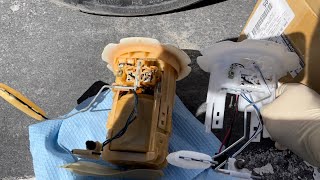
- To remove the fuel pump assembly to access the sensor, you will likely need a special fuel tank lock ring tool to safely unscrew the large plastic retaining nut. Using a hammer and screwdriver is not recommended due to the risk of sparks and damage.
- Once the assembly is out, disconnect the sensor and check the resistance between the signal and ground pins on the sensor side. Refer to the factory service manual for specifications.
- Move the float arm by hand and watch the resistance reading on a multimeter. It should change smoothly. If it jumps, drops out, or reads open, the sensor is bad.
- If the sensor tests good, perform continuity and voltage checks on the vehicle's wiring harness between the PCM and the sensor to rule out an open or shorted wire.
- If wiring and sensor are good, the problem may lie with the instrument cluster or PCM, which is rare and may require professional diagnosis.
Parts You'll Likely Need
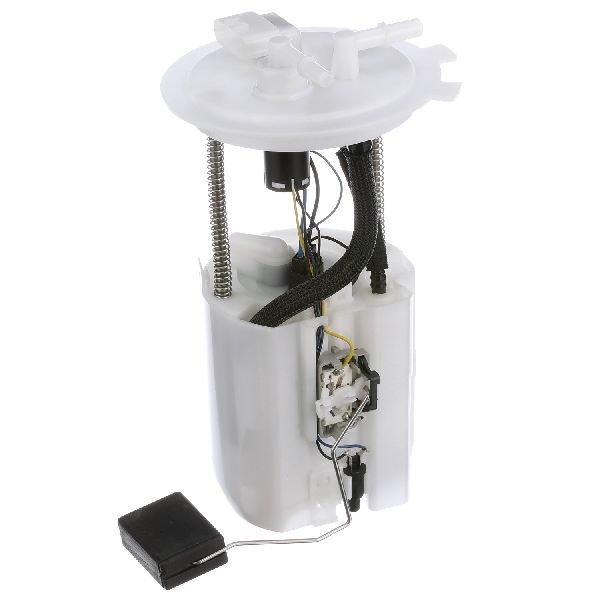
- Fuel Level Sensor
(OEM #25060-3TA0A)— This is the most common cause of P0463, and Nissan has identified it as a replaceable component separate from the fuel pump assembly. The part number is well-corroborated for the Maxima and other Nissan models.
Trusted brands: Nissan (OEM), Dorman
OEM price range: $125-$165
Aftermarket price range: $90-$130
Related Codes That Often Appear With This One
- P0460 — This code relates to the fuel level sensor circuit in general and is listed in the same TSB (NTB22-026) as P0463.
- P0461 — This code indicates an issue with the fuel level sensor's performance or range, often appearing with P0463 and is also covered by TSB NTB22-026.
- P0462 — This is the opposite of P0463, indicating a 'Circuit Low' condition. Seeing them together could point to an intermittent wiring problem. It is also covered by TSB NTB22-026.
Technical Service Bulletins (TSBs) & Recalls
- NTB22-026: Service Information for Fuel Gauge Inaccurate with DTCs Stored in ECM. Confirms that for P0463, the fuel level sensor can be replaced separately from the fuel pump assembly.
Platform-Specific Known Issues
- A safety recall campaign (PC384) was issued for some early 2016 Maxima models for a fuel tank sending unit that may not have been affixed correctly, potentially causing a leak. While not directly causing P0463, it involves the same components and area of the vehicle.
- A voluntary emissions service campaign (NTB19-115) was issued for 2016-2018 Maximas in California to reprogram the ECM, which could potentially address software-related interpretations of sensor data.
Mechanic-Grade Diagnostic Values
- Fuel Level Sensor Resistance — expected: Approximately 4-7 Ohms when full, and 73-85 Ohms when empty. The resistance should change smoothly as the float arm moves.. Failure: A reading of OL (Open Loop), infinite resistance, or a value that jumps erratically indicates a faulty sensor.
- Fuel Level Sensor Signal Wire Voltage (at harness connector, KOEO) — expected: The PCM applies a reference voltage, typically around 5.0 volts, to the signal circuit. The return voltage will vary based on fuel level.. Failure: A constant high voltage (near 5V) that doesn't change when the vehicle is rocked side-to-side suggests an open in the signal return or ground circuit, or a failed sensor.
Wiring & Ground Locations
- Fuel Pump Assembly Connector — On top of the fuel pump assembly, accessible by removing the rear seat bottom and the inspection cover.. This is the primary test point for the fuel level sensor circuit. A P0463 is often caused by an open circuit, which can be at this connector due to corrosion or a loose pin.
- Sensor Signal Wire — Pin 2 (often a White wire) on the fuel pump harness connector. This wire sends the level reading to the ECM/instrument cluster.. A break or short-to-power on this wire will cause a constant high voltage reading, triggering P0463.
- Sensor Ground Wire — Pin 3 (often a Green wire) on the fuel pump harness connector. This ground path may be controlled by the ECU or Fuel Pump Control Unit (FPCU).. A poor or open ground is a very common cause for a 'Circuit High' code. The sensor needs a solid ground reference to provide an accurate voltage reading. If the ground is lost, the circuit becomes open, and voltage floats high.
- Fuel Pump Power Wire — Pin 5 (often a Blue wire) on the fuel pump harness connector. Another common color is Black with a Yellow stripe.. While not directly part of the sensor circuit, checking for battery voltage here confirms the assembly is receiving power. A short between this wire and the sensor signal wire could cause P0463.
OEM Part Supersession History
25060-3TA0A→25060-3TA0A (current)— No supersession found. This part number appears to be the consistent OEM part for the entire 2016-2022 generation.
Heads up: This part is also used on the Nissan Altima of the same era, indicating component sharing across platforms.
Helpful Videos

![How to Fix P0463 Engine Code in 2 Minutes [1 DIY Method / Only $11.5]](https://img.youtube.com/vi/vmZ6y3GoXH4/mqdefault.jpg)

We Have This Part in Stock


The information in this article is provided for general reference and educational purposes only. Vehicle specifications, procedures, and part compatibility can vary by production date, trim level, and region. Always consult your vehicle's factory service manual and verify part numbers before purchasing or performing repairs. Safety-critical components such as airbags, seat belts, and braking systems should be installed by a qualified professional.
- Nissan MAXIMA:
- 🎬 Helpful Videos
- 🛍️ Shop This Part
- What's Unique About the 2016-2022 Nissan MAXIMA
- Diagnostic Flowchart
- Symptoms You May Notice
- Most Likely Causes
- Rare But Worth Checking
- Diagnosis Steps
- Parts You'll Likely Need
- Related Codes That Often Appear With This One
- Technical Service Bulletins (TSBs) & Recalls
- Platform-Specific Known Issues
- Mechanic-Grade Diagnostic Values
- Wiring & Ground Locations
- OEM Part Supersession History
- 🎟️ Get 5% Off