

P0463 on 2016-2020 Nissan 370Z: Fuel Level Sensor Circuit High Input Causes and Fixes
P0463 on a 2016-2020 Nissan 370Z almost always indicates a failed fuel level sensor, causing an inaccurate fuel gauge, typically stuck on full. Nissan issued a TSB (NTB22-026) for this known issue. The 370Z has two sensors (left/driver and right/passenger side); diagnosis is required to replace the correct one. The sensors can be replaced separately from the fuel pump, with individual parts costing around $150-$280.
- P0463 on a 370Z means the fuel level sensor circuit has a high voltage fault, causing your fuel gauge to read incorrectly (usually stuck on full).
- The most common cause by far is a failed fuel level sensor, which is a known issue addressed by Nissan TSB NTB22-026.
- Your 370Z has two fuel sensors; proper diagnosis is essential to identify and replace the correct one, which is usually the 'main' sensor on the passenger side for this code.
- Do not let a shop replace the entire fuel pump assembly. The sensor is a separate, much less expensive part.
- Due to the fire hazard associated with handling gasoline, this repair is recommended for professionals or experienced DIYers with proper safety measures.
What's Unique About the 2016-2020 Nissan 370Z
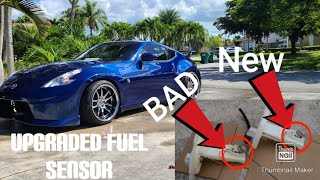
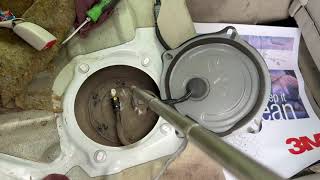
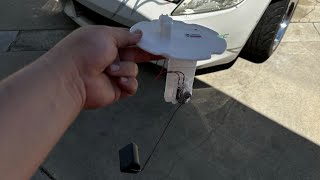
The Nissan 370Z features a saddle-shaped fuel tank, which requires two separate fuel level sending units to accurately measure the fuel level across the tank: a 'sub' or secondary sensor on the left (driver's) side, and a 'main' sensor on the right (passenger's) side which is part of the fuel pump module. This design doubles the potential points of failure 🎬 Watch: A quick look at the driver side sub sensor location. for a fuel level sensor. Nissan has acknowledged issues with these sensors by releasing Technical Service Bulletin NTB22-026, which specifically advises technicians to replace only the faulty sensor rather than the entire, more expensive fuel pump assembly.
Diagnostic Flowchart
Tap your situation to follow the diagnostic path that matches what you're seeing on this vehicle.
Symptoms You May Notice
- Check Engine Light is illuminated.
- Fuel gauge reads inaccurately, often stuck on full.
- Fuel gauge fluctuates erratically or drops to empty after starting the car.
- Low fuel warning light stays on or flashes, even with a full tank.
- In some related cases on platform mates, this code may appear alongside a U1000 CAN communication code and cause the gauge cluster to be unresponsive.
- Replacing the entire fuel pump assembly. TSB NTB22-026 explicitly warns against this common mistake, as the sensor is a separate, serviceable, and much cheaper part.
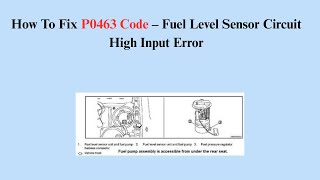
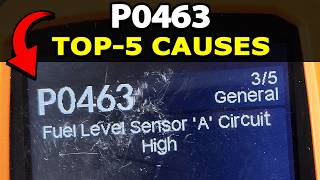
- Replacing the wrong fuel level sensor. Since the 370Z has two sensors, it is crucial to diagnose which one is sending the faulty signal before purchasing a replacement. The P0463 code refers to Sensor 'A', which is typically the main sensor on the passenger side, but confirming with a scan tool is essential. 🎬 See this guide on diagnosing and fixing the P0463 code.
- Replacing the fuel gauge/instrument cluster first. While a faulty gauge can cause incorrect readings, it is a much less common failure point than the sensors themselves for this specific code.
Most Likely Causes
- Failed Fuel Level Sensor (Sending Unit) 🔴 High Probability This is a well-documented issue for Nissan and Infiniti vehicles with the VQ37VHR engine, leading to the creation of TSB NTB22-026. The vehicle's use of two sensors also increases the statistical likelihood of a failure. Forum discussions on the370z.com are filled with owners experiencing this exact issue.
How to confirm: Access the sensor and test its resistance with a multimeter while moving the float arm. The resistance should change smoothly. Based on data from a 350Z (a similar platform), a good main sensor (passenger side) should read approximately 3-4 Ohms when full and 80 Ohms when empty. The sub sensor (driver side) should read around 3 Ohms when full and 43 Ohms when empty. An open circuit (infinite resistance) or a reading that doesn't change indicates failure.
Typical fix: Replace the faulty fuel level sensor. The 370Z has two: the main sensor (passenger side) and the sub sensor (driver side). Diagnosis is needed to identify the failed unit. Per TSB NTB22-026, the sensor is replaced independently of the fuel pump.
Est. part cost: $150-$280 - Damaged Wiring or Connectors ⚪ Low Probability
How to confirm: Visually inspect the wiring harness leading to the fuel tank for any signs of breaks, corrosion, or loose connections at the sensor connector, which is located under an access panel in the rear of the car. A continuity test can verify the integrity of the signal, power, and ground wires between the PCM and the sensor connector.
Typical fix: Repair the damaged section of the wire or clean/replace the corroded connector. Pay special attention to the ground circuit, as high resistance here can cause a high voltage reading.
Est. part cost: $10-$50
Rare But Worth Checking
- Failed Instrument Cluster: Extremely rare. If the fuel gauge is the only gauge behaving erratically and both fuel level sensors and wiring have been confirmed to be good, the cluster itself could be the issue. A self-diagnosis can be run to test the cluster's gauges. This should be a last resort in diagnosis.
- Failed Powertrain Control Module (PCM): This is highly unlikely and should only be considered after all other possibilities, including sensors, wiring, and the instrument cluster, have been exhaustively ruled out by a professional.
Diagnosis Steps
- Confirm the P0463 code is present using an OBD-II scanner.
- Check for any other related fuel system or communication codes, such as P0461, P0462, or U1000.
- Observe the fuel gauge behavior. Note if it is stuck on full, empty, or fluctuating.
- Use a scan tool with live data capability to monitor the voltage from both fuel level sensors (Main and Sub). The sensor causing the P0463 code will likely show a voltage stuck at or near its maximum (e.g., close to 5 volts).
- Gain access to the top of the fuel tank by removing the access panels located under the rear carpeting and trim. The passenger side covers the main sensor/pump assembly, and the driver side covers the sub-sensor.
- Visually inspect the wiring and connectors for visible damage, corrosion, or loose pins.
- If wiring appears intact, disconnect the suspect sensor. With the key on, test the signal wire in the harness; it should read a reference voltage (typically 5 volts) from the PCM.
- If the circuit is confirmed to be good, remove the sensor from the tank. Using a multimeter set to Ohms, measure the resistance across the sensor's pins while manually moving the float arm. The resistance should sweep smoothly. For Nissan platforms, a full tank is low resistance (~3-4 Ohms) and an empty tank is high resistance (~43-80 Ohms depending on the sensor). If the reading is erratic, infinite (open), or does not change, the sensor is faulty.
- Replace the confirmed faulty sensor. 🎬 Watch: A step-by-step walkthrough of the fuel level sensor replacement.
Parts You'll Likely Need
- Fuel Level Sensor (Main/Right/Passenger Side)
(OEM #25060-6GC1A (for 2015+ models), 25060-1EA1B (for 2011-2014 models))— This is the 'Sensor A' and the most common point of failure for the P0463 code on this platform. It is located with the fuel pump. Part numbers vary by production date.
Trusted brands: Nissan Genuine, Hitachi, Aisan
OEM price range: $160-$230
Aftermarket price range: $95-$160 - Fuel Level Sensor (Sub/Left/Driver Side)
(OEM #25060-1EA0B (for models up to 02/2015))— This is the secondary sensor. While less likely to be the cause of P0463 ('Sensor A'), it can also fail and is often replaced preventatively or if diagnosis points to it.
Trusted brands: Nissan Genuine, Delphi
OEM price range: $200-$280
Aftermarket price range: $100-$170
Related Codes That Often Appear With This One
- P0462 — P0462 indicates 'Fuel Level Sensor Circuit Low Input'. Seeing both codes could point to an intermittent wiring issue or a sensor that is failing erratically across its full range of motion.
- P0461 — P0461 is for 'Fuel Level Sensor Circuit Range/Performance'. It's a more general code for erratic sensor behavior and may appear with P0463 if the signal fluctuates wildly before getting stuck in the 'high' position.
- U1000 / U1001 — These are CAN (Controller Area Network) communication codes. On platform mates like the Infiniti G37, these codes sometimes appear with P0463, suggesting the sensor fault may be intermittently disrupting communication between the combination meter and the ECM. If these codes are present, they should be diagnosed first.
Technical Service Bulletins (TSBs) & Recalls
- NTB22-026: Addresses codes P0460, P0461, P0462, and P0463, advising that the fuel level sensor can be replaced separately from the fuel pump assembly. It warns that warranty claims for replacing the entire pump assembly for this issue will be charged back.
Platform-Specific Known Issues
- The Nissan 370Z's saddle-style fuel tank necessitates two fuel level sensors, one on the driver's side (sub, Part No. 25060-1EA0B) and one on the passenger side with the fuel pump (main, Part No. 25060-6GC1A for 2015+). This design increases the chances of a sensor-related fault.
- Nissan issued Technical Service Bulletin NTB22-026 for fuel level sensor issues, including P0463. It instructs technicians to replace only the individual sensor, not the entire fuel pump module, to correct the fault.
Mechanic-Grade Diagnostic Values
- Main Fuel Level Sensor (Passenger Side) Resistance — expected: Approximately 3-4 Ω at Full, 80 Ω at Empty. Failure: Readings are infinite (open circuit), do not change when the float is moved, or jump erratically.
- Sub Fuel Level Sensor (Driver Side) Resistance — expected: Approximately 3 Ω at Full, 43 Ω at Empty. Failure: Readings are infinite (open circuit), do not change when the float is moved, or jump erratically.
- Fuel Level Sensor Circuit Voltage (at PCM or connector) — expected: Normal range is ~0.5V (Empty) to ~4.5V (Full).. Failure: A voltage signal that consistently exceeds 4.5-5.0V will trigger P0463.
Scan Tool Commands That Help
- Nissan CONSULT or advanced OBD-II scanner: Combination Meter Self-Diagnosis / Actuation Test — To rule out a faulty instrument cluster. This test commands the needles (speedometer, tachometer, fuel, temp) to sweep through their range, confirming the gauge motor itself is functional. If the gauge sweeps correctly during the test but reads incorrectly during normal operation, the fault lies with the sensor or wiring, not the cluster.
Wiring & Ground Locations
- M11 — Left end of the dash.. This is a primary ground point for many components in the driver's side dash area, including potentially the combination meter. A poor ground here could cause erratic gauge behavior.
- M55 — Center of the dash.. A central ground point for dash electronics. Verifying this ground is clean and tight is a good step when diagnosing any instrument panel issue.
- M95 — Right end of the dash.. A primary ground point for components in the passenger side dash area.
- Driver's Side Fuse Box Mounting Bolt — Underneath the kick panel by the dead pedal.. This is a known, reliable chassis ground point used by owners for adding accessories. It can be used as a reference point for testing the ground circuit continuity from the fuel pump harness.
Real Owner Repair Stories
- my350z.com forum user (Nissan 350Z (platform mate) with 230k miles) — Fuel gauge was erratic. After replacing both sensors with new OEM parts, the problem got worse. Gauge would read over 1/2 tank after 300+ miles of driving.
❌ Tried (didn't work) Replacing both the main (passenger) and sub (driver) fuel level sensors with new Nissan parts.
✅ What actually fixed it The user re-tested the brand new main (passenger side) sensor and found it was faulty from the factory. The resistance would jump from 80 Ohms (empty) down to the 30s with only a slight movement of the float arm, instead of sweeping linearly. Replacing the new, faulty sensor with another new one resolved the issue.
OEM Part Supersession History
25060-1EA1A→25060-1EA0B— Part update/revision by Nissan.
Heads up: 25060-1EA0B is the replacement for 25060-1EA1A for the left (sub) sending unit.2009-2010 era sensor (PN Discontinued)→25060-1EA1B (2011-2014 sensor)— Original part was discontinued.
Heads up: When using the 2011-2014 sensor (25060-1EA1B) on a 2009-2010 model, a new mounting bracket is also required for proper fitment.
Model Year Variations Within This Range
- 2015: There is a part number split for the left-side (sub) sensor in February 2015. Models built up to 02/2015 use part number 25060-1EA0B. Post-02/2015 models use a different part number. It is crucial to verify the vehicle's production date before ordering.
Helpful Videos

We Have This Part in Stock


The information in this article is provided for general reference and educational purposes only. Vehicle specifications, procedures, and part compatibility can vary by production date, trim level, and region. Always consult your vehicle's factory service manual and verify part numbers before purchasing or performing repairs. Safety-critical components such as airbags, seat belts, and braking systems should be installed by a qualified professional.
- Nissan 370Z:
- 🎬 Helpful Videos
- 🛍️ Shop This Part
- What's Unique About the 2016-2020 Nissan 370Z
- Diagnostic Flowchart
- Symptoms You May Notice
- Most Likely Causes
- Rare But Worth Checking
- Diagnosis Steps
- Parts You'll Likely Need
- Related Codes That Often Appear With This One
- Technical Service Bulletins (TSBs) & Recalls
- Platform-Specific Known Issues
- Mechanic-Grade Diagnostic Values
- Scan Tool Commands That Help
- Wiring & Ground Locations
- Real Owner Repair Stories
- OEM Part Supersession History
- Model Year Variations Within This Range
- 🎟️ Get 5% Off