

P0463 on 2008-2017 Mitsubishi Lancer: Fuel Level Sensor Circuit High Causes and Fixes
On a 2008-2017 Mitsubishi Lancer, code P0463 almost always means the fuel level sending unit has failed. Since it's integrated into the fuel pump module, the entire assembly usually needs to be replaced. AWD models have two sending units, complicating the diagnosis slightly. Expect to pay $250-$450 for an aftermarket assembly or $550+ for OEM.
- P0463 on a Lancer points directly to a problem in the fuel level sensor circuit, usually a failed sensor.
- The most probable fix is replacing the entire fuel pump and sender assembly, which is accessible from under the rear seat.
- Before buying parts, perform a simple resistance test on the sender pins at the top of the fuel pump module to confirm the failure. The reading will likely be over 186 ohms.
- Ensure you purchase the correct fuel pump assembly for your Lancer's specific drivetrain (FWD vs. AWD), as they are different and not interchangeable.
What's Unique About the 2008-2017 Mitsubishi Lancer
For the 2008-2017 Lancer, the fuel level sensor is not typically sold as a separate component. Instead, it is integrated into the main fuel pump assembly located inside the fuel tank. This means that a simple sensor failure often requires replacing the entire fuel pump module. The signal from this sensor first goes to the instrument cluster (combination meter), which then relays the information to the engine's computer, adding another potential point of failure compared to systems where the sensor reports directly to the ECM. Furthermore, All-Wheel Drive (AWD) models like the Ralliart and some SE/SEL trims use a saddle-style fuel tank with two fuel level sending units (a main and a sub-sender), which requires identifying which of the two has failed.
Generation note: The 2008-2017 model years cover the same generation of the Mitsubishi Lancer (often called the Lancer X platform). However, there are different fuel system components for front-wheel-drive (FWD), all-wheel-drive (AWD), and turbocharged (Ralliart/Evolution) models, which affects part numbers and diagnosis. AWD models use a saddle tank with two fuel level senders, requiring two access ports under the rear seat.
Symptoms You May Notice
- Check Engine Light is on
- Fuel gauge reads full all the time
- Fuel gauge reads empty and low fuel light is on, despite fuel in tank
- Fuel gauge fluctuates wildly or reads inaccurately
- Low fuel warning light may stay on constantly
- Replacing the instrument cluster without first testing the fuel sending unit and wiring.
- Replacing the ECM when the problem is a simple wiring or ground fault.
- On AWD models, replacing the main fuel pump assembly when the sub-sender on the other side of the tank was the actual cause.
Most Likely Causes
- Failed Fuel Level Sending Unit 🔴 High Probability The variable resistor on the sending unit's float arm can wear out or the contacts can corrode over time, causing it to send an incorrect high resistance or an open circuit signal. This is the most common cause by a wide margin.
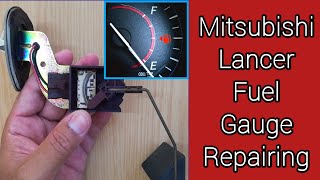
How to confirm: Access the fuel pump assembly under the rear seat. Disconnect the connector and measure the resistance across the fuel level sender pins with a multimeter. 🎬 Watch how to test a fuel level sending unit with a multimeter The reading will likely be very high (over 186 ohms) or show an open loop (OL), regardless of the float's position.
Typical fix: Replace the entire fuel pump module, as the sending unit is integrated. For AWD models, you must first determine if the main or sub-sender has failed before replacing the correct assembly.
Est. part cost: $250-$700 - Damaged Wiring or Corroded Connector 🟡 Medium Probability The main connector on top of the fuel pump assembly is under the rear seat cushion and can be exposed to moisture from spills or physical damage from items stored there, leading to corrosion or broken wires.
How to confirm: Visually inspect the wiring harness and connector going to the fuel pump module. Look for green or white corrosion on the pins, chafed insulation, or broken wires. A wiggle test on the harness while monitoring live data may show the reading change.
Typical fix: Clean the connector terminals with an electrical contact cleaner or replace the connector pigtail if damage is severe. Repair any broken wires.
Est. part cost: $10-$50 - Poor Ground Connection ⚪ Low Probability The fuel tank and pump assembly rely on a solid chassis ground. If the ground strap becomes corroded or loose, it can cause high resistance in the circuit.
How to confirm: Locate the ground strap for the fuel tank/pump assembly and check for corrosion or looseness. Use a multimeter to test for high resistance between the ground pin at the fuel pump connector and a known good chassis ground.
Typical fix: Clean the ground connection point on the chassis and the ground strap terminal. Replace the ground strap if it is badly corroded.
Est. part cost: $5-$25
Rare But Worth Checking
- Faulty Combination Meter (Instrument Cluster): The Lancer's fuel signal is processed by the instrument cluster before going to the ECM. While rare, a fault within the cluster's circuitry can corrupt the signal, causing the P0463 code. This is usually accompanied by other gauge-related issues and should only be considered after the sender and wiring are confirmed to be good. One owner on a forum reported a dealer incorrectly diagnosed this, replacing the cluster without fixing the issue.
- Faulty Engine Control Module (ECM): This is the least likely cause. The ECM's internal circuit for reading the fuel level data could fail, but all other potential causes should be exhaustively ruled out before condemning the ECM.
Diagnosis Steps
- Read the code with an OBD-II scanner to confirm P0463 is the primary code. Note any other codes, especially P2068 on an AWD model.
- Check the fuel gauge. Note if it is stuck on full, empty, or behaving erratically.
- Gain access to the fuel pump assembly by removing the rear seat bottom cushion. 🎬 Watch this step-by-step video on removing the Lancer fuel pump There will be one access cover on the floor pan for FWD models, and two covers for AWD models.
- Visually inspect the electrical connector(s) on top of the fuel pump module(s) for any signs of corrosion, moisture, or damage.
- Disconnect the connector. With the key on, use a multimeter to check for proper voltage and ground at the harness side of the connector.
- With the connector still off, measure the resistance across the two fuel level sender pins on the fuel pump module itself.
- Compare the reading to the manufacturer's specification. For this code, you will likely find the resistance is above 186 ohms or reads as an open circuit (OL).
- If resistance is out of spec, the fuel level sending unit is faulty and the fuel pump assembly needs to be replaced.
- If the resistance is normal, the problem is likely in the wiring between the pump and the combination meter, or the meter itself. Perform a wiggle test on the harness to check for intermittent opens or shorts.
- For AWD models, if the main sender tests good, repeat steps 4, 6, and 7 on the secondary (sub-sender) unit on the opposite side of the fuel tank.
Parts You'll Likely Need
- Fuel Pump and Sender Assembly (FWD)
(OEM #1760A322 (replaces 1760A251))— This is the most common failure for FWD models. The fuel level sender is integrated into the assembly. This part fits 2.0L & 2.4L non-turbo models.
Trusted brands: Mitsubishi Genuine, Denso, Delphi, Spectra Premium, Carter
OEM price range: $550-$800
Aftermarket price range: $250-$450 - Fuel Pump and Sender Assembly (AWD - Main)
(OEM #1760A271)— For AWD models, this is the main assembly on the passenger side which includes the fuel pump and the primary level sender.
Trusted brands: Mitsubishi Genuine, Spectra Premium
OEM price range: $600-$850
Aftermarket price range: $300-$500 - Fuel Level Sub-Sender Assembly (AWD - Secondary)
(OEM #1718A049)— For AWD models, this is the secondary level sender on the driver's side of the saddle tank. It does not contain a fuel pump. Failure can also cause P0463 or related codes.
Trusted brands: Mitsubishi Genuine
OEM price range: $200-$300
Aftermarket price range: $80-$150
Related Codes That Often Appear With This One
- P0461 (Fuel Level Sensor 'A' Circuit Range/Performance)
- P0462 (Fuel Level Sensor 'A' Circuit Low Input)
- P2068 (Fuel Level Sensor 'B' Circuit High) - On AWD models with dual senders.
Platform-Specific Known Issues
- AWD models (Ralliart, SE, SEL) have a saddle-style fuel tank with two separate fuel level sending units. The main unit is part of the fuel pump assembly on the passenger side, and a secondary 'sub-sender' is on the driver's side. Both are accessed via separate panels under the rear seat. A P0463 code could point to either sender, requiring individual testing to isolate the fault.
Mechanic-Grade Diagnostic Values
- Fuel Level Sensor Resistance (at sender unit connector) — expected: Tank Full: 1 - 5 Ω. Tank Empty: 103 - 117 Ω. Resistance should change smoothly as the float arm moves.. Failure: A reading over 186 Ω for more than two seconds, or an Open Loop (OL) reading, triggers P0463. Any spikes or dead spots during float movement indicate a faulty sender.
- Fuel Pump Connector (C-313) Pin Voltages (Key On) — expected: Fuel Pump Power (Thick Blue wire): 9-14V (variable, may only appear for ~2 seconds at key-on). Fuel Level Sensor Signal (Thin Yellow/Red or Red wire): 0-5V. Sensor Ground (Thin Black or White/Black wire): ~0V (continuity to ground).. Failure: No voltage on the power wire indicates a relay or wiring issue. Voltage on the signal wire that is stuck high or does not correspond to the fuel level points to a sender or wiring fault.
Scan Tool Commands That Help
- Mitsubishi M.U.T.-III SE: Forced Refuel control completion — This special function, found under the 'ENGINE' module, is used as part of the official procedure for checking for fuel tank leaks. While not a direct test for P0463, it is a dealer-level command related to the fuel system integrity.
Wiring & Ground Locations
- C-313 — The main 5-pin electrical connector on top of the fuel pump assembly, located under the rear seat bottom cushion (passenger side for FWD, both sides for AWD have connectors).. This is the primary connection point for testing the fuel level sender, its ground, and the fuel pump power. Corrosion or damage here is a common cause of P0463. The fuel level sender signal wire is typically Yellow/Red (2008-2010) or Red (2011-2017), and the sensor ground is Black (2008-2010) or White/Black (2011-2017).
- Fuel Pump Ground Splice Pack — On second-generation models (which includes the 2008-2017 Lancer), the body ground splice pack that includes the fuel pump ground is located under the rear package tray, requiring removal of the rear seat back and side bolsters to access.. A corroded or loose ground at this location can introduce high resistance into the entire fuel pump circuit, including the sender, potentially causing a P0463 code.
Real Owner Repair Stories
- EvolutionM.net user 'AreSTG' (Mitsubishi Lancer Evolution (similar fuel pump assembly design)) — Fuel gauge stopped working immediately after installing a new dual fuel pump assembly.
❌ Tried (didn't work) Replacing the float/electrical sensor piece with a known-good used one.
✅ What actually fixed it The user discovered the metal contact arm on the float level sensor had been accidentally bent away from the circuit board during installation, creating an open circuit. Bending the arm back so it made proper contact with the resistor board resolved the issue. - EvolutionM.net user 'splattj' (2009 Mitsubishi Lancer Ralliart) — Car would not start, no power to the fuel pump.
❌ Tried (didn't work) Swapping fuel pump relays., Replacing the fuel pump assembly (the original pump was tested and found to be working).
✅ What actually fixed it The user was troubleshooting a no-power issue but provided critical diagnostic information for P0463 in the process. They confirmed the pinout and expected voltages at the 5-pin fuel pump connector, identifying the thick blue wire for pump power (variable 9-14V) and the thin wires for the fuel level and temp sensors (0-5V). This information is crucial for diagnosing if the fault is in the wiring harness or the sender itself.
OEM Part Supersession History
1760A251→1760A322— Standard part revision and update by the manufacturer.
Heads up: The parts are interchangeable for their specified application (FWD 2.0L/2.4L non-turbo). No known incompatibility issues.1760A166, 1760A317, 1760A321→1760A271— Consolidation of part numbers for the AWD main fuel pump assembly.
Heads up: These numbers all refer to the main fuel pump assembly for AWD models and should be cross-compatible.
Model Year Variations Within This Range
- 2008-2010 vs 2011-2017: The wire colors at the fuel pump connector (C-313) changed. For the fuel level sensor, the signal wire was Yellow/Red from 2008-2010 and changed to Red from 2011-2017. The sensor ground was Black from 2008-2010 and changed to White/Black from 2011-2017. This is critical for accurate pin-point testing.
Diagnostic Flowchart
Other Known Issues on This Vehicle
Issues unrelated to this code that are worth knowing about as an owner of this generation:
- CVT Transmission Failure/Overheating 🔴 High — Common, especially on earlier models (2008-2012) and vehicles without a factory auxiliary cooler. Symptoms like whining, slipping, or hesitation can appear after 60,000 miles. (Ref: A recall was issued for some 2015-2016 models for CVT hesitation, but widespread issues exist beyond that.)
- Clear Coat Peeling/Paint Delamination 🟠 Medium — Very common, particularly on darker colors like red and blue, and on horizontal surfaces (roof, trunk, hood). Often starts as small white spots and progresses to large peeling sections after 5-8 years.
- Prematurely Worn Lower Control Arm Bushings 🟠 Medium — Widespread issue causing clunking noises over bumps, steering wander, and uneven tire wear. Often requires replacement starting around 80,000-100,000 miles. (Ref: TSB 05-34-001 was issued for a similar issue on a previous generation, but the problem persists on the 2008-2017 models.)
- Cooling Fan Control Module Failure 🔴 High — A common failure point that causes the radiator fans to stop working, leading to engine overheating, especially in traffic or with the A/C on.
Used vs. New Parts: Buying Guide for This Vehicle
When a used part is the smart pick: A used OEM fuel pump assembly from a low-mileage donor vehicle can be a cost-effective option, as the failure is often the electronic sender unit, not the pump motor itself. If you can verify the donor vehicle's mileage and confirm the part is from a non-accident vehicle, it's a reasonable choice. The plastic housing and lines are durable.
Donor-vehicle mileage cap: roughly under 60000 miles for the part to have meaningful remaining life.
What to inspect on the donor part:
- Check for a clean, corrosion-free electrical connector.
- Ensure the float arm moves freely without binding and is not bent.
- Inspect the plastic housing for any cracks, especially around the hose connections.
- Ask for the VIN of the donor car to verify its model year and mileage if possible.
OEM-only on this vehicle (don't cheap out):
- While not strictly OEM-only, many forum members express a strong preference for OEM or OEM-supplier (Denso) fuel pumps due to the labor involved in replacement. A cheap aftermarket pump failing prematurely means doing the job twice.
Aftermarket brands forum-validated for this vehicle:
- Denso (often the OEM supplier, known for reliability and quiet operation)
- Delphi (another top-tier OEM supplier with a strong reputation)
- Spectra Premium (a widely available and generally well-regarded aftermarket option)
Brands owners have reported issues with on this vehicle:
- Generic, unbranded 'white box' parts from online marketplaces. Users on various forums report higher failure rates and noise issues with no-name brands.
Real Owner Stories
Aggregated from forums and TSBs cited above. Mileages and costs reflect what owners reported in those sources.
2009 Mitsubishi Lancer GTS
Symptoms: The owner reported a 'No fuel reading' condition and the P0463 code. A dealership incorrectly suggested replacing the instrument cluster twice after a fuel gauge repair failed to clear the code.
What fixed it: The owner's account highlights that the issue required proper testing of the sender unit and checking for wiring issues rather than replacing the instrument cluster.
Source hint: evolutionm.net - '09 GTS P0463 No fuel reading'
Related OBD-II Codes
Frequently Asked Questions
I have a Lancer Ralliart with the AWD system; why are there two access panels under my rear seat?
My fuel gauge is stuck on full even though I've been driving for days. Is this a common Lancer issue?
Can I just replace the sending unit sensor, or do I need the whole $250-$700 pump assembly?
Could the P0463 code be related to the CVT transmission issues common in 2008-2012 Lancers?
Is there a TSB for the fuel level sensor like there is for the lower control arm bushings?
Helpful Videos


We Have This Part in Stock


The information in this article is provided for general reference and educational purposes only. Vehicle specifications, procedures, and part compatibility can vary by production date, trim level, and region. Always consult your vehicle's factory service manual and verify part numbers before purchasing or performing repairs. Safety-critical components such as airbags, seat belts, and braking systems should be installed by a qualified professional.
- Mitsubishi Lancer:
- 🎬 Helpful Videos
- 🛍️ Shop This Part
- What's Unique About the 2008-2017 Mitsubishi Lancer
- Symptoms You May Notice
- Most Likely Causes
- Rare But Worth Checking
- Diagnosis Steps
- Parts You'll Likely Need
- Related Codes That Often Appear With This One
- Platform-Specific Known Issues
- Mechanic-Grade Diagnostic Values
- Scan Tool Commands That Help
- Wiring & Ground Locations
- Real Owner Repair Stories
- OEM Part Supersession History
- Model Year Variations Within This Range
- Diagnostic Flowchart
- Other Known Issues on This Vehicle
- Used vs. New Parts: Buying Guide for This Vehicle
- Real Owner Stories
- 2009 Mitsubishi Lancer GTS
- Related OBD-II Codes
- Frequently Asked Questions
- 🎟️ Get 5% Off