

P0462 on 2016-2020 Nissan Pathfinder: Fuel Level Sensor Circuit Low Causes and Fixes
On a 2016-2020 Pathfinder, P0462 almost always means the fuel level sensor (or sending unit) inside the gas tank has failed. The PCM is seeing a voltage signal lower than its expected range (typically below 0.5V). Nissan issued a TSB (NTB22-026) confirming the sensor can be replaced separately from the expensive fuel pump assembly.
- P0462 on your Pathfinder almost certainly points to a bad fuel level sensor in the gas tank.
- Your fuel gauge will be unreliable; track your mileage to avoid running out of fuel.
- Nissan has a TSB (NTB22-026) confirming you only need to replace the sensor, not the entire expensive fuel pump assembly.
- The OEM part number for the sensor is 25060-3KA1A, which also fits the Infiniti QX60.
- Due to the fire hazard of working with gasoline, this repair is recommended for professionals or experienced DIYers with proper safety equipment.
What's Unique About the 2016-2020 Nissan PATHFINDER
For the 2016-2020 Pathfinder and its platform-mate, the Infiniti QX60, this is a known issue. Nissan released Technical Service Bulletin NTB22-026 which directly addresses P0462, along with related codes P0461 and P0463. The bulletin clarifies that if the fuel level sensor is diagnosed as faulty, only the sensor itself needs to be replaced, not the entire fuel pump module, which saves a significant amount of money on parts. This is a crucial distinction from shops that might recommend replacing the whole assembly out of practice or policy, especially on higher mileage vehicles.
Diagnostic Flowchart
Tap your situation to follow the diagnostic path that matches what you're seeing on this vehicle.
Symptoms You May Notice
- Check Engine Light is on
- Fuel gauge reads empty or is stuck in one position (often empty), even after filling the tank
- Fuel gauge behaves erratically, fluctuating randomly between full, empty, or somewhere in between
- Low fuel warning light stays on even with a full tank
- Distance to Empty (DTE) display is inaccurate or shows dashes 🎬 Watch: How to fix the P0462 code and repair your gas gauge.
- Replacing the entire fuel pump assembly. Per Nissan TSB NTB22-026, this is unnecessary and costly, as the sensor is available separately. Some shops may recommend this as a preventative measure on older, high-mileage vehicles, but it is not required to fix the P0462 code itself.
Most Likely Causes
- Faulty Fuel Level Sensor (Sending Unit) 🔴 High Probability This is a well-documented issue, as confirmed by Nissan's own Technical Service Bulletin NTB22-026. The resistive strip on the sensor can wear out or become contaminated over time, causing it to send an incorrect low-voltage signal or create a short.
How to confirm: Access the sensor and use a multimeter set to Ohms. The resistance should change smoothly as you move the float arm. A properly functioning sensor should read approximately 31 (±2) ohms when full and 247 (±3) ohms when empty. An open circuit (infinite resistance) or a reading of 0 ohms confirms it's bad.
Typical fix: Replace the fuel level sensor inside the fuel tank. Per TSB NTB22-026, the sensor (part #25060-3KA1A) can be replaced by itself without replacing the entire fuel pump assembly.
Est. part cost: $98-$252 - Wiring or Connector Issue 🟡 Medium Probability The wiring harness runs under the vehicle to the fuel tank, making it susceptible to damage from road debris or corrosion. The connector on top of the fuel tank can also accumulate dirt and moisture.
How to confirm: Visually inspect the wiring harness leading to the fuel tank for any signs of damage, corrosion, or loose connections. Disconnect the sensor and use a multimeter to check for a short to ground on the signal wire; a reading of 0 ohms indicates a short. Check for 5V reference voltage at the connector with the key on.
Typical fix: Repair the damaged section of wiring or clean/replace the corroded connector.
Est. part cost: $5-$50
Rare But Worth Checking
- Instrument Cluster Failure: In some cases, a faulty component within the instrument cluster itself can cause incorrect fuel gauge readings and may trigger this code. This is less common than a sensor failure, but it's a possibility if a new sensor and verified wiring don't fix the issue. Some services specialize in repairing these clusters.
- Stuck Float Arm: The float arm that moves the sensor can become physically stuck, especially on vehicles that have been sitting for a long time, leading to rust or sediment buildup. When removing the fuel pump assembly, you can physically check if the float arm moves freely through its full range of motion.
- Powertrain Control Module (PCM) Fault: This is extremely rare, but a faulty PCM could theoretically misinterpret the signal from the fuel level sensor. This should only be considered after all other possibilities have been exhaustively ruled out.
Diagnosis Steps
- Confirm the P0462 code is present using an OBD-II scanner. Check live data for the 'Fuel Level Sensor Voltage'. A reading below 0.5V (or more specifically, below 0.25V) points towards a low input fault.
- Observe the fuel gauge. Is it reading empty, full, or fluctuating? Compare with your manual estimate of fuel in the tank.
- Gain access to the top of the fuel tank by removing the driver's side rear seat cushion and then the access panel(s).
- Visually inspect the fuel level sensor's wiring harness and connector for any obvious damage, corrosion, or loose pins.
- With the key on, engine off, disconnect the connector and use a multimeter to check for a 5-volt reference signal and a good ground at the appropriate pins per the service manual.
- Check for a short to ground on the signal wire. With the connector unplugged, measure resistance between the signal wire and the chassis ground. The reading should be very high (open loop); a reading near zero ohms indicates a short.
- If wiring is confirmed good, remove the fuel pump assembly to access the sensor.
- Test the sensor's resistance with a multimeter. Connect the leads to the sensor's signal and ground pins. Slowly move the float arm from its lowest to highest position. 🎬 See this walkthrough on testing and replacing the fuel level sensor. The resistance reading should change smoothly from approximately 247 ohms (empty) to 31 ohms (full). If it jumps, drops out (open), or reads 0, the sensor is faulty and must be replaced.
Parts You'll Likely Need
- Fuel Level Sensor
(OEM #25060-3KA1A)— This is the component that fails most often, causing the P0462 code, as documented by Nissan's TSB. This part is also referred to as a Fuel Tank Sending Unit.
Trusted brands: Nissan (OEM), Hitachi, Standard Ignition (LSF143)
OEM price range: $180-$252
Aftermarket price range: $98-$150
Related Codes That Often Appear With This One
- P0461 — This code for 'Fuel Level Sensor Circuit Range/Performance' relates to the same component and can be triggered by similar sensor faults or erratic signals.
- P0463 — This code for 'Fuel Level Sensor Circuit High Input' is the opposite of P0462 but can appear if the sensor is failing erratically, causing voltage to swing from one extreme to the other.
Technical Service Bulletins (TSBs) & Recalls
- NTB22-026: 'SERVICE INFORMATION FOR FUEL GAUGE INACCURATE WITH DTCS STORED IN ECM' - Confirms that for a P0462 code, the fuel level sensor can be replaced independently of the fuel pump assembly. It also warns that warranty claims for replacing the entire assembly for this issue will be charged back.
Platform-Specific Known Issues
- Nissan issued Technical Service Bulletin NTB22-026 on April 5, 2022, for 2016-2022 models, including the Pathfinder. It explicitly states that for DTCs P0460, P0461, P0462, or P0463, the fuel level sensor can be replaced separately from the entire fuel pump assembly.
- The access panels to the fuel tank are located under the driver's side rear seat.
Mechanic-Grade Diagnostic Values
- Fuel Level Sensor Resistance — expected: A smooth, linear variation from 31 (±2) Ohms at Full to 247 (±3) Ohms at Empty.. Failure: Readings of 0 Ohms (short), infinite resistance (open), or values that jump or do not change smoothly when moving the float arm.
- Fuel Level Sensor Signal Voltage at PCM — expected: Typically between 0.5V and 4.5V.. Failure: A sustained voltage reading of less than 0.25V will trigger the P0462 code.
Scan Tool Commands That Help
- Nissan CONSULT-II / CONSULT-III: DATA MONITOR for METER/M&A — To compare the raw fuel level signal value received by the combination meter with the actual gauge pointer indication, helping to isolate a faulty gauge from a faulty sensor.
- Nissan CONSULT-III Plus: Active Test / Actuator Test — To manually command the fuel pump ON and OFF. While not directly for the sensor circuit, this can help verify the integrity of the overall fuel pump module's power and ground circuits during diagnosis.
- Nissan CONSULT-II: Work Support > Fuel Pressure Release — To safely depressurize the fuel system before disconnecting fuel lines to service the in-tank fuel level sensor or pump.
Wiring & Ground Locations
- Fuel Pump / Sensor Access Panel — Under the driver's side rear seat cushion.. This is the primary access point needed to reach the fuel level sensor connector for electrical testing and to remove the sensor/pump assembly from the tank.
Real Owner Repair Stories
- YouTube channel 'Pattay's Performance' (2006 Nissan Altima (demonstrates a common Nissan failure pattern)) — Check engine light on, fuel gauge read full when tank was full, but dropped to empty when the tank was only at half.
❌ Tried (didn't work) Lived with the issue for a long time, managing fuel level manually.
✅ What actually fixed it The instrument cluster was removed and sent to a specialist repair service (Automotive Circuit Solutions) who fixed a fault on the circuit board. This resolved the inaccurate fuel gauge and cleared the associated code. - YouTube channel 'HowIFixedIt' (2014 Nissan Pathfinder (R52 platform)) — Check engine light on with code P0462, fuel level circuit fault.
❌ Tried (didn't work) The video proceeds directly to the fix, implying diagnosis pointed to the sending unit.
✅ What actually fixed it The entire fuel pump assembly, which includes the fuel level sensor, was replaced. The video details the process of accessing the pump through the panel under the driver's side rear seat.
OEM Part Supersession History
25060-3KA1A→No supersession found as of early 2026. This remains the current OEM part number.
Heads up: Aftermarket interchange part numbers include Standard Ignition LSF143, FLV213, and LSS313.
Model Year Variations Within This Range
- 2017-2020: The 2017 model year introduced a significant facelift with a new V6 engine featuring Direct Injection Gasoline (DIG), resulting in increased horsepower and towing capacity. However, this powertrain change did not affect the fuel level sensor; the same part number (25060-3KA1A) is specified for all 2016-2020 Pathfinders, indicating the fuel sending unit and its related diagnostics are consistent across this range.
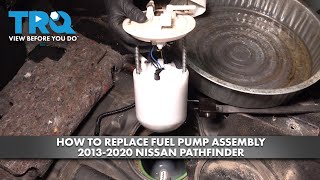
Helpful Videos

We Have This Part in Stock


The information in this article is provided for general reference and educational purposes only. Vehicle specifications, procedures, and part compatibility can vary by production date, trim level, and region. Always consult your vehicle's factory service manual and verify part numbers before purchasing or performing repairs. Safety-critical components such as airbags, seat belts, and braking systems should be installed by a qualified professional.
- Nissan PATHFINDER:
- 🎬 Helpful Videos
- 🛍️ Shop This Part
- What's Unique About the 2016-2020 Nissan PATHFINDER
- Diagnostic Flowchart
- Symptoms You May Notice
- Most Likely Causes
- Rare But Worth Checking
- Diagnosis Steps
- Parts You'll Likely Need
- Related Codes That Often Appear With This One
- Technical Service Bulletins (TSBs) & Recalls
- Platform-Specific Known Issues
- Mechanic-Grade Diagnostic Values
- Scan Tool Commands That Help
- Wiring & Ground Locations
- Real Owner Repair Stories
- OEM Part Supersession History
- Model Year Variations Within This Range
- 🎟️ Get 5% Off