

P0462 on 2016-2020 Nissan NV: Fuel Level Sensor Circuit Low Causes and Fixes
On a 2016-2020 Nissan NV, code P0462 is almost always caused by a failed fuel level sensor (sending unit) inside the fuel tank. This results in an inaccurate or empty fuel gauge and triggers the Check Engine Light. Nissan TSB NTB22-026 confirms the sensor can and should be replaced separately from the much more expensive fuel pump assembly, a critical cost-saving measure.
- P0462 on a Nissan NV points directly to a problem with the fuel level sensor circuit, most often the sensor itself.
- Symptoms are straightforward: an illuminated Check Engine Light and an unreliable fuel gauge, often stuck on empty.
- Do not replace the entire fuel pump assembly. Per Nissan TSB NTB22-026, the sensor (PN 25060-9JJ0B) can and should be replaced on its own.
- This repair requires dropping the fuel tank, which is labor-intensive and carries safety risks. Professional repair is recommended for those not experienced with fuel system work.
- The issue is common across other Nissan trucks and SUVs built on the F-Alpha platform, like the Titan and Armada.
What's Unique About the 2016-2020 Nissan NV
For the Nissan NV and other F-Alpha platform mates like the Titan and Armada, the failure of the fuel level sensor is a well-documented, common issue. Nissan issued Technical Service Bulletin NTB22-026, which covers this exact code across numerous models. The bulletin's key directive is that technicians must replace only the fuel level sensor itself, not the entire fuel pump assembly. It explicitly warns that warranty claims for replacing the whole assembly for this issue will be charged back, underscoring that the sensor is the intended and separate service part.
Diagnostic Flowchart
Tap your situation to follow the diagnostic path that matches what you're seeing on this vehicle.
Symptoms You May Notice
- Check Engine Light is on
- Fuel gauge reads empty or is stuck in one position (often empty)
- Fuel gauge fluctuates erratically or drops to zero intermittently.
- Low fuel warning light stays on even with a full tank.
- Inability for the trip computer to calculate distance-to-empty. 🎬 Watch: Understanding the causes and fixes for the P0462 code.
- Replacing the entire fuel pump assembly. Nissan TSB NTB22-026 specifically advises against this, as the sensor is available separately and is the usual point of failure. This mistake can increase the repair cost by hundreds of dollars, as the full assembly is far more expensive than the sensor alone.
Most Likely Causes
- Faulty Fuel Level Sensor (Sending Unit) 🔴 High Probability This is a known, widespread issue acknowledged by Nissan in TSB NTB22-026. The internal variable resistor on the sensor can wear out, corrode, or develop an internal short, causing it to send a continuous low voltage signal.
How to confirm: After accessing the fuel pump module, disconnect the sensor. Use a multimeter to measure the sensor's resistance while manually moving the float arm from its lowest to highest position. The resistance should change smoothly and fall within the manufacturer's specified range (e.g., ~4-6 ohms full, ~80-85 ohms empty). A reading that is out of specification, does not change, or shows a short circuit (very low resistance) confirms a bad sensor. 🎬 See this guide on how to test a fuel sending unit.
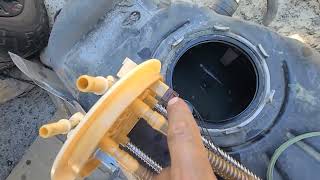
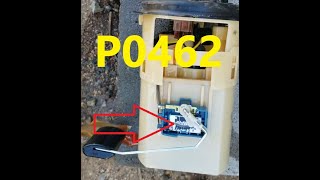
Typical fix: Replace the fuel level sensor. The sensor is attached to the fuel pump module inside the tank but can be purchased and replaced as a separate component (Part No. 25060-9JJ0B).
Est. part cost: $75-$150 - Wiring Harness or Connector Issue 🟡 Medium Probability The wiring harness to the fuel tank is routed underneath the vehicle, making it susceptible to damage from road debris, moisture, and corrosion. A wire can chafe and short to the chassis ground, or the connector pins at the tank can corrode, both of which would cause a low voltage signal.
How to confirm: Visually inspect the wiring harness leading to the fuel tank for any signs of damage, chafing, or corrosion at the connector. Unplug the harness and check for a short to ground on the signal wire using a multimeter. Perform a voltage drop test on the signal and ground circuits to check for high resistance or a short.
Typical fix: Repair the damaged section of the wire or clean/replace the corroded connector. Ensure the harness is properly secured away from moving parts or sharp edges.
Est. part cost: $5-$50
Rare But Worth Checking
- Faulty Instrument Cluster: This is rare, but a known issue on some older Nissan platforms. A failing capacitor or internal fault in the cluster can prevent it from correctly interpreting a good signal from the sensor. One forum user on a Pathfinder with P0462 reported that replacing the sending unit did not fix the issue, but a repaired instrument panel did. This is more likely if the gauge behaves erratically (e.g., reads 1/2 tank when empty) rather than just reading empty.
- Faulty Powertrain Control Module (PCM): A PCM failure is extremely unlikely but remains a remote possibility if all other components in the circuit, including the wiring and instrument cluster, have been ruled out.
Diagnosis Steps
- Scan the vehicle's computer for P0462 and any other related trouble codes. Note any other codes like P0461, P0463, or P0460.
- Use an advanced scan tool to monitor the live data for fuel level sensor voltage. An abnormally low and unchanging voltage (typically <0.5V) points towards a sensor or circuit issue.
- Visually inspect the wiring harness and connector at the fuel tank. Look for any signs of physical damage, corrosion, or loose connections. Pay close attention to areas where the harness might rub against the frame or body.
- If wiring appears intact, the next step is to access the fuel level sensor. This requires lowering the fuel tank.
- Before removing the unit, test the circuit. With the key on, check for the correct reference voltage at the sensor connector.
- Disconnect the sensor and test its resistance with a multimeter. Manually sweep the float arm from empty to full. The resistance reading should change smoothly and be within the manufacturer's specified range. An infinite or zero ohm reading that doesn't change confirms the sensor has failed.
- If the sensor tests good, the fault lies in the wiring (short to ground) or, rarely, the instrument cluster or PCM.
- If the sensor fails the resistance test, it is faulty and needs to be replaced.
Parts You'll Likely Need
- Fuel Level Sensor
(OEM #25060-9JJ0B)— This is the most common failure point for code P0462 on this vehicle, as confirmed by Nissan's own service bulletin. It is sold as a separate component from the fuel pump.
Trusted brands: Nissan (OEM)
OEM price range: $77-$90
Aftermarket price range: $50-$90 - Fuel Pump Tank Seal / Gasket
(OEM #17342-7S000)— This gasket seals the fuel pump assembly to the tank. It is highly recommended to replace it anytime the fuel pump assembly is removed to prevent fuel leaks and vapor evaporation. It is often sold separately.
Trusted brands: Nissan (OEM)
OEM price range: $40-$60
Aftermarket price range: $20-$40
Related Codes That Often Appear With This One
- P0461 — This code indicates a 'Fuel Level Sensor Circuit Range/Performance' issue, often triggered by an intermittent or irrational signal before it fails completely to a low state.
- P0463 — This code for 'Fuel Level Sensor Circuit High Input' is the opposite of P0462 but points to a fault in the same component or circuit, such as an open wire instead of a short.
- P0460 — Indicates a general 'Fuel Level Sensor Circuit Malfunction' and is also mentioned in TSB NTB22-026 alongside P0462.
Technical Service Bulletins (TSBs) & Recalls
- NTB22-026: States that for a P0462 code, the fuel level sensor can and should be replaced separately from the fuel pump assembly. It warns that warranty claims for replacing the entire pump for this issue will be charged back.
Platform-Specific Known Issues
- Nissan issued Technical Service Bulletin NTB22-026 on April 5, 2022, for multiple vehicles including the 2016-2022 NV. It addresses inaccurate fuel gauge readings and DTCs P0460, P0461, P0462, or P0463. The bulletin explicitly states that if the fuel level sensor is diagnosed as the cause, it should be replaced separately from the entire fuel pump assembly to avoid unnecessary costs.
Mechanic-Grade Diagnostic Values
- Fuel Level Sensor Resistance — expected: Approximately 4-6 Ohms at 'Full' and 80-85 Ohms at 'Empty'. The key is a smooth, linear change as the float arm is moved, with no dropouts (infinite resistance) or spikes.. Failure: A reading near zero ohms regardless of float position indicates a short. An infinite reading (OL) indicates an open circuit. Erratic jumps or dead spots during the sweep also indicate failure.
- Fuel Level Sensor Signal Voltage (Live Data) — expected: A range between approximately 0.5V (Empty) and 4.5V (Full).. Failure: A constant voltage reading below 0.5V, typically near 0V, confirms the 'Circuit Low' condition seen by the ECM.
- Sensor Ground Circuit Resistance — expected: Less than 5 Ω between the sensor's ground pin at the connector and a clean chassis ground.. Failure: Resistance higher than 5 Ω indicates a poor ground connection, which can cause various incorrect signal voltage issues.
Scan Tool Commands That Help
- Nissan CONSULT or compatible advanced scanner: Instrument Cluster Self-Diagnosis / Gauge Test — This function commands all gauges, including the fuel gauge, to perform a full sweep. If the fuel gauge needle moves correctly during the test but reads incorrectly during normal operation, it confirms the gauge itself is mechanically sound and the fault lies with the sensor, wiring, or module processing the signal.
Real Owner Repair Stories
- YouTube channel 'Automotive Insight' (2010 Dodge Charger (Illustrates a similar system failure)) — Inoperative fuel gauge and a stored P0462 code.
❌ Tried (didn't work) Replacing both fuel level sending units in the saddle tank.
✅ What actually fixed it The instrument cluster was diagnosed as faulty. Upon disassembly, a bad solder joint for the fuel level sensor input pin was found. Re-soldering the joint on the cluster's circuit board restored proper gauge function and resolved the code.
OEM Part Supersession History
25060-9JJ0B→No supersession found.— This part number appears to be the current and correct one for the specified vehicle range.17342-7S000→No supersession found.— This fuel tank seal part number is consistent across many Nissan models and years, including the 2016-2020 NV.
Helpful Videos


Used OEM Parts in Stock


New Aftermarket Parts Available


The information in this article is provided for general reference and educational purposes only. Vehicle specifications, procedures, and part compatibility can vary by production date, trim level, and region. Always consult your vehicle's factory service manual and verify part numbers before purchasing or performing repairs. Safety-critical components such as airbags, seat belts, and braking systems should be installed by a qualified professional.
- Nissan NV:
- 🎬 Helpful Videos
- 🛍️ Shop This Part
- What's Unique About the 2016-2020 Nissan NV
- Diagnostic Flowchart
- Symptoms You May Notice
- Most Likely Causes
- Rare But Worth Checking
- Diagnosis Steps
- Parts You'll Likely Need
- Related Codes That Often Appear With This One
- Technical Service Bulletins (TSBs) & Recalls
- Platform-Specific Known Issues
- Mechanic-Grade Diagnostic Values
- Scan Tool Commands That Help
- Real Owner Repair Stories
- OEM Part Supersession History
- 🎟️ Get 5% Off