

P0462 on 2016-2017 Nissan JUKE: Fuel Level Sensor Circuit Low Causes & Fixes
On a 2016-2017 Nissan JUKE, code P0462 is almost always caused by a failed fuel level sensor inside the gas tank. This will make your fuel gauge inaccurate. A Nissan Technical Service Bulletin (NTB22-026) confirms the sensor can be replaced separately from the more expensive fuel pump assembly, with the part costing around $120-$150. The correct part for AWD models is 25060-1KM1A.
- P0462 on a 2016-2017 JUKE almost always points to a bad fuel level sensor.
- Your primary symptom will be an inaccurate fuel gauge and the Check Engine Light.
- You can save significant money by replacing only the fuel level sensor, not the entire fuel pump assembly, as advised by Nissan TSB NTB22-026.
- Ensure you buy the correct part: 25060-1KM1A for AWD models or 25060-1KM0A for 2WD models.
- Always replace the fuel tank O-ring (e.g., part 17342-CE800) at the same time to prevent leaks.
- You can continue driving, but you must track your mileage to avoid running out of fuel.
- The repair involves accessing the top of the fuel tank under the rear seat and is a manageable DIY for those comfortable with basic safety precautions around fuel.
What's Unique About the 2016-2017 Nissan JUKE
For the Nissan JUKE and other models like the Rogue and Sentra from this era, Nissan has specifically acknowledged this common failure. The manufacturer issued Technical Service Bulletin NTB22-026, which covers the P0460, P0461, P0462, and P0463 codes. The key takeaway from this bulletin is that the fuel level sensor can be replaced as a separate component, which is a significant cost saving compared to replacing the entire fuel pump assembly it is attached to. Nissan explicitly warns that warranty claims for replacing the whole assembly for this issue will be charged back. Furthermore, AWD models use a dual-sensor system due to a saddle-style tank; P0462 refers to Sensor 'A', the primary unit on the driver's side.
Diagnostic Flowchart
Tap your situation to follow the diagnostic path that matches what you're seeing on this vehicle.
Symptoms You May Notice
- Check Engine Light is on
- Inaccurate or erratic fuel gauge (e.g., stuck on empty, full, or fluctuates wildly).
- Low fuel warning light stays on even with fuel in the tank.
- Fuel gauge reads empty immediately after filling the tank.
- Replacing the entire fuel pump assembly when only the serviceable fuel level sensor has failed. The TSB for this vehicle explicitly states the sensor can be replaced alone, and warns dealers against this practice.
- Replacing the instrument cluster before properly diagnosing the fuel level sensor and its wiring.
Most Likely Causes
- Faulty Fuel Level Sensor (Sending Unit) 🔴 High Probability This is a known common failure point on many Nissan models, as acknowledged by TSB NTB22-026. The internal resistor strip on the sensor wears out from the constant movement of the float's contact arm, causing it to send a voltage signal below the specified range (a short).
How to confirm: Access the fuel pump module connector (usually under the rear seat). Use a multimeter set to Ohms to test the resistance of the sensor. As the float arm is moved, the resistance should change smoothly. A reading of near zero ohms or an open circuit indicates a failed sensor. While specific resistance values for the Juke are not readily published, a functional sensor should show a smooth sweep, not a static low or open reading.
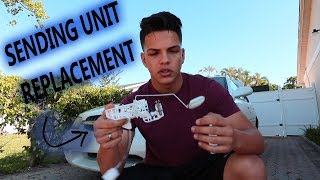
Typical fix: Replace the fuel level sensor. Per Nissan's TSB, the sensor can be replaced separately from the fuel pump assembly. The fuel tank may need to be partially dropped to access the assembly. 🎬 See this walkthrough on replacing the fuel level sensor. The first step is to depressurize the fuel system and disconnect the negative battery terminal.
Est. part cost: $120-$200 - Wiring Harness or Connector Issues 🟡 Medium Probability The wiring that runs to the fuel tank is exposed to the elements under the vehicle and can be damaged by road debris or corrosion, leading to a short to ground in the signal wire. The connector on top of the fuel pump assembly can also corrode.
How to confirm: Visually inspect the wiring harness leading to the fuel tank for any signs of chafing, breaks, or corrosion. Check the connector at the fuel pump module for corrosion or loose pins. A user on a Carly forum noted that cleaning a corroded connector solved their stalling and fuel gauge issue.
Typical fix: Repair the damaged section of wire or clean/replace the faulty connector.
Est. part cost: $5-$50
Rare But Worth Checking
- Faulty Instrument Cluster: While rare, the instrument cluster itself processes the signal from the sensor to display the fuel level. A failure within the cluster's circuitry, such as a bad capacitor, can mimic the symptoms of a bad sensor. One Nissan owner reported replacing the sensor did not fix the issue, but swapping the instrument panel did.
- Faulty Powertrain Control Module (PCM): This is extremely rare. The PCM should only be considered a potential cause after all other possibilities (sensor, wiring, cluster) have been exhaustively ruled out.
- Stuck Fuel Level Float Arm: It is possible, though uncommon, for the float arm itself to become mechanically stuck in the lowest position due to debris in the tank or if the vehicle has sat for a very long time.
Diagnosis Steps
- Verify the P0462 code is present using an OBD-II scanner. Note any other related codes (P0460, P0461, P0463).
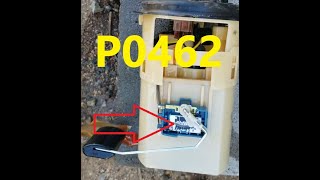
- Use the scanner's live data function to observe the fuel level sensor voltage. A reading consistently below 0.5 volts, often near zero, strongly suggests a short or failed sensor. 🎬 Watch: A breakdown of P0462 causes and common fixes.
- Visually inspect the wiring harness and connector leading to the fuel tank. Look for any obvious damage, corrosion, or loose connections.
- Access the fuel pump assembly connector, which is typically under the rear seat cushion. Lift the cushion to find the access panel. 🎬 Watch: How to access and remove the fuel pump assembly.
- Disconnect the connector and use a multimeter set to Ohms to test the resistance across the fuel level sensor pins. Refer to a service manual for the exact pins. A healthy sensor should show resistance changing smoothly as the fuel level changes. A reading near zero ohms or OL (open loop) indicates a failed sensor.
- If the resistance is out of specification, the fuel level sensor has failed and needs to be replaced.
- If the sensor tests good, check for a short to ground on the signal wire between the fuel pump connector and the ECM.
- If wiring and the sensor are confirmed to be good, the problem may lie with the instrument cluster or, very rarely, the ECM.
Parts You'll Likely Need
- Fuel Level Sensor (AWD)
(OEM #25060-1KM1A)— This is the most common failure point for code P0462 on AWD Juke models, as confirmed by owner experiences and a manufacturer TSB.
Trusted brands: Nissan (OEM)
OEM price range: $140-$200
Aftermarket price range: $70-$110 - Fuel Level Sensor (2WD)
(OEM #25060-1KM0A)— This is the corresponding part for the 2WD (Front-Wheel Drive) models.
Trusted brands: Nissan (OEM)
OEM price range: $110-$170
Aftermarket price range: $60-$100 - Fuel Tank O-Ring / Gasket
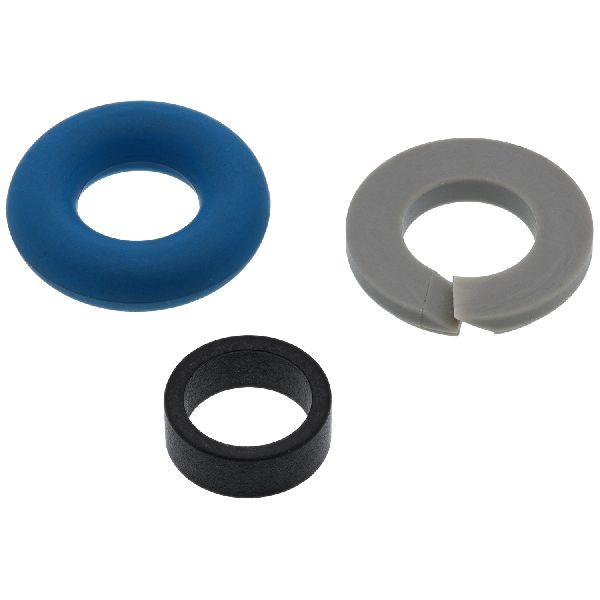
(OEM #17342-CE800 or 17342-EM30A)— This seal is located between the fuel pump assembly and the fuel tank. It is a single-use part that should be replaced whenever the fuel pump assembly is removed to prevent fuel leaks and fumes.
Trusted brands: Nissan (OEM)
OEM price range: $25-$40
Aftermarket price range: $10-$20
Related Codes That Often Appear With This One
- P0460 — This is a generic code for a 'Fuel Level Sensor Circuit Malfunction' and can be triggered by the same fault.
- P0461 — This code indicates a 'Fuel Level Sensor Circuit Range/Performance' issue, often set when the signal is erratic or irrational, which can happen as the sensor fails.
- P0463 — This code for 'Fuel Level Sensor Circuit High Input' can appear intermittently with P0462 if the failing sensor's signal is jumping between high and low extremes.
Technical Service Bulletins (TSBs) & Recalls
- NTB22-026: Addresses fuel level sensor codes and confirms that the sensor can be replaced separately from the fuel pump assembly. It applies to the Juke, Rogue, Sentra, and other Nissan vehicles.
Platform-Specific Known Issues
- Nissan has issued Technical Service Bulletin NTB22-026, which applies to the 2016-2017 JUKE (and other models like the Rogue and Sentra) and addresses codes P0460, P0461, P0462, and P0463. It specifically notes that the fuel level sensor can be replaced separately from the fuel pump assembly, which is a key piece of information for a cost-effective repair.
- There are different part numbers for the fuel level sensor depending on whether the Juke is All-Wheel Drive (AWD) or Front-Wheel Drive (2WD). The AWD part is 25060-1KM1A, while the 2WD part is 25060-1KM0A.
Mechanic-Grade Diagnostic Values
- Fuel Level Sensor Signal Voltage — expected: 0.5V (empty) to 4.5V (full). Failure: Consistently below 0.5V, often near 0V, triggers P0462.
- Fuel Level Sensor Resistance — expected: Approx. 30-40 Ω when empty and 250-300 Ω when full. The reading should change smoothly when rocking the vehicle or adding fuel.. Failure: A reading near 0 Ω (short), OL/infinite resistance (open), or readings that do not change smoothly indicate a failed sensor.
- Ground Circuit Resistance — expected: Less than 1.0 Ω from the fuel pump connector ground wire to a clean chassis point.. Failure: Resistance over 5.0 Ω indicates a poor ground connection that can cause erratic readings.
Scan Tool Commands That Help
- Nissan CONSULT or professional-grade scanner: Live Data: Meter/BCM Module — To observe the raw voltage or resistance value being reported by the fuel level sensor(s) to the Body Control Module or Instrument Cluster. This helps confirm if the computer is receiving the same low signal that is triggering the code.
- Nissan CONSULT or professional-grade scanner: Work Support: Fuel Gauge Calibration/Reset — After replacing the fuel level sensor, some modules may benefit from a calibration or reset function to ensure the gauge displays the correct level accurately.
- Nissan CONSULT: IPDM E/R Configuration — This is a mandatory procedure if the Intelligent Power Distribution Module (IPDM) is replaced. The vehicle will not start until the new module is programmed to the vehicle's specifications.
Wiring & Ground Locations
- Fuel Pump Fuse F20 — Located in the main engine compartment fuse box (which is the IPDM E/R), hidden behind the battery and under a plastic air hose.. This 15A fuse supplies power to the fuel pump. While not a direct cause of a 'low circuit' code (which is a signal issue), checking it is a basic preliminary step in any fuel system diagnosis.
- IPDM E/R (Intelligent Power Distribution Module Engine Room) — This is the main fuse/relay box in the engine compartment, near the battery.. On the Juke, this module replaces a traditional fuel pump relay and controller. It directly controls the fuel pump based on CAN bus signals. A fault within the IPDM could theoretically cause fuel system issues, though P0462 points more to the sensor/wiring.
- Fuel Pump Assembly Ground — The ground path for the fuel pump and sensor is controlled by the vehicle's computer systems, often through a dedicated control module (like the FPCU in other Nissans, or integrated into the IPDM/BCM on the Juke). The final chassis ground point is often located in the engine bay or on the main frame.. A poor ground connection for the sensor circuit is a common cause of incorrect voltage readings. A high-resistance ground can prevent the signal voltage from dropping correctly, though P0462 is a 'low' code, often indicating a direct short to ground.
Real Owner Repair Stories
- YouTube video from channel 'Car Problems Urdu Hindi' (Nissan Juke (year not specified, F15 generation)) — Inaccurate fuel gauge and low fuel light on despite having fuel.
❌ Tried (didn't work) Initial diagnosis pointed to a standard electrical sensor failure.
✅ What actually fixed it The mechanic removed the fuel pump assembly and found the plastic structure holding the float arm was physically broken on one side and bent. This caused the float to sit at an incorrect angle, providing a false reading. The mechanic repaired the bent and broken plastic assembly, reinstalled it, and the gauge began reading correctly. This was a mechanical failure, not an electrical one. - NICOclub forum user 'elwesso' (Nissan Q45 (Principle applies to Nissan fuel control logic)) — Car died 50 miles after a new fuel pump was installed. The pump would not run.
❌ Tried (didn't work) Replacing the Fuel Pump Control Unit (FPCU) did not solve the problem.
✅ What actually fixed it The car would only run if the ground wire at the FPCU was manually jumped to the chassis. The problem was not the pump or the FPCU itself, but that the FPCU had lost its own chassis ground. The fix was to re-establish a solid ground connection for the control module. This highlights that control modules themselves need a good ground to function.
OEM Part Supersession History
25060-1KM1A→N/A— This is the Primary Fuel Level Sensor ('A') for AWD models, located on the driver's (Left) side.
Heads up: AWD models have a saddle tank and use a second, different sensor on the passenger (Right) side, PN 25060-1KM1B. P0462 specifically refers to sensor 'A' (1KM1A). Do not confuse the two.25060-1KM0A→N/A— This is the fuel level sensor for 2WD models, which use a single-sensor configuration.
Heads up: This part is not for AWD models.
Helpful Videos

We Have This Part in Stock


The information in this article is provided for general reference and educational purposes only. Vehicle specifications, procedures, and part compatibility can vary by production date, trim level, and region. Always consult your vehicle's factory service manual and verify part numbers before purchasing or performing repairs. Safety-critical components such as airbags, seat belts, and braking systems should be installed by a qualified professional.
- Nissan JUKE:
- 🎬 Helpful Videos
- 🛍️ Shop This Part
- What's Unique About the 2016-2017 Nissan JUKE
- Diagnostic Flowchart
- Symptoms You May Notice
- Most Likely Causes
- Rare But Worth Checking
- Diagnosis Steps
- Parts You'll Likely Need
- Related Codes That Often Appear With This One
- Technical Service Bulletins (TSBs) & Recalls
- Platform-Specific Known Issues
- Mechanic-Grade Diagnostic Values
- Scan Tool Commands That Help
- Wiring & Ground Locations
- Real Owner Repair Stories
- OEM Part Supersession History
- 🎟️ Get 5% Off