

P0461 on 2013-2014 Volkswagen Beetle: Fuel Level Sensor Causes and Fixes
This code means your Beetle's fuel gauge is unreliable due to a problem with the fuel level sensor. The most common fix is to replace the fuel level sending unit, which is located in the fuel tank and often integrated with the fuel pump module. The sender's resistive strip wears out over time. Expect to pay $150-$400 for an aftermarket part, with the replacement being a moderately difficult DIY job.
- P0461 on your 2013-2014 Beetle almost always points to a problem with the fuel level sensor in the gas tank.
- The most common symptom is an unreliable fuel gauge, which can cause you to run out of gas. Manually track your mileage as a backup.
- The most probable fix is replacing the fuel level sending unit (Part #1K0-919-673-AF), which is accessible from under the rear seat.
- Before replacing parts, visually inspect the connector on top of the fuel tank for corrosion, as this can be a simpler fix.
- This is a common issue on other VWs from the same era, like the Golf and Jetta.
What's Unique About the 2013-2014 Volkswagen BEETLE
The 2013-2014 Beetle (A5 generation) shares its PQ35 platform with other VW models like the Jetta and Golf, so this issue is not unique to the Beetle. The fuel level sensor is typically integrated into the main in-tank fuel pump assembly. While wiring or other issues can cause this code, the sending unit itself is the most frequent point of failure on this platform due to wear on its internal resistor strip.
Diagnostic Flowchart
Tap your situation to follow the diagnostic path that matches what you're seeing on this vehicle.
Symptoms You May Notice
- Inaccurate or wildly fluctuating fuel gauge.
- Fuel gauge stuck on empty or full.
- Check Engine Light is on.
- Low fuel warning light may flash or stay on even with a full tank.
- In rare cases, stalling at idle has been reported, potentially due to the faulty sensor signal affecting fuel pump operation.
- Difficulty filling the fuel tank; the pump nozzle may click off prematurely if the system incorrectly believes the tank is full.
- Replacing the instrument cluster before thoroughly testing the fuel level sender and its wiring.
- Replacing the entire fuel pump assembly when only the sending unit has failed (though they are often sold as an integrated unit).
Most Likely Causes
- Faulty Fuel Level Sending Unit 🔴 High Probability The variable resistor contacts on the sending unit can wear out, become contaminated by fuel additives or sulfur, or corrode over time, leading to erratic signals. This is a common wear-and-tear item.
How to confirm: Using a scan tool, observe the fuel level sensor's live data. If the reading is erratic, does not change when fuel is added, or shows an illogical value, the sender is likely faulty. For a definitive test, remove the unit and test its resistance with a multimeter while moving the float arm. The resistance should change smoothly. For many VWs, the range is approximately 250-280 Ohms (empty) to 20-50 Ohms (full). Any jumps or dead spots confirm a bad sender.
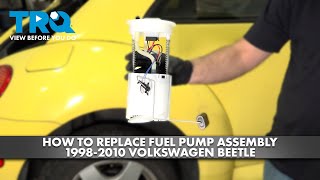
Typical fix: Replace the fuel level sending unit. 🎬 Watch: How to replace the fuel level sender unit It is often sold as part of the complete fuel pump module, but can sometimes be purchased separately. Always replace the large tank seal at the same time to prevent leaks.
Est. part cost: $150-$400 - Wiring or Connector Issue 🟡 Medium Probability The wiring harness leading to the fuel tank can be susceptible to corrosion or damage. The main connector on top of the fuel pump assembly is a common spot for moisture intrusion, and the fuel tank grounding strap can also corrode, causing erratic readings.
How to confirm: Visually inspect the wiring and connector at the top of the fuel pump assembly (usually under the rear seat) for any signs of corrosion, damage, or loose connections. Check the fuel tank ground strap for integrity. Check for continuity and proper voltage at the connector using a multimeter and a wiring diagram.
Typical fix: Repair the damaged section of the wiring harness, clean the ground connection point, or clean/replace the corroded connector.
Est. part cost: $10-$50 - Stuck Fuel Level Float ⚪ Low Probability Debris in the fuel tank or mechanical failure can cause the float arm to become stuck in one position. The float itself can also become saturated with fuel over time and fail to rise properly.
How to confirm: If the fuel level reading on a scan tool is stuck at a fixed value and does not change at all (even after rocking the vehicle or adding fuel), the float may be stuck. Confirmation requires removing the fuel pump assembly to visually inspect the float's movement.
Typical fix: Free the stuck float. If the arm is damaged or the float is saturated, the sending unit will need to be replaced.
Est. part cost: $0-$400
Rare But Worth Checking
- Faulty Instrument Cluster: The instrument cluster processes the signal from the sender to display it on the gauge. A failure here is uncommon but possible if the sender and wiring test good.
- Faulty Powertrain Control Module (PCM): In very rare cases, the PCM itself can fail to correctly interpret the sensor's signal. This should only be considered after all other possibilities have been exhausted.
- Software Glitch: While less common on this specific platform, other VW/Audi vehicles have experienced P0461 due to software errors that misinterpret sensor data, especially after certain refueling behaviors. An Audi TSB (2041594/2) and a VW Atlas TSB (01-23-06) both address this with a software update, showing it's a possibility within the VAG family.
Diagnosis Steps
- Safety First: Before working on the fuel system, disconnect the battery and ensure you are in a well-ventilated area with no open flames or sparks. Relieve fuel system pressure if required by your service manual.
- Scan Tool Data: Connect an OBD-II scanner and confirm the P0461 code. 🎬 See this quick guide on fixing the P0461 code View the live data for 'Fuel Level Sensor' or a similar PID. Note the reading in percentage or volts.
- Physical Test: Gently rock the vehicle side-to-side to see if the reading on the scan tool fluctuates erratically or stays stuck. An erratic reading points towards a bad sender; a stuck reading could be a stuck float or bad sender.
- Access and Inspect: Access the top of the fuel pump module by lifting the rear seat cushion and removing the access cover. Inspect the electrical connector and wiring for any visible signs of damage, corrosion, or looseness. Check the chassis ground strap for the fuel tank if accessible.
- Voltage Check: With the key on, carefully back-probe the connector to check for the correct reference voltage being sent to the sensor and a good ground.
- Resistance Test (The Definitive Test): Disconnect the fuel pump assembly connector. Remove the fuel pump/sending unit assembly from the tank. Connect a multimeter set to Ohms to the sensor's pins. Manually move the float arm up and down. The resistance reading should change smoothly and linearly without any dropouts or spikes. A common VW range is ~280 ohms at empty to ~50 ohms at full. If the reading is erratic, the sending unit is bad.
- Final Consideration: If the sensor and wiring test good, the issue may lie with the instrument cluster or PCM, which requires more advanced diagnostics.
Parts You'll Likely Need
- Fuel Level Sending Unit
(OEM #1K0-919-673-AF)— This is the most common component to fail, causing the erratic signal that triggers code P0461. It is often integrated with the in-tank fuel pump but can be sourced separately.
Trusted brands: VDO (OEM supplier), Bosch, Genuine VW, Topran
OEM price range: $100-$150
Aftermarket price range: $30-$80 - Fuel Tank Seal / Gasket — This rubber gasket seals the fuel pump assembly to the tank. It is critical to replace it whenever the assembly is removed to prevent dangerous fuel leaks 🎬 Watch: Step-by-step fuel pump and filter replacement walkthrough and vapor smells.
Trusted brands: Genuine VW, Elring, Vaico
OEM price range: $15-$30
Aftermarket price range: $10-$20
Related Codes That Often Appear With This One
- P0462 — This code indicates the fuel level sensor circuit input is low, which can be an intermittent state of the same failure causing P0461.
- P0463 — This code indicates the fuel level sensor circuit input is high, which can be an intermittent state of the same failure causing P0461.
Technical Service Bulletins (TSBs) & Recalls
- VIN4APIN20210728: Mentions customer complaints of MIL-on with P0461 in the ECM for the 2013 VW Beetle, among other codes.
- Audi TSB 2041594/2: While for Audi models, this TSB shows that VAG has acknowledged P0461 can be triggered by software that needs an update, establishing a precedent for non-hardware causes.
Platform-Specific Known Issues
- The provided NHTSA TSB VIN4APIN20210728 lists P0461 as a potential customer complaint for the 2013 Beetle, indicating it's a recognized issue by the manufacturer.
- Contamination of the resistive strip on the sender from sulfur in fuel is a known issue on this platform, leading to incorrect resistance readings.
Mechanic-Grade Diagnostic Values
- Fuel Level Sender Resistance — expected: Older air-cooled VWs are often 10 Ohms (full) to 73 Ohms (empty). However, some modern VW/Audi platforms use a reversed range, such as ~50 Ohms (full) to ~200-280 Ohms (empty). The key is a smooth transition, not the exact numbers.. Failure: Sudden jumps, dropouts to zero, or infinite resistance (open circuit) when moving the float arm.
- VCDS Live Data - Instrument Cluster (17) — expected: In Measuring Blocks, Group 002, the fuel level resistance in Ohms should be displayed and should react smoothly to fuel sloshing or filling.. Failure: The value is erratic, stuck, or does not match a manual multimeter reading at the sender.
Scan Tool Commands That Help
- VCDS (VAG-COM): Instrument Cluster (17) -> Output Tests (03) — To perform a gauge sweep test. This command cycles all the instrument cluster needles through their full range of motion, which helps confirm if the fuel gauge needle itself is physically able to move correctly, isolating the problem to the sender/wiring or the gauge's internal electronics.
- VCDS (VAG-COM): Instrument Cluster (17) -> Adaptation (10) -> Channel 30 — To calibrate the fuel gauge after replacing the sender. The default value is 128. It can be adjusted between 120-136 to fine-tune the needle position by +/- 2 liters. This is useful if a new, slightly different resistance range sender causes the gauge to read inaccurately.
Wiring & Ground Locations
- Fuel Pump Ground — The fuel pump assembly is typically grounded through its wiring harness to a chassis ground point. For many VWs, a common ground splice pack is located under the rear seat or in the trunk area, often secured by a single 10mm bolt. A corroded or loose ground at this point can cause erratic pump and sender behavior.. A poor ground for the fuel sending unit can cause fluctuating voltage signals, which is a direct cause of the P0461 range/performance error.
- Fuel Pump Connector — On top of the fuel pump assembly, accessible by removing the rear seat cushion and a metal or rubber access cover.. This connector is the primary interface for the fuel level sender. Corrosion or damage to the pins here will directly impact the signal sent to the instrument cluster and ECM.
Real Owner Repair Stories
- Ross-Tech Forums user (2006 New Beetle Cabriolet) — Fuel gauge wandering all over the place, then after sender replacement, gauge stuck on empty with low fuel light on.
❌ Tried (didn't work) Initial replacement of the fuel sender with a new one that came with a complete fuel pump assembly.
✅ What actually fixed it The fuel pump assembly that was ordered came with the incorrect sender unit for that specific model year Beetle. The user ordered a new sender using the official VW part number, which was different from the one included with the pump, and this resolved the issue.
When the Usual Fixes Don't Work
- While Pass 2 correctly identifies the fuel sending unit as the most common cause, a real-world repair story highlights a critical nuance: replacing the sender with an incorrect (but physically compatible) part can lead to a persistent problem. A user on the Ross-Tech forums replaced their sender, but the gauge remained stuck on empty. The final fix was realizing the new pump assembly came with the wrong sender for their model year. They had to order the sender separately using the official VW part number to resolve the issue, demonstrating the importance of VIN-specific part verification over visual matching.
OEM Part Supersession History
1K0-919-673-AF→No direct supersession found, but this part number is used across a wide range of VW/Audi/SEAT/Skoda models from 2005-2019.— N/A
Heads up: While the part number is widely used, forum reports indicate that different resistance ranges exist even for parts that look identical. It is critical to match the part to the vehicle's VIN to avoid installing a sender that reads in reverse or is calibrated incorrectly.
Helpful Videos


We Have This Part in Stock

The information in this article is provided for general reference and educational purposes only. Vehicle specifications, procedures, and part compatibility can vary by production date, trim level, and region. Always consult your vehicle's factory service manual and verify part numbers before purchasing or performing repairs. Safety-critical components such as airbags, seat belts, and braking systems should be installed by a qualified professional.
- Volkswagen BEETLE:
- 🎬 Helpful Videos
- 🛍️ Shop This Part
- What's Unique About the 2013-2014 Volkswagen BEETLE
- Diagnostic Flowchart
- Symptoms You May Notice
- Most Likely Causes
- Rare But Worth Checking
- Diagnosis Steps
- Parts You'll Likely Need
- Related Codes That Often Appear With This One
- Technical Service Bulletins (TSBs) & Recalls
- Platform-Specific Known Issues
- Mechanic-Grade Diagnostic Values
- Scan Tool Commands That Help
- Wiring & Ground Locations
- Real Owner Repair Stories
- When the Usual Fixes Don't Work
- OEM Part Supersession History
- 🎟️ Get 5% Off