

P0461 on 2019-2020 Ram 2500: Fuel Level Sensor Performance Causes and Fixes
On a 2019-2020 Ram 2500, P0461 is often caused by a software issue that requires a dealer reflash. If software is current, the fuel level sending unit (part of the fuel pump module) has likely failed. Always check for TSBs before replacing parts, especially on 2020 diesel models with the 50-gallon tank, which are subject to a specific bulletin regarding PCM configuration and fueling habits.
- Always check with a Ram dealer for software updates before replacing any parts. A PCM reflash is a very common and inexpensive fix for P0461 on these trucks.
- If a hardware repair is needed, the entire fuel pump module (which includes the sending unit) must be replaced. This is a labor-intensive job.
- You can continue to drive with this code, but you cannot trust your fuel gauge. Track your mileage manually to avoid running out of fuel.
- For 2020 diesel models with the 50-gallon tank, be aware that your fueling habits or a simple PCM configuration error could be the cause, not a broken part.
What's Unique About the 2019-2020 Ram 2500
For the fifth-generation Ram 2500, this code is very frequently a software problem, not a hardware failure. Ram has issued multiple Technical Service Bulletins (TSBs) for both gasoline and diesel models that address P0461 with a PCM software update. This suggests the original software logic was overly sensitive or had glitches. 🎬 Watch: Understanding P0461 causes and common fixes. For 2020 diesel models with the optional 50-gallon tank (Sales Code NFC) built on or before June 11, 2020, TSB 14-002-20 is particularly important. It notes the code can be triggered by an incorrect computer configuration that requires a dealer to run an 'enable 50 gallon tank' routine, or by specific fueling habits, like repeatedly adding small amounts of fuel when the tank is below 15% full over a 240-mile interval.
Diagnostic Flowchart
Tap your situation to follow the diagnostic path that matches what you're seeing on this vehicle.
Symptoms You May Notice
- Inaccurate or wildly fluctuating fuel gauge.
- Fuel gauge stuck on empty or full.
- Check Engine Light (Malfunction Indicator Lamp) is on.
- Low fuel warning light may be on, even with a full tank, or may not illuminate when the tank is empty.
- Distance to Empty (DTE) reading is inaccurate or shows dashes.
- Replacing the fuel pump module before checking for software updates. A PCM reflash is a very common, less expensive fix for this specific truck and code.
- Replacing the instrument cluster. A faulty gauge is possible but extremely rare, as the signal is processed by the PCM first, making a sensor, software, or wiring issue far more likely.
Most Likely Causes
- Outdated Powertrain Control Module (PCM) Software 🔴 High Probability Multiple TSBs (e.g., S2008000120RevB for gas, 18-012-21 REV. A for diesel) have been issued by Ram to fix this code with a software update, indicating the original logic was too sensitive or contained errors. These updates often bundle fixes for several unrelated codes.
How to confirm: A Ram dealership or a qualified shop with a wiTECH scan tool can check your VIN for applicable TSBs and see if a software update is available. This should always be the first step.
Typical fix: Reflashing the PCM with the latest manufacturer software. This is a dealer-only procedure that typically costs between $100 and $200.
Est. part cost: $0 - Faulty Fuel Level Sending Unit 🟡 Medium Probability The sending unit is a mechanical component with a float and a variable resistor that can wear out, become contaminated, or develop dead spots, leading to erratic readings. The float arm can also become stuck.
How to confirm: If a software update doesn't fix the code, monitor the fuel level sensor voltage on a scan tool. A normal range is typically ~0.5V (empty) to ~4.5V (full). If the voltage is erratic or doesn't change smoothly as the vehicle is rocked, the sending unit is likely bad. A definitive test involves measuring the sensor's resistance sweep with a multimeter; for diesel models, the expected range is approximately 20 Ohms (Full) to 220 Ohms (Empty). Another diagnostic trick is to jump the sensor connector pins with a known resistor (e.g., 470 ohms) to see if the gauge reads a corresponding level (around half a tank).
Typical fix: The sending unit is integrated with the fuel pump module inside the fuel tank. The entire module must be replaced. This requires dropping the fuel tank or lifting the truck bed for access. Many owners and technicians prefer lifting the bed as it can be easier than handling a heavy fuel tank.
Est. part cost: $390-$850 - Wiring Harness or Connector Issue ⚪ Low Probability The harness running to the fuel tank is exposed to road debris and weather, which can cause corrosion on connector pins, chafed wires, or a poor ground connection. The main connector on top of the fuel tank is a common spot for moisture intrusion.
How to confirm: Visually inspect the wiring and the main connector on top of the fuel tank for corrosion or damage. On many 2019+ models, the sensor wires are Pin 2 (Black) and Pin 3 (Dark Blue with White tracer) in the gray 4-pin connector. Test for continuity (should be <5.0 Ohms) and shorts on the signal and ground wires between the PCM and the tank connector.
Typical fix: Repair the damaged section of wiring or clean/replace the corroded connector pigtail.
Est. part cost: $20-$100
Rare But Worth Checking
- Incorrect PCM Configuration (50-Gallon Tank): On 2020 diesel models with the 50-gallon tank, TSB 14-002-20 (also known as RRT 20-081) notes the code can be set if the PCM configuration for the tank size is incorrect. A dealer must use the wiTECH tool to perform an 'enable 50 gallon tank' routine to resolve this.
Diagnosis Steps
- Check for active Technical Service Bulletins (TSBs) with a dealer using your VIN. This is the most critical first step, especially for 2020 diesel models with the 50-gallon tank (check for TSB 14-002-20).
- If a TSB for a PCM software update exists, have the dealer perform the reflash.
- If the code persists, use a scan tool to monitor the 'Fuel Level Sensor 1' voltage or percentage. The reading should be stable and change logically as fuel is consumed. A typical voltage range is ~0.5V (empty) to ~4.5V (full).
- Visually inspect the wiring harness and the 4-pin gray connector on top of the fuel tank for any signs of physical damage, chafing, or corrosion.
- If the signal is erratic and wiring appears okay, the fuel level sending unit is the primary suspect. Access the fuel pump module by dropping the tank or lifting the bed. Note: For some tank sizes, like the 32-gallon, the pump assembly is partially under the cab, forcing you to drop the tank instead of lifting the bed.
- Test the resistance of the sending unit directly at the module. The resistance should change smoothly as you manually move the float arm. For diesel models, the range is about 20 Ohms (full) to 220 Ohms (empty). An open circuit (infinite resistance) or erratic jumps indicate a failed sensor.
- If the sensor and wiring both test good, the issue may be an internal fault in the Powertrain Control Module (PCM), though this is rare.
Parts You'll Likely Need
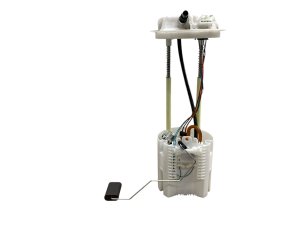
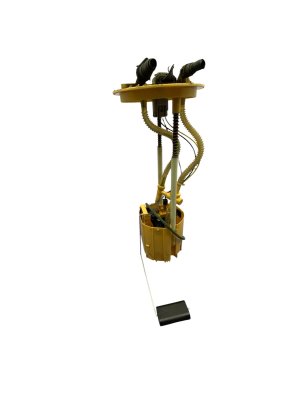
- Fuel Pump and Sending Unit Assembly
(OEM #68490266AB)— The fuel level sensor (sending unit) is the most common hardware failure for this code. It is integrated into the fuel pump module and is not sold separately, requiring the replacement of the entire assembly. This part number is for the 6.7L diesel and supersedes 68490266AA. Always verify fitment with your VIN.
Trusted brands: Mopar
OEM price range: $580-$850
Aftermarket price range: $390-$550
Related Codes That Often Appear With This One
- P0191 — Mentioned in TSB #1810222REVA and #18-012-21 REV. A alongside P0461. This suggests a potential shared cause, such as a PCM software glitch or a widespread wiring harness issue affecting multiple sensors.
- P0299 — Listed in TSB #1806623 and TSB 18-012-21 REV. A with P0461. The connection is a comprehensive software update that addresses multiple unrelated performance codes simultaneously.
- P0401 — Appears with P0461 in TSBs #1810222REVA and #18-012-21 REV. A, pointing towards a PCM software update that resolves various system monitoring faults.
- P203F — A user on the HD Rams forum reported this code appearing alongside P0461 on a 2020 truck with a 50-gallon tank, which was ultimately resolved by the dealer performing the TSB 14-002-20 re-configuration.
Technical Service Bulletins (TSBs) & Recalls
- 1810222REVA: Addresses P0461 on 2020 diesel models as part of a software update.
- 1806623: Lists P0461 on 2019 models, likely fixed by a software update.
- S2008000120RevB: Specific to P0461 on 2020 gasoline models.
- 18-012-21 REV. A: Covers P0461 on 2020 diesel models, fixed by a PCM reflash.
- 14-002-20: For 2020 diesel models with 50-gallon tanks, addresses P0461 caused by fueling habits or PCM configuration. Also known as RRT 20-081.
Platform-Specific Known Issues
- TSB S2008000120RevB was issued for 2020 gasoline models specifically for P0461, often requiring a PCM reflash.
- TSB 14-002-20 applies to 2020 diesel models with the 50-gallon tank built on or before June 11, 2020. It notes that P0461 can be caused by specific fueling habits (adding small amounts of fuel when the tank is below 15%) or a PCM configuration error, not necessarily a hardware fault.
- TSB 18-012-21 REV. A (and subsequent REV. B) is a comprehensive PCM software update for 2020 diesel models that resolves P0461 along with many other drivability and system faults.
- Multiple other TSBs (#1810222REVA, #1806623) include P0461 as a code resolved by a comprehensive PCM software update for both gas and diesel engines.
Mechanic-Grade Diagnostic Values
- Fuel Level Sensor Voltage (Live Data) — expected: ~0.5V (Empty) to ~4.5V (Full). Failure: Voltage is stuck, erratic, jumps, or is consistently outside this range while rocking the vehicle.
- Fuel Level Sending Unit Resistance (Diesel Models) — expected: Approx. 20 Ohms (Full) to 220 Ohms (Empty). Failure: Readings show an open circuit (OL), are outside the range, or do not change smoothly when manually moving the float arm.
- Fuel Level Sending Unit Resistance (Alternate Spec) — expected: Approx. 50 Ohms to 1,000 Ohms. Failure: Readings are outside this range or do not sweep smoothly. This may apply to gasoline models or different tank configurations.
- Resistor Substitution Test — expected: Jumping the signal and return pins (Pin 2 and 3) on the vehicle-side harness with a 470 Ohm resistor should make the gauge read approx. half a tank.. Failure: If the gauge does not respond or reads incorrectly, the issue is likely in the wiring, PCM, or instrument cluster, not the sending unit.
- Signal Circuit Continuity — expected: Less than 5.0 Ohms. Failure: Resistance higher than 5.0 Ohms indicates excessive resistance in the wiring harness between the PCM and the fuel tank connector.
Scan Tool Commands That Help
- wiTECH: PCM Reprogramming/Flash — This is the primary fix when a TSB is available for P0461. It updates the PCM software to correct over-sensitive logic or other glitches causing the code to set falsely.
- wiTECH: Enable 50 Gallon Tank Routine — This is a specific routine required by TSB 14-002-20 for 2020 diesel models with the 50-gallon tank. It corrects a PCM configuration error that can cause P0461.
- wiTECH: View Live Data (Fuel Level Sensor Voltage/Resistance) — Used to monitor the sensor's output in real-time while rocking the vehicle or driving to check for erratic signals, confirming a sensor or wiring fault.
Wiring & Ground Locations
- Fuel Pump Module Connector — On top of the fuel tank. It is a gray, 4-pin connector on most 2019-2020 models.. This is the primary connection point for the fuel level sensor. It is exposed to the elements and is a common location for corrosion or pin damage that directly causes P0461.
- Fuel Level Sensor Wires — In the 4-pin connector at the tank: Pin 2 (Black) is the sensor return/ground, and Pin 3 (Dark Blue with White tracer) is the signal wire.. These are the specific wires to test for voltage, resistance, and continuity when diagnosing the circuit.
- Fuel Tank Ground Strap — A strap connecting the metal fuel tank (if equipped) to the vehicle's frame/chassis.. Corrosion or a loose connection at this ground point can create a poor ground reference for the sending unit, causing erratic voltage readings and triggering P0461 without the sensor itself being faulty.
- Powertrain Control Module (PCM) — Located in the engine compartment, on the passenger's side, towards the rear firewall.. This is the destination for the fuel level sensor signal. The wiring must be checked back to this point. In rare cases, the PCM itself can be the fault.
Real Owner Repair Stories
- HD Rams Forum User (2020 Ram 2500 6.7L Cummins with 50-gallon tank) — Check Engine Light with codes P0461 and P203F stored.
❌ Tried (didn't work) Initial diagnosis pointed towards a faulty sensor.
✅ What actually fixed it The dealer performed the procedure outlined in TSB 14-002-20, specifically running the 'enable 50 gallon tank routine' with the wiTECH scan tool. No parts were replaced. - Camaro5 Forum User (similar issue) (5th Gen Chevrolet Camaro with aftermarket dual fuel pumps) — Persistent P0461 code after installing new fuel pump module.
❌ Tried (didn't work) Calibrating the new fuel pump module with tuning software.
✅ What actually fixed it The problem was a single spread female pin in the main fuel pump connector that was not making consistent contact. The fix was to perform a 'pin drag test' using a spare male pin to check the tension of each female terminal, identify the loose one, and replace that specific terminal.
When the Usual Fixes Don't Work
- While replacing the fuel pump module is a common fix, a significant number of P0461 cases on this platform are resolved without replacing any parts. The most common counter-evidence is a dealer performing a PCM software update as directed by a TSB. The second most common is resolving the issue via the 'enable 50 gallon tank' routine for specific 2020 diesel models. Lastly, technicians sometimes find the root cause to be a simple, inexpensive wiring issue, such as a corroded fuel tank ground strap or a loose terminal in the main connector, which can be fixed for a fraction of the cost of a new fuel pump module.
OEM Part Supersession History
68490266AA→68490266AB— Revision or update to the part.
Heads up: This part number is typically for 6.7L Diesel models with the 48 or 50-gallon tank. Always verify with VIN.5145571AA, 5145625AA→05145571AB— Part consolidation and revision.
Heads up: This part number is listed for 6.7L Diesel models with the 31 or 32-gallon tank. This highlights the importance of matching the part to the tank size.
Model Year Variations Within This Range
- 2019-2020 (Diesel): These model years used the Bosch CP4.2 high-pressure fuel pump, which was subject to a major safety recall (Y78 / NHTSA 21V880). The recall fix involves replacing the CP4 with a CP3 pump and a mandatory PCM software update. This software update could inadvertently resolve unrelated software-based P0461 issues.
- 2020 (Diesel with 50-gallon tank): Models built on or before June 11, 2020, are subject to TSB 14-002-20, which points to fueling habits or a PCM configuration error as a cause for P0461, rather than a hardware failure.
- 2020 (Gasoline): These models are specifically covered by TSB S2008000120RevB for P0461, pointing to a software fix.
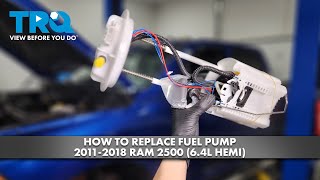
Helpful Videos

Used OEM Parts in Stock




New Aftermarket Parts Available


The information in this article is provided for general reference and educational purposes only. Vehicle specifications, procedures, and part compatibility can vary by production date, trim level, and region. Always consult your vehicle's factory service manual and verify part numbers before purchasing or performing repairs. Safety-critical components such as airbags, seat belts, and braking systems should be installed by a qualified professional.
- Ram 2500:
- 🎬 Helpful Videos
- 🛍️ Shop This Part
- What's Unique About the 2019-2020 Ram 2500
- Diagnostic Flowchart
- Symptoms You May Notice
- Most Likely Causes
- Rare But Worth Checking
- Diagnosis Steps
- Parts You'll Likely Need
- Related Codes That Often Appear With This One
- Technical Service Bulletins (TSBs) & Recalls
- Platform-Specific Known Issues
- Mechanic-Grade Diagnostic Values
- Scan Tool Commands That Help
- Wiring & Ground Locations
- Real Owner Repair Stories
- When the Usual Fixes Don't Work
- OEM Part Supersession History
- Model Year Variations Within This Range
- 🎟️ Get 5% Off