

P0461 on 2016-2017 Nissan Quest: Fuel Level Sensor Causes and Fixes
This code almost always indicates a faulty fuel level sensor inside the gas tank. Nissan TSB NTB22-026 confirms this is a known issue and advises replacing only the sensor, not the entire fuel pump assembly, which is a much more expensive repair.
- P0461 on a 2016-2017 Nissan Quest almost certainly means the fuel level sensor has failed.
- Your primary symptom will be an erratic or inaccurate fuel gauge and the Check Engine Light.
- Per Nissan TSB NTB22-026, you should only replace the fuel level sensor (p/n 25060-1JA0A), not the entire expensive fuel pump assembly.
- The vehicle is safe to drive, but you must track your mileage with the trip odometer to avoid running out of fuel.
What's Unique About the 2016-2017 Nissan QUEST
For this generation of Nissan Quest and many other Nissan models from the same era, the P0461 code is a well-documented issue. Nissan released a Technical Service Bulletin (TSB NTB22-026) that directly addresses this code for a wide range of its vehicles. The bulletin's key takeaway is that the fuel level sensor is the culprit and can be replaced separately from the more expensive fuel pump assembly, a critical detail for an affordable repair. The TSB explicitly warns dealerships that warranty claims for replacing the entire fuel pump assembly for this code will be rejected, underscoring that the sensor is the sole intended repair.
🎬 Watch: How to fix P0461 without replacing the whole pump.Diagnostic Flowchart
Tap your situation to follow the diagnostic path that matches what you're seeing on this vehicle.
Symptoms You May Notice
- Inaccurate or erratic fuel gauge readings (e.g., stuck on full, empty, or fluctuating wildly).
- Check Engine Light is on.
- Low fuel warning light may illuminate even with fuel in the tank.
- Distance-to-Empty (DTE) display is inaccurate, not updating, or shows dashes.
- Replacing the entire fuel pump assembly. This is the most common and costly mistake. TSB NTB22-026 specifically warns technicians against this, stating that only the sensor should be replaced for this code and that warranty claims for the full assembly will be charged back to the dealer.
Most Likely Causes
- Faulty Fuel Level Sensor (Sending Unit) 🔴 High Probability This is a known high-failure part across many 2016-2022 Nissan models, as acknowledged by Nissan in TSB NTB22-026. The sensor's internal variable resistor's contacts wear out or become corroded over time, creating dead spots or an open circuit in its sweep.
How to confirm: Use a scan tool to monitor the fuel level sensor's voltage, which should typically range from around 0.5V (full) to 4.5V (empty). If the reading is erratic, stuck, or doesn't change smoothly when you rock the vehicle to slosh fuel, the sensor is bad. 🎬 Watch: A quick DIY method to fix the P0461 code. Alternatively, access the sensor and test its resistance with a multimeter. For many Nissans, the resistance should be approximately 4-6 ohms when full and 77-83 ohms when empty. A smooth, linear change in resistance should be observed when manually moving the float arm.
Typical fix: Replace the fuel level sensor. Per TSB NTB22-026, the sensor can be replaced separately from the fuel pump assembly.
Est. part cost: $70-$180 - Damaged or Corroded Wiring/Connectors ⚪ Low Probability Wiring harnesses can be susceptible to chafing against brackets or body components over time due to engine vibration, potentially leading to shorts or open circuits.
How to confirm: Visually inspect the wiring harness leading to the fuel tank for any signs of damage, chafing, or corrosion, particularly at the connector on top of the fuel pump assembly, which is typically under the rear seat. Use a multimeter to check for continuity and proper voltage at the connector.
Typical fix: Repair or replace the damaged section of the wiring harness or clean/replace the corroded connector.
Est. part cost: $10-$50
Rare But Worth Checking
- Stuck or Damaged Fuel Float Arm: The float arm can become mechanically stuck, bent, or damaged, preventing it from moving with the fuel level. This is less common than electronic failure of the sensor itself but results in the same symptoms. This is usually discovered during the sensor replacement process.
- Instrument Cluster or BCM/PCM Issue: In very rare cases, the problem may lie with the instrument cluster that displays the reading, the Body Control Module (BCM) that processes it, or the Powertrain Control Module (PCM) that interprets it. This should only be considered after the sensor and wiring have been definitively ruled out. A failing BCM often presents with multiple, unrelated electrical issues.
Diagnosis Steps
- Confirm the P0461 code is present using an OBD-II scanner.
- Use the scanner's live data function to monitor the 'Fuel Level Sensor' voltage or percentage. Rock the vehicle side-to-side to slosh fuel in the tank. Observe if the reading changes smoothly or if it is erratic, stuck, or jumps.
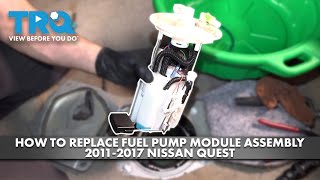
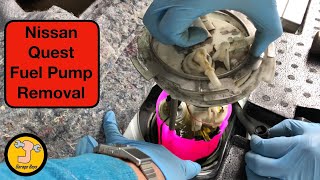
- If the reading is faulty, the next step is to access the fuel pump assembly. On the Quest, this is typically done by removing the two middle-row seats to pull back the carpet and access the service panel. 🎬 See this walkthrough on how to remove the fuel pump.
- Disconnect the electrical connector at the top of the fuel pump assembly. Inspect the connector and pins for corrosion or damage.
- If the connector looks good, use a multimeter set to Ohms to test the resistance across the two pins for the fuel level sensor. For many Nissan models, the specification is approximately 4-6 ohms at full and 77-83 ohms at empty. Refer to a service manual for the exact pins and specifications for your vehicle.
- If the resistance is out of specification or does not change smoothly when the float is moved (if the unit is removed), the fuel level sensor is bad and needs to be replaced.
- If the sensor tests good, the problem is likely in the wiring between the fuel tank and the BCM/PCM, or in a rare case, the control module itself.
Parts You'll Likely Need
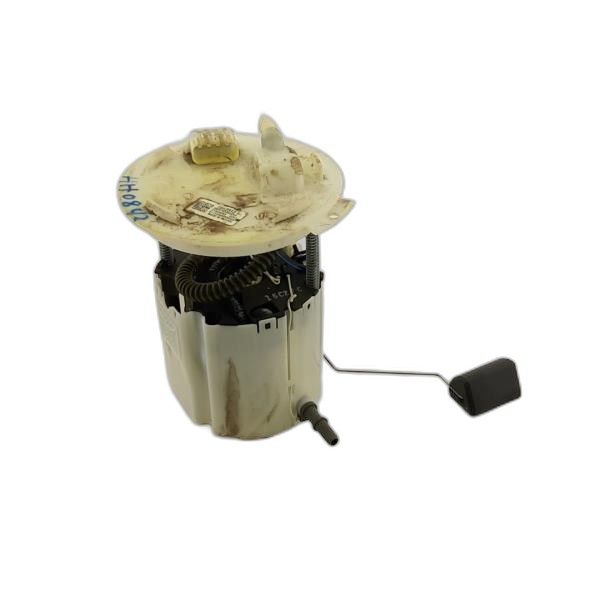
- Fuel Level Sensor
(OEM #25060-1JA0A)— This is the component that fails most often, causing the P0461 code. Its internal resistor wears out, leading to incorrect signals. Nissan TSB NTB22-026 identifies this as the primary repair part.
Trusted brands: Nissan OE, Hitachi, Delphi, Dorman
OEM price range: $120-$180
Aftermarket price range: $70-$130 - Fuel Pump Assembly Gasket / Seal — It is best practice to replace the main gasket for the fuel pump assembly anytime it is removed to prevent dangerous fuel leaks and vapor smells.
Trusted brands: Nissan OE
OEM price range: $15-$30
Aftermarket price range: $10-$20
Related Codes That Often Appear With This One
- P0460 — This is a general fault code for the fuel level sensor circuit and is often set alongside the more specific P0461 performance code. Both are mentioned in TSB NTB22-026.
- P0462 — Indicates the sensor circuit input is low (short to ground). This can be caused by the same failing sensor or a wiring issue. It is also covered by TSB NTB22-026.
- P0463 — Indicates the sensor circuit input is high (open circuit). This can be caused by the same failing sensor or a wiring issue. It is also covered by TSB NTB22-026.
Technical Service Bulletins (TSBs) & Recalls
- NTB22-026: Confirms that for P0461 and related codes, the fuel level sensor is the likely cause and can be replaced separately from the fuel pump assembly. Warns that warranty claims for replacing the entire pump assembly for this issue will be charged back.
Platform-Specific Known Issues
- Nissan Technical Service Bulletin NTB22-026 was issued on April 5, 2022, for a wide range of 2016-2022 vehicles, including the Quest, for codes P0460, P0461, P0462, and P0463. It advises that the fuel level sensor can be replaced separately from the fuel pump assembly.
- An older service campaign (PC335 / NTB15-071) for 2007-2009 Quest models involved a different fuel gauge accuracy issue, but the problem with 2016-2017 models is directly tied to the sensor itself per the newer TSB.
Mechanic-Grade Diagnostic Values
- Fuel Level Sensor Voltage (Live Data) — expected: ~0.5V (Full) to ~4.5V (Empty). Failure: Voltage is jumpy, stuck, or does not change smoothly when fuel is sloshed or added.
- Fuel Level Sensor Resistance (at sensor connector) — expected: Approximately 4-6 Ohms (Full) to 77-83 Ohms (Empty) for many Nissan models.. Failure: Resistance is infinite (open circuit), zero (short circuit), or does not change smoothly as the float arm is moved manually.
Scan Tool Commands That Help
- Nissan CONSULT-III Plus: Active Test — The CONSULT tool can perform active tests on various vehicle systems. While a specific test for the fuel gauge isn't detailed in the search results, this factory tool would be used to command the instrument cluster or read raw data from the BCM to differentiate between a sensor/wiring issue and a module/gauge problem.
Wiring & Ground Locations
- Body Control Module (BCM) — Inside the passenger cabin, typically behind the glove box or in the driver's side footwell behind the lower dash panels and kick plate.. The BCM receives and processes the signal from the fuel level sensor before it is displayed on the instrument cluster. A fault in the BCM or its ground connection is a rare but possible cause for P0461, especially if other unrelated electrical issues are present.
- Fuel Pump / Sensor Connector — On top of the fuel pump assembly, accessed by removing the middle-row seats and a service panel in the floor.. This is the primary connection point to test the sensor's resistance and check for voltage from the BCM/PCM. Corrosion or damage here is a common failure point.
- Wiring Harness Chafe Points — General areas to inspect include where the harness may contact chassis brackets, control arms, or shock towers, as engine vibration can cause the protective loom to wear through over time.. A chafed wire can cause an intermittent short or open in the fuel level sensor circuit, leading to the P0461 code when the sensor itself is perfectly fine.
OEM Part Supersession History
25060-1JA0A→
Heads up: This part number is listed as fitting the 2011-2017 Nissan Quest. No supersession information was found in the search results.
Helpful Videos
![How to Fix P0461 Engine Code in 2 Minutes [1 DIY Method / Only $11.86]](https://img.youtube.com/vi/9Mf7-bMIICY/mqdefault.jpg)
Used OEM Parts in Stock
New Aftermarket Parts Available


The information in this article is provided for general reference and educational purposes only. Vehicle specifications, procedures, and part compatibility can vary by production date, trim level, and region. Always consult your vehicle's factory service manual and verify part numbers before purchasing or performing repairs. Safety-critical components such as airbags, seat belts, and braking systems should be installed by a qualified professional.
- Nissan QUEST:
- 🎬 Helpful Videos
- 🛍️ Shop This Part
- What's Unique About the 2016-2017 Nissan QUEST
- Diagnostic Flowchart
- Symptoms You May Notice
- Most Likely Causes
- Rare But Worth Checking
- Diagnosis Steps
- Parts You'll Likely Need
- Related Codes That Often Appear With This One
- Technical Service Bulletins (TSBs) & Recalls
- Platform-Specific Known Issues
- Mechanic-Grade Diagnostic Values
- Scan Tool Commands That Help
- Wiring & Ground Locations
- OEM Part Supersession History
- 🎟️ Get 5% Off