

P0461 on 2017-2022 Honda CR-V: Fuel Gauge Problems, Causes, and Fixes
On a 2017-2022 Honda CR-V, code P0461 is most likely caused by a software glitch needing a dealer update. This is a known pattern on similar Honda models. If not software, it's likely the fuel level sending unit. Always have a dealer check for software updates for your VIN before replacing any parts, as this is the cheapest and most probable fix.
- Your first action should be to call a Honda dealer with your VIN to check for a free software update; this is the most probable cause based on Honda's fixes for identical codes on related models.
- Do not let a repair shop replace the entire fuel pump assembly if only the sending unit is needed. The sending unit is much cheaper and sold as a separate part (17047-TLA-A02).
- The vehicle is safe to drive with this code, but the unreliable fuel gauge means you should keep the tank relatively full and get it fixed soon to avoid being stranded.
- If you are performing a DIY repair, the fuel sending unit is accessed through a panel under the rear seats, but be sure to relieve fuel pressure and disconnect the battery first for safety.
What's Unique About the 2017-2022 Honda CR-V
For many Honda models from this era, P0461 is frequently caused by a software issue, not a hardware failure. Honda has issued Technical Service Bulletins (TSBs) for other models like the 2019 Civic (TSB 19-035) and 2022 Insight (TSB 23-054) where the official fix is a simple software update to the PGM-FI (Programmed Fuel Injection) system. The TSB for the Civic explicitly states, "The PCM software misinterprets sensor inputs as a fuel sender issue, and sets DTC P0461". Manufacturer Bulletin #A23-054 further clarifies that during refueling, the vehicle may be unable to recognize the event, leading to the MIL and P0461. While a specific TSB for the CR-V was not found in public research, this established pattern makes a software glitch a very high-probability cause. The first step should always be to check with a Honda dealer for any available software updates for your specific vehicle's VIN.
Symptoms You May Notice
- Check Engine Light is on
- Fuel gauge is erratic, fluctuating wildly
- Fuel gauge is stuck on Full or Empty
- Low fuel warning light may stay on, even with a full tank
- Distance-to-empty reading on the trip computer is inaccurate or shows dashes
- Replacing the entire fuel pump assembly. The fuel level sending unit is often sold separately and is much cheaper. Shops may quote for the entire assembly, significantly increasing the cost.
- Replacing the instrument cluster. A faulty gauge is almost always a symptom, not the cause. The problem lies with the signal getting to the cluster.
Most Likely Causes
- PGM-FI Software Needs Update 🔴 High Probability Honda has released software updates for other models of the same era (Civic, Insight) to fix this exact code, where the PCM misinterprets normal sensor signals. This is a known pattern for Honda vehicles on this platform. Manufacturer Bulletin #ONL6LS06242021 notes that the system may misinterpret signals as a fuel gauge sending unit issue, resulting in an improperly functioning on-board emission-related diagnostic.
How to confirm: Contact a Honda dealership with your vehicle's VIN and ask them to check for any open product updates or service bulletins related to DTC P0461 or the fuel system. Reference TSBs 19-035 and 23-054 as examples of this issue on other models.
Typical fix: A technician at a Honda dealership will connect the vehicle to their diagnostic station (i-HDS) and update the PGM-FI software. The update itself takes less than an hour. 🎬 Watch: How a Honda PGM-FI software update is performed
Est. part cost: $0 - Faulty Fuel Level Sending Unit 🟡 Medium Probability The sending unit is a moving part (a float on a resistor) inside the fuel tank. Over time, the resistor contacts can wear out, get contaminated by fuel additives, or corrode, causing incorrect readings.
How to confirm: After confirming no software update is available or the update didn't fix the issue, a mechanic can test the resistance (ohms) of the sending unit. An open circuit or a reading that doesn't change smoothly indicates a failure. Based on data for similar Hondas, the resistance should be around 105-110 Ohms when empty and much lower (approx. 5-10 Ohms) when full.
Typical fix: Replace the fuel level sending unit (also called a meter set). It is located on the fuel pump module, accessible via a panel under the rear seats.
Est. part cost: $105-$150 - Stuck Fuel Level Float Arm ⚪ Low Probability The float arm can physically get stuck, often in the full or empty position. This can happen from a sharp jolt or sometimes debris in the tank. A stuck float means the sensor's reading never changes, which the PCM flags as a performance issue after comparing it to expected fuel consumption.
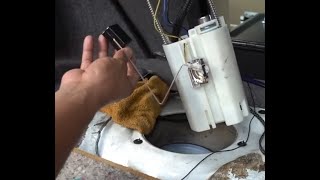
How to confirm: This is often found during the inspection when accessing the sending unit. Sometimes, simply accessing the fuel pump module and manually freeing the float can be attempted. 🎬 Watch: How a stuck CR-V fuel level sensor behaves
Typical fix: In the best case, the float can be freed manually. More commonly, the issue is with the sending unit itself, and the entire unit is replaced.
Est. part cost: $0-$150
Rare But Worth Checking
- Wiring Harness Issue: A damaged wire or corroded connector between the fuel tank and the PCM can cause the signal to be lost or incorrect. This is less common than sensor or software issues but should be checked before replacing an expensive PCM. Pay close attention to the connector on top of the fuel pump assembly.
- Faulty Instrument Cluster or PCM: It is very rare for the gauge cluster or the main computer (PCM) to be the cause of this specific code. These should only be considered after all other possibilities (software, sensor, wiring) have been exhaustively ruled out.
Diagnosis Steps
- Check for Software Updates (Crucial First Step): Contact a Honda dealer with your VIN. Ask if there are any service bulletins (TSBs) or product updates for a P0461 code or fuel gauge issues. This is the most likely and cheapest fix.
- Scan Tool Live Data: If no software update is available, connect an OBD-II scanner and observe the fuel level sensor voltage or percentage. Does the reading change when you add fuel or gently rock the vehicle? A stuck value points to a stuck float or failed sensor.
- Inspect Wiring: Visually inspect the wiring harness leading to the fuel tank for any obvious signs of damage, corrosion, or loose connections, especially at the 4-pin connector on the fuel tank unit access panel.
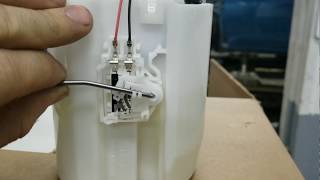
- Test the Sending Unit: Access the fuel pump module under the rear seat. Disconnect the sending unit connector and measure the resistance (ohms) across the sensor pins. 🎬 See: How to test a fuel level sensor without removing the pump Refer to a service manual for exact specs, but typical Honda values are high resistance when empty (e.g., ~110 Ohms) and low resistance when full (e.g., ~5 Ohms). Manually move the float arm and watch for a smooth change in resistance. If the resistance is out of spec, infinite (open), or doesn't change smoothly, the sending unit has failed.
- Test the Circuit: If the sensor tests good, check for reference voltage and a good ground at the connector harness coming from the PCM. This will confirm the issue is with the sensor and not the wiring to the PCM.
Parts You'll Likely Need
- Fuel Level Sending Unit (Meter Set)
(OEM #17047-TLA-A02)— This is the sensor inside the fuel tank that fails. It is the most common hardware component to be replaced after a software update is ruled out. This part number supersedes 17047-TLA-A01.
Trusted brands: Honda (Genuine OEM)
OEM price range: $102-$150
Aftermarket price range: $70-$120
Related Codes That Often Appear With This One
- P0462 — This code indicates 'Fuel Level Sensor Circuit Low Input'. It can appear with P0461 if the sensor circuit has a short to ground.
- P0463 — This code indicates 'Fuel Level Sensor Circuit High Input'. It can appear with P0461 if the sensor circuit has an open or high resistance, which can happen if the float is stuck full or the sensor fails.
Technical Service Bulletins (TSBs) & Recalls
- A19-035 (for 2019 Honda Civic, demonstrates pattern of software fixes for P0461)
- 23-054 (for 2022 Honda Insight, demonstrates pattern of software fixes for P0461)
- Bulletin #A23-054 (Notes that the vehicle is unable to recognize a refueling event, setting P0461)
- Bulletin #ONL6LS06242021 (Confirms the PCM misinterprets sensor signals as a fuel level sensor issue)
Mechanic-Grade Diagnostic Values
- Fuel Level Sending Unit Resistance — expected: Approximately 5-10 Ω when Full and 105-132 Ω when Empty. The reading should change smoothly when moving the float arm.. Failure: A reading of infinity (OL) indicates an open circuit. A reading that jumps or doesn't change smoothly indicates a worn or faulty resistor track.
- Voltage at Fuel Tank Unit 4P Connector — expected: Battery voltage should be present between terminals No. 1 and No. 3 with the ignition ON.. Failure: If voltage is not present, it indicates an open or short in the power (ORN) or ground (LT BLU) wires leading to the connector.
Scan Tool Commands That Help
- Honda i-HDS (J2534): J2534 Rewrite — This is the specific dealer-level function used to perform the PGM-FI software update that is the most common fix for P0461 on this platform, as detailed in TSBs for similar models.
- Honda i-HDS: PCM Reset — After replacing a hardware component like the fuel level sensor, a PCM reset should be performed to clear any learned incorrect values and force the system to re-adapt to the new, functioning part.
- Honda i-HDS: Fuel Gauge Sweep Test — Some advanced scan tools can command the instrument cluster to perform a full sweep of the fuel gauge. This helps to quickly determine if the physical gauge in the cluster is functioning correctly, separating a sender/wiring issue from a cluster issue.
Wiring & Ground Locations
- Fuel Tank Unit 4P Connector — On top of the fuel pump assembly, accessible via a panel under the driver's side rear seat.. This is the main connection point for the fuel pump and sending unit. Corrosion or damage here will directly interrupt the signal, causing P0461. Testing for power, ground, and signal resistance occurs at this connector.
- G503 — A shared ground point located under the center of the dashboard.. Wiring diagrams for the PGM-FI system show this as a relevant ground. While a failure here would likely cause multiple other codes, a poor connection at G503 could contribute to erratic sensor readings.
Real Owner Repair Stories
- YouTube user 'Melnix Automotive' (2018 Honda CR-V) — Fuel gauge read completely full, but the distance-to-empty display showed only 225 miles, indicating the tank was not full.
❌ Tried (didn't work) The owner could have been fooled into thinking they had a full tank and run out of gas.
✅ What actually fixed it The fuel level sensor float arm was physically stuck in the uppermost (full) position. The technician accessed the fuel pump module under the rear seat, removed the sending unit, and manually freed the stuck float arm. After reinstallation, the gauge read the correct (quarter tank) level. - NHTSA ODI #11210146 — An owner reported receiving a product update notice from Honda regarding a fuel level sensor DTC P0461 software update, while also experiencing a sudden stop while in motion on a highway.
OEM Part Supersession History
17047-TLA-A01→17047-TLA-A02— Standard part revision by the manufacturer, likely for improved durability or to correct a minor flaw in the original design.
Diagnostic Flowchart
Other Known Issues on This Vehicle
Issues unrelated to this code that are worth knowing about as an owner of this generation:
- Engine Oil Dilution (1.5L Turbo) 🔴 High — More common on 2017-2018 models, especially in cold climates with frequent short trips. Unburned fuel mixes with engine oil, raising the oil level and reducing lubrication. (Ref: Honda addressed this with software updates to improve engine warm-up and offered warranty extensions in some cases.)
- Parasitic Battery Drain 🟠 Medium — Affects many 2017-2019 models. The battery can drain overnight, causing failure to start. A class-action lawsuit was filed regarding this issue. (Ref: TSB #17-032 points to a VSA modulator software logic flaw that prevents the unit from going into 'sleep mode'. An update is required.)
- Infotainment System Glitches 🟡 Low — Common across 2017-2019 models, owners report the screen freezing, randomly beeping, dimming, or making phantom inputs. (Ref: TSB A19-066 was issued to address these issues via a software update for the audio/navigation unit.)
- Premature Fuel Injector Failure (1.5L Turbo) 🟠 Medium — Reported by owners, sometimes leading to multiple warning lights, rough idling, and misfire codes (like P0172). Can be an expensive repair if out of warranty.
Used vs. New Parts: Buying Guide for This Vehicle
When a used part is the smart pick: A used fuel level sending unit is generally not recommended but could be a very cheap, last-resort option if the budget is extremely tight. The primary failure mode is wear on the resistor contacts, so a used part has an unknown amount of life remaining. It only makes sense if sourced from a very low-mileage donor vehicle.
Donor-vehicle mileage cap: roughly under 30000 miles for the part to have meaningful remaining life.
What to inspect on the donor part:
- Verify the donor vehicle's mileage; lower is significantly better.
- Inspect the electrical connector pins for any signs of corrosion or heat damage.
- Manually move the float arm; it should travel smoothly through its entire range with no binding or gritty feeling.
- If possible, test the resistance with a multimeter while moving the float to ensure the reading changes smoothly without dropouts.
OEM-only on this vehicle (don't cheap out):
- While aftermarket is available, the Genuine Honda sending unit (17047-TLA-A02) is the most reliable choice given the high probability of a software issue. Eliminating hardware variance with an OEM part is crucial before pursuing a software update at the dealer.
Brands owners have reported issues with on this vehicle:
- Unnamed, no-brand units from online marketplaces should be avoided. They often have incorrect resistance ranges, leading to inaccurate gauge readings and the code returning.
Real Owner Stories
Aggregated from forums and TSBs cited above. Mileages and costs reflect what owners reported in those sources.
2019 Honda Civic (Platform Mate)
Symptoms: The vehicle triggered a P0461 code due to the PCM misinterpreting normal sensor signals from the fuel level sender.
What fixed it: A technician updated the PGM-FI software using the i-HDS diagnostic station as per TSB 19-035.
Source hint: TSB A19-035
2022 Honda Insight (Platform Mate)
Symptoms: Check engine light on with code P0461; fuel level sensor performance issue detected by the PCM.
What fixed it: Software update to the PGM-FI system.
Source hint: TSB 23-054
2017-2019 Honda CR-V
Symptoms: Owners report various electrical quirks including random warning lights and infotainment blackouts.
What fixed it: Checking for software updates at the dealer or performing a battery reset.
Source hint: reddit.com/r/crv
Related OBD-II Codes
Frequently Asked Questions
Could my 2017-2022 Honda CR-V's P0461 code be fixed by a software update like the Civic?
Where is the fuel level sending unit located on the 2017-2022 CR-V if I need to test it?
What are the specific resistance values I should look for when testing the CR-V fuel sender?
Is the P0461 code related to the 1.5L Turbo engine oil dilution issue?
Can I use a used fuel sending unit from a donor vehicle to fix this?
My fuel gauge is stuck on empty even though I just filled up; is this P0461?
Helpful Videos


We Have This Part in Stock


The information in this article is provided for general reference and educational purposes only. Vehicle specifications, procedures, and part compatibility can vary by production date, trim level, and region. Always consult your vehicle's factory service manual and verify part numbers before purchasing or performing repairs. Safety-critical components such as airbags, seat belts, and braking systems should be installed by a qualified professional.
- Honda CR-V:
- 🎬 Helpful Videos
- 🛍️ Shop This Part
- What's Unique About the 2017-2022 Honda CR-V
- Symptoms You May Notice
- Most Likely Causes
- Rare But Worth Checking
- Diagnosis Steps
- Parts You'll Likely Need
- Related Codes That Often Appear With This One
- Technical Service Bulletins (TSBs) & Recalls
- Mechanic-Grade Diagnostic Values
- Scan Tool Commands That Help
- Wiring & Ground Locations
- Real Owner Repair Stories
- OEM Part Supersession History
- Diagnostic Flowchart
- Other Known Issues on This Vehicle
- Used vs. New Parts: Buying Guide for This Vehicle
- Real Owner Stories
- 2019 Honda Civic (Platform Mate)
- 2022 Honda Insight (Platform Mate)
- 2017-2019 Honda CR-V
- Related OBD-II Codes
- Frequently Asked Questions
- 🎟️ Get 5% Off