

P0461 on 2014-2016 Audi Q5: Fuel Level Sensor Causes and Fixes
On a 2014-2016 Audi Q5, code P0461 is most often caused by a software glitch in the engine computer, not a bad part. The fix is typically an ECM software update from an Audi dealer. If the software is current, the fuel level sensor in the tank may be faulty.
- For a 2014-2016 Audi Q5, P0461 is most likely a software problem. Check for an available ECM update before replacing any parts.
- The vehicle is safe to drive with this code, but the fuel gauge may be unreliable. Track your mileage to be safe.
- Avoid refueling with the ignition on or frequently adding small amounts of fuel, as these behaviors were linked to triggering the software glitch.
- If a software update doesn't fix it, the fuel level sensor (sending unit) inside the gas tank is the next most likely cause.
What's Unique About the 2014-2016 Audi Q5

For this specific generation of Audi Q5 (and its platform mates), the P0461 code is very frequently a 'ghost' code caused by sensitive software logic in the ECM, rather than a physical part failure. Audi released Technical Service Bulletins (TSBs) acknowledging that the check engine light could illuminate for this code without any actual hardware problem. The issue was often triggered by specific refueling habits, like adding small amounts of gas (less than 4-5 gallons) or, more critically, refueling while the ignition is on. Therefore, the first and most important step is always a software check, not an expensive part replacement.
🎬 Watch: This quick video explains the P0461 software logic fix.Diagnostic Flowchart

Tap your situation to follow the diagnostic path that matches what you're seeing on this vehicle.
Symptoms You May Notice

- Check Engine Light is on
- Fuel gauge reading is inaccurate, erratic, or stuck on full or empty.
- Distance-to-empty calculation may be incorrect or show '---'.
- Fuel gauge may drop to empty suddenly, even with a full tank.
- Replacing the fuel pump or fuel level sensor before checking for the required ECM software update. The Audi TSB specifically warns against this, as it will not solve the issue if it's software-related.
Most Likely Causes

- Engine Control Module (ECM) Software Glitch 🔴 High Probability Audi issued TSBs #2041594 and #2043357, stating the code could be set by 'miscalculations within the ECM software' or an 'incorrect diagnostic procedure'. This is especially likely after frequent, small refueling events or refueling with the ignition on.
How to confirm: Contact an Audi dealership or a qualified independent shop with Audi-specific scan tools (like ODIS) to check if the vehicle's ECM software is up-to-date per TSB #2043357/11 or later revisions.
Typical fix: Update the ECM software to the latest version. The TSB explicitly advised dealers not to replace any parts for this condition. One owner on AudiWorld reported a dealer cost of ~$200 for the diagnosis and ~$230 for the software update.
Est. part cost: $0 - Faulty Fuel Level Sensor (Sending Unit) 🟡 Medium Probability If the ECM software is already updated, the sensor itself is the next likely culprit. The resistive strip on the sensor can wear out over time, causing erratic readings or dead spots in its travel.
How to confirm: Using a scan tool (like VCDS or ODIS), monitor the fuel level sensor's resistance (Ohms) or voltage in live data while rocking the vehicle or adding fuel. If the reading is jumpy, drops out, or doesn't change smoothly, the sensor is likely bad.
Typical fix: Replace the fuel level sending unit. It is located inside the fuel tank and is often integrated with the fuel pump module. Access is typically under the rear seat.
Est. part cost: $150-$400 - Wiring or Connector Issue ⚪ Low Probability The connector on top of the fuel tank is located under the vehicle or rear seat, where it can be exposed to moisture or physical damage, leading to corrosion or loose pins over time. A known chafe point exists where the sender wiring can rub through on the service opening for the fuel tank.
How to confirm: Visually inspect the wiring harness and connector at the top of the fuel tank (usually accessed by removing the rear seat bottom cushion) for corrosion, damage, or loose pins. Pay close attention to the harness routing near the fuel tank service opening for signs of rubbing. Perform a continuity test on the wires between the sensor and the control module.
Typical fix: Repair the damaged section of wiring or clean/replace the corroded connector.
Est. part cost: $10-$50
Rare But Worth Checking
- Stuck Fuel Level Float: The float arm that moves the sensor can get stuck due to debris in the fuel tank or deformation of the tank itself, though this is uncommon. This was reported by one owner after having their fuel tank replaced, suggesting a potential installation error.
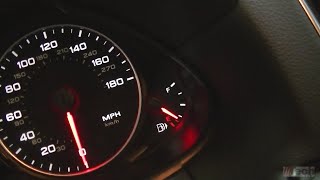
- Faulty Instrument Cluster: In very rare cases, the instrument cluster itself can fail to interpret a correct signal from the ECM, leading to an incorrect gauge reading, but this would not typically set a P0461 code in the ECM. An output test of the cluster can verify its function. 🎬 Watch: How to perform a fuel gauge calibration test.
Diagnosis Steps
- Read the fault codes with an OBD-II scanner to confirm P0461 is the primary code. Check for related codes in the Comfort System Central Control Module (J393 / Address 46), such as B103E1A or B10581B, using an advanced scanner.
- Determine if the ECM software update related to Audi TSB #2041594 or #2043357 has been performed. This is the most critical first step for this vehicle. A dealer or specialist shop can verify the software version.
- If the software is not up-to-date, have the ECM updated. Clear the code and monitor. Per the TSB, this is the definitive fix for the software-induced fault.
- If the software is current or the problem persists, use an advanced scan tool to observe the fuel level sensor's live data. Note the resistance reading in Ohms.
- Compare the live data to the fuel gauge and the approximate actual fuel level. Look for erratic jumps or dead spots in the data as the vehicle is gently rocked or driven. A reading of 66-68 Ohms should indicate a full tank, while 295-305 Ohms should indicate empty, though these values can vary.
- If data is erratic, gain access to the fuel tank sending unit (typically under the rear seat).
- Inspect the electrical connector and wiring for any signs of corrosion, moisture, or damage. Specifically check for chafing on the harness where it passes the fuel tank service opening.
- If wiring is okay, test the sensor's resistance directly with a multimeter while manually moving the float arm (if the unit is removed). The resistance should change smoothly without dropouts. If it does, the sensor is faulty.
Parts You'll Likely Need
- Fuel Level Sending Unit
(OEM #8R0919673D (Gasoline) or 8R0919673F (Diesel))— If the issue is not software-related, the sensor itself is the most common hardware failure point. It provides the signal that the ECM is flagging as out of range.
Trusted brands: Genuine Audi, VDO
OEM price range: $240-$350
Aftermarket price range: $150-$250 - Fuel Pump/Sender Unit Seal
(OEM #1J0919133B (example, verify by VIN))— This large rubber gasket seals the sending unit to the fuel tank. It is strongly recommended to replace it anytime the sending unit is removed to prevent fuel leaks and vapor smells.
Trusted brands: Genuine Audi, Elring
OEM price range: $20-$40
Aftermarket price range: $10-$20
Technical Service Bulletins (TSBs) & Recalls
- 2041594 / 15582041594: States that P0461 may illuminate the check engine light due to a software issue, that the vehicle is safe to drive, and that components should not be replaced. It also notes the issue is more likely with frequent, small refueling.
- 2043357/11: Supersedes the earlier TSB, providing a specific software update as the solution and identifying refueling with the ignition on as a primary trigger. It covers a wide range of Audi models from 2013-2017 with various engines.
Platform-Specific Known Issues
- A widespread software issue prompted Audi to release TSB #2041594, which states that P0461 can be triggered without a hardware fault. The recommended fix is an ECM software update, not component replacement.
- TSB #2043357/11 later clarified the cause as 'miscalculations within the ECM software when the vehicle is being filled with gasoline while the ignition is on'.
- The TSB also notes that the fault is more likely to occur if the vehicle is frequently refueled with small amounts of fuel (less than 4-5 gallons).
Mechanic-Grade Diagnostic Values
- Fuel Level Sensor Resistance (General Audi) — expected: Approx. 66-68 Ohms (Full) to 295-305 Ohms (Empty). Failure: Readings outside this range, erratic jumps, or an open/short circuit.
- Fuel Level Sensor Live Data (VCDS) — expected: Resistance should change smoothly. A reading of 122 Ohms corresponded to ~12.6 gallons (63% full) in one example.. Failure: Value does not change with fuel level, or jumps erratically when the vehicle is rocked.
- Fuel Level Sensor Voltage — expected: Typically 0.5V (Full) to 4.5V (Empty). Failure: Voltage is stuck, or does not correspond logically with the fuel level.
Hidden / Shadow Codes Worth Checking
- B103E1A / B103E1B: Fuel gauge sensor 1 Resistance too low / too high. These codes are stored in the Comfort System Central Control Module (J393). (see via Advanced scan tool (like VCDS or ODIS) capable of reading modules beyond the standard ECM, specifically Address 46.)
- B10581A / B10581B: Fuel gauge sensor 2 Resistance too low / too high. The Q5 uses a dual-sender system, and this points to a fault in the second sensor. (see via Advanced scan tool (like VCDS or ODIS) capable of reading Address 46 (Comfort System).)
- U042300: Invalid Data Received From Instrument Panel Cluster Control Module. This code may be stored in the ECM (J623) when the fuel level data is implausible. (see via Standard OBD-II scanner or advanced tools.)
Scan Tool Commands That Help
- VCDS / ODIS: Instrument Cluster (17) -> Output Tests — To verify the physical fuel gauge in the instrument cluster is working correctly. The test will command the needle to a set position (e.g., half-full). If the needle moves correctly, the gauge itself is good, and the fault is elsewhere in the system.
- VCDS / OBDeleven: Instrument Cluster (17) -> Adaptation -> Channel 30 (older models) or 'Offset for tank calibration values' — To perform a fine-tune calibration of the fuel gauge needle if it is reading slightly off after a repair or from the factory. This can adjust the reading by an equivalent of a few liters. A security access code (e.g., 20103) may be required.
Wiring & Ground Locations
- Fuel Pump Control Module (J538) — Under the rear seat bench on the right side, near the fuel tank access panel.. On TFSI engines, the fuel level sensor signal is routed through this module before being sent to the rest of the vehicle network. A fault in this module or its connections can cause P0461.
- Wiring Harness Chafe Point — The wiring for the fuel tank senders where it passes the service opening for the fuel tank.. An Audi TSB identified that this harness can rub through on the body, causing a short or open in the sensor circuit, leading to P0461 and related codes.
- Ground Point 663 — Behind the trim/seatback in the right rear side panel.. A poor ground connection for the fuel pump/sender assembly can cause erratic voltage and resistance readings, triggering a range/performance code.
- 5-Pin Sensor Connector — On top of the fuel level sensor flange, under the rear seat.. Knowing the pinout (e.g., Pin 2 is sensor ground, Pin 3 is the signal wire) allows for direct testing of the sensor and wiring with a multimeter.
Real Owner Repair Stories
- AudiWorld Forums user 'Bob K.' (2014 Audi Q5 2.0T) — Check Engine Light with code P0461, fuel level reading was inaccurate.
❌ Tried (didn't work) Initially just cleared the code, but it returned.
✅ What actually fixed it An ECM software update performed by an Audi dealer, as specified in TSB #2043357/11. The dealer charged $195 for diagnosis and $232.32 for the software update. No parts were replaced.
OEM Part Supersession History
8R0919673→8R0919673D— Revision and improvement of the part.8R0919673D→8R0919673E, 8R0919673F— Further revisions. The 'F' suffix is often associated with the diesel model.
Heads up: Part numbers must be verified by VIN. 8R0919673D is for gasoline models, while 8R0919673F is specified for diesel models in Pass 2.
Model Year Variations Within This Range
- 2014-2016 (TFSI Engines): On vehicles with TFSI engines, the fuel level signal is routed from the sensor to the Fuel Pump Control Module (J538), which then communicates the data to the instrument cluster and ECM. This adds the J538 module and its wiring as a potential point of failure, which may not be the case on older or different engine types where the sensor might wire more directly to the cluster.
Helpful Videos

Used OEM Parts in Stock




New Aftermarket Parts Available


The information in this article is provided for general reference and educational purposes only. Vehicle specifications, procedures, and part compatibility can vary by production date, trim level, and region. Always consult your vehicle's factory service manual and verify part numbers before purchasing or performing repairs. Safety-critical components such as airbags, seat belts, and braking systems should be installed by a qualified professional.
- Audi Q5:
- 🎬 Helpful Videos
- 🛍️ Shop This Part
- What's Unique About the 2014-2016 Audi Q5
- Diagnostic Flowchart
- Symptoms You May Notice
- Most Likely Causes
- Rare But Worth Checking
- Diagnosis Steps
- Parts You'll Likely Need
- Technical Service Bulletins (TSBs) & Recalls
- Platform-Specific Known Issues
- Mechanic-Grade Diagnostic Values
- Hidden / Shadow Codes Worth Checking
- Scan Tool Commands That Help
- Wiring & Ground Locations
- Real Owner Repair Stories
- OEM Part Supersession History
- Model Year Variations Within This Range
- 🎟️ Get 5% Off