

P0461 on 2014-2016 Audi A6: Fuel Level Sensor Range and Performance Issues
On a 2014-2016 Audi A6, code P0461 is often a software glitch acknowledged by Audi. The vehicle is safe to drive, and the issue may be resolved by clearing the code or getting a software update from a dealer. Avoid replacing parts unless a true sensor failure is confirmed.
- P0461 on a 2014-2016 Audi A6 is most likely a software glitch, not a bad part.
- Audi issued a TSB (2041594) confirming the issue for the A6 and other models like the A4, A5, A7, A8, and Q5, stating the vehicle is safe to drive.
- The recommended first step is to clear the code. If it returns, seek a software update from a dealer before replacing any parts.
- Avoid frequently refueling with small amounts of gasoline or refueling with the ignition on, as this can trigger the sensitive software to set the code.
- Only consider replacing the fuel level sensor if a software update does not fix the problem and the sensor fails a resistance test.
What's Unique About the 2014-2016 Audi A6

For the C7 generation Audi A6 (and many other contemporary models), this code is a widely documented software issue. Audi released a TSB explaining that the fault can be triggered by an "incorrect diagnostic procedure" or specific refueling habits, such as frequently adding small amounts of fuel or refueling with the ignition on. Unlike many other vehicles where P0461 points directly to a bad sending unit, on this platform, it's often a false alarm that doesn't require immediate parts replacement.
Diagnostic Flowchart
Tap your situation to follow the diagnostic path that matches what you're seeing on this vehicle.
Symptoms You May Notice
- Check Engine Light is illuminated.
- Fuel gauge may be inaccurate, erratic, or stuck on empty/full.
- A 'tank malfunction' error may appear on the instrument cluster display.
- Replacing the fuel level sensor without first checking for software updates. The official TSB for this vehicle range explicitly warns against replacing parts as the primary solution.
Most Likely Causes

- Engine Control Module (ECM) Software Sensitivity 🔴 High Probability Audi has officially documented this as a software shortcoming in TSB #2041594. The logic for interpreting the fuel level sensor data is overly sensitive.
How to confirm: Clear the code. If it returns without any physical symptoms other than the Check Engine Light, a software issue is the most likely cause. The TSB notes that refueling with small amounts (less than 4-5 gallons) or refueling with the ignition on can trigger the fault.
Typical fix: The TSB recommends clearing the DTC and releasing the vehicle. A more permanent solution is an ECM software update performed by an Audi dealership using their ODIS system and a specific SVM (Software Version Management) code. The TSB explicitly states, "Do not replace any components for this condition since this will not resolve the customer's concern." Owners report dealer costs for diagnosis and update ranging from approximately $200 to $450.
Est. part cost: $0 - Faulty Fuel Level Sending Unit ⚪ Low Probability While less common due to the known software issue, the sending unit is a mechanical part with a resistor strip that can wear out over time, causing incorrect voltage signals. The C7 A6 has a saddle-style tank with two sending units (left and right), and a failure in either can cause issues.
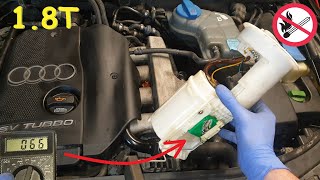
How to confirm: If a software update does not fix the issue or if the fuel gauge is completely dead or highly erratic, the sensor itself should be tested. This involves accessing the fuel tank (under the rear seat), disconnecting the sensor, and measuring its resistance with a multimeter 🎬 Watch: Professional DIY guide for testing and replacing the sensor while moving the float arm. The resistance should change smoothly without dropouts. A normal sensor voltage range is typically 0.5V (empty) to 4.5V (full). A forum user reported measuring resistance on a C7 A6 sender, finding a range from ~52 ohms to ~195 ohms.
Typical fix: Replace the fuel level sending unit. The Audi A6 has a saddle-style tank with two sending units. Diagnostic codes should specify which sensor is faulty (e.g., 'Sensor 2'). They are often replaced as part of the fuel pump assembly. 🎬 See this walkthrough for replacing the fuel pump and sensor assembly
Est. part cost: $150-$250 - Wiring or Connector Issue ⚪ Low Probability Wiring leading to the fuel tank can be damaged, and connectors can corrode, altering the voltage signal sent to the ECM.
How to confirm: Visually inspect the wiring harness going to the fuel tank for any signs of damage, chafing, or corrosion at the connector. Perform a continuity test on the wires between the sensor and the ECM. A technician may perform a "pin drag" test on the female connectors to ensure a tight connection.
Typical fix: Repair the damaged section of the wiring harness or clean/replace the corroded connector.
Est. part cost: $10-$50
Rare But Worth Checking
- Stuck Fuel Level Float:
Diagnosis Steps

- Scan the vehicle for codes to confirm P0461 is present.
- Check for any Audi Technical Service Bulletins (TSBs) related to P0461 and your vehicle's VIN. TSB #2041594 is highly relevant.
- Clear the trouble code and drive the vehicle to see if the code returns. When refueling, ensure the ignition is off and try to add more than 5 gallons at a time.
- If the code returns, contact an Audi dealer or qualified independent shop to inquire about an ECM software update. This is the most common permanent fix.
- If symptoms persist after a software update (or if the fuel gauge is completely inoperative), proceed with physical diagnosis.
- Access the fuel level sending unit connector (typically under the rear seat bench).
- With the key on, check for correct reference voltage (typically ~5V) and ground at the connector. Check for voltage drop on the ground wire; it should be less than 0.4 volts.
- If power and ground are good, disconnect the sensor and measure its resistance with a multimeter while manually moving the float arm (if removed) or rocking the vehicle. The resistance should change smoothly. Compare readings to the manufacturer's specifications if available. One user reported a range of approximately 52-195 ohms on a C7 sensor.
- If the sensor tests bad, replace it. If the sensor tests good, the problem is likely in the wiring between the sensor and the ECM.
Parts You'll Likely Need

- Fuel Level Sending Unit (Left or Right)
(OEM #4G0919673C (Left), 4G0919673B (Right))— This is the physical sensor that fails. It's only needed if the documented software issue is ruled out and the sensor is confirmed to be faulty through testing.
Trusted brands: Audi (Genuine), VDO, Bosch
OEM price range: $180-$250
Aftermarket price range: $70-$150
Technical Service Bulletins (TSBs) & Recalls
- 2041594 / 155820415945: States that the Check Engine Light may illuminate with DTC P0461 due to a software issue, that the vehicle is safe to drive, and that components should not be replaced for this condition. It affects A4, A5, A6, A7, A8, and Q5 models from 2014-2016.
Platform-Specific Known Issues
- A Technical Service Bulletin (TSB #2041594, with multiple revisions like /2, /3, /6) was issued for 2014-2016 A6 models (among others) for this code. It identifies a software issue as the root cause and advises against replacing parts unless a software update fails to resolve the issue.
- The TSB identifies specific driver habits that can trigger the fault, including refueling with the ignition on or frequently adding small amounts of fuel (less than 4-5 gallons).
Mechanic-Grade Diagnostic Values
- Fuel Level Sensor Resistance (G/G169) — expected: A forum user measured a range of ~52 ohms to ~195 ohms on a C7 A6 sending unit. Another VCDS log showed values of 197 Ohm for Sensor 1 and 281 Ohm for Sensor 2, indicating a potential fault in Sensor 2.. Failure: Resistance readings that are erratic, jump, show an open circuit (infinite resistance), or are stuck at one value when the float is moved. A VCDS log showing a high 'soiling resistance' (e.g., 89 Ohm) can also indicate a problem.
- Fuel Pump Ground Wire Voltage Drop — expected: Less than 0.4 volts.. Failure: A voltage drop greater than 0.4V indicates excessive resistance in the ground circuit, which can cause erratic component behavior.
Hidden / Shadow Codes Worth Checking
- B10581B: Fuel level sensor 2 Resistance too high. This is an instrument cluster fault code that points more specifically to the right-side sending unit. (see via Appears on VAG-specific scan tools like VCDS or OBDeleven when scanning the Instrument Cluster (Address 17).)
Scan Tool Commands That Help
- VCDS (VAG-COM): Instrument Cluster (17) -> Adaptation (10) -> Channel for Fuel Gauge Calibration — This function allows for fine-tuning the fuel gauge reading. It can be used to correct a gauge that is consistently off by a small, predictable amount after a sensor replacement. The default value is typically 128, and it can be adjusted up or down in single-digit increments, where each increment corresponds to a fraction of a liter. However, Ross-Tech notes that a formal procedure for using the Basic Settings calibration is not widely documented.
- ODIS (Official Dealer Software): Software Version Management (SVM) Update — This is the primary, official fix for P0461 when it is caused by software sensitivity, as per TSB 2041594. The dealer uses ODIS to connect to Audi's servers and flash the Engine Control Module (ECM) with the updated software designed to be less sensitive to fuel level fluctuations.
Wiring & Ground Locations
- Fuel Pump Control Module (J538) — On the C7 platform, the module is notoriously difficult to access, mounted between the top of the fuel tank and the floor of the car, often requiring the fuel tank to be partially dropped. On some related models like the Q7, it is found under the rear seat and carpet.. While not a primary cause for P0461 (which is sensor-circuit related), a faulty control module can cause a wide range of fuel system issues and is often misdiagnosed. Knowing its location is critical for comprehensive fuel system diagnosis.
- Ground Point 44 — Located at the lower part of the left A-pillar.. This is a key grounding point for various components in the dash panel area. A poor ground here could potentially affect the instrument cluster's interpretation of the fuel level signal.
- Ground Connection 269 (Sender Earth) — This is the specific earth connection for the fuel senders, located in the main dash panel wiring harness.. This is the most critical ground for the P0461 code. A fault or high resistance at this specific ground point directly impacts the voltage signal from both fuel level senders, making it a primary suspect for physical electrical faults.
- Connector T17h — A 17-pin connector located at the base of the right A-pillar.. This connector is a key junction in the wiring between the fuel level senders (G and G169) and the instrument cluster. Corrosion or a loose pin at this location can interrupt the signal and cause P0461.
Real Owner Repair Stories
- AudiWorld Forums user 'Weezyocg' (2015 Audi A6 C7) — Fuel gauge only reads sometimes, with a 'tank malfunction' error on the dash at other times.
❌ Tried (didn't work) Having the fuel pump and float assembly 'serviced'. The problem returned a few minutes later.
✅ What actually fixed it The user diagnosed the issue as a faulty 'Sensor 2' based on a diagnostic scan showing high resistance. The fix is to replace the second fuel level sensor, which is separate from the main fuel pump assembly in the saddle tank. - AudiWorld Forums user 'gk1' (2012 Audi A6 C7) — 'Fuel tank system malfunction!' error message and a blank fuel gauge after filling the tank.
❌ Tried (didn't work) The user first suspected the passenger side sending unit (part of the pump assembly) but found it tested correctly.
✅ What actually fixed it The user removed and tested the driver's side (left) sending unit and found its resistance was faulty (only reading in the upper half of its range). Replacing the driver's side sending unit with one from a used assembly resolved the problem.
OEM Part Supersession History
4G0919051C, 4G0919051G→4G0919051K— Revisions to improve reliability of the low-pressure fuel pump assembly, which includes one of the sending units.
Heads up: While not directly for P0461, a recall (16V-730) for some 2012-2013 A6 models involved replacing a fuel hose and the in-tank fuel pump as a precaution. When replacing the pump assembly, it is critical to use the latest revision to prevent future issues.
Model Year Variations Within This Range
- 2016-2018 (C7.5 Facelift): The facelifted models (C7.5) received an upgraded in-tank low-pressure fuel pump (LPFP) that flows more and is more robust, similar to the one used in the RS7. Additionally, the 3.0T CREC engine in the C7.5 features both direct and port injection, which eliminates the carbon cleaning concerns of the earlier C7 3.0T engine. While the P0461 software TSB still applies to the 2016 model year, the physical fuel system components may be more reliable.
Helpful Videos
We Have This Part in Stock

The information in this article is provided for general reference and educational purposes only. Vehicle specifications, procedures, and part compatibility can vary by production date, trim level, and region. Always consult your vehicle's factory service manual and verify part numbers before purchasing or performing repairs. Safety-critical components such as airbags, seat belts, and braking systems should be installed by a qualified professional.
- Audi A6:
- 🎬 Helpful Videos
- 🛍️ Shop This Part
- What's Unique About the 2014-2016 Audi A6
- Diagnostic Flowchart
- Symptoms You May Notice
- Most Likely Causes
- Rare But Worth Checking
- Diagnosis Steps
- Parts You'll Likely Need
- Technical Service Bulletins (TSBs) & Recalls
- Platform-Specific Known Issues
- Mechanic-Grade Diagnostic Values
- Hidden / Shadow Codes Worth Checking
- Scan Tool Commands That Help
- Wiring & Ground Locations
- Real Owner Repair Stories
- OEM Part Supersession History
- Model Year Variations Within This Range
- 🎟️ Get 5% Off