

P0461 on 2014-2016 Audi A4: Fuel Level Sensor Circuit Causes and Fixes
For this specific Audi A4, code P0461 is often caused by a software glitch, not a failed part. An official Audi TSB advises clearing the code and avoiding component replacement. If the fuel gauge is truly erratic, the fuel level sending unit may need replacement at a cost of around $200-$300 per sensor, with total shop costs potentially exceeding $1,600.
- Before buying any parts for a P0461 code on a 2014-2016 A4, be aware of TSB #155820415945, which identifies a software glitch as the likely cause.
- The first and cheapest step is to simply clear the code with a scanner and see if it returns.
- Avoid frequently adding small amounts of fuel (less than 4-5 gallons), as this may trigger the software-related fault.
- If the fuel gauge is clearly malfunctioning and the code persists, the vehicle has two fuel level sensors, and one or both may need to be replaced.
- This code does not indicate an engine performance issue, and the car remains safe to drive.
What's Unique About the 2014-2016 Audi A4
Unlike many vehicles where this code points directly to a failed part, on the 2014-2016 Audi A4 (and related models like the A5 and Q5), Audi issued a Technical Service Bulletin (2041594) stating P0461 is often triggered by a software shortcoming. The TSB explicitly warns that replacing parts will not resolve the issue and that the code may be triggered by frequent, small refueling events or refueling while the ignition is on. The recommended action from the manufacturer is often to simply clear the code and, if available, perform a software update.
Diagnostic Flowchart
Tap your situation to follow the diagnostic path that matches what you're seeing on this vehicle.
Symptoms You May Notice
- Check Engine Light is on
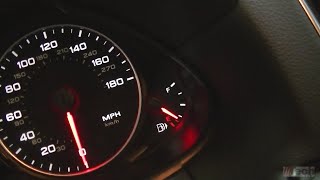
- Fuel gauge behaves erratically (e.g., drops to empty, jumps to full, or doesn't move)
- Fuel gauge reading is inaccurate
- Check Engine Light is on but fuel gauge appears to be working correctly
- Replacing the fuel level sensor when the actual cause is the software glitch described in TSB #2041594.
Most Likely Causes
- ECM Software Glitch 🔴 High Probability An official Audi TSB (#2041594 and its revisions) identifies a software shortcoming as the primary cause for this code on this specific vehicle. It can be triggered by an 'incorrect diagnostic procedure', frequent refueling with small amounts of fuel (less than 4-5 gallons), or refueling with the ignition on. Forum users have confirmed that a dealer software update resolved the issue.
How to confirm: Check with an Audi dealership to see if TSB #2041594 applies to your vehicle's VIN and if a software update is available. The TSB advises clearing the code as the initial step. If the code appears but the gauge works, it is highly likely to be the software issue.
Typical fix: Clear the fault code. If a software update is available from Audi, have the ECM reflashed. The TSB states that no components should be replaced for this condition. A dealership may charge for diagnosis and the update; one Q5 owner reported a total cost of around $427 ($195 for diagnosis, $232 for the update) in 2020.
Est. part cost: $0 - $250 - Faulty Fuel Level Sensor (Sending Unit) 🟡 Medium Probability If the software issue is ruled out, the sensor itself is the next most likely cause. The sensor's variable resistor can wear out over time, causing incorrect readings. Audi A4s have a saddle-style tank with two separate sending units (left and right), doubling the chance of a single sensor failure.
How to confirm: Use a scan tool to monitor the live data for fuel level sensor resistance/voltage. The reading should be stable and change smoothly as the fuel level changes. A jumpy or out-of-spec reading indicates a bad sensor. Physical access is via a round panel in the trunk, behind the rear seat.
Typical fix: Replace the faulty fuel level sending unit. It is often located on the fuel pump assembly inside the fuel tank. This requires removing the union nut on top of the tank, which is best done with a special tool to avoid damaging the plastic components or creating a spark hazard.
Est. part cost: $200-$290 per sensor - Wiring or Connector Issues ⚪ Low Probability The wiring harness leading to the fuel tank can be exposed to moisture and debris, potentially causing corrosion on the connectors or a break in the wire. An owner performing a DIY repair on an older A4 discovered a broken wire on the sending unit itself.
How to confirm: Visually inspect the wiring and connector on top of the fuel tank. Perform a continuity and resistance test on the wiring between the sensor and the ECM.
Typical fix: Repair the damaged wire or clean/replace the corroded connector.
Est. part cost: $5-$50
Rare But Worth Checking
- Faulty Instrument Cluster: In rare cases, the instrument cluster itself may fail to correctly interpret a valid signal from the fuel level sensor.
- Faulty Engine Control Module (ECM): This is extremely rare, but the ECM's internal circuit for reading the fuel level could fail. This should only be considered after all other possibilities have been exhausted.
Diagnosis Steps
- Read the fault codes with an OBD-II scanner to confirm P0461 is present. Note if it is listed as 'intermittent'.
- Consult Audi TSB #2041594 (with revisions like /2 or /3). Note its recommendation to clear the code and not replace parts as a first step.
- Clear the fault code and monitor if it returns. Avoid refueling with small amounts or with the ignition on.
- If the code returns and the fuel gauge is visibly malfunctioning, use a scan tool to observe the live data from the fuel level sensor(s). Look for erratic voltage or resistance readings.
- If live data is inconclusive, gain access to the top of the fuel tank. On the A4, the access point is under a round panel in the trunk behind the rear seats.
- Inspect the wiring and connectors for corrosion or damage. If wiring appears intact, perform a resistance test on the fuel level sensor terminals with a multimeter. 🎬 Watch: How to test the fuel level sensor without removal. Compare the readings to the manufacturer's specifications for full and empty.
- If a sensor is confirmed to be faulty, replace it. This requires a special tool to safely remove the large plastic union nut holding the assembly in the tank. Always replace the union nut and seal.
- If sensors and wiring test good, the problem may lie with the instrument cluster or ECM, which requires more advanced diagnostics.
Parts You'll Likely Need
- Fuel Level Sending Unit (Left)
(OEM #8K0919671B)— If a hardware failure is the cause, one of the two sending units has likely failed. This is the part that measures the fuel level in the left side of the saddle tank.
Trusted brands: Genuine Audi, Bosch
OEM price range: $205-$290
Aftermarket price range: $100-$180 - Fuel Level Sending Unit (Right)
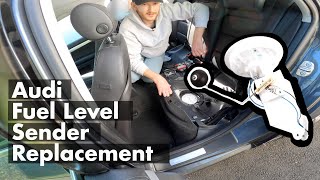
(OEM #8K0919673L)— If a hardware failure is the cause, one of the two sending units has likely failed. This is the part that measures the fuel level in the right side of the saddle tank. A DIY video shows replacement of a similar part, 8K0-919-673-A. 🎬 See this walkthrough on how to replace the sending unit.
Trusted brands: Genuine Audi, Bosch
OEM price range: $205-$290
Aftermarket price range: $100-$180
Technical Service Bulletins (TSBs) & Recalls
- 2041594 / 155820415945: Fuel level sensor, circuit range/performance - Check engine light on with DTC P0461. Advises against part replacement, pointing to a software issue caused by an 'incorrect diagnostic procedure' or refueling habits.
Platform-Specific Known Issues
- TSB #2041594 (revisions /2, /3): States that for 2014-2016 A4, A5, Q5, and other models, DTC P0461 may be stored due to a software issue, and no parts should be replaced. The bulletin advises to clear the code and inform the customer that a final software solution was under development. The issue is more likely to occur if the vehicle is frequently refueled with small amounts of fuel or refueled with the ignition on.
Mechanic-Grade Diagnostic Values
- Resistance of Fuel Gauge Sender 2 (G169) — expected: Sender at lower stop (empty): approx. 290 Ω. Sender at upper stop (full): approx. 45 Ω.. Failure: A reading of 0 Ω indicates a short circuit, while an infinite (∞) reading indicates an open circuit. Any reading that is erratic or significantly outside the specified range when moving the float indicates a faulty sender.
- Fuel Level Sensor Voltage Signal to ECM/IPC — expected: Typically varies from ~0.5V (full) to ~4.5V (empty).. Failure: A signal that is stuck, erratic, or outside this voltage range will trigger the P0461 code.
Hidden / Shadow Codes Worth Checking
- 00438: Fuel Supply Sensor 2 (G169): Open or Short to Plus. This is a VAG-specific fault code that often accompanies the generic P0461 and points directly to an issue with the secondary fuel level sender in the saddle tank. (see via Requires a VAG-specific scan tool like VCDS (VAG-COM) or OBDeleven to read from the Instrument Cluster (Address 17).) 🎬 See how to perform a fuel gauge calibration using VCDS.
Scan Tool Commands That Help
- VCDS / OBDeleven: Instrument Cluster (17) -> Output Test — To verify the physical fuel gauge needle is working correctly. The test will command the needle to sweep to a set position (e.g., halfway). If the needle moves correctly, the gauge itself is likely not the problem.
- VCDS / OBDeleven: Instrument Cluster (17) -> Adaptation -> Channel 30 — To manually recalibrate the fuel gauge reading after a sensor replacement or if the gauge is inaccurate despite a full tank. The factory value is 128, and it can be adjusted within a small range (e.g., 120-136) to raise or lower the needle's position.
Wiring & Ground Locations
- Fuel Pump Control Module — Located next to the fuel pump access flange, under the rear seat or trunk floor panel.. A poor connection at this module's connector can interrupt the signal from the fuel level senders, causing intermittent faults that mimic a failed sensor. This location is often overlooked during diagnosis.
- J533 - Data Bus Diagnostic Interface (Gateway) — Commonly located in the passenger footwell or behind the lower dashboard trim.. The J533 Gateway acts as a router for all CAN bus messages, including the fuel level data. In rare cases, particularly with water intrusion in the footwell, a failing gateway can corrupt or block this signal, causing P0461 along with other communication faults.
- Sensor Ground (e.g., Point 269) — Wiring diagrams for similar models show a common sensor ground point within the main instrument panel wiring harness.. A faulty or corroded ground connection for the instrument cluster or the sensor itself can cause a floating voltage and erratic readings, leading to a P0461 code even if the sensor itself tests good.
Real Owner Repair Stories
- AudiWorld Forums user 'nusarangkuti' (2011 Audi A4 B8 1.8T) — Car would not start intermittently. Disconnecting and reconnecting the fuel pump socket would temporarily fix it. Eventually, the car would not start at all. The fuel pump worked when powered directly.
❌ Tried (didn't work) Checking all fuses and relays.
✅ What actually fixed it The final cause was a poor connection at the 'fuel pump control module,' which is located hidden next to the fuel pump. Accessing and securing this connection resolved the no-start and power issue. - AudiWorld Forums user (Audi Q7 (similar fuel system design)) — Check engine light with VAG code 00438 for Fuel Supply Sensor 2 (G169).
❌ Tried (didn't work) Initial diagnosis pointed towards a faulty sending unit.
✅ What actually fixed it A technician discovered that a rat had chewed through the wiring harness leading to the fuel level sensor. Repairing the damaged wire fixed the problem.
"I Checked Everything" — The Actual Cause
- For the electrical code P0461, the equivalent scenario is 'all wiring tests good, but the problem persists.' In these cases, the root cause is often not a simple open or short in the main harness. The issue could be a corroded ground connection at the instrument panel, a poor connection at the often-overlooked fuel pump control module, or a failing J533 CAN Gateway module that is corrupting the data signal.
Model Year Variations Within This Range
- 2014-2016: No significant hardware variations related to this fault have been identified within this model year range. The primary known issue, a software glitch addressed by TSB 2041594/1, applies across the entire 2014-2016 B8.5 platform.
Helpful Videos

We Have This Part in Stock


The information in this article is provided for general reference and educational purposes only. Vehicle specifications, procedures, and part compatibility can vary by production date, trim level, and region. Always consult your vehicle's factory service manual and verify part numbers before purchasing or performing repairs. Safety-critical components such as airbags, seat belts, and braking systems should be installed by a qualified professional.
- Audi A4:
- 🎬 Helpful Videos
- 🛍️ Shop This Part
- What's Unique About the 2014-2016 Audi A4
- Diagnostic Flowchart
- Symptoms You May Notice
- Most Likely Causes
- Rare But Worth Checking
- Diagnosis Steps
- Parts You'll Likely Need
- Technical Service Bulletins (TSBs) & Recalls
- Platform-Specific Known Issues
- Mechanic-Grade Diagnostic Values
- Hidden / Shadow Codes Worth Checking
- Scan Tool Commands That Help
- Wiring & Ground Locations
- Real Owner Repair Stories
- "I Checked Everything" — The Actual Cause
- Model Year Variations Within This Range
- 🎟️ Get 5% Off